 Yueqing Yijin Electronics Co., Ltd.




Choosing Between DC and AC Miniature Circuit Breakers
A dc mcb vs ac mcb choice is not a letter swap on the same part. Match the breaker to AC or DC duty using arc-handling design and the printed utilisation limits. Amp numbers and look-alike housings are not enough.
This guide covers the AC MCB vs DC MCB contrast, polarity and label rules, decision cases, and Yijin’s live DC frames in the circuit breaker category.
DC MCB vs AC MCB at a Glance: Pick by Current Type
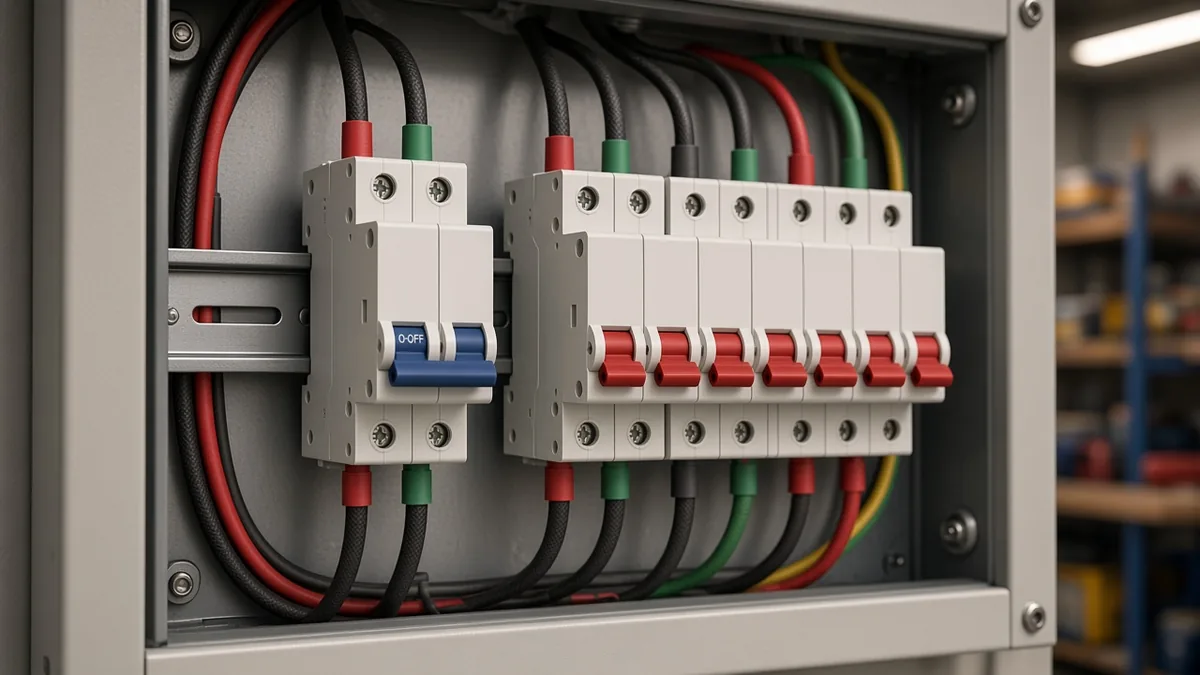
Match the breaker to AC or DC duty first. Amp marks alone do not make the housings interchangeable.
Buyers compare the two classes because DIN-rail bodies share a familiar outline. Spare stock is expensive. Matching amp marks alone sounds efficient.
The first filter is simpler: is the protected feeder alternating current or direct current? An AC MCB belongs on AC utilisation. A DC MCB belongs on DC utilisation.
| Decision factor | AC MCB | DC MCB |
|---|---|---|
| Current type on the job | Alternating current branches, inverter AC output, building AC distribution | Battery feeders, PV DC, other DC distribution |
| Arc help from the waveform | Benefits from natural zero-crossings | No natural zero — forced extinction design |
| Polarity wiring | Not polarity-oriented like many DC frames | Often requires “+” / “−” orientation |
| What the label must show | Printed AC limits for the pole arrangement | Printed DC limits for the pole arrangement |
| Dual-use | Only if the same device also prints DC limits you need | Only if the same device also prints AC limits you need |
For myth-style swap questions, see DC MCB AC circuit compatibility and Can I use a DC breaker for AC?. This page stays on when to pick which.
Why Arc Handling Differs: Zero-Crossing vs Forced Extinction
AC gets help from zero-crossings. DC needs chute geometry and magnetic blowout methods to force the arc out.
When contacts open under load or fault, an arc forms. On mains frequency, alternating current changes direction dozens of times each second—about fifty times at 50 Hz and sixty times at 60 Hz.
The current passes through zero twice each cycle. That pause helps the arc extinguish during switching. Direct current flows one way without that pause.
Low-voltage miniature breakers typically use air plus stacked plates called arc chutes. Magnetic blowout / permanent magnet hardware can deflect the arc into those plates so it splits and cools.
On Yijin’s YJB1Z-63 Small DC Circuit Breaker page, that idea shows up as a strong permanent magnet arc extinguishing system tied to DC distribution duty. It is not permission to park the same device on an AC panel.
Similar plastic housings do not prove similar interruption physics. If the job is DC, specify a DC miniature circuit breaker. If the job is AC, specify an AC-rated device.
Polarity Marks and Contact Geometry on DC Frames
Many DC MCBs require “+”/“−” orientation. AC frames are not wired the same way.
Polarized DC designs arrange magnetic blowout and arc runners for a preferred current direction. Reverse the terminals and the arc may not be driven into the chute the way the design expects.
Yijin’s YJB1Z DC miniature pages state that attention must be paid to the polarity of “+” and “−” when wiring. That is a field discipline for DC distribution, not a cosmetic marking.
AC miniature breakers do not carry that same directional wiring story, because the current reverses every half cycle. Mixing habits is how look-alike parts fail the job they were bought for.
Independent technical write-ups note that DC work leans on larger gaps and stronger magnetic assistance. You do not need a cutaway drawing to act on that. You need the utilisation category / label limits printed for the circuit you are protecting.
Read the Label: Utilisation Limits and the Dual-Rated Exception
Dual use is allowed only when the device prints both AC and DC limits you need.
A dual-rated circuit breaker is not a DIN-rail shape and not a catalog nickname. It means the manufacturer printed specific AC and DC voltage information for that exact device.
Independent comparison guidance puts it the same way. A breaker marked only for one regime is not evidence for the other. Visual similarity is not a substitute for the dual symbol with rated limits.
A short label check before you buy or install:
- Confirm the current type on the feeder—AC or DC—before you open the carton.
- Read the side marking or datasheet for the pole arrangement you will actually wire.
- If you need both services, both AC and DC limits must appear for that model.
- If a DC page shows only DC voltages, do not invent an AC rating for procurement paperwork.
IEC 60898-2 describes additional requirements for household and similar circuit-breakers suitable for AC and DC operation.
Stated ceilings include rated d.c. voltage not exceeding 220 V for single-pole and 440 V for two-pole devices. Rated current does not exceed 125 A in that family scope.
Rated d.c. short-circuit capacity does not exceed 10000 A. That is standards-family scope language.
The YJB1Z-63 page claims compliance with IEC60898-2 and GB10963.2 as a product-page statement. It is not a third-party UL listing for U.S. practice.
It does not by itself make the device dual-rated for AC panel duty.
Ampere numbers still matter for cable and load, but they do not override utilisation. A 20 A DC marking is not automatic permission to protect a 20 A AC branch with the same body.
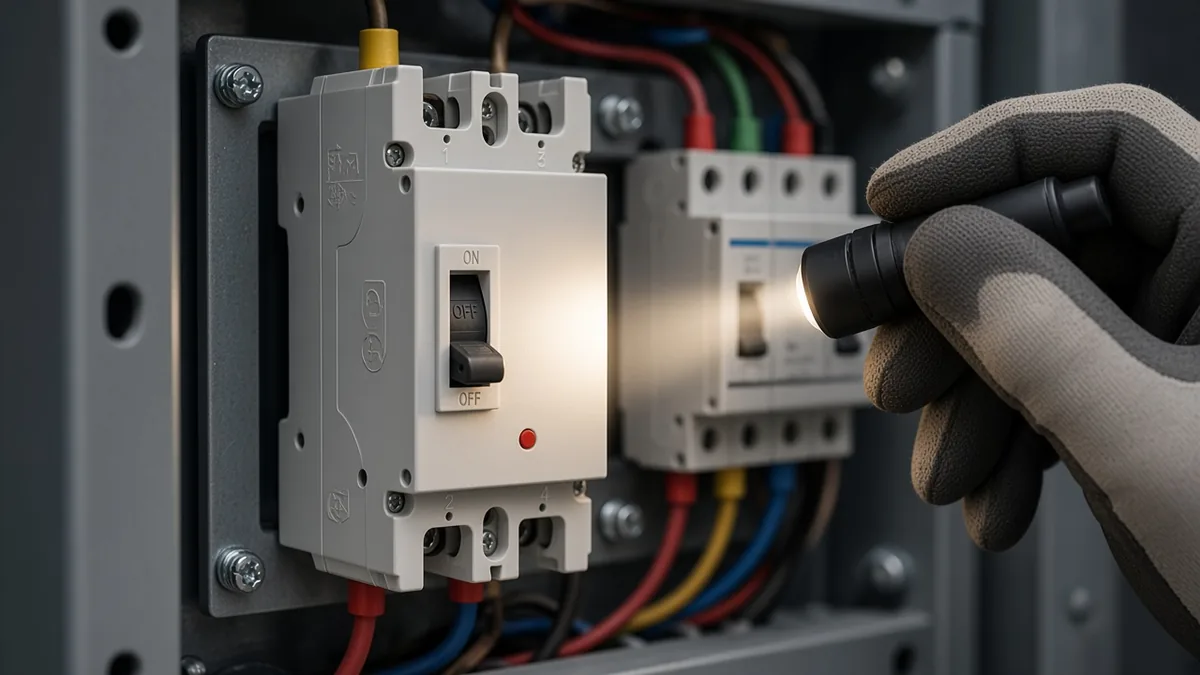
Label reading belongs with the utilisation check above.
Decision Cases: AC Branch, DC Distribution, and Mixed Panels
Use a short case table. AC jobs take AC-rated devices. DC jobs take DC-rated devices.
| Job case | What belongs | What to avoid | Why |
|---|---|---|---|
| Building AC branch or inverter AC output | AC-rated MCB / AC-described frame for that voltage | DC-only MCB used as a spare | AC interruption expects AC utilisation; DC-only pages do not print AC limits |
| Battery feeder or DC distribution ≤63 A | DC MCB such as YJB1Z-63 within printed DC voltages | AC-only MCB because “amps match” | DC has no zero-crossing help; wrong class risks standing arcs |
| Higher DC current or higher DC voltage class | YJB1Z-125 or YJM1Z per those product pages | Assuming every DC MCB covers every DC voltage | Page voltages and frames differ |
| Mixed panel with AC and DC sections | Correct class on each section; dual-rated only inside printed dual limits | One “universal” spare across both sections | Utilisation is per circuit, not per enclosure |
Important: Field threads on AC breakers used on DC warn about standing arcs and contact damage when the datasheet never listed a DC rating. Carrying normal load is not proof the device can clear a fault safely on the wrong utilisation. — EEVblog discussion of AC breakers on DC circuits
For solar string sizing depth beyond this comparison, use Best DC breaker for solar. Keep this page on class choice, not Voc worksheets.
Honest Yijin Map: DC Frames, AC Contrast, and a Starting SKU
YJB1Z and YJM1Z are DC pages. YJB2 is AC contrast. Start DC DIN duty at 63 A and below with YJB1Z-63.
The live circuit breaker category mixes DC protection frames and AC-side devices. That mix is useful for contrast and dangerous if you treat every SKU as the same class.
YJB2-125 / 1P+N is mainly AC 50 Hz with rated working voltage 230 V / 400 V and rated current up to 80 A on the product page. It is AC-side contrast only.
| Live frame | Page utilisation signals | Role in this comparison |
|---|---|---|
| YJB1Z-63 | ≤63 A; DC 250 V and 440 V; IEC60898-2 / GB10963.2 page claim; 10KA; permanent-magnet arc language; “+”/“−” polarity; DIN rail TH35-7.5 | Primary DC MCB starting point for DIN DC distribution |
| YJB1Z-125 | ≤125 A; DC 220 V and 440 V; IEC60947-2 / GB14048.2 page claim; 10KA class page language; polarity discipline | Higher-current DC MCB sibling |
| YJM1Z | DC molded case; working voltage DC750 V and below on page; higher current frames | DC MCCB-scale option when miniature frames are too small |
| YJB2-125 / 1P+N | Mainly AC 50 Hz; rated working voltage 230 V / 400 V; rated current up to 80 A (page) | AC-side contrast only — not a DC MCB |
None of the YJB1Z or YJM1Z pages reviewed print an AC dual rating. Do not invent one. This package does not claim North American listing marks for these SKUs.
Choose the YJB1Z Frame for DC Distribution
For typical DIN DC distribution at 63 A and below, the YJB1Z-63 page is the practical starting frame.
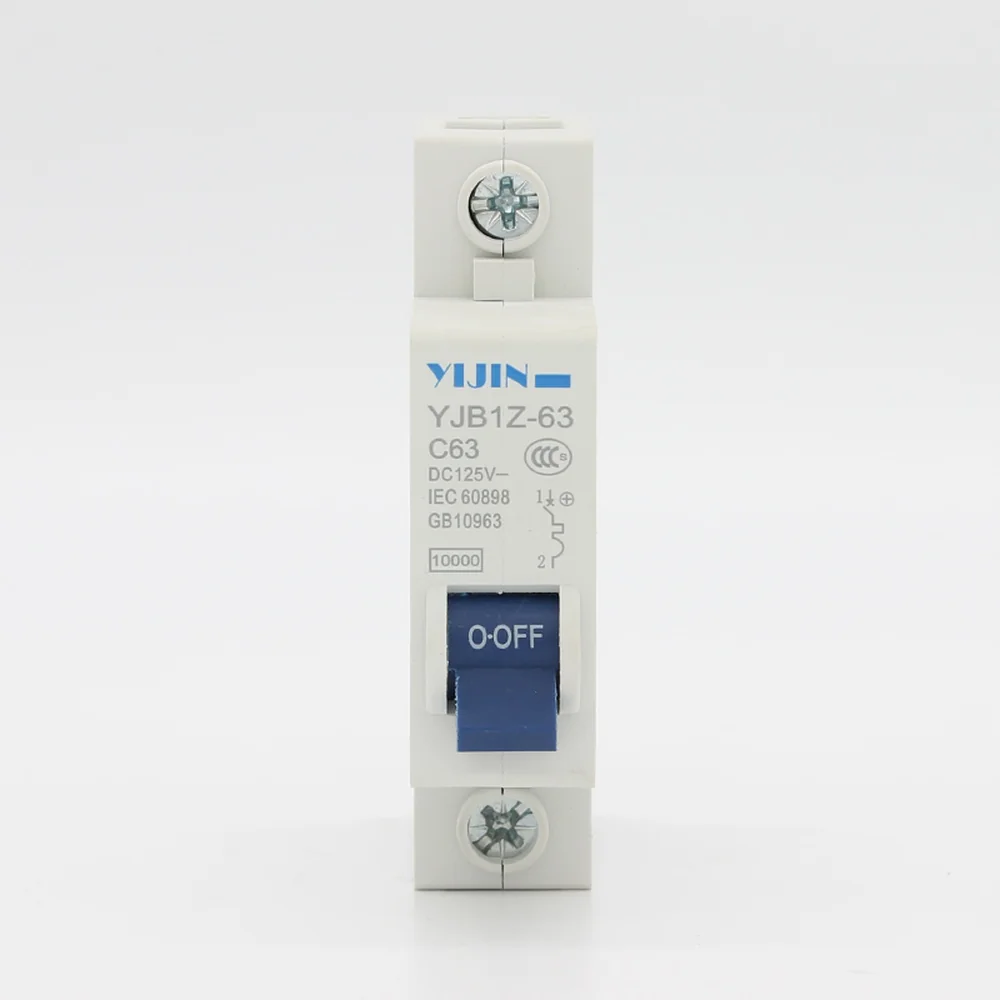
The product photograph shows the live YJB1Z-63 frame.
Choose the YJB1Z-63 Small DC Circuit Breaker when the protected feeder is DC distribution within the page’s rated current of 63 A and below. The page also states DC rated voltages of 250 V and 440 V.
Observe the printed “+” / “−” polarity. The page ties the frame to overload and short-circuit protection in DC distribution systems. It cites GB10963.2 and IEC60898-2 as product-page claims.
It describes a strong permanent magnet arc extinguishing system with a short-circuit capacity of 10KA. Installation uses DIN rail TH35-7.5 mounting.
Do not choose it for an AC branch because the page does not print AC dual limits. If current or voltage climbs beyond that miniature frame, move to YJB1Z-125 or YJM1Z using those pages’ own numbers.
FAQ
Can I use an AC MCB on a DC circuit?
Usually no. AC-only devices rely on interruption behavior suited to alternating current. Community reports warn about standing arcs when an AC breaker is used on DC without a printed DC rating. Use a DC-rated breaker for DC duty, or a dual-rated circuit breaker only inside its printed DC limits.
Can I use a DC MCB on an AC circuit?
Usually no unless that exact device is dual-rated for AC on its label or datasheet. Yijin’s reviewed YJB1Z and YJM1Z pages print DC limits without AC dual ratings. For the myth-length answer, see Can I use a DC breaker for AC?.
Is a 20 A DC breaker the same as a 20 A AC breaker?
No. The ampere mark sizes continuous current capacity. It does not prove the other utilisation. Class, arc design, and printed voltage limits still have to match the feeder.
Does polarity matter on every DC MCB?
It matters on polarized designs and on any device whose instructions require “+” / “−” orientation—including Yijin’s YJB1Z pages. Some DC products are marketed as bidirectional. That still has to be stated by the manufacturer, not assumed from the plastic shape.
What does dual-rated AC/DC mean on the label?
It means the manufacturer printed specific AC and DC limits for that device. Without both sets of limits, do not treat the breaker as dual-use.
Which Yijin breaker should I pick for DC distribution under 63 A?
Start with YJB1Z-63 when the page voltages and polarity instructions fit the feeder. Step up to YJB1Z-125 or YJM1Z when the job outgrows that frame on the product pages.
Do AC and DC MCBs look different from the outside?
Often not enough to decide by eye. Housing similarity is why wrong-class swaps happen. Read the utilisation marking instead of trusting silhouette.
Is IEC 60898-2 the same as a UL listing?
No. IEC 60898-2 is an IEC family for household and similar AC/DC circuit-breakers with stated scope ceilings. A product-page claim that a model complies with IEC60898-2 is not the same as a third-party UL Listed status for U.S. installations. This site package does not assert UL 489 for Yijin SKUs.