 Yueqing Yijin Electronics Co., Ltd.



DC MCB AC Circuit Compatibility — Myth, Limits, and Labels
A dc mcb ac circuit compatibility question usually has a blunt answer: a DC miniature circuit breaker is not interchangeable with an AC MCB by default. You only treat the two as matching when the device is dual-rated for AC on its nameplate and documentation. Below you get the myth answer, the interruption difference, the label check, the failure modes, and which Yijin DC breakers fit true DC jobs.
The myth: a DC MCB is not an AC drop-in
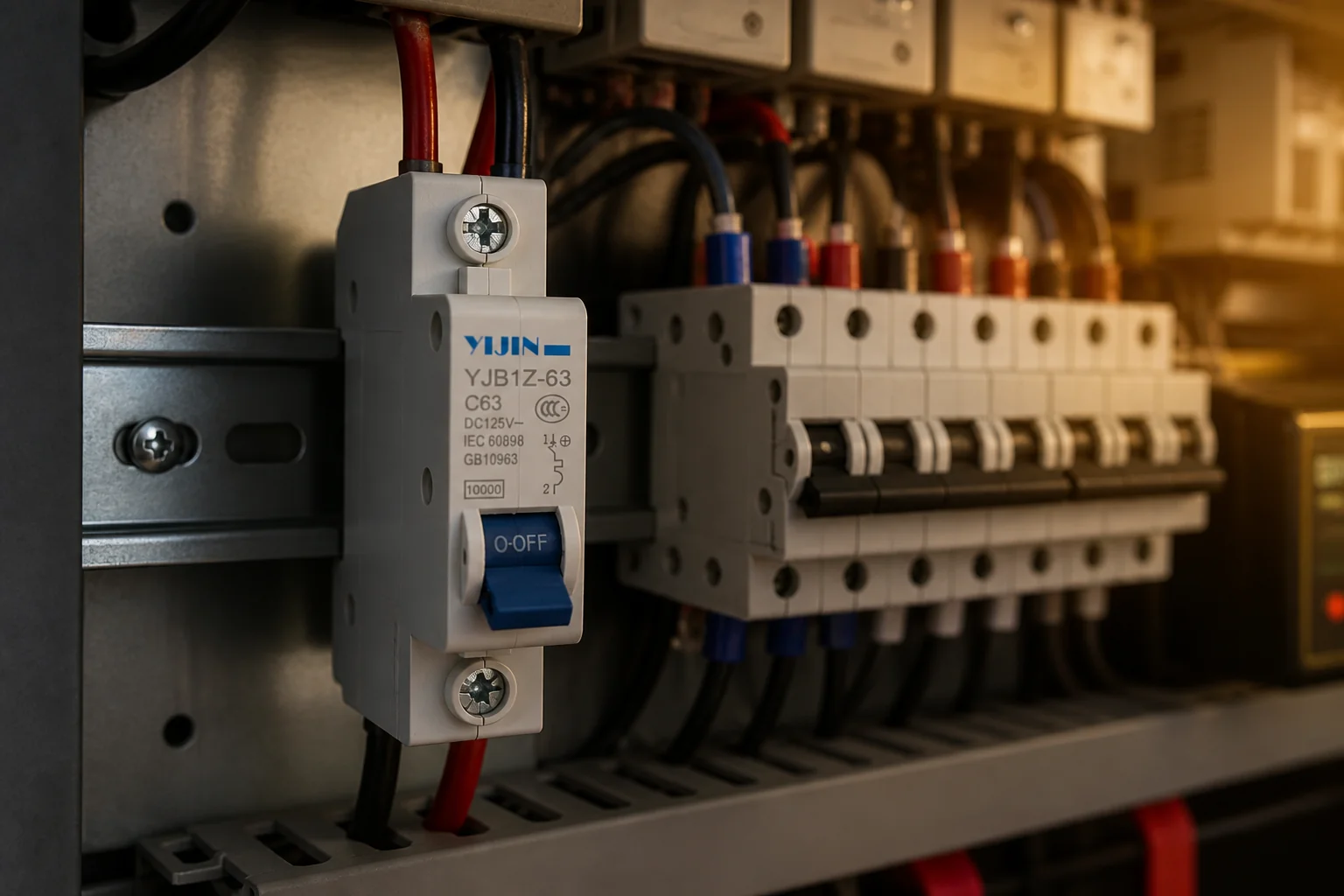
Treat a DC MCB and an AC MCB as different rated devices unless the breaker documents both. Sharing a DIN-rail footprint or a familiar “MCB” silhouette leaves AC approval unproven.
Procurement teams hit this myth when a DC breaker is cheaper, already in stock, or looks identical to the AC devices already mounted in a panel. The safe decision rule is boring on purpose: follow the published voltage type and interrupting rating, not the plastic color or rail width.
The only common exception is a dual-rated circuit breaker. That means the manufacturer states AC voltage and interrupting capacity on the nameplate or datasheet — beyond hoping the device “is still a circuit breaker.”
| Buyer assumption | Honest check |
|---|---|
| “It mounts on the same rail, so it should work on AC.” | Mounting form is not a rating. |
| “DC is harder, so DC gear must cover AC too.” | Harder DC interruption design still needs a published AC rating. |
| “I will use it only at low AC current.” | Without a published AC rating, that remains an undocumented use. |
| “The datasheet lists AC and DC voltages.” | Dual-rated path — stay inside both published limits. |
Why AC and DC breakers interrupt differently
AC and DC breakers both open contacts to stop overcurrent, but the arc they must kill behaves differently. Alternating current passes through zero many times each second, which helps extinguish an arc; direct current does not hand you that free pause.
Field electricians describe the same physics in blunt language: many AC breakers lean on zero-crossing to clear an arc, while DC keeps pushing energy into the gap. That is why a high AC-rated disconnect can carry a much lower DC rating when a manufacturer publishes both figures.
Breaker designers answer that continuous DC arc with hardware, not wishful thinking. Low-voltage breakers commonly use an arc chute — stacked plates that split and cool the arc — and may add magnetic blowout or permanent magnets to stretch the arc into those plates.
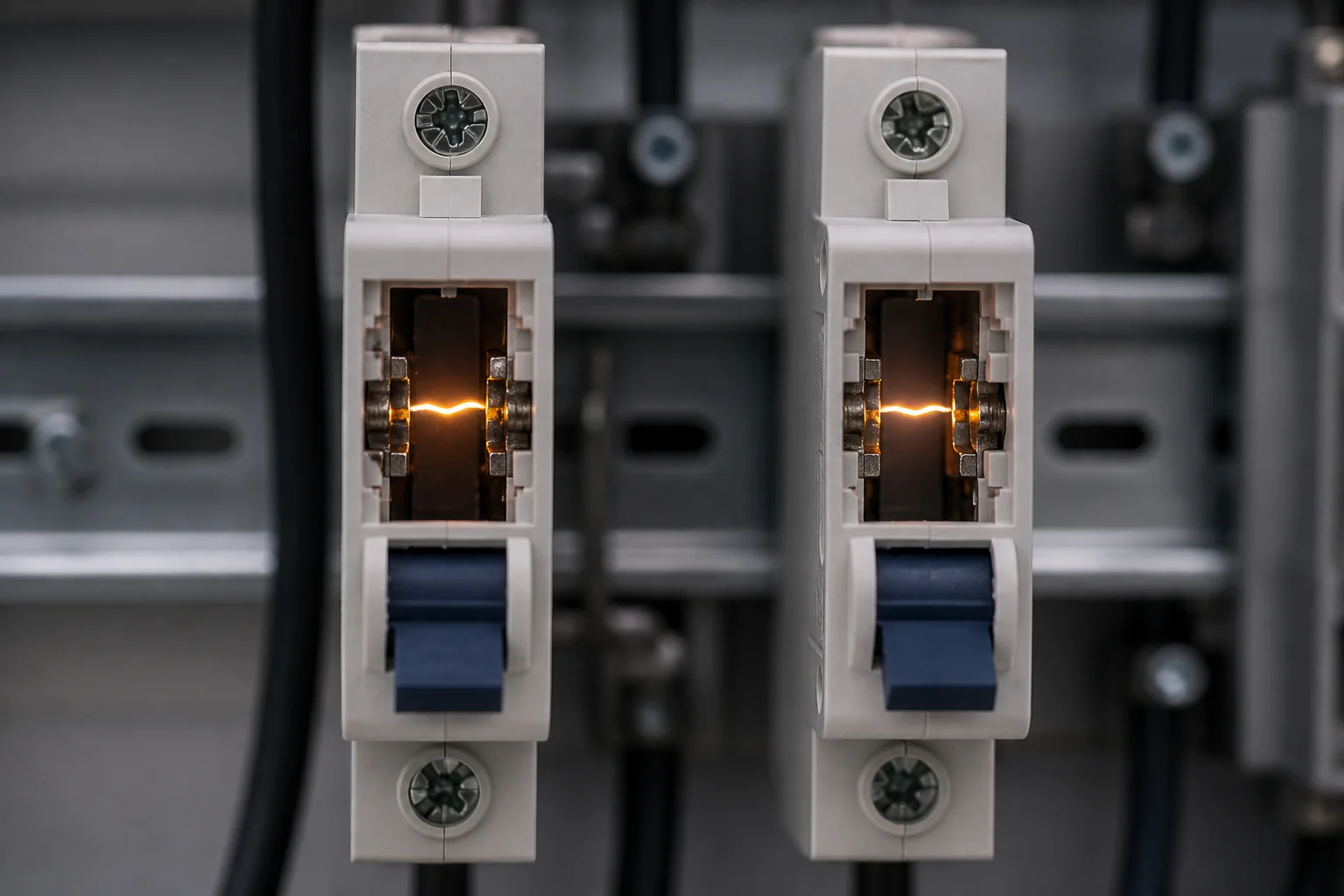
Yijin’s YJB1Z series product text calls out a strong permanent-magnet arc extinguishing system for its DC miniature breakers. That language supports a DC design story; it still leaves an AC dual rating unpublished on the same page.
How to read the label for dual rating
Dual rating is a paperwork check, not a vibe check. Before you mix power types, confirm the nameplate or datasheet lists the AC voltage and the interrupting capacity you need.
A practical label pass looks like this:
- Find the AC or DC symbol, or plain “AC” / “DC” voltage text.
- Confirm the interrupting rating that applies to the system you will feed.
- For DC MCBs, also confirm polarity markings if the product requires “+” and “−” orientation.
- If only DC voltages appear, stop short of inventing an AC allowance for panel work.
Community answers on this topic keep returning to the same discipline: some AC breakers do carry a reduced DC rating when the manufacturer says so, and some devices are DC-only. The listing and the label decide — ahead of any forum anecdote about “it worked once.”
What goes wrong when ratings are ignored
Mismatched ratings show up as heat, contact damage, and unreliable clearing — long before any polite warning light appears. On DC, an arc can linger because the current never returns to zero the way AC does.
Important: Electrician Talk contributors describing AC-rated float switches on a 24 VDC lift-station circuit reported devices dying early, and replies tied that failure mode to harsher DC arcing and contact pitting — source: component voltage vs circuit voltage. Carry the lesson forward: an AC-marked switching device needs a published DC rating before you trust it on DC, and a DC MCB needs a published AC rating before you trust it on AC.
On the reverse myth — forcing a DC-only MCB into an AC fault path — the risk is unsafe interruption for a waveform the device was never documented to clear. Appearance compatibility leaves that gap open.
What compatibility does not mean
“Compatible” in this topic means the published electrical rating matches the supply you are protecting. Rail fit, “MCB” silhouette, or a circuit-breaker catalog badge alone fall short of that bar.

Yijin’s Circuit Breaker category is a live hub for DC breaker SKUs. Buyers who open that category looking for generic AC panel MCBs need a different device family — the published lineup on that hub is DC-oriented.
Compatibility also stops short of proving a US project listing. Public site materials in this package leave UL Listed or NEC compliance for these Yijin breakers unestablished. Treat listing needs as a separate project requirement.
When a Yijin DC breaker fits the job
A Yijin DC breaker fits when the protected circuit is DC and the published voltage, current, and wiring rules match. Familiar housing alone is a weak reason to park the same SKU on an AC panel.
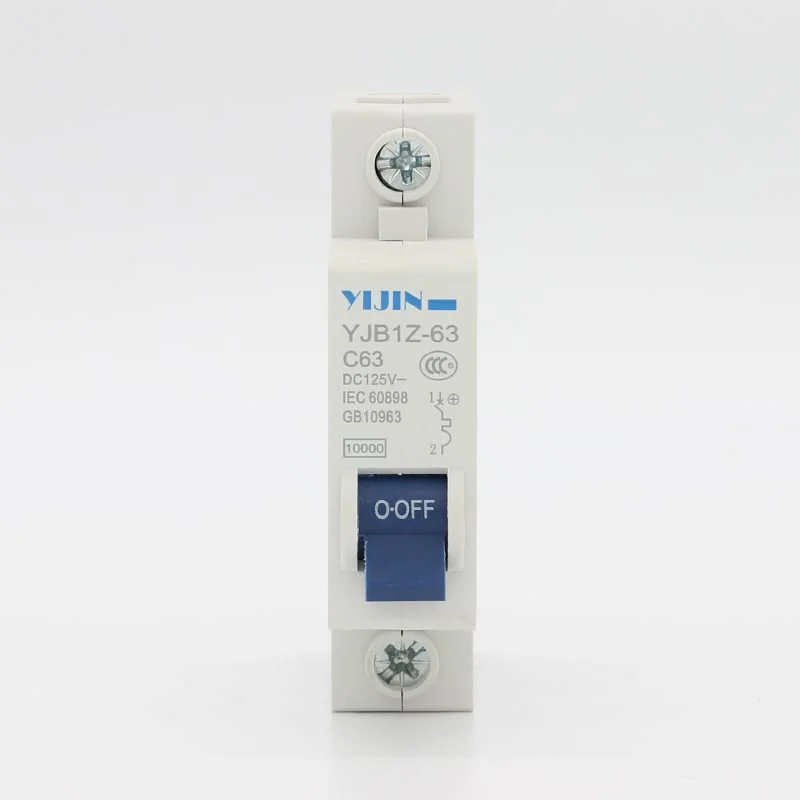
Primary recommendation: YJB1Z-63 Small DC Circuit Breaker. The product page describes a DC miniature circuit breaker for rated current of 63 A and below, with DC rated voltage of 250 V and 440 V class, overload and short-circuit protection in DC distribution systems, a page claim of GB10963.2 / IEC60898-2, a short-circuit capacity of 10 kA, mechanical life over 20,000 operations, TH35-7.5 rail mounting, and mandatory “+” / “−” polarity attention when wiring.
| Model | Role | Published highlights (product page) |
|---|---|---|
| YJB1Z-63 | Primary DC MCB | ≤63 A; DC 250/440 V class; 10 kA; polarity; permanent-magnet arc language |
| YJB1Z-125 | Higher-current DC MCB | ≤125 A; DC 220/440 V; 10 kA; polarity; IEC60947-2 / GB14048.2 page claim |
| YJM1Z | DC molded-case option | DC750 V and below; up to 800 A class; short-circuit + overload protection |
None of those product sheets, as reviewed here, publish an AC dual rating for drop-in AC panel use. Keep them on DC jobs that match the printed limits, and keep polarity honest on the YJB1Z miniature series.
If your next step is comparing frames rather than arguing AC interchange, start at the Circuit Breaker hub and open the SKU that matches current and DC voltage — skip the look-alike that merely resembles an AC MCB already in stock. For telecom, industrial DC distribution, or battery-backed DC feeds, match In and Ue first, then confirm poles and wiring diagrams on the same SKU page before you buy.
FAQ
Can I use a DC MCB on an AC circuit?
Only if the breaker is dual-rated and the AC voltage plus interrupting rating are published for that device. Otherwise, no.
Can I use an AC MCB on a DC circuit?
Generally no. Use a DC-rated breaker, or an AC breaker that the manufacturer explicitly rates for the DC voltage and interrupting duty you need.
Are AC and DC circuit breakers different?
Yes. Both protect against overcurrent, but arc interruption and markings follow the supply type. Design details such as arc chutes and magnetic assistance matter more on DC.
What does dual-rated mean on a breaker?
It means the manufacturer documents separate AC and DC ratings — typically voltage and interrupting capacity — on the nameplate or datasheet. Guessing from form factor does not count.
Why does zero-crossing matter for interruption?
AC current returns to zero each half-cycle, which helps extinguish an arc. DC does not, so the breaker must handle a more persistent arc.
Do YJB1Z DC MCBs need polarity attention?
Yes. YJB1Z-63 and YJB1Z-125 product text requires attention to “+” and “−” polarity when wiring.
Does a DIN-rail DC MCB automatically work in an AC panel?
No. Rail compatibility is mechanical. Electrical compatibility still depends on published ratings.
Are Yijin DC breakers UL Listed or NEC compliant on the public pages?
Keep UL Listed or NEC compliance claims out of the public product pages reviewed here. Confirm project listing requirements separately.
References
- Circuit breaker — Wikipedia — arc interruption, arc chutes, and magnetic/permanent-magnet blowout context.
- Arc suppression — Wikipedia — why break arcs are energetic when contacts open under load.
- AC MCBs vs DC MCBs — c3controls — independent education framing AC and DC MCBs as different classes.
- component voltage vs circuit voltage — Electrician Talk — field discussion of DC arcing harshness, zero-crossing, and why AC and DC interrupting classes are not interchangeable.