 Yueqing Yijin Electronics Co., Ltd.




Where a DC Breaker Belongs Between Battery and Inverter
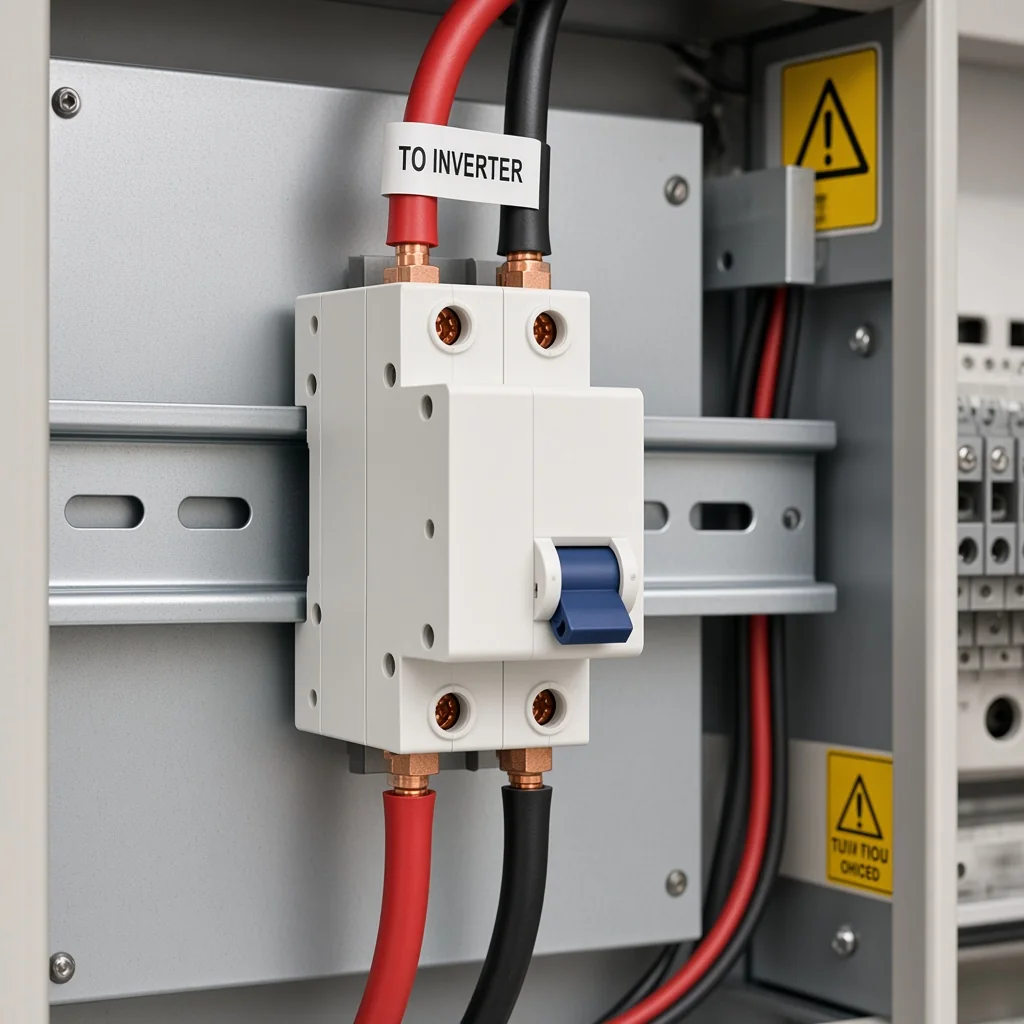
A dc breaker between battery and inverter belongs on the battery-to-inverter DC feed—usually in the positive cable, as close as practical to the battery—so a DC-rated device can open on overload or short circuit and can often serve as the service disconnect. The sections below separate that placement job from an outdoor PV string disconnect, walk the breaker-versus-fuse fork and polarity marks, then match the job to a DIN-rail DC MCB sheet such as YJB1Z-63 without inventing UL or NEC PV listings.
Where the battery–inverter DC breaker actually sits
Put the protective device on the DC path between the battery bank and the inverter, not on the AC output of the inverter.
Installer manuals for battery-fed inverters treat that path as a high-energy short-circuit source. Batteries can push thousands of amps into a faulted cable. The usual practice is a DC-rated fuse or circuit breaker located as close as practical to the DC positive battery terminal, with the cable ampacity and the inverter’s DC input current guiding the ampere rating.
Keep the run short when you can. Some inverter install manuals add a near-battery fuse or DC breaker when the battery cable exceeds about 1.5 m, and some listed models require that near-battery device even on shorter cables. Distance through a wall or partition can also change how many disconnect points a US energy storage layout needs.
In US energy storage system language, NEC Article 706 discussions emphasize readily accessible disconnecting means for ungrounded conductors derived from the storage system. A circuit breaker on the battery feed can satisfy both DC overcurrent protection battery needs and a battery inverter DC disconnect when the device and the listing path allow it. That is market context for the placement conversation—not a claim that any one catalog MCB is UL Listed for every ESS nameplate.
Tip: Place DC-rated overcurrent protection as close as practical to the battery positive on the inverter feed; do not substitute an AC panel breaker on that cable. Source: https://xantrex.com/wp-content/uploads/2021/12/XPower_Inverter_3000_Install_Guide975-0556-01-01_Rev-A.pdf
Negative-only protection is the wrong mental model for most of these feeds. The industry pattern protects the positive conductor near the source so a shorted positive cable cannot dump the bank through unprotected copper.
Placement intent vs a PV string disconnect
Battery–inverter placement is not the same buyer job as an outdoor PV string disconnect or knife isolator on the array side of a charge controller or string inverter.
| Decision | Battery–inverter DC breaker intent | PV string / outdoor disconnect intent |
|---|---|---|
| Where it lives | Between battery bank and inverter/charger on the DC battery feed | On PV string or array conductors, often outdoors |
| What it protects first | Battery short-circuit energy into inverter cables | PV source circuits and string isolation for service |
| Typical form factor here | DIN-rail DC miniature circuit breaker in a cabinet | Enclosed PV isolator / knife / outdoor disco |
| Catalog honesty here | Match a DC MCB sheet (voltage, current, poles, polarity) | Do not pretend a small rail MCB is a listed outdoor PV disco |
US searchers often say “solar disconnect” when they mean any DC switch near solar gear. Off-grid and ESS crews who actually mean the battery feed should write “battery-to-inverter DC breaker / OCPD” on the RFQ so vendors stop shipping PV knife hardware for a rail cabinet slot.
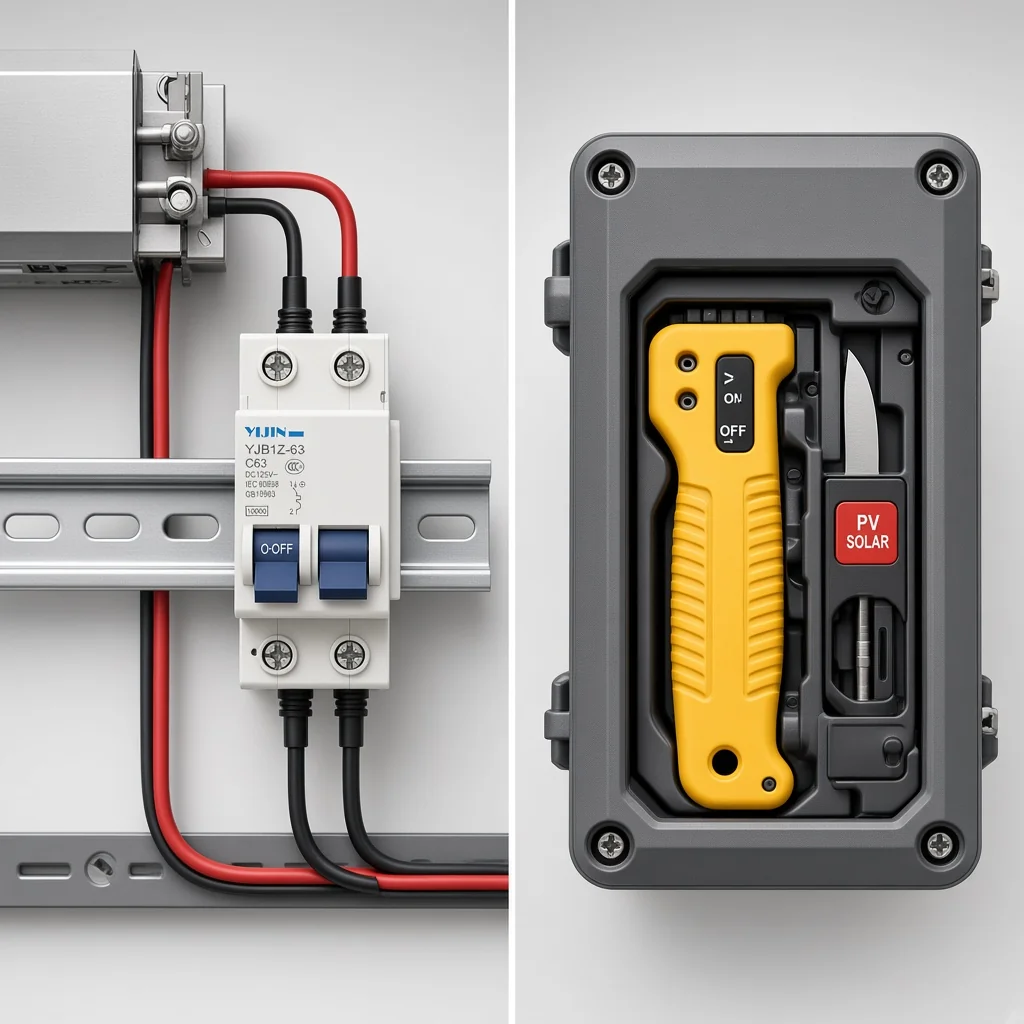
Yijin’s live circuit breaker hub is a circuit breaker hub that is DC-oriented—the category schema reads as a DC Circuit Breaker aisle—so treat it as a DC distribution MCB family, not a generic AC house breaker shelf and not an outdoor PV string disconnect catalog.
Breaker vs fuse-plus-disconnect on the same feed
A DC circuit breaker can provide both overcurrent protection and a usable disconnect handle on one body. A fuse protects the cable but usually needs a separate DC disconnect so you can de-energize the circuit before replacing the fuse.
OEM install language often allows a breaker, a fused disconnect, or a fuse plus a disconnect switch. The choice is about service workflow and interrupting capability as much as about ampere numbers. Class-T and similar DC fuses remain common on high-amp inverter feeds because battery available fault current is severe; a small DIN-rail MCB is only in the conversation when its printed current and short-circuit language cover the feed you actually built.
If the drawing already shows a fuse at the battery positive, do not delete the disconnect requirement. Keep a load-break rated DC disconnect in series unless the breaker you select is explicitly intended to serve both roles for that install.
Procurement should also separate inverter DC input protection from AC branch protection. The AC side of the inverter uses AC overcurrent devices. Mixing those families is a common shop-floor shortcut that manuals explicitly reject.
Polarity marks when current can reverse
A polarized DC breaker uses marked “+” / “−” or Line/Load terminals so the permanent-magnet arc path pushes the arc into the quench chamber. Land the wires against those marks.
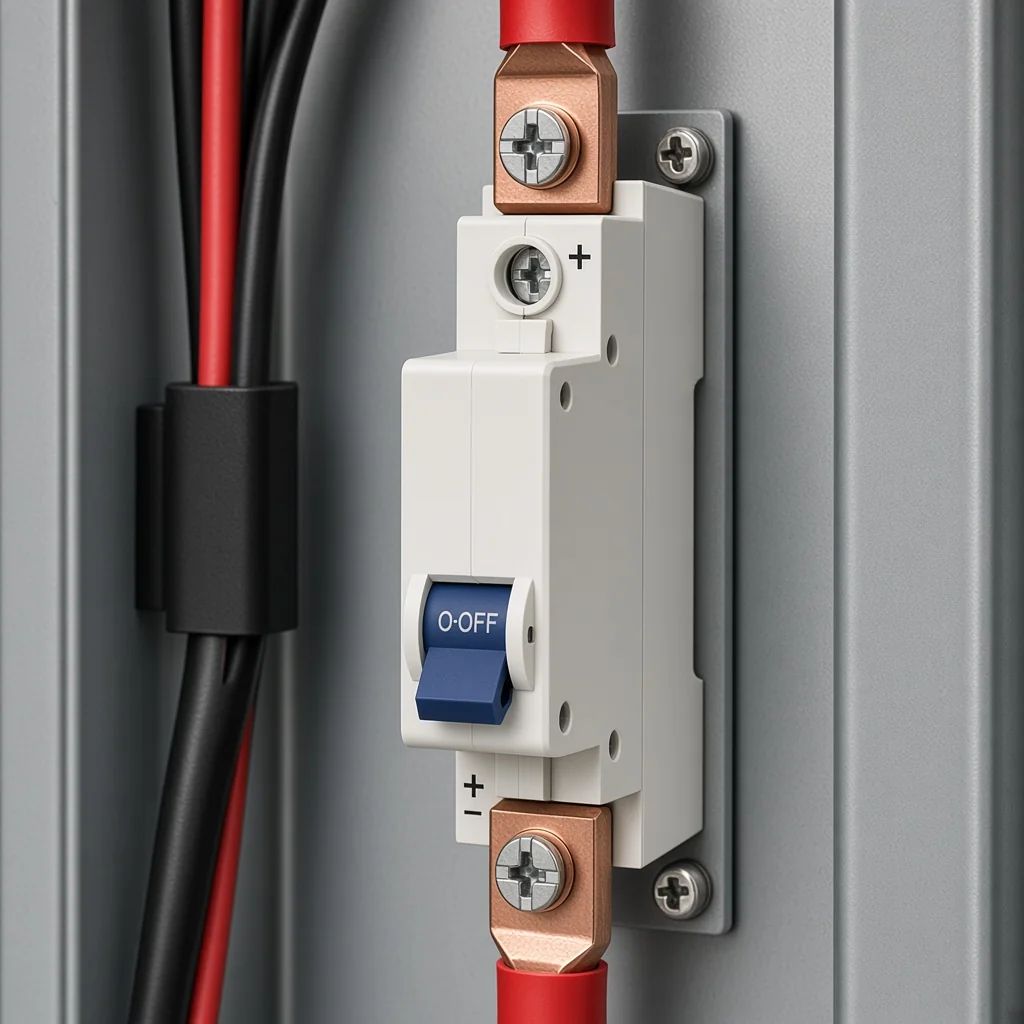
An inverter that only discharges the battery is a simpler polarity story: battery as source, inverter as load. An inverter/charger or hybrid unit that also charges the bank pushes current both ways on the same cable. Field threads on DIY Solar and Reddit repeatedly warn that a polarized breaker on a bidirectional feed can fail to interrupt correctly in one direction and can damage the device.
From the field: Installers wiring a breaker between batteries and an inverter/charger stress that charge and discharge both flow through the same device, so a purpose-built bidirectional DC breaker—or a fuse path—matters when the body is polarized. Source: DIY Solar / Reddit community language retained in research (live fetch blocked for automated clients; not linked here).
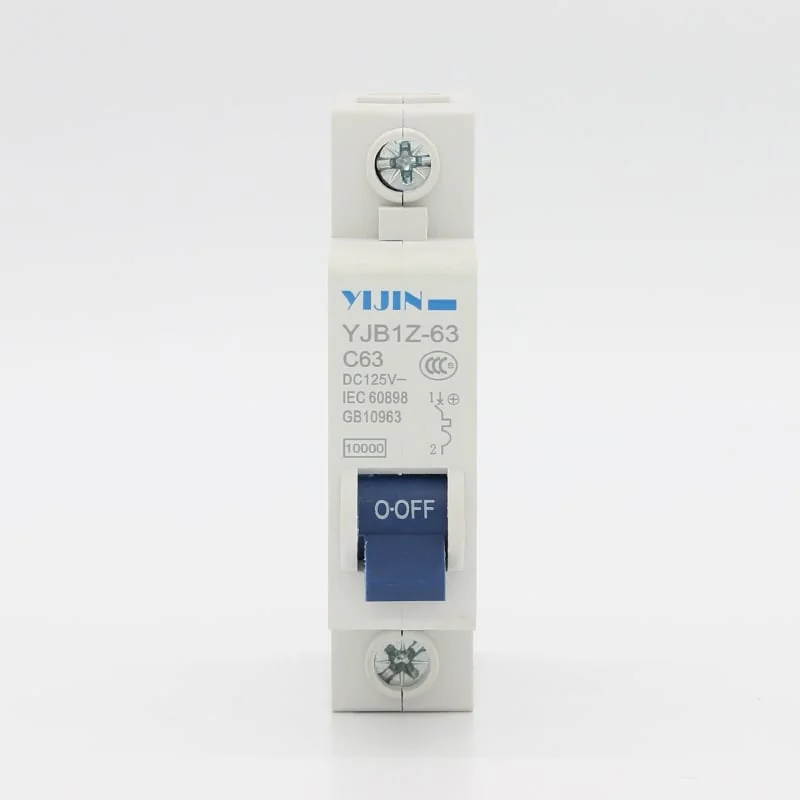
The YJB1Z-63 small DC circuit breaker product prose tells installers to observe “+” and “−” polarity when wiring and describes a permanent-magnet arc-extinguishing system. Read that as a polarized wiring instruction for the printed DC distribution use case—not as a published bidirectional ESS listing.
Encyclopedia and talk-page notes on circuit breakers treat extinguishing the arc after contacts part as a core design problem, and they note that some trip mechanisms must be designed differently for AC and DC.
What the DIN-rail DC MCB sheet must match
Before you shortlist a rail MCB for the battery–inverter feed, match five sheet items to the real circuit.
- DC voltage class — the bank and inverter DC window must sit inside the printed DC voltage, including pole count (1P vs 2P) notes.
- Ampere rating — protect the cable and respect continuous inverter DC input; nuisance trips on surge mean the feed was undersized relative to the inverter, not that “any bigger breaker is fine.”
- Poles and wiring diagram — follow the product wiring diagram; do not cross polarities.
- Polarity / bidirectional honesty — if marks exist, wire them; if the inverter charges and discharges through the same device, confirm the device is suitable for that duty.
- Interrupting / short-circuit language — battery banks can exceed small-device interrupting expectations; read the printed short-circuit capacity and stop if the bank’s available fault current is outside what engineering accepts for that body.
AC panel breakers fail item one and item five for this job even when the ampere stamp looks familiar. DC-rated language is mandatory.
Marketplace sizing charts that list fuse and breaker amps next to inverter watts are useful as a conversation starter about cable protection. They are not a substitute for the inverter manual, the battery short-circuit data, or the breaker sheet you are about to buy.
Product fit: YJB1Z-63 for battery–inverter DC selection
The YJB1Z-63 small DC circuit breaker fits when your placement intent is a DIN-rail DC miniature circuit breaker for overload and short-circuit protection on a DC distribution feed—and the printed ratings cover that feed.
Live product prose states the series is suitable for circuits with rated current of 63 A and below and DC rated voltage of 250 V and 440 V. It is described for overload and short-circuit protection of facilities and electrical equipment in DC distribution systems across power, postal and telecommunications, transportation, and industrial and mining sites.
The feature paragraph prints a short-circuit capacity of 10 kA, a mechanical life of more than 20,000 operations, thermal and electromagnetic releases, and a TH35-7.5 steel mounting rail. The page requires attention to “+” and “−” polarity when wiring and states compliance with GB10963.2 and IEC60898-2.
A note says 1P DC 220 V and 2P DC 440 V need to be customized. Instantaneous trip types B and C appear in the time-current table.
| Printed sheet item | YJB1Z-63 live prose / note |
|---|---|
| Rated current | 63 A and below |
| DC rated voltage | 250 V and 440 V |
| Short-circuit capacity | 10 kA (feature paragraph) |
| Mounting rail | TH35-7.5 |
| Polarity | Observe “+” and “−” when wiring |
| Standards named | GB10963.2; IEC60898-2 |
| Customization note | 1P DC 220 V / 2P DC 440 V need customization |
That is the honest product fit after the battery–inverter placement job is locked: a rail DC MCB sheet you can compare on printed facts alone.
It is not a claim of UL Listed status, NEC PV disconnect listing, outdoor PV string disconnect duty, or a knife-isolator substitute. Those words are absent from the live page, so they stay absent here.
If continuous current needs sit above the 63 A family, open the sibling YJB1Z-125 small DC circuit breaker sheet (125 A and below; DC 220 V and 440 V; IEC60947-2 and GB14048.2 on that page) or a higher-capacity DC OCPD path—still without inventing US listing language.
Browse the circuit breaker hub when you need the wider DC breaker family after the placement decision is settled.
Misfits that break the battery–inverter expectation
The job fails when the device family and the drawing disagree, even if the carton says “DC.”
Using an AC miniature breaker on the battery positive cable ignores the no-zero-crossing arc problem and contradicts installer guidance that AC and DC devices are not interchangeable.
Ordering an outdoor PV string disconnect because the email said “solar DC breaker” leaves the battery feed unprotected or forces a field redesign when the cabinet only has rail space.
Assuming bidirectional hybrid current is safe through any polarized body creates a silent failure mode that only appears when the charger pushes reverse current into a quench path built for one heading.
Treating a rail MCB as automatic coverage for a much larger inverter cable without reading cable ampacity and available fault current is a sizing error, not a brand preference.
Inventing UL Listed or NEC PV disconnect credentials for a sheet that does not print them fails US procurement review even if the mechanical fit looks tidy.
Walk away, change the specification, or change the SKU family when any of those misfits show up. The cheaper wrong part is still the wrong part after the first commissioning delay.
FAQ
Where should a DC breaker sit between the battery and the inverter?
On the DC battery feed—typically the positive cable—as close as practical to the battery terminal, sized to protect the cable and to work with the inverter’s DC input current.
Can one DC breaker act as both overcurrent protection and a disconnect?
Often yes: install manuals treat a DC circuit breaker as a combined OCPD and disconnect option. If you use a fuse instead, plan a separate DC disconnect for service.
Why can’t I use an AC panel breaker on the battery cable?
AC and DC overcurrent devices are not interchangeable on that path. DC arcs do not get AC zero crossings, so the body must be DC-rated for voltage, current, and interruption.
How do polarity marks interact with an inverter that also charges the battery?
Polarized breakers expect current in the marked direction. Charge and discharge through the same cable is bidirectional; confirm the device is suitable or use a fuse/disconnect path designed for that duty.
Is YJB1Z-63 an outdoor PV string disconnect?
No. The live sheet describes a small DC miniature circuit breaker for DC distribution protection with rail mounting and polarity notes. It does not present outdoor PV string disconnect or knife-isolator listing language.
What US ESS rules should buyers ask their AHJ or engineer about?
Ask how NEC Article 706 disconnect location, labeling, and OCPD sizing (often discussed at 125% of marked ESS current) apply to the specific energy storage system layout, especially when conductors pass through walls or run more than a few feet from the battery equipment.
When should I look at YJB1Z-125 instead of YJB1Z-63?
When continuous current sits above the YJB1Z-63 family. Open the YJB1Z-125 sheet and read its printed scope and standards line directly—still without inventing UL/NEC claims.
Does the YJB1Z-63 page claim UL Listed or NEC PV disconnect listing?
No. Quote only the printed voltage, current, poles, polarity, rail, short-circuit capacity, and named IEC/GB standards. Do not add US listing language the page does not show.