 Yueqing Yijin Electronics Co., Ltd.
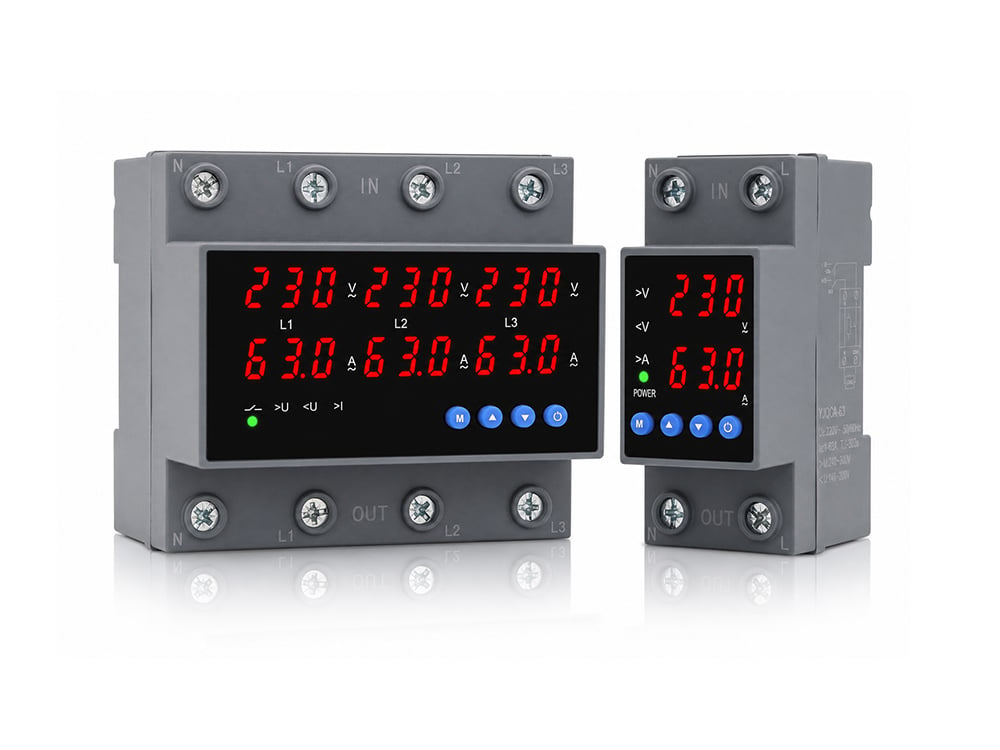



What Is a Voltage Protector and How It Works
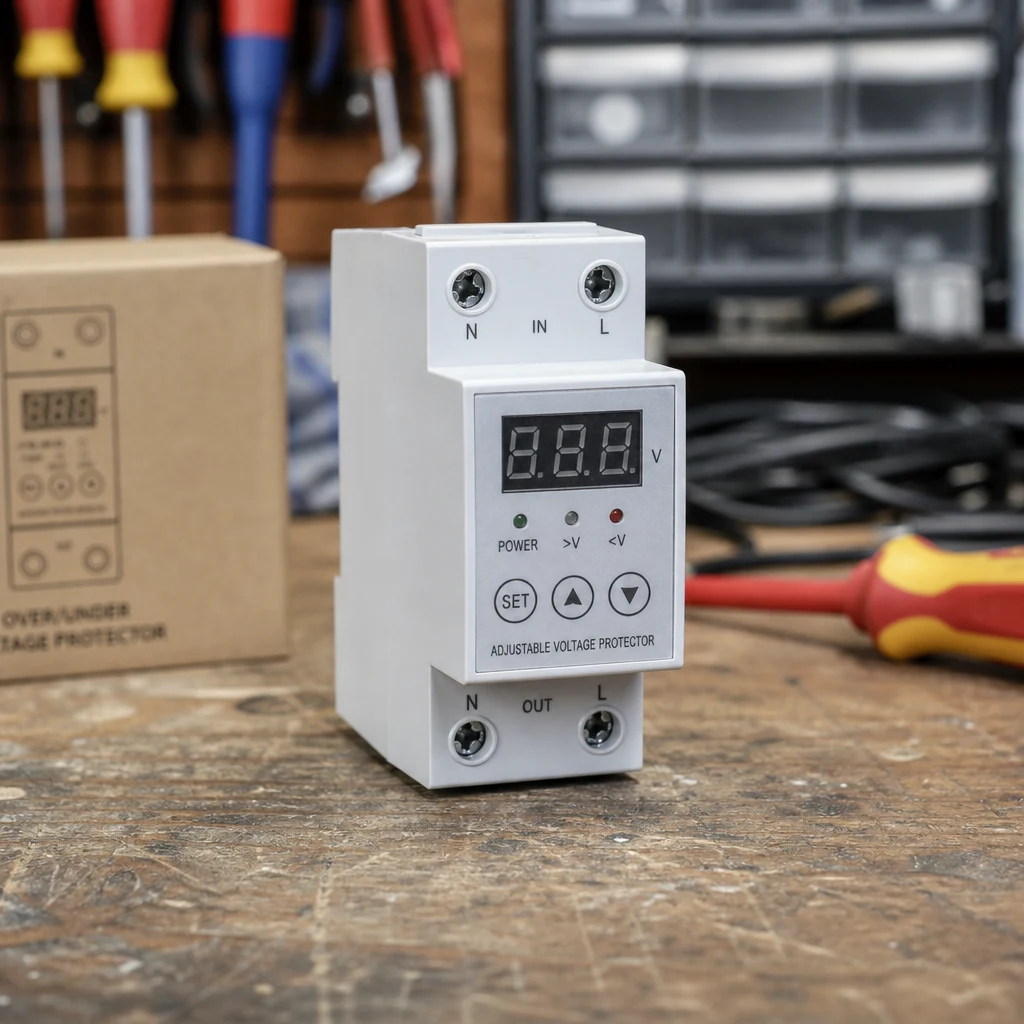
A voltage protector is a low-voltage switch that opens the load when supply voltage stays too high or too low, then can restore after a delay. Specifiers who type what is voltage protector usually want that RMS cutoff, not a power-strip joule rating.
Written by Yijin application engineering. This page is a definition for panel builders and facility specifiers. It is not a field-test report.
US search results often answer with a power-strip surge protector. The device below is an over and under voltage protector: it cuts on a sustained RMS window. The later comparison keeps voltage protector vs surge protector, breaker, and stabilizer as four different jobs.
What a voltage protector actually disconnects
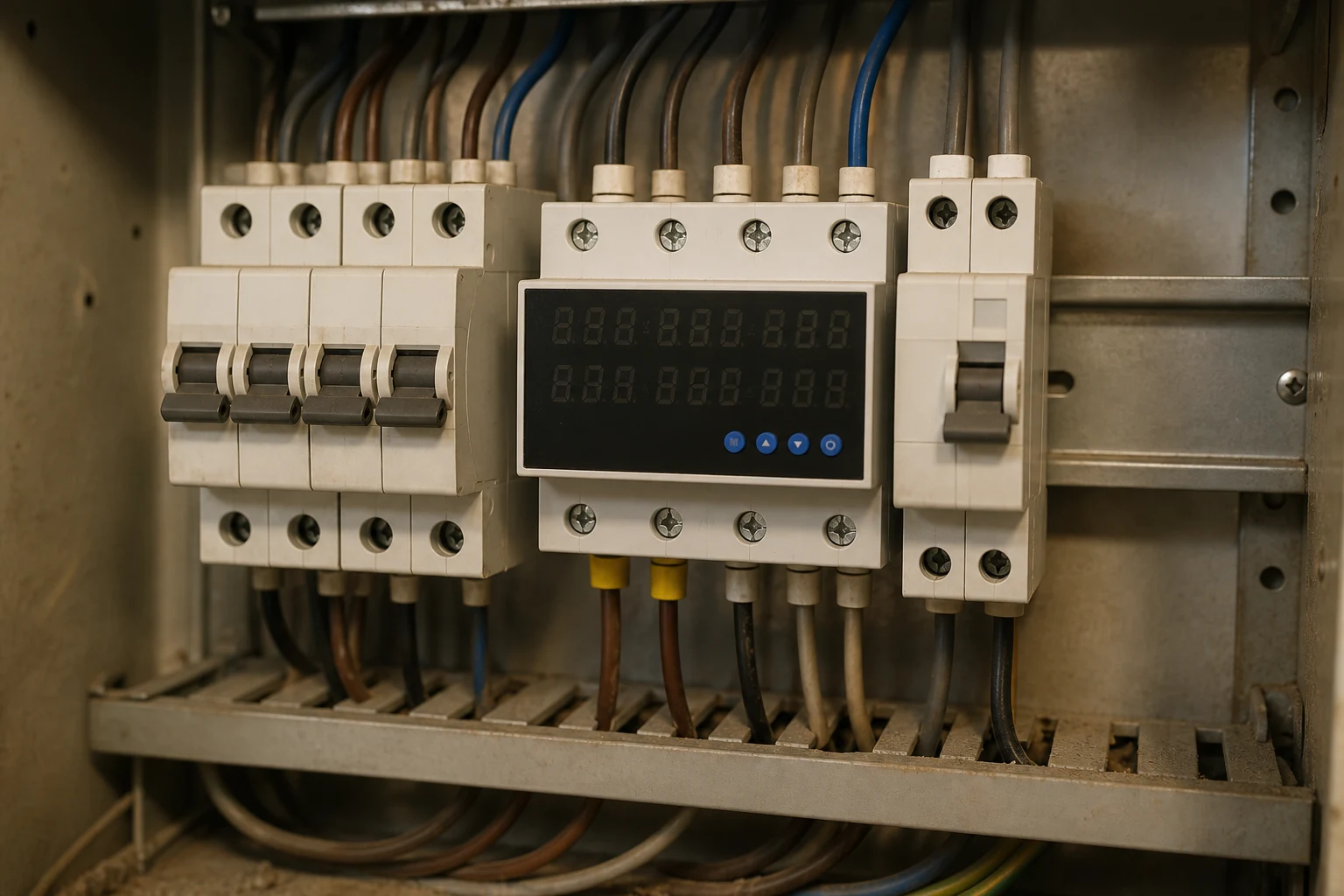
A voltage protector opens the load path when supply voltage stays outside a set window; it does not absorb surge energy.
Think of a refrigeration or HVAC feeder that sits on a soft utility or generator tap. The compressor does not need a joule rating. It needs the branch to go dark when the RMS value stays high or low long enough to cook a motor.
What is a voltage protector in that setting? A monitor plus a series switch. Some units also watch current.
After the line returns, many restore themselves once a timer expires.
Names you will see on drawings: over/under-voltage protector, voltage protection relay, or voltage monitoring relay. The shared act is disconnect, not clamp and not boost.
The voltage events it is built for
It is aimed at sustained high or low RMS voltage, not lightning-speed transients.
Engineers split those events by how long the RMS value stays off-nominal. IEEE 1159 names a sag or swell as a change that lasts up to one minute. Overvoltage and undervoltage are the names used when the same direction of change lasts longer than one minute, often framed as above 110 percent or below 90 percent of nominal.
IEC 61000-4-30 is the measurement method for those RMS events — dips, swells, and interruptions — on 50 Hz or 60 Hz supplies.
Short reductions that last less than one minute still matter to motors and controls.
Ride-through tests for equipment rated below 1000 V sit in IEEE 1668-2017 as a recommended practice. That document is a sag ride-through test method, not the naming rule for events longer than one minute.
Dips, short interruptions, and voltage variations on 50 Hz or 60 Hz supplies up to 16 A per phase are the subject of IEC 61000-4-11. YJQGA-63 is a 63 A rail unit; that standard names the phenomena, it is not a test report for this device.
For the other clock — microseconds — the tool is a surge protective device (SPD). A long overvoltage lasting seconds, minutes, or hours is not handled by a transient protector.
Brownout is informal shop talk for a sagging supply. Use it as language, not as a trip setpoint.
How the monitor-trip-delay loop works
It measures, compares a window, waits, opens a relay or contactor, then restores only after a set delay.
Work through the loop in four steps:
- Measure the supply RMS.
- Compare it with high and low limits, often with a few volts of hysteresis so the output does not chatter.
- Open the series path when the window is exceeded long enough.
- Hold off, then reconnect if the line is back inside the reset band.
That hold-off is the auto-restore / delayed reconnect. On Yijin’s YJQGA-63 the published over/under reset delay is 5–300 s, default 30 s, with a separate 1–300 s power-on delay defaulting to 5 s.
The wait is there so a flickering utility or a sudden restore does not slam a compressor back on. Factory-default auto-reset has also put HVAC motors back onto a still-bad supply; that is a setting problem, not a reason to skip the delay.
Voltage protector vs surge protector, breaker, and stabilizer
Each device watches a different quantity; using one as the other leaves a hole.
The voltage protector vs surge protector mix-up is the one US search pages keep making. An SPD clamps a spike. The voltage protector opens the circuit for a long high or low RMS window.
Fit a surge protection device where the threat is a microsecond transient. That catalog is for surge/transient clamps, not for a sustained over/under-voltage window.
A circuit breaker watches current. Yijin’s published circuit breaker range is DC; those SKUs still illustrate the current-watching job, not a generic AC MCB and not a voltage window.
A voltage stabilizer / AVR tries to hold voltage up or down without intending to cut.
| Job | Voltage protector | Surge protective device (SPD) | Circuit breaker / MCB | Voltage stabilizer / AVR |
|---|---|---|---|---|
| Quantity watched | RMS voltage window (some units add current) | Microsecond transient | Overcurrent | Incoming voltage to correct |
| Action | Open the load path | Clamp or divert the spike | Trip the overcurrent path | Boost, buck, or regulate |
| Brownout / long high voltage | Yes, that is the job | No | Not by design | Different tool: keep running |
| Lightning-speed spike | No clamp | Yes | No | Not its job |
| Still need the others? | Upstream overcurrent device remains | Complements the cutoff device | Does not see voltage alone | Use when the process cannot stop |
A specifier who is told to “add surge protection” because compressors die on saggy feeds is being handed the wrong catalog.
Keep the breaker for faults. Keep the SPD for spikes. Use the voltage protector for the RMS window.
Plug-in, DIN-rail, or a relay plus contactor
Choose the sensing point and the switched path; do not protect a whole MCC to save one motor.
A plug-in appliance protector (fridge guard, AVS socket) sits at one load. It is the cousin people mean when they ask for the “best home” unit. It is not the rail device in a distribution board.
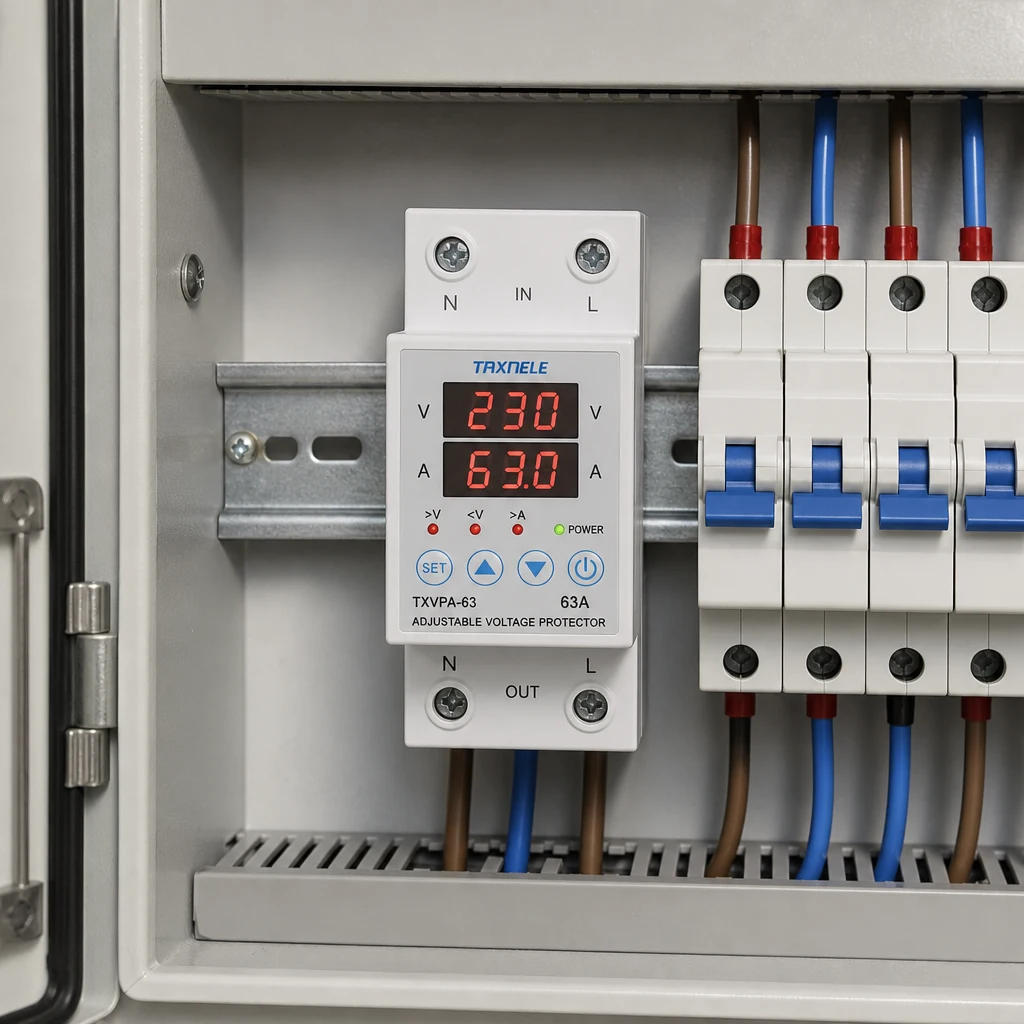
A DIN-rail protector snaps onto the guide rail and switches a branch or a small panel feed. That is the form on Yijin’s over-and-under-voltage category.
A voltage monitoring relay + contactor splits brains and muscle. The relay decides; the contactor carries inrush. That split shows up on HVAC and refrigeration drawings as a phase monitor or motor saver.
Sensing location matters as much as the form. A technician on Mike Holt’s HVAC thread put it simply: the only monitors he kept seeing watched incoming voltage, and condensers still died after a failed contactor downstream.
A DIN-rail unit is the form that belongs on a distribution board, not a plug-in fridge guard.
What a 220/230 V rail product publishes — YJQGA-63
YJQGA-63 publishes its window for AC220/230 V, not a 120 V plug-in default.
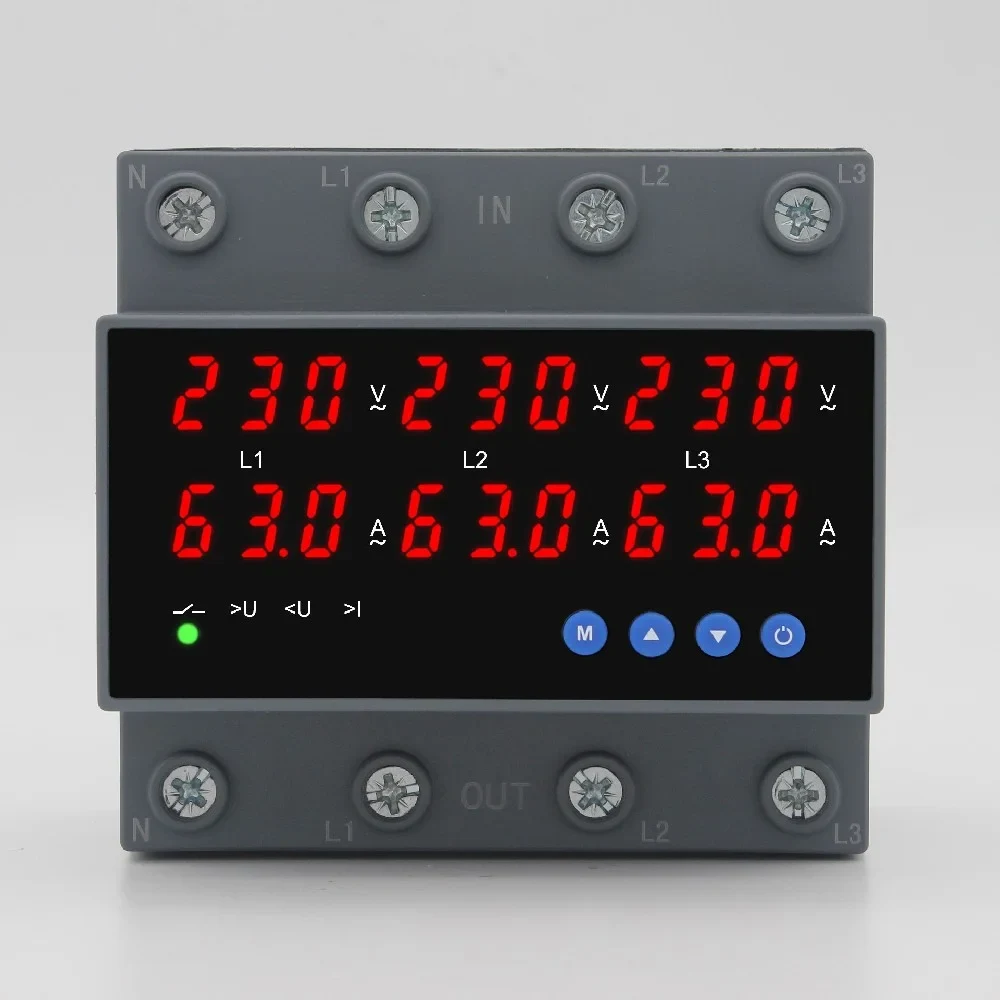
YJQGA-63 is a DIN-rail over/under voltage and overcurrent protector with delayed auto-restore. The YJQGA-63 3P+N over/under voltage and overcurrent protector and the YJQGA-63 1P+N sibling share one published table. Both sit on the over and under voltage protector hub.
The same cutoff class shows up on plant and building boards described under electricity industry and industrial and mining applications, next to motors and mixed building loads.
YJQGA-63 3P+N is the published example below.
| Published item | YJQGA-63 value |
|---|---|
| Poles | 1P+N or 3P+N |
| Rated voltage | AC220 V / 230 V, 50 Hz / 60 Hz |
| Rated current | 1–63 A adjustable, default 63 A |
| Overvoltage cutoff / reset | 240–300 V default 270 V; reset default 265 V |
| Undervoltage cutoff / reset | 140–200 V default 170 V; reset default 175 V |
| Power-on delay | 1–300 s, default 5 s |
| Over/under reset delay | 5–300 s, default 30 s |
| Overcurrent confirm / reset | confirm 6 s; reset 30–300 s, default 30 s |
| Line-voltage ceiling | do not exceed 330 VAC |
| Working conditions | −25 °C to +75 °C; altitude ≤ 2000 m |
| Electrical/mechanical life | > 100000 operations (published table) |
Those numbers belong to this model on a 220/230 V rail.
A 120 V plug-in guard uses a different window.
The unit still needs an upstream breaker. “Reclosing” on this rail unit only means delayed restore on low voltage, not a medium-voltage automatic recloser.
Skip this SKU when the job is lightning clamping only, when the process cannot stop, or when you need a 120 V socket device with socket-scale setpoints.
Why auto-restore and tight windows get blamed
Delay and reset exist so the load is not re-energized into a moving supply; a tight UV window can nuisance-trip on motor start.
On another Mike Holt thread, an over/under voltage relay on a motor saver shunted a whole MCC. A reply called that boundary choice a mistake: starting a compressor drops voltage, and a tight undervoltage setting will take the board down.
From the field: Factory-default auto-reset of voltage monitors put motors back into a single-phased condition and cost a condenser plant real hardware (Mike Holt HVAC / refrigeration phase-monitor thread). Set the window and the switched boundary to the load, not to the whole MCC.
The same delay that protects a compressor against short-cycle can look like “the protector failed” if someone expected instant restore. Write the delay you want. Then decide whether restore is automatic at all.
FAQ
What is a voltage protector?
A voltage protector is a low-voltage switch that monitors supply voltage and opens the load when that voltage stays too high or too low. Many units restore after a delay once the line is back inside the reset window.
How does a voltage protector work?
It measures RMS voltage, compares a high/low window, opens a relay or contactor, then waits. On YJQGA-63 the published over/under reset delay is 5–300 s (default 30 s).
What is the difference between a voltage protector and a surge protector?
A surge protector clamps microsecond spikes. A voltage protector disconnects the load during sustained high or low RMS voltage. One does not do the other’s job.
Does a circuit breaker do the same job as a voltage protector?
No. A breaker watches current. A voltage protector watches voltage.
The protector is not a short-circuit breaker and still needs upstream overcurrent protection.
Can a voltage protector replace a voltage stabilizer?
No. A voltage protector cuts power. It does not raise or lower the incoming voltage.
If the process cannot stop, a stabilizer or UPS is a different tool.
Do I need both a voltage protector and an SPD?
Often yes, because they cover different clocks. Use both when the site sees long RMS excursions and lightning-speed transients.
What is the reconnect delay for, and why can auto-restore cause trouble?
The delay keeps the load off while voltage is still moving. Auto-restore can re-energize a still-abnormal line if reset values or the sensing point are wrong.
Is a DIN-rail auto-restore protector the same as a medium-voltage automatic recloser?
No. The rail unit here is a low-voltage cutoff with a timed restore, not a medium-voltage automatic recloser.
Are the trip voltages on a 220/230 V rail unit the same as a 120 V US plug-in guard?
No. YJQGA-63 publishes AC220/230 V windows (overvoltage default 270 V, undervoltage default 170 V).
A 120 V plug-in guard uses a different window. Do not copy one table onto the other.
References
Standards and field threads used on this page.
- IEC 61000-4-11:2020 — voltage dips, short interruptions, and voltage variations.
- IEEE 1159-2019 — recommended practice for monitoring electric power quality.
- IEC 61000-4-30:2025 — power quality measurement methods.
- IEEE 1668-2017 — recommended practice for voltage-sag ride-through testing.
- Surge protector — Wikipedia.
- Phase-protecting HVAC / refrigeration — Mike Holt Forum.
- Symcom Motor Saver 500 / over-under voltage relay — Mike Holt Forum.