 Yueqing Yijin Electronics Co., Ltd.




Best DC Breaker for Solar: Match Voltage, Fault Duty, and Poles Before You Buy
The best dc breaker for solar is the one whose printed DC voltage, continuous-current band, interrupting capacity, polarity rules, and pole count match the circuit you are protecting — not the ampere badge with the loudest marketing. The sections below turn that idea into a buyer checklist for a DC circuit breaker for solar, then map the criteria to live DC breaker SKUs on Yijin’s circuit-breaker category.
What “Best” Means for a Solar DC Breaker
“Best” on this query is a fit decision, not a celebrity top-10 list.
A solar DC circuit asks the breaker to carry continuous DC current without nuisance trips, and to interrupt a DC fault arc that does not get the free “current zero” help AC breakers enjoy. Wikipedia’s circuit-breaker overview puts that physics plainly: direct current needs special interruption design because the arc is continuous, and every breaker also carries a maximum short-circuit current it can safely interrupt.
Score candidates in this order:
- DC voltage class that covers the circuit maximum
- Continuous current band for string or array duty
- Interrupting capacity at that DC voltage
- Polarity rules the installer must obey
- Pole count for the grounding arrangement
- Enclosure reality (indoor rail vs outdoor weather)
Only after those filters should brand preference or catalogue gloss matter. Amp labels alone are how people end up with a neat DIN module that is electrically out of its depth.
| Criterion | What you are matching | Failure mode if ignored |
|---|---|---|
| DC voltage | Circuit maximum, including series string rise | Device sees more volts than its DC rating |
| Continuous current | String or paralleled array duty | Nuisance trip or unprotected cable |
| Interrupting capacity | Prospective DC fault at that voltage | Breaker cannot finish clearing the fault |
| Polarity | Marked line/load or +/− orientation | Arc control may not work as designed |
| Pole count | One vs both current-carrying conductors | One conductor stays live after “open” |
| Enclosure | Indoor DIN vs outdoor weather shell | Moisture and UV attack an indoor body |
Match DC Voltage Class to the String, Not the Marketing Amp Label
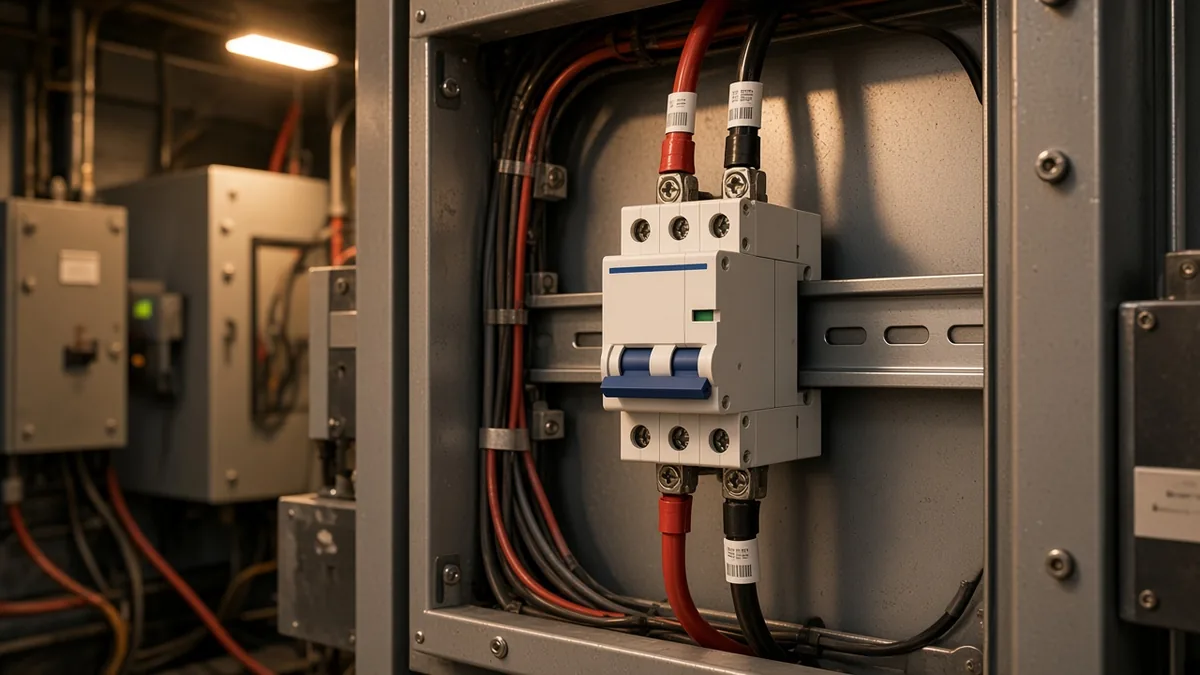
Voltage class is the first gate, because a photovoltaic string of series modules raises open-circuit voltage far above any “12 V / 24 V / 48 V” battery shorthand.
Field installers on solar DC threads make the same point in plain language: size for the maximum voltage and current of that circuit, and remember that panels in series can put out voltages a 48 V-labeled habit will not cover.
Guides on solar DC breaker sizing push the same discipline from the engineering side. Choose a DC voltage rating that sits above the temperature-corrected string maximum, then move to the next standard device class rather than skating the edge.
On Yijin’s live DC pages, the printed voltage bands are specific:
- YJB1Z-63 scope text covers DC rated voltages of 250 V and 440 V for currents of 63 A and below.
- YJB1Z-125 scope text covers DC rated voltages of 220 V and 440 V for currents of 125 A and below.
- YJM1Z scope text covers rated working voltage of DC750 V and below, with a note that DC750 V needs to be customized.
If your cold-day string voltage sits above those printed bands, pick another voltage class or architecture. The printed DC voltage on the breaker has to win against the real circuit maximum.
Size Current for String vs Array Duty
Current selection follows where the breaker sits in the DC path.
A single-string protective device — the usual DC MCB for PV string duty — sees roughly one string’s short-circuit behaviour. A combiner output or DC feeder sees paralleled strings, so the continuous current climbs even though the voltage does not add. That is why the same “solar DC breaker” search returns both compact DIN MCBs and molded-case frames: they are answering different current jobs.
Educational sizing write-ups commonly walk two frameworks. One IEC-style reminder uses about 1.25 × maximum circuit current. Many US designers summarize a NEC-style PV source-circuit framing as Isc × 1.56 before rounding up to a standard size.
Treat those as method reminders rather than a finished calculator for your bill of materials.
Mapped to live Yijin printed current bands:
- Stay inside 63 A and below on a DIN DC MCB → YJB1Z-63 family scope.
- Need 63 A to 125 A options on a DIN DC MCB → YJB1Z-125 parameter table lists 63, 80, 100, and 125 A.
- Climb toward hundreds of amps on DC distribution → YJM1Z frames carry rated working current up to 800 A across shell sizes such as 100 / 225 / 400 / 630 / 800.
Cable ampacity still caps the OCPD. A breaker is not a permission slip to undersize wire.
Interrupting Capacity and Polarity Decide Whether the Breaker Can Finish the Job
Ampere branding without fault duty is incomplete, because a solar DC breaker still has to finish clearing a continuous DC arc at the real system voltage.
Breaking capacity — also called interrupting rating or AIC in North American speech — is the largest short-circuit current the device can interrupt at a stated voltage without destroying itself or leaving an unacceptable arc. Wikipedia’s breaking-capacity entry notes that a device may carry different interrupting ratings for AC and DC, and that DC systems are harder because current does not cross zero.
Independent technical explainers add that short-circuit current loads the breaker with thermal and mechanical stress until the contacts part. On the YJM1Z product page, the main parameter table prints a breaking-capacity column as 10KA/20KA by frame. For the DIN YJB1Z pages, lean on the clear scope sentences for voltage and current when a table cell is ambiguous in the page markup.
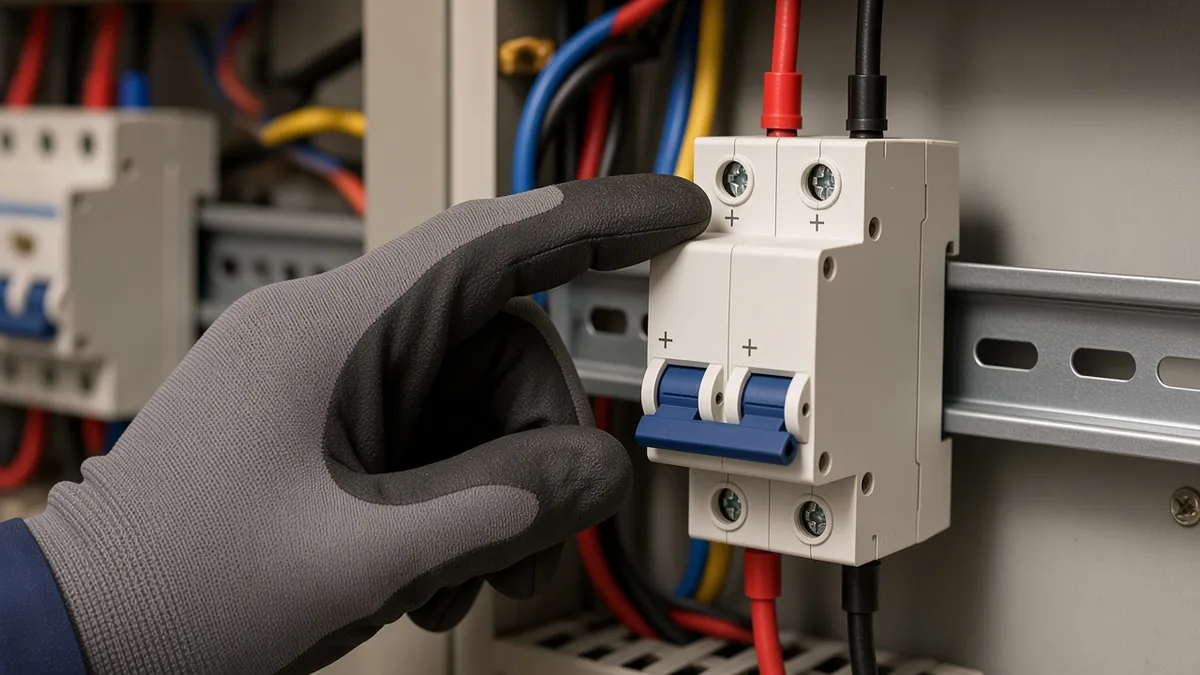
Reddit installers repeatedly warn that many DC breakers are polarized and must follow the marked orientation. Polarity sits beside interrupting capacity as a non-negotiable filter.
Wire a polarized module backward and the arc-control path can fight the current direction even though the handle looks installed. Non-polarized or bidirectional designs exist for reversing duty, but only when the datasheet says so.
Pole Count on Ungrounded DC: Why Both Conductors Often Matter
Pole count is an isolation decision, not a shopping upsell.
On many modern PV layouts that are functionally grounded rather than solidly grounded, both the positive and the negative are current-carrying conductors that need to open for a true isolation point. Solar DIY threads put it bluntly: a disconnect must open all ungrounded conductors, which often means breaking both POS and NEG.
Two-pole DC breakers show up so often on string and small-array boards for that reason. A one-pole device can still be correct on a solidly grounded conductor arrangement when the design and listing path say so. Opening the handle is still different from proving both DC conductors are open.
Some high-voltage DC catalogues raise voltage capability with series-connected poles. That remains a manufacturer wiring-diagram job. If the product page omits the series-pole diagram you need, stop and get the diagram rather than improvising.
Indoor DIN Mount vs Outdoor Enclosure Reality
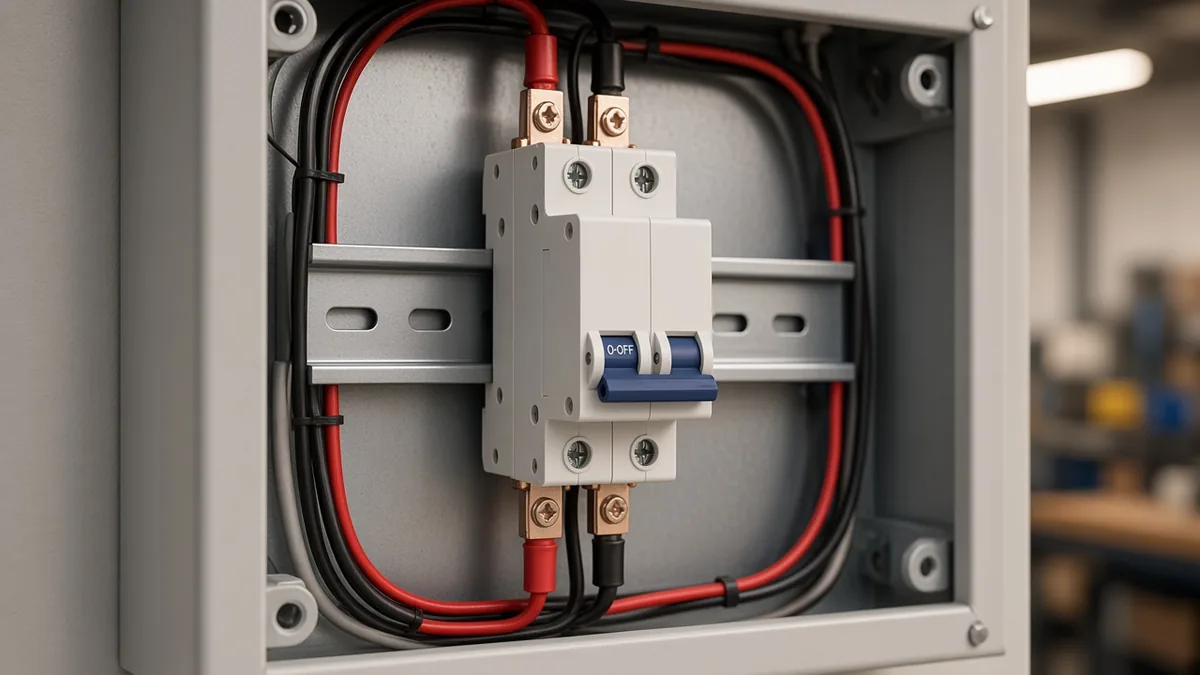
A DIN-rail DC breaker is usually an indoor component unless the catalogue says otherwise.
Competitor PV DIN breakers commonly print indoor environmental ratings such as Type 1, and university PV component lectures remind buyers that outdoor disconnect hardware needs an outdoor rating. Yijin’s three DC breaker pages omit a NEMA outdoor enclosure type for the breaker body itself. Read that omission as a design input: keep the breaker in a suitable enclosure rather than treating a bare rail module as weatherproof rooftop gear.
Important: The live YJB1Z-63, YJB1Z-125, and YJM1Z product pages omit UL 489B, UL Listed, NEC 690 compliance, and outdoor NEMA enclosure ratings. US educational material often names UL 489B as a PV DC breaker listing class buyers ask for — treat that as a separate procurement filter, not as a mark these pages already show.
If the install is outdoors, the enclosure — lockable, UV-stable, correctly gasketed — becomes part of the “best” answer even when the breaker SKU is correct.
Thermal vs Magnetic Trip Behaviour Under DC
Trip behaviour tells you how the breaker notices trouble.
In a typical miniature circuit breaker, thermal-magnetic trip behaviour splits the job: a bimetal path responds to sustained overload heating, while an electromagnetic path responds to a sudden short-circuit surge. Electrical4U’s MCB explainer is the clean version of that split: thermal for overload, magnetic for short circuit.
Under DC, that split still matters for expectation setting. Long mild overloads lean on the thermal path. Bolt-faults lean on the magnetic path and on the arc chute’s ability to stretch a continuous DC arc.
YJB1Z-63 page text references B/C instantaneous types in its technical discussion; YJB1Z-125 discusses C-type instantaneous behaviour in its DC test notes. Read the trip information on the product page when you need curve detail, rather than borrowing an AC residential habit without checking the DC sheet.
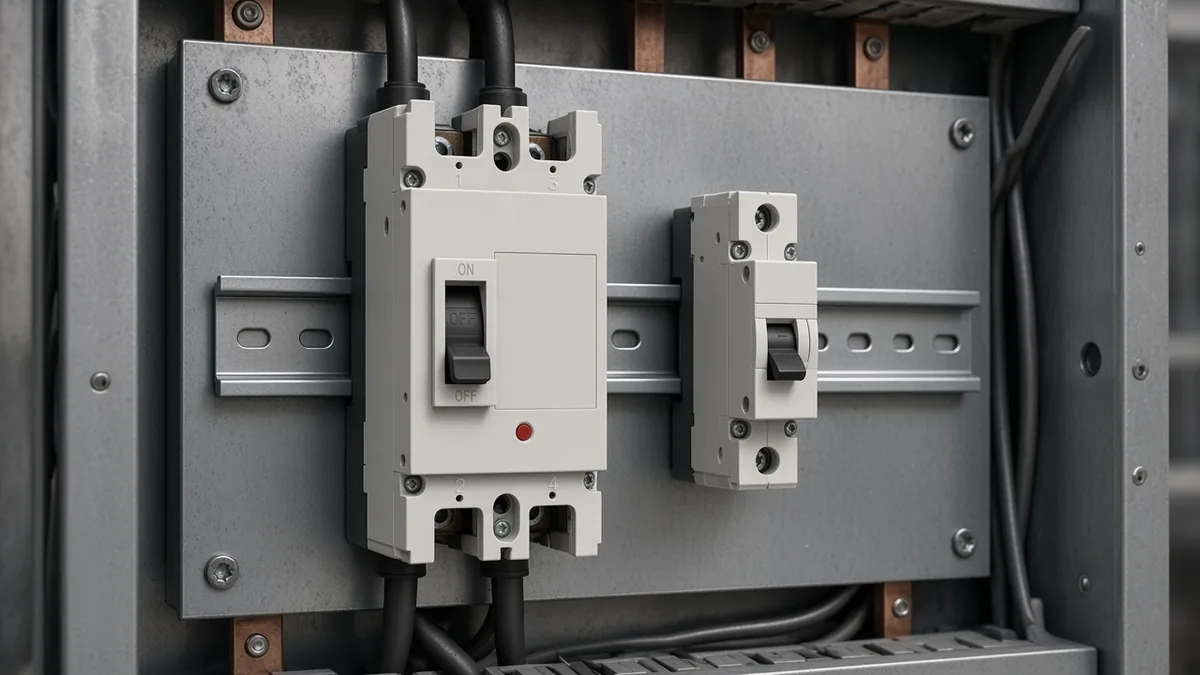
Molded-case frames such as YJM1Z add another layer: higher continuous current and higher breaking figures for feeder-class DC duty, still with overload and short-circuit protection called out in the page scope. They are the answer when current and fault duty leave the DIN band, not a style upgrade on a 16 A string.
Choose a Yijin DC Breaker SKU That Fits Your Criteria
Once the criteria are scored, map them to the three live DC primary SKUs. Keep the other ten circuit-breaker catalogue items out of the solar DC shortlist.
The circuit-breaker category currently lists 13 published products. Only three are DC primary candidates.
The remainder are WiFi/GQ/RS485 breakers and intelligent / AC-oriented frames. Those siblings may be useful elsewhere on a project; they are the wrong tool for solar DC string or DC distribution protection.
The fit table below keeps only the three DC primary SKUs.
| SKU | Printed voltage scope | Printed current scope | Standards printed on page | Typical fit inside those printed bands |
|---|---|---|---|---|
| YJB1Z-63 Small DC Circuit Breaker | DC 250 V and 440 V | 63 A and below | GB10963.2, IEC60898-2 | Default DIN pick for small DC distribution / string-class currents inside that voltage class |
| YJB1Z-125 Small DC Circuit Breaker | DC 220 V and 440 V | 125 A and below (table options include 63, 80, 100, 125 A) | IEC60947-2, GB14048.2 | Same DIN role when In must step into the higher printed amp options |
| YJM1Z plastic shell DC circuit breaker | DC750 V and below (DC750 V customize note) | Up to 800 A across frames | IEC60947-1 / GB14048 family language on page; breaking column 10KA/20KA | Molded-case choice when current and fault duty leave the DIN MCB band |
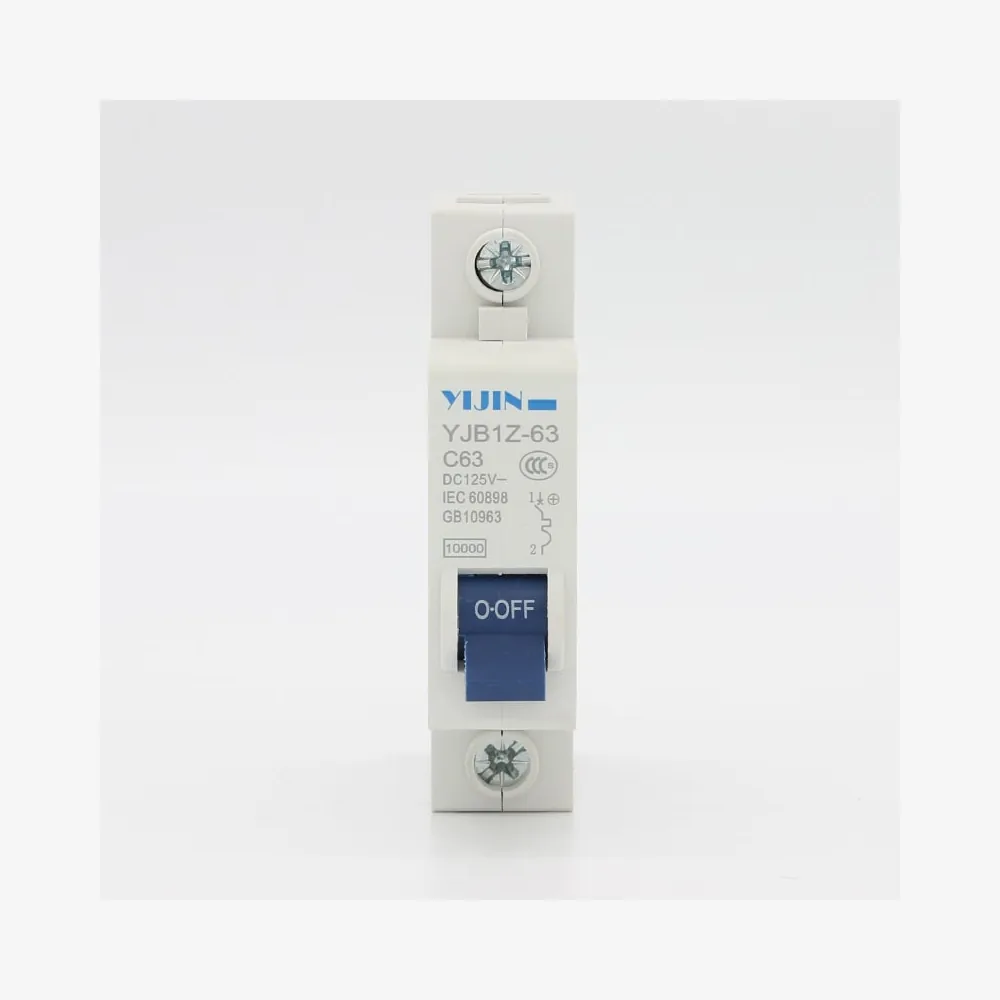
For most buyers with a compact DIN need inside the printed 250/440 V class and ≤63 A, start with the YJB1Z-63 small DC circuit breaker.
Step to YJB1Z-125 when the printed In options must reach 80-125 A. Step to YJM1Z when the board is clearly in molded-case current territory.
Before the purchase order closes, re-check polarity markings, pole count for your grounding arrangement, and enclosure rating. Wiring details and AC-reuse myths belong to adjacent articles; this page stays on the selection frame that makes “best” measurable.
FAQ
What does “best DC breaker for solar” actually mean?
It means the breaker whose DC voltage, continuous current, interrupting capacity, polarity rules, and pole count match the solar DC circuit. Brand fame is a tie-breaker after those filters, not a substitute for them.
Can I use an AC MCB on a PV DC string?
No. Community installers and DC arc physics agree that AC-rated breakers are the wrong interrupting tool for continuous DC. Keep the deep AC-reuse argument thin here; the selection rule is simply “DC-rated device only.”
What voltage rating should I choose?
Choose a printed DC voltage class that covers the circuit’s maximum, including series string open-circuit rise in cold weather. YJB1Z-63 and YJB1Z-125 pages print up to a 440 V DC class in their scope text; YJM1Z prints DC750 V and below with a customize note at DC750 V.
How should I think about current sizing without a full calculator?
Separate string duty from paralleled array / feeder duty, start from short-circuit-based continuous-current methods used in PV sizing education, round up to a standard In, and confirm cable ampacity. Use YJB1Z-63, YJB1Z-125, or YJM1Z only inside their printed current bands.
Why does polarity matter on a DC breaker?
Many DC breakers are polarized. Install them against the marked orientation so the arc-control path sees current in the direction it was designed for.
Do I need a 2-pole DC breaker for solar?
Often yes on functionally grounded or ungrounded DC layouts where both positive and negative must open. Confirm the grounding arrangement and the manufacturer diagram before defaulting to one pole.
Which Yijin SKU fits my current band?
- ≤63 A DIN DC → YJB1Z-63
- Higher DIN options through 125 A → YJB1Z-125
- Hundreds of amps / molded-case duty → YJM1Z
Leave WiFi/GQ/RS485 breakers off the solar DC shortlist.
Are Yijin DC breakers UL 489B listed?
The live product pages for YJB1Z-63, YJB1Z-125, and YJM1Z omit UL 489B or UL Listed marks. If a US project requires that listing class, treat it as an open procurement requirement rather than something these pages already claim.
References
- Circuit breaker — Wikipedia
- Breaking capacity — Wikipedia
- Miniature Circuit Breaker or MCB — Electrical4U
- Circuit Breakers for solar (DC) — r/OffGrid
- DC Circuit Breaker — r/SolarDIY
Humanizer audit: PASS
Humanizer second-pass owner: YJ-BESTDC-DRF-20260918-C
Patterns removed: repeated “page does not print” hedging outside the single Important callout; source-first openings; celebrity-list framing.
No-fabrication boundary: no UL/NEC/Voc invent; no fake Icu for DIN tables; no field test stories.