 Yueqing Yijin Electronics Co., Ltd.

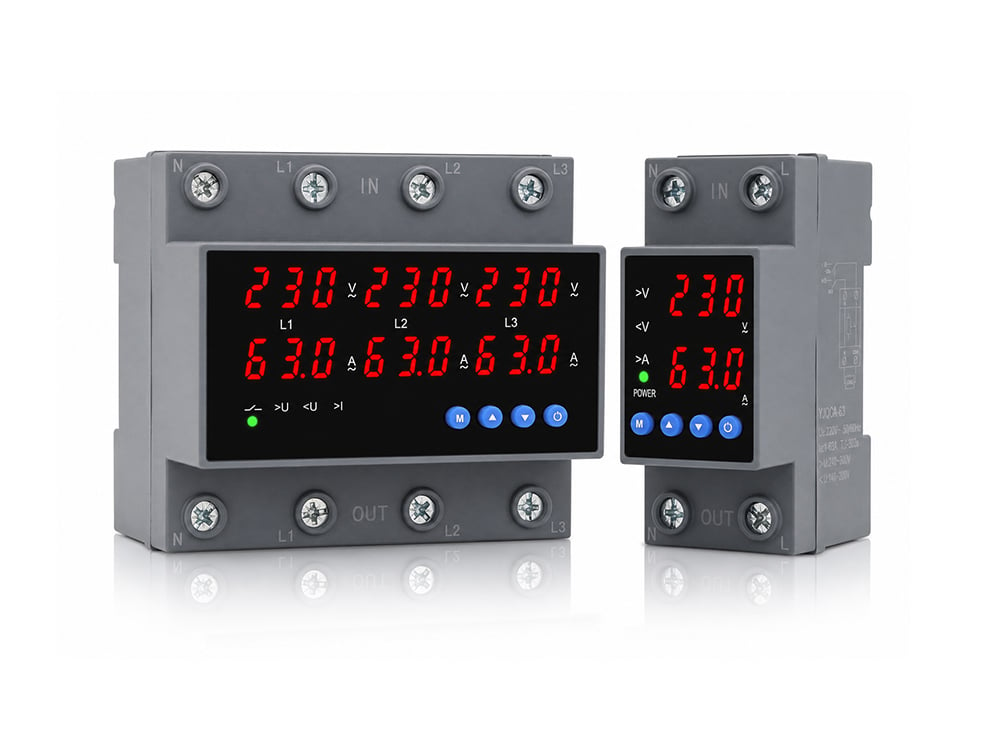



A spring is not this clock
A 30 minute mechanical timer switch in US retail copy usually means a spring-wound in-wall countdown—not the KG316T rail clock.
The spring dial lives in a wall box. The stored weekly clock events live on a DIN-rail module in a panel.
The query buys a spring-wound wall countdown
Retail listings for this query point to a twist-knob spring-wound countdown timer: you turn the dial clockwise, the load runs, and the mechanism opens the contacts when the selected interval ends.
A timer switch operates an electric switch on a time schedule—that umbrella covers both a spring-wound countdown timer and a rail clock, so the first job is to name which machine the buyer actually needs.
Spring-wound mechanical timers use internal gears and a spring to count down and often need no standby neutral for the timing electronics. At the end of the selected run, a default SPST spring-wound layout turns the load off when the dial finishes.
Many US spring-wound listings cap the dial at thirty minutes for fan and light run limits. That cap is a run limiter, not a weekday street-light program.
| Class signal | What the buyer usually gets |
|---|---|
| Twist knob, gears, tick optional | Spring-wound countdown timer |
| Preset buttons 5/10/15/30 | Digital 30-minute countdown |
| Set Week / Set Hour keys on LCD | Weekly clock events on panel gear |
Neutral, poles, and reverse OFF wiring
Spring-wound wall units often fit older boxes where a neutral wire was never pulled for timer electronics. Digital push-button countdown timers usually need a neutral conductor for the electronics, unlike many spring-wound wall units.
An SPDT spring-wound unit can wire reverse action so the load returns on after a timed off interval. That is the same spring-wound family with different contact logic—not a weekly clock table.
For two-forty-volt loads, manufacturer guidance points to double-pole spring-wound models that switch both hot legs—not a single-pole dial on one leg. Match pole count and voltage label to the load before anyone quotes a SKU.
Use SPST spring-wound when the default job is “on for the dial, then off.” Use SPDT spring-wound when the job is “off for an interval, then return on.” Use DPST spring-wound when both legs of a two-forty-volt load must switch together.
This section is compatibility language only, not a step-by-step wiring manual.
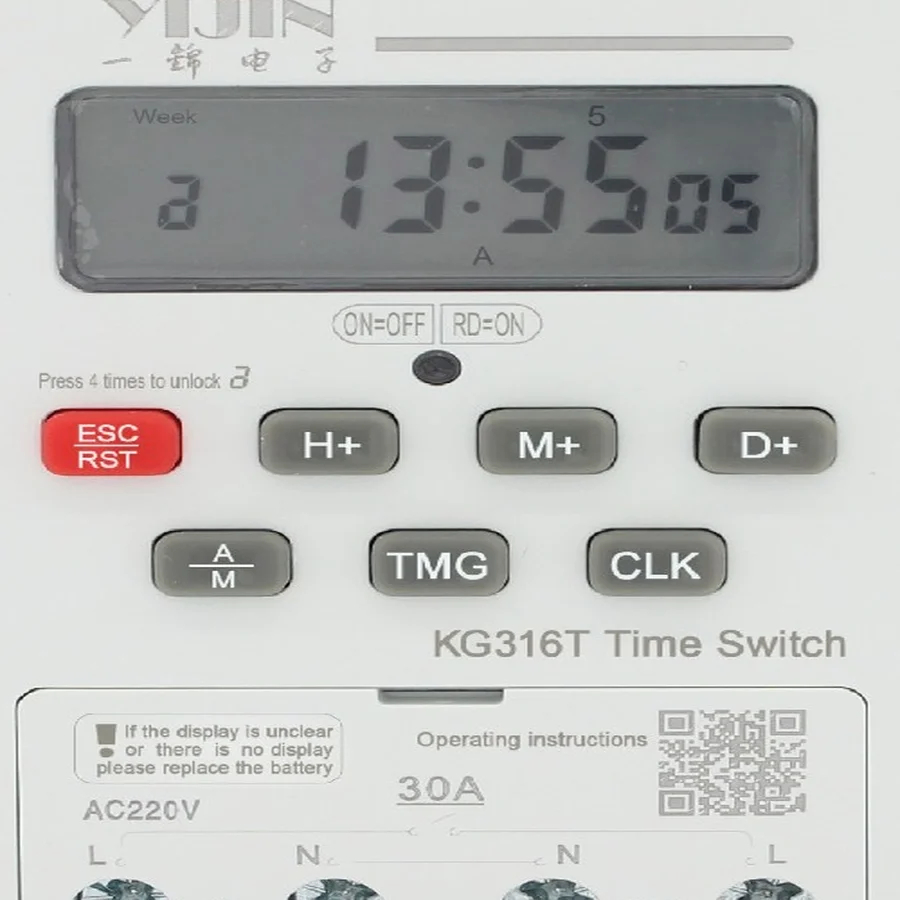
The close face belongs to the rail clock body, not a decorator spring plate.
Digital presets hide behind mechanical labels
Roundups and marketplace titles still say “mechanical” while showing electronic faceplates. Leviton-style preset buttons (five, ten, fifteen, or thirty minutes) are digital countdown electronics, not a wound spring dial.
The digital 30-minute countdown class uses a microcontroller and preset minutes. It can answer a bath-fan run limit, but it is not the same mechanism as a spring-wound countdown timer.
| Label on the box | Mechanism | Neutral tendency |
|---|---|---|
| Spring-wound / twist knob | Gears and spring | Often no neutral for timer electronics |
| Decora preset buttons | Digital countdown | Usually needs neutral |
| LCD Set Week keys | Stored clock events | Panel control supply per sheet |
If the buyer says “mechanical” but points at preset buttons, stop and rewrite the requirement as digital preset or spring-wound—before a rail clock enters the conversation.
A one-shot run is not a weekly schedule
A twist-knob spring run is a one-shot run limit: you wind once, the load runs, then the contacts open until someone winds again. Weekly clock events repeat on a stored timetable instead of waiting for a fresh wind.
From the field: A DIY thread wanted loads temporarily OFF for fifteen to thirty minutes, then back ON—the answer named a spring-wound SPDT timer. Source: DIY Stack Exchange thread on reverse OFF wiring.
That job is still a spring-wound run or reverse-off interval, not an alert every thirty minutes on a clock. An interval reminder that fires every thirty minutes while power stays on belongs to a different control story—often a clock event or specialty wiring—not the default SPST “run then stay off” spring layout.
| Job story | Spring-wound default | Stored weekly clock events |
|---|---|---|
| Cap a fan after a shower | One wind, one run, then off | Overkill unless you also need a week table |
| Street or sign lights on a week plan | Wrong tool | Weekly clock events |
| Temporary OFF, then return ON | SPDT spring-wound | Wrong unless you program many rows |
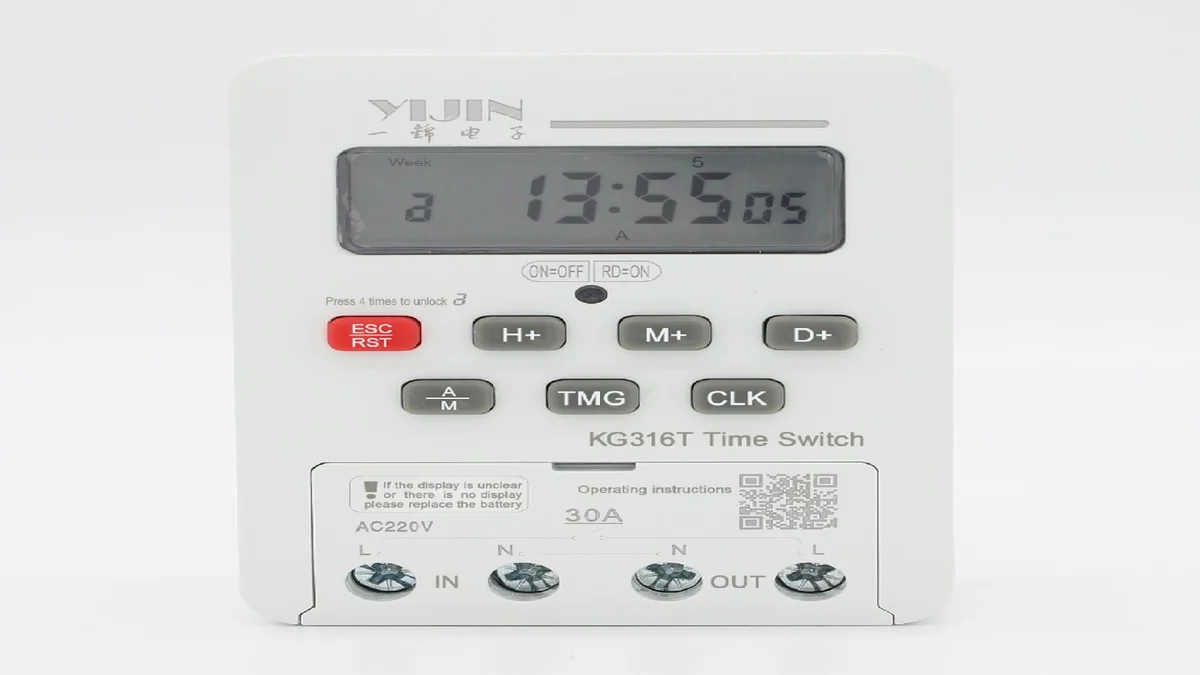
The note and the module stay on separate lines of the order.
When a heavy two-twenty or two-forty load exceeds wall spring ratings, a Contactor / relay path is common: a contactor is an electrically controlled switch used when the load needs heavier switching than a wall spring dial rating. The spring or clock may only drive the coil—size the switching device to the load.
Product fit: clock events, not a spring dial
Yijin describes the KG316T as a microprocessor time control switch with LCD keys—not a spring-wound thirty-minute wall plate. Do not quote it when the only requirement is an Intermatic-class twist knob in a US decorator box.
The printed schedule allows sixteen paired on/off actions daily, down to one-minute steps and up to a one-hundred-sixty-eight-hour span.
Switching times can repeat on a daily or weekly cycle.
The KG316T page prints a rated control supply of AC 50/60 Hz at 220 V and 380 V.
The page also prints a lamp load of 0.9 kW.
The KG316T page prints a protection rating of IP50.
| Printed line | How procurement should read it |
|---|---|
| Control supply | Match printed panel control supply before energizing |
| 16 on/off per day | Stored clock events, not a single wind |
| Min 1 minute / max 168 hours | Resolution for each stored event |
| Lamp load 0.9 kW | Stay inside the printed lamp line |
| IP50 | Panel enclosure rating, not a wall plate |
DIN-rail / panel mounting is where the KG316T lives—not a decorator box.
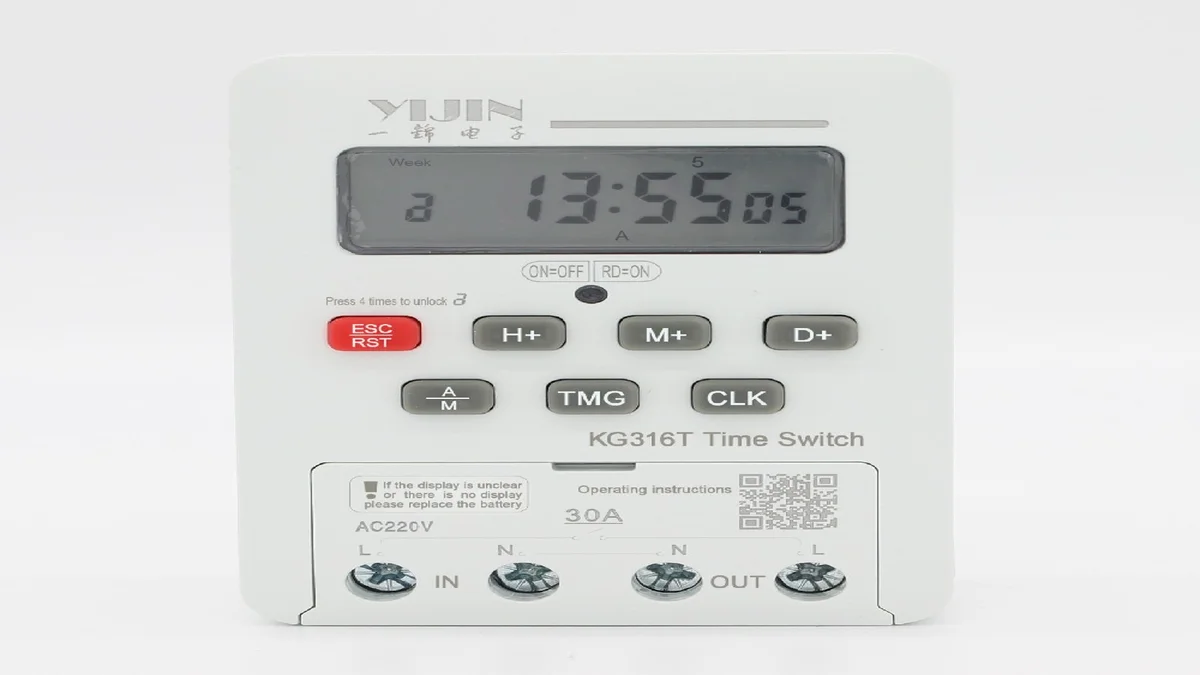
The KG316T time control switch fits when the job is weekly clock events on DIN-rail / panel mounting with the printed control supply—not when the job is a spring-wound countdown timer in a hallway box.
Contrast only: types of timer switch maps the wider family; 7-day weekly programmable timer switch owns the week-table spine; 24-hour countdown timer switch covers breaker-opening countdown releases—not spring wall dials.
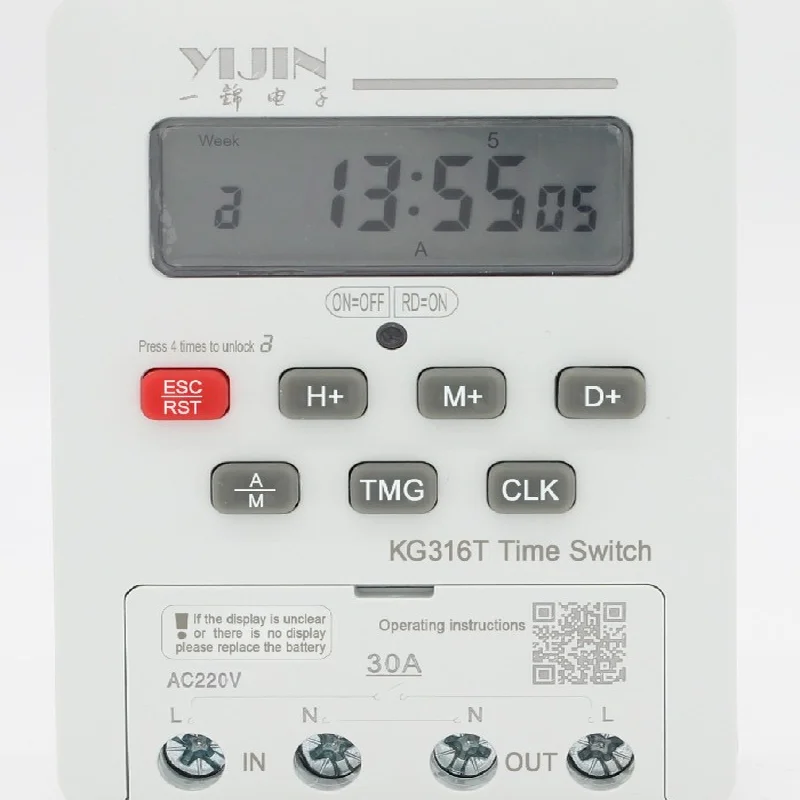
The rail still only holds the timer
A DIN rail is a metal rail of a standard type widely used for mounting circuit breakers and industrial control equipment inside equipment racks. Panel DIN time switches store repeating clock events with many on/off pairs per day, unlike a single spring countdown run.
The rail holds the KG316T module. It does not turn into a decorator spring plate because marketing copy mentions street lights or signs.
A relay is an electrically operated switch. The KG316T uses a relay output for the timed circuit. The rail still does not grow a twist knob because the load sits in a plant room cabinet.
If the only mount anyone describes is a gang box and a cover plate, stop. This page is the panel conversation.
Keys set the week, not a winding dial
Programming uses Timer, Set Week, Set Hour, and Set Minute keys on the LCD—not a clockwise wind. Unlock on the page uses Cancel/Restore four times. That workflow stores weekly clock events; it does not emulate a thirty-minute spring run.
If the operator language is “wind it to twenty minutes after each shower,” the spring-wound countdown timer family is still the honest answer. If the operator language is “off at 23:00 every weekday,” the stored weekly clock events on this sheet are the honest answer.
Before you order, say whether anyone will touch a wall dial. If yes, do not open the KG316T carton for that room. If the only need is a repeating sign or production schedule on panel control supply, read the printed event count and lamp line again.
Keep spring-wound countdown language on the wall line of the quote. Keep weekly clock events on the panel line. Mixing them is how a rail module ships into a bath-fan retrofit.
A buyer who only says “thirty minute mechanical timer” will expect a twist knob. Answer with the spring-wound countdown timer place first. Then answer with whether weekly clock events belong in the same job at all.
Only after both are clear should anyone specify the KG316T time control switch for the panel side.
When the timer mounts inside a locked plant cabinet, the rail clock conversation still makes sense. A hallway spring dial does not relocate into that cabinet by itself.
Stay inside the printed lamp line; marketing stories about signs or streets do not add a twist-knob plate.
Copy control supply, event count, and lamp load onto the panel line of the PO. Keep spring-wound wording on the wall line when the job is truly a dial run.
Name the wall room and the panel room on separate lines so the installer does not search a gang box for a DIN module.
Frequently asked questions
These answers stay with the sources opened for this draft.
Do 30 minute mechanical timers need a neutral?
Spring units count down with gears and a spring, so many wall models skip a standby neutral for timer electronics; digital preset faceplates usually still need a neutral wire for their circuit board.
What happens when the dial reaches zero?
On default SPST wiring the load drops out when the dial hits zero; SPDT wiring can instead bring the load back after a timed dark interval.
Spring wound vs digital 30 minute countdown?
Preset-minute buttons are microcontroller countdowns even when the listing says mechanical; a true spring-wound countdown timer still uses a twist knob and gears.
Can it control a bathroom fan?
Yes, when the job is a one-shot run limit after moisture—spring-wound is the usual US class—but match amp and voltage label to the fan circuit. The KG316T rail clock is not a drop-in bath-fan dial.
Does spring wound need electricity to operate the timer?
The spring and gears count down without timer electronics standby power; line voltage still passes through the contacts when the load is on. Digital presets need electronics power and usually a neutral wire.
240 V and spring wound?
Use a double-pole spring-wound model that opens both hot legs on two-forty-volt loads rather than switching only one leg with a single-pole dial.
SPST vs SPDT?
SPST ends with the load off; SPDT lets you wire reverse action so the load returns after the interval.
Can KG316T replace a 30 min wall spring switch?
No. Yijin describes the KG316T as a microprocessor time control switch with LCD keys—not a spring-wound thirty-minute wall plate.
When is KG316T the compatible choice?
When the job is stored daily or weekly clock events on DIN-rail / panel mounting with the printed control supply—not for a decorator spring-wound wall countdown.
Fan run time after shower?
Moisture guides often suggest a short fan run after a shower; spring-wound dials in US listings often cap near the same half-hour band as the query.
IEC 60730-2-7 names particular requirements for timers and time switches; wall time-delay countdown switches sit under a different IEC branch.
References
See the Engineer Fix spring timer guide.
See the ElectraSim timer switch explainer.