 Yueqing Yijin Electronics Co., Ltd.

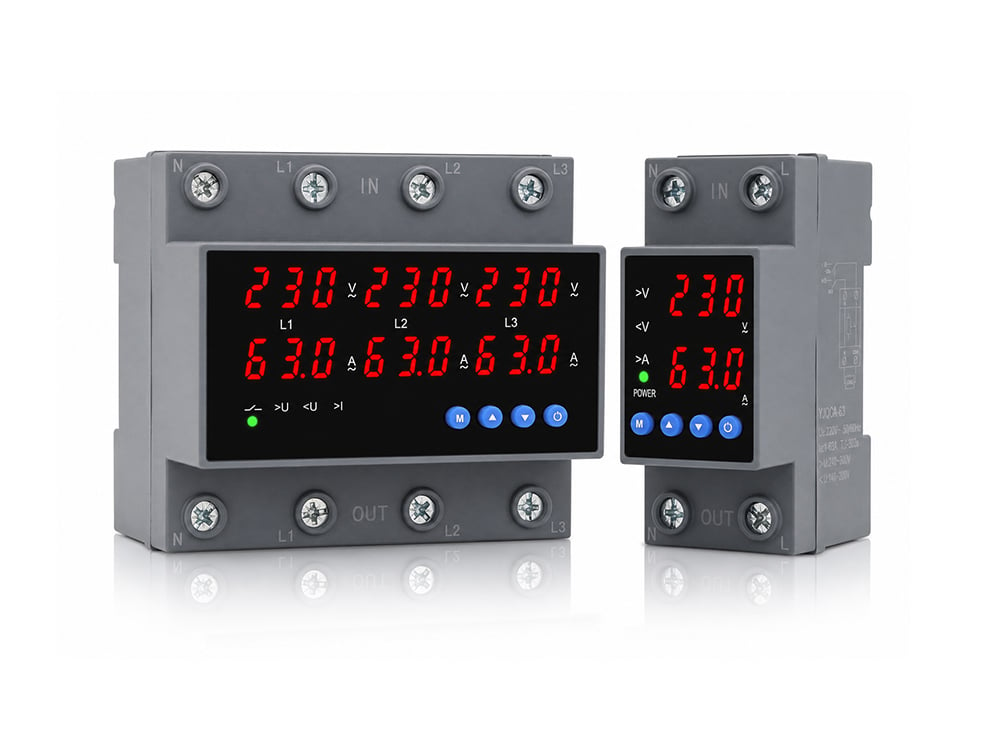



Types of Timer Switch: Weekly, Astronomical, Photocell, and Countdown Families
Types of timer switch usually split by how they decide when to open or close a circuit: weekly digital clocks, astronomical or latitude-longitude calculators, photocell light sensors, and countdown releases. Mounting style — mechanical dial, plug-in, in-wall, or DIN rail timer switch form factors — is a separate axis, not a second mystery “brand.” This page is a family map for US English B2B readers, not a programming manual or wall-box install checklist.
How Buyers Usually Group Types of Timer Switch
Group timer switches by control method first, then by how the device mounts. That order prevents shopping pages from collapsing every lighting timer into one “7-day” SKU.
Control-method families answer a different question than form factor. A weekly digital unit runs clock-and-weekday programs. An astronomical or lat-long unit calculates dusk and dawn for a location.
A photocell reacts to ambient light. A countdown release times a duration after the circuit closes.
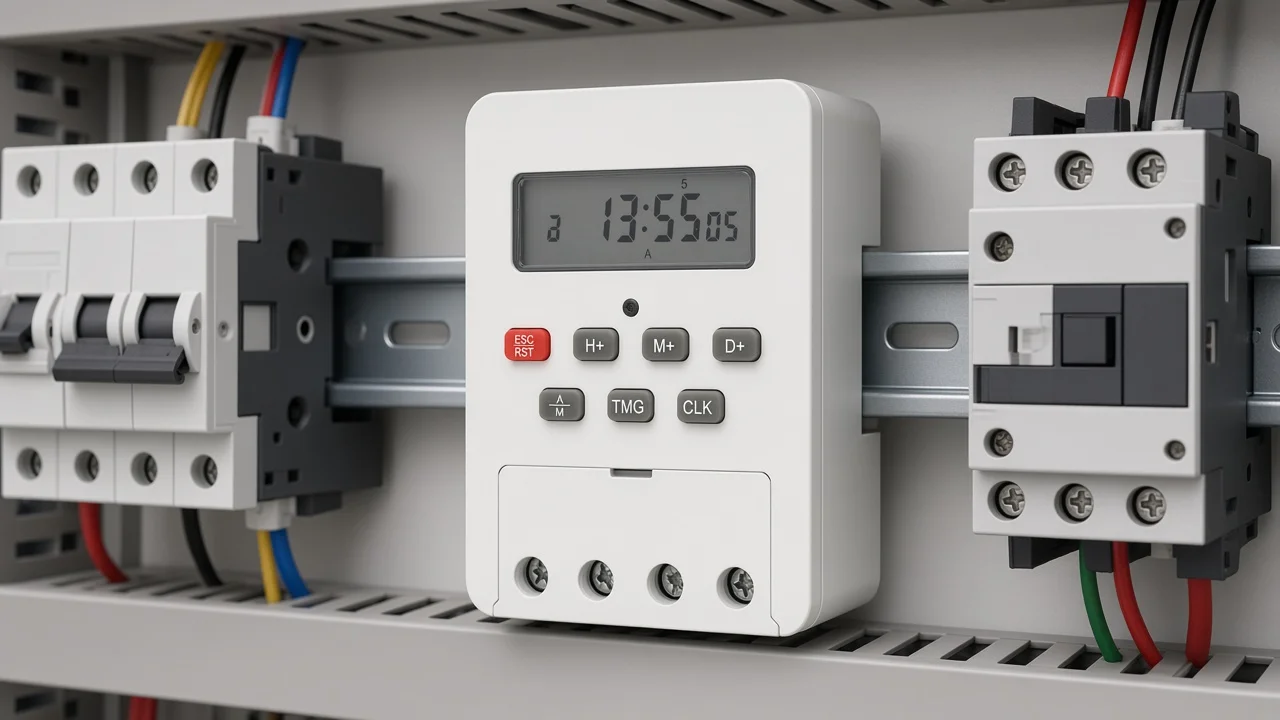
Form factor answers a second question: plug-in outlets, decorator in-wall boxes, mechanical dial housings, or DIN-rail modules inside a panel. A DIN-rail timer can be mechanical, digital, or astronomical. Mounting never proves the timing method by itself.
| Control family | What sets the switch points | Buyer cue |
|---|---|---|
| Weekly digital | Clock time + weekday / day-block programs | LCD or keypad schedule that repeats each week |
| Astronomical / lat-long | Calculated sunrise and sunset for a location | Location or zone fields; seasonal dusk tracking without an eye |
| Photocell | Ambient light threshold | Sensor “eye” that must see the sky cleanly |
| Countdown | Duration after a close event | Minutes or hours remaining, not a weekly calendar |
Yijin’s timer switch category already spans weekly digital, lat-long modular, countdown release, and Wi-Fi adjacent SKUs. Keep those as type lanes before you open a datasheet.
Weekly Digital Programmable Timer Switches
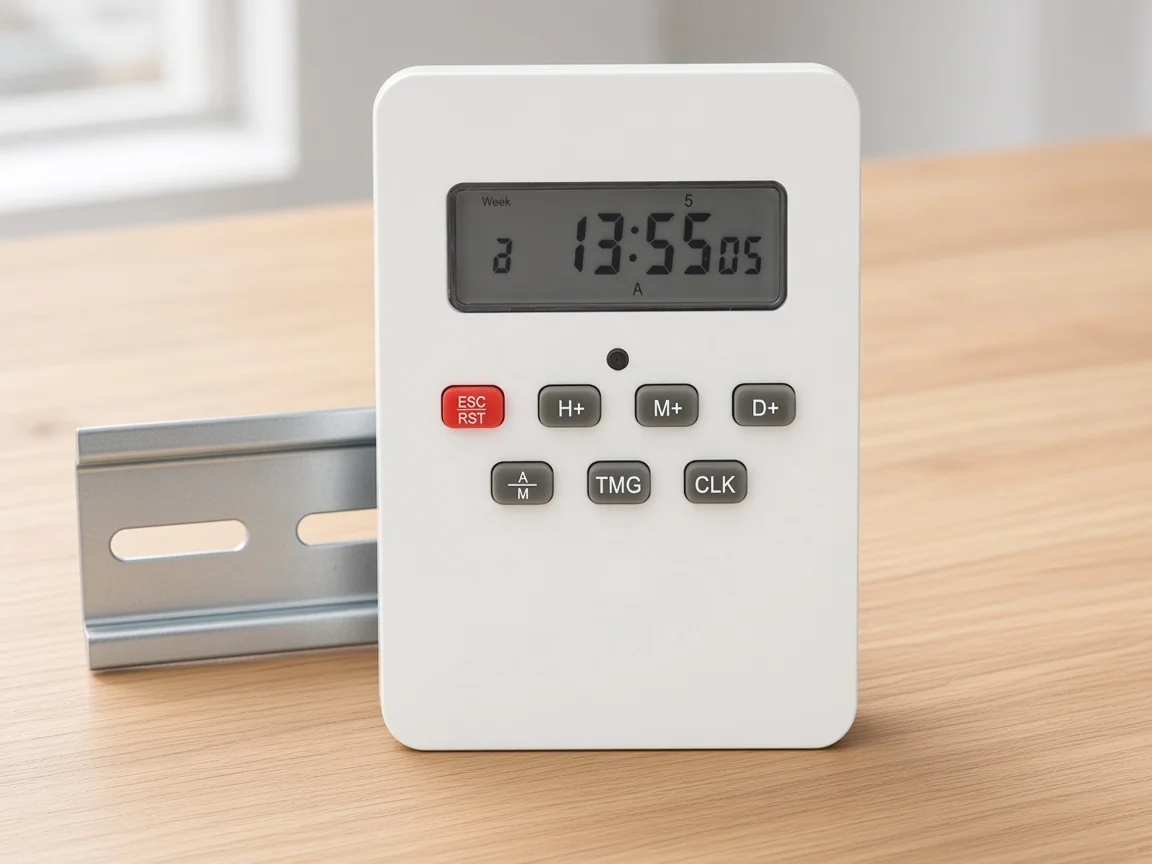
A weekly digital programmable timer switch stores ON and OFF events against clock time and weekdays, then repeats that cycle. It does not watch the sky.
Independent explainers describe the usual stack: a microcontroller, a crystal time base, an LCD or keypad, and a relay or similar output. Buyers use that family when weekday and weekend hours differ, or when a load must switch at fixed civil times rather than at dusk.
On Yijin’s live KG316T time control switch page, the weekly/daily digital family is printed as daily or weekly cycling, up to 16 on/off actions per day, and a control range from 1 minute to 168 hours. Treat those figures as that product page’s claims.
Weekly digital control ignores sudden storm darkness and seasonal sunset drift until someone edits the program. If the real job is dusk tracking, move to the astronomical or photocell families instead of forcing more clock rows.
For deep weekly programming and leftover-event troubleshooting, use the sibling guide on 7-day weekly programmable timer switch. This types page only places the family on the map.
Astronomical and Latitude-Longitude Timer Switches
Astronomical timer switches calculate sunrise and sunset for a geographic position and date, then switch from those solar events instead of from a photocell eye.
Many models ask for latitude, longitude, and time zone, or a city list that stands in for those inputs. Some DIN products combine a weekly program with an astronomical channel on one module. The shared idea is seasonal dusk tracking without remounting a light sensor.
Yijin’s live KG316TG36mm modular latitude and longitude time control switch page describes enable/disable latitude-longitude control so switch times follow geography and seasonal sunshine hours. Printed index figures on that page include AC 187–240 V 50/60 Hz supply, resistive switch capacity options of 40 A and 63 A, timing error under ±2 seconds per day, latitude 0°–80°N, and east/west longitude ranges, with time zone required when lat-long is enabled.
Calculated dusk can still differ from observed darkness in heavy weather. That is a type trade-off, not a programming bug. For outdoor lighting decision depth, use the sibling article on astronomical timer for outdoor lighting.
Photocell and Light-Sensing Timer Controls
Photocell controls close or open a circuit when ambient light crosses a threshold. They sense real darkness; they do not store a weekly calendar by themselves.
Contractor explainers contrast photocells with clock timers: the sensor reacts to lux, while a clock uses programmed hours. Placement matters. If the eye sees the lamp it controls, street light spill, or reflected light, the circuit can chatter.
From the field: Contractor explainers warn that photocells react to lux while clock timers follow programmed hours, so a sensor that sees spill light can chatter while a fixed clock stays on schedule — https://www.siroiselectric.com/photocell-vs-timer-choosing-outdoor-lighting-controls
Photocells remain a real family when the project needs true ambient response and a sensor can sit with a clean sky view. Do not treat “photocell” as a synonym for astronomical lat-long control, and do not treat it as a countdown release.
Countdown Timer Switches and Digital Releases
Countdown timer switches time a duration after a close event, then remove power. They are not weekly programmable clocks and they are not dusk calculators.
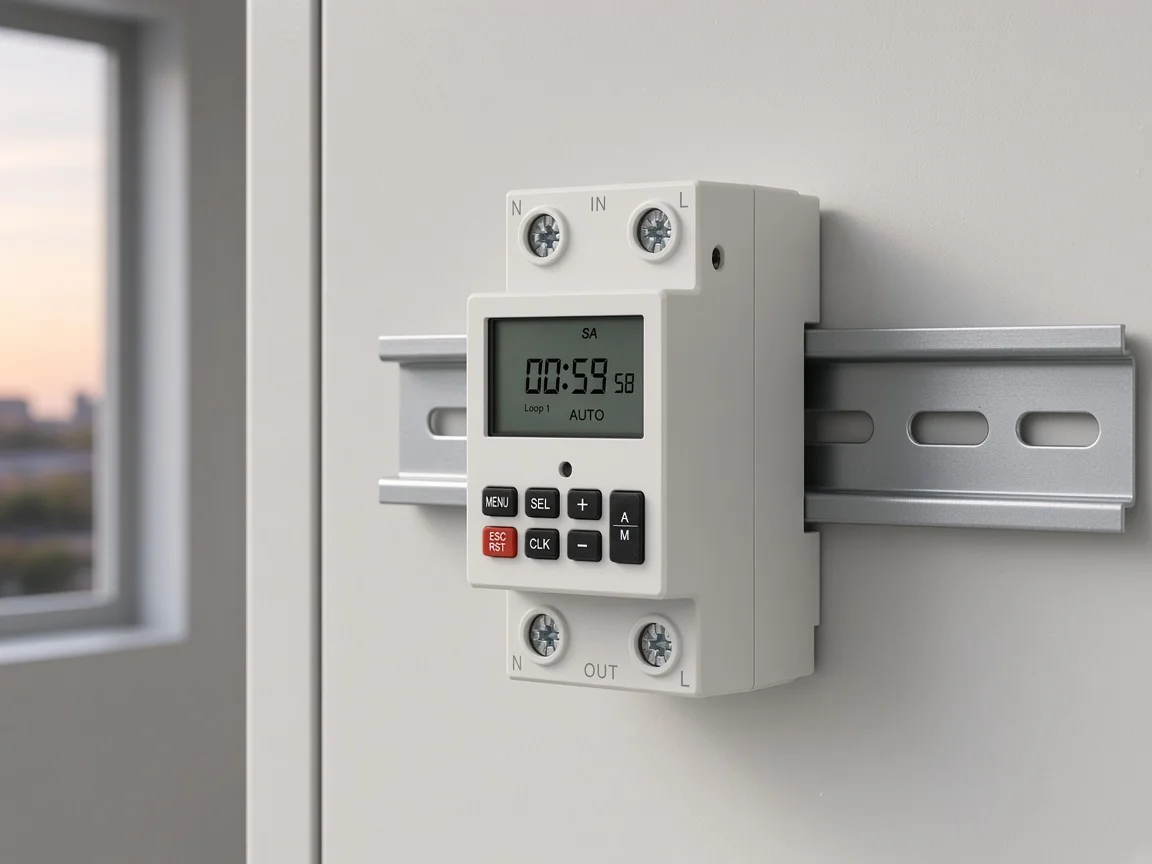
Bathroom-fan wall timers and some plug-in “minutes remaining” devices sit in this family for consumer installs. On the panel side, Yijin’s live YJDST-I digital countdown release page states countdown power-off for small circuit breakers, timing from 2 seconds to 99 hours 59 minutes 59 seconds, DIN-rail mounting, and AC 110 V–240 V 50/60 Hz ratings as printed.
Use countdown when the job is “run for N time after closing.” If the RFQ actually wants weekday schedules or seasonal dusk, move back to weekly digital or astronomical families instead of stretching a release into a clock.
Mechanical Dials and Plug-In vs DIN Form Factors
Mechanical dial timers set segments or pins on a rotating dial. Digital housings replace that dial with an LCD and keys. Both constructions can appear as plug-in, in-wall, or DIN-rail products.
Tip: Independent type explainers note that mechanical dials are pin-driven rotating mechanisms, while digital timers use a microcontroller and crystal time base — a useful construction split before you argue about plug-in versus DIN mounting — https://electrasim.com/blog/how-a-timer-switch-works-and-how-to-wire-one/
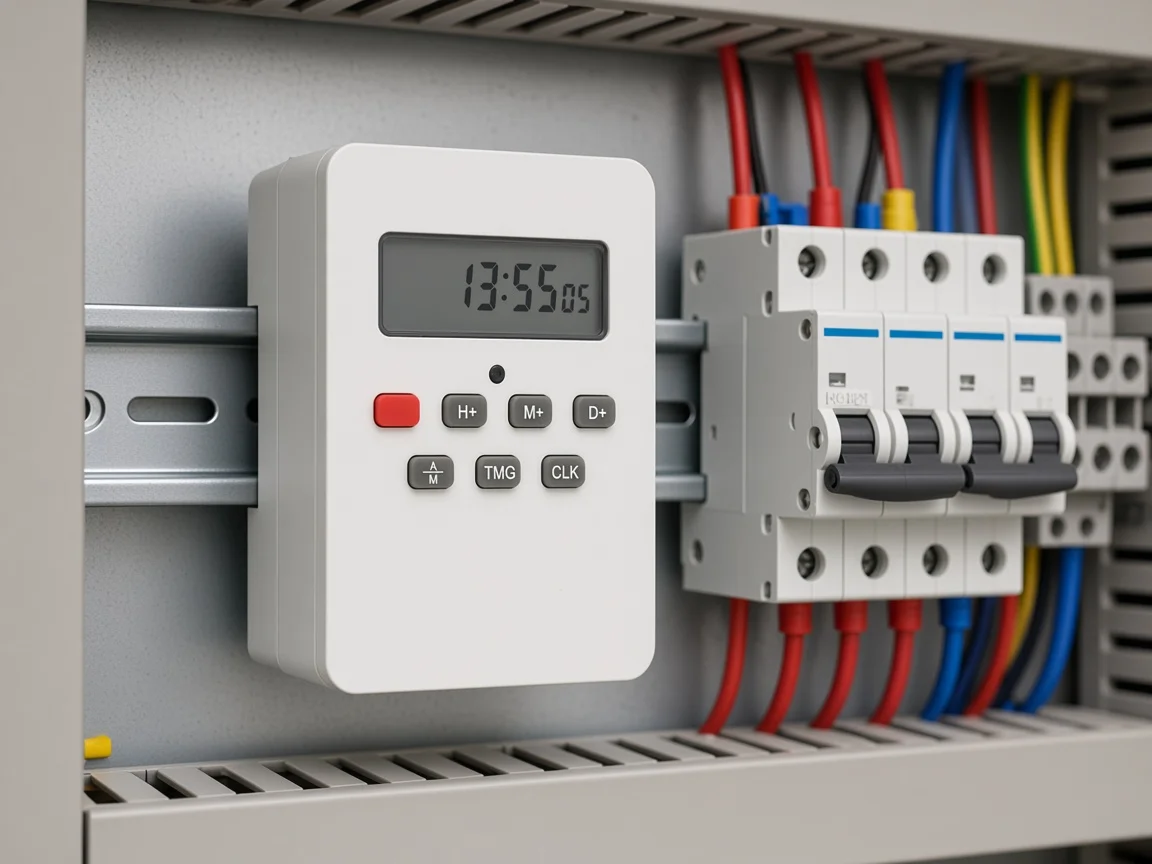
DIN-rail modules snap into distribution boards beside breakers and contactors. Plug-in timers sit on an outlet. In-wall timers replace a decorator switch.
Those form factors cut across weekly, astronomical, photocell, and countdown methods. A US wall-box listing is not the same shopping class as a DIN module whose product page prints dual high-voltage control-supply labels.
Choose a Yijin Timer Switch Product That Fits the Family Map
For a weekly digital DIN panel need, choose the KG316T time control switch as the primary recommendation on this types map.
| Yijin type lane | Live model to open first | What the live page is claiming |
|---|---|---|
| Weekly digital DIN | KG316T | Daily/weekly cycle; up to 16 on/off per day; 1 minute–168 hours; Auto/Manual; replaceable battery |
| Astronomical / lat-long | KG316TG lat-long modular | Enable lat-long; AC 187–240 V; 40 A / 63 A resistive options as listed |
| Countdown release | YJDST-I | Countdown after close; 2 s–99:59:59; DIN rail |
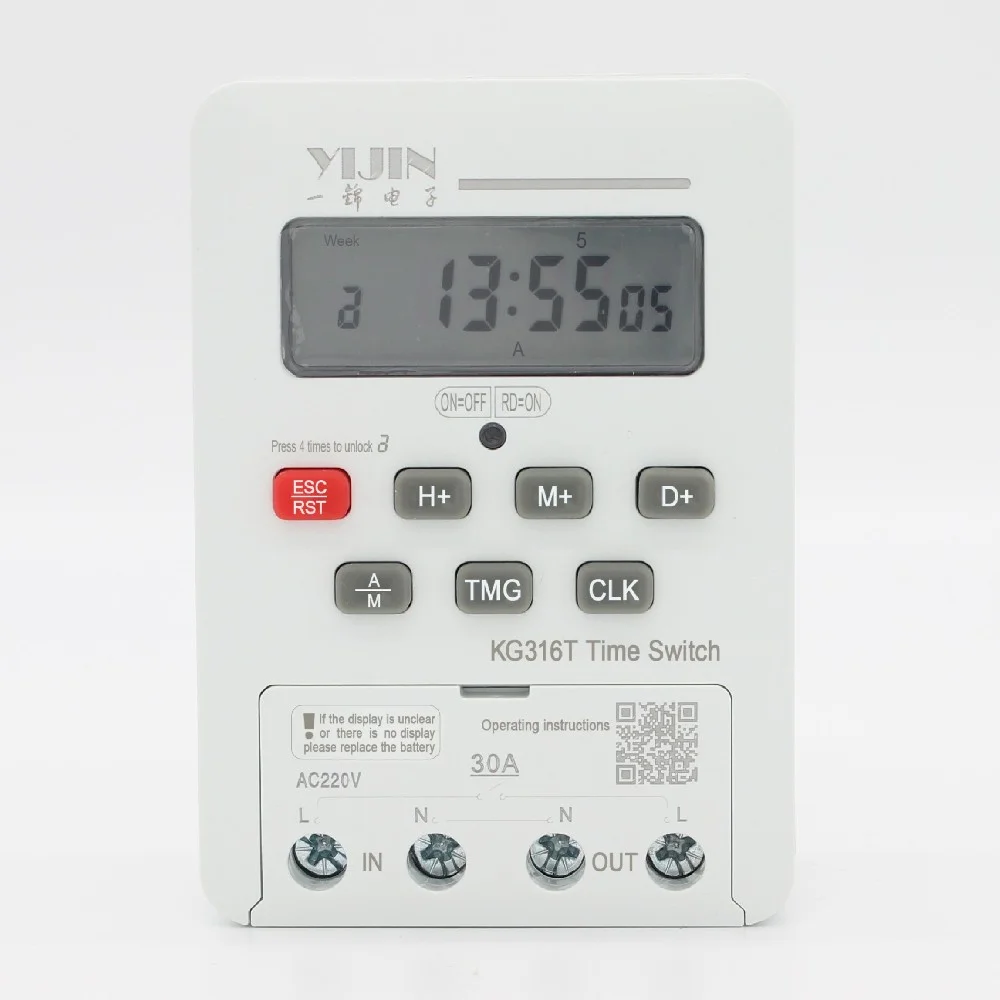
KG316T page labels also list control supply AC 50/60 Hz at 220 V and 380 V, enclosure IP50, daily timekeeping error within ±2 seconds, and load power figures of resistive 6 kW, inductive 1.8 kW, motor 1.2 kW, and lamp 0.9 kW. Those are printed page claims for that model. They are not a US 120 V wall-box listing, and they are not an UL or NEC approval statement.
Important: This article did not bench-test or field-test KG316T, KG316TG, or YJDST. Treat the numbers as live product-page claims, not as a firsthand review score. Source: https://yijinele-group.com/product/kg316t-time-control-switch/.
Name siblings honestly when the type requires them. Point astronomical dusk jobs to KG316TG. Point duration-after-close jobs to YJDST.
Keep the category hub at timer switch for the full family list, including the Wi-Fi adjacent SKU that is not the primary weekly recommendation here.
FAQ
What are the main types of timer switch?
The useful buyer map is weekly digital, astronomical or lat-long, photocell / light-sensing, and countdown, plus a form-factor axis for mechanical dials, plug-in, in-wall, and DIN-rail housings.
Mechanical vs digital timer switch — what actually differs?
Mechanical units set pins or segments on a dial. Digital units use a microcontroller and usually an LCD or keypad for finer schedules and, often, backup timekeeping after outages.
What is an astronomical or lat-long timer switch?
It calculates sunrise and sunset for a location so outdoor or sign circuits can track seasons without a photocell eye. Yijin’s lat-long modular page is the first-party example of that family.
How is a photocell different from a clock timer?
A photocell reacts to ambient light. A clock timer follows programmed hours. Photocells can false-trigger if the sensor sees the load or stray light.
Is a countdown timer the same as a weekly programmable timer?
No. Countdown times a duration after closing. Weekly digital stores clock-and-weekday ON/OFF events that repeat.
Are DIN-rail timers a separate type from plug-in or in-wall timers?
DIN rail is a mounting form factor. The same rail can host weekly digital, astronomical, or other timing methods. Do not treat “DIN” as one timing technology.
Which Yijin product fits a weekly digital DIN panel need?
Start with the KG316T time control switch for weekly/daily clock programs on DIN-style panel duty, then open KG316TG or YJDST only when the job is lat-long dusk tracking or countdown release.
Do Yijin dual-voltage page labels mean a US wall-box listing?
No. Treat those figures as the product page’s control-supply labels. They do not prove a US decorator wall-box listing or UL/NEC approval.
Does the IEC timers-and-time-switches standard prove a Yijin SKU is certified?
No. IEC 60730-2-7 names the timers and time switches product class. Repeating the standard name is not the same as claiming a listed certification for KG316T, KG316TG, or YJDST.
References
- IEC 60730-2-7:2015 — timers and time switches — product-class standard name for timers and time switches.
- How a Timer Switch Works — ElectraSim — mechanical, digital, and astronomical type mechanics; DIN vs plug-in form factor.
- Photocell vs Timer — Sirois Electric — ambient-light sensing versus clock-hour control language.
- Electrician Talk — timer — trade thread on choosing and troubleshooting field timer controls.