 Yueqing Yijin Electronics Co., Ltd.




What a 24 Hour Mechanical Timer Switch Actually Buys
A 24 hour mechanical timer switch is the peg-or-dial machine US catalogs still sell as a gray-box daily repeater: a motor turns a 24-hour face, and pins or trippers flip a contact. It is not an LCD weekday programmer, and it is not a Yijin first-party SKU.
The next sections unscramble that name, show where the mechanical class stops, and point repeating-clock buyers to the KG316T time control switch Yijin actually lists.
The Name Usually Means a Peg-and-Dial Daily Repeater
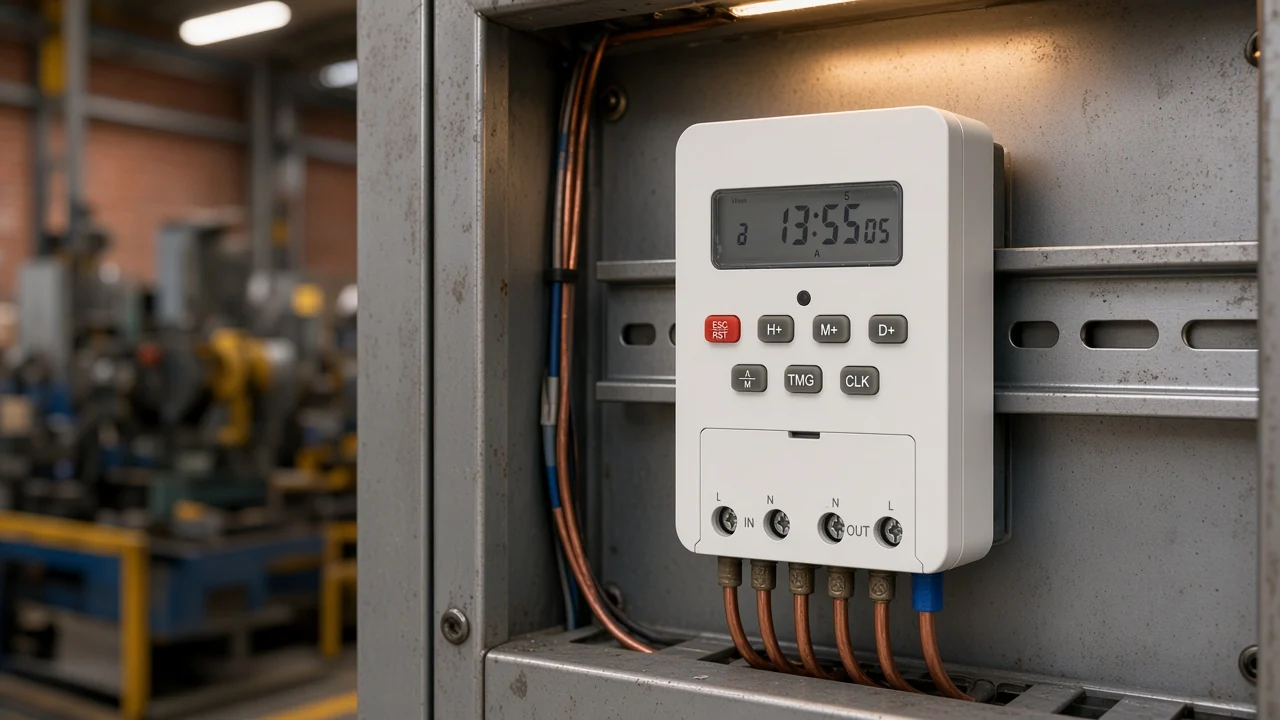
A 24 hour mechanical timer switch in US trade language is a motor-driven dial with pegs or trippers, not an LCD menu. Retail search still surfaces boxed time switches whose copy talks about segment pins, screw-on trippers, and a schedule that repeats daily.
“Mechanical” here names the electromechanical construction: a small motor turns a disc or drum once per day, and hardware on the rim physically operates the switch. Field threads still ask for a “24 hour clock” with extra ON/OFF pegs when the load is only a motor starter coil.
Tip: Independent explainers describe a 24-hour mechanical timer as a rotating disc driven by a synchronous motor, with pins that flip the contact as the disc turns — https://electrasim.com/blog/how-a-timer-switch-works-and-how-to-wire-one/
That is why a 24 hours timer switch manual for this class reads like a clock face, not a key map. You set time-of-day by aligning a pointer, then you mark ON and OFF on the rim. Trade electricians still treat T101/T104-class 24 hour clocks as that object, not as a digital weekly programmer.
The confusion is mostly lexical. Buyers hear “mechanical” and picture a kitchen wind-up, or they hear “24 hour” and picture any timer that can repeat a day. Hardware people mean the rim, the motor, and the contact.
If an RFQ lands with a photo of a lockable outdoor enclosure and a pair of brass trippers, you are looking at that class. If it lands with an LCD and a week-key, you have already left it.
What the Pegs Buy — Same Hours Every Calendar Day
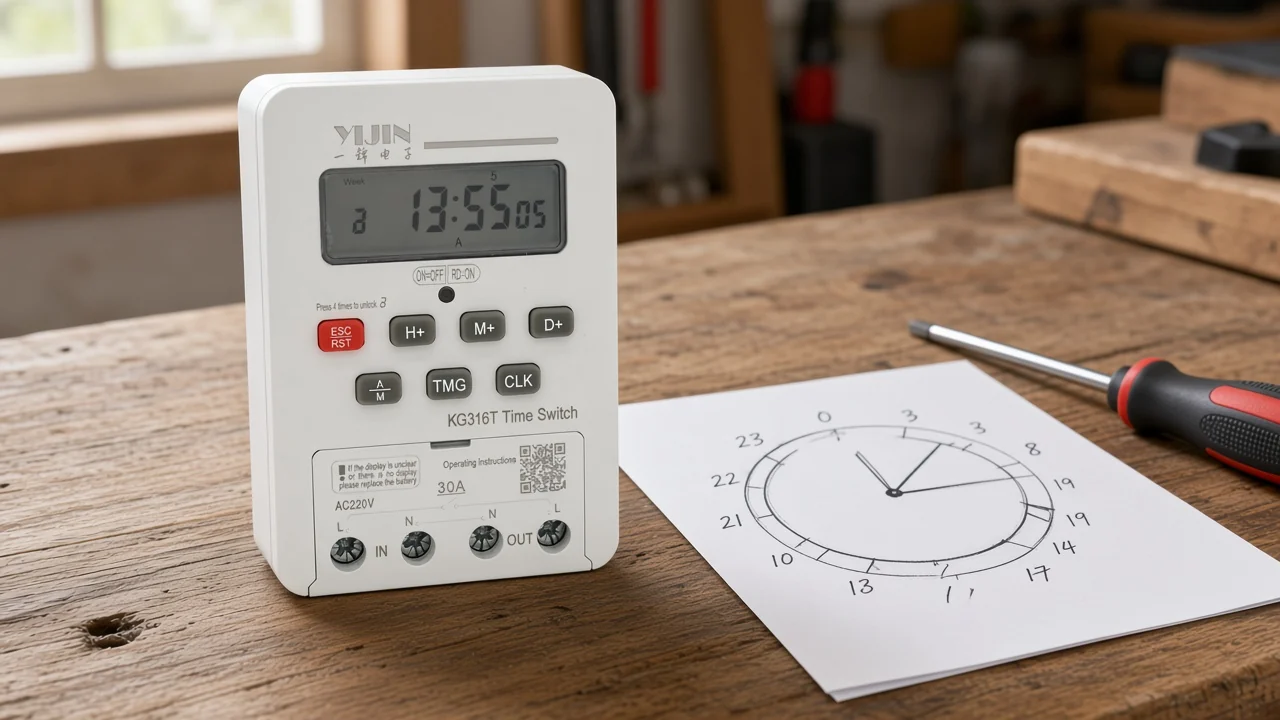
Pegs mark blocks on one 24-hour face, so the pattern repeats every calendar day. If you need lights off Saturday and on Monday at different hours, a basic 24-hour mechanical dial has nowhere to store that difference.
The job the pegs actually buy is visual and coarse. You can see the whole day at a glance. You cannot hide a weekday exception without changing the pegs by hand.
| Buyer asked for | Mechanical 24-hour peg/dial class | Digital stored program |
|---|---|---|
| Same on/off every calendar day | Native job of the 24-hour face | Possible as a daily cycle |
| Different Saturday vs Monday | Not on a basic 24h dial | Weekly cycle / day groups |
| Minute-exact event | Usually a 15 to 30 minute pin grid | Often 1 minute class |
| After a power cut | Reset time-of-day on typical mains motors | Program memory often kept on a backup cell |
Some US pin dials advertise up to 24 on/off settings per day in 30 minute intervals that repeat daily. That is still one calendar-day tape, not a 7 day weekly programmable timer switch.
If the RFQ is “run the sign 18:00–23:00 every night,” pegs can express it. If the RFQ is “weeknights only,” you have already left the basic 24-hour mechanical class.
Procurement still sends that second RFQ under the first name. The pegs cannot remember Saturday. Someone on site has to move them, or the load runs the weekday pattern on Sunday too.
Where a Mechanical 24-Hour Dial Stops
Coarse pin grids, no weekday memory on basic 24h dials, and time-of-day drift after an outage. Those three limits are why the retail name keeps disappointing digital-program buyers.
Analog pin positions typically sit on a 15 to 30 minute grid. You cannot schedule an exact 06:17 ON on that class of drum; you pick the neighboring pin.
Some tripper boxes are coarser still. T100-series mechanical time switches are documented with up to 12 ON/OFF operations per day and a minimum of one hour between ON and OFF on that series.
From the field: Electricians still specify a “24 hour clock” mechanical timeclock with extra ON/OFF pegs when the load is only a motor starter — https://www.electriciantalk.com/threads/which-intermatic-timer-do-i-need.59315/
Typical mains-driven mechanical timers stop with the motor when power dies. After restoration you reset the dial to the correct time-of-day; the pegs themselves usually stay where you left them.
A spring-reserve mechanical clock exists in the wider market. Yijin does not publish one, so do not treat KG316T as a wind-up reserve.
A Digital Daily Program Is a Different Machine
Stored clock events (often 1-minute, optionally weekly) are not pegs on a disc. Calling both objects “24 hour” is the collision that sends the wrong drawing to a factory.
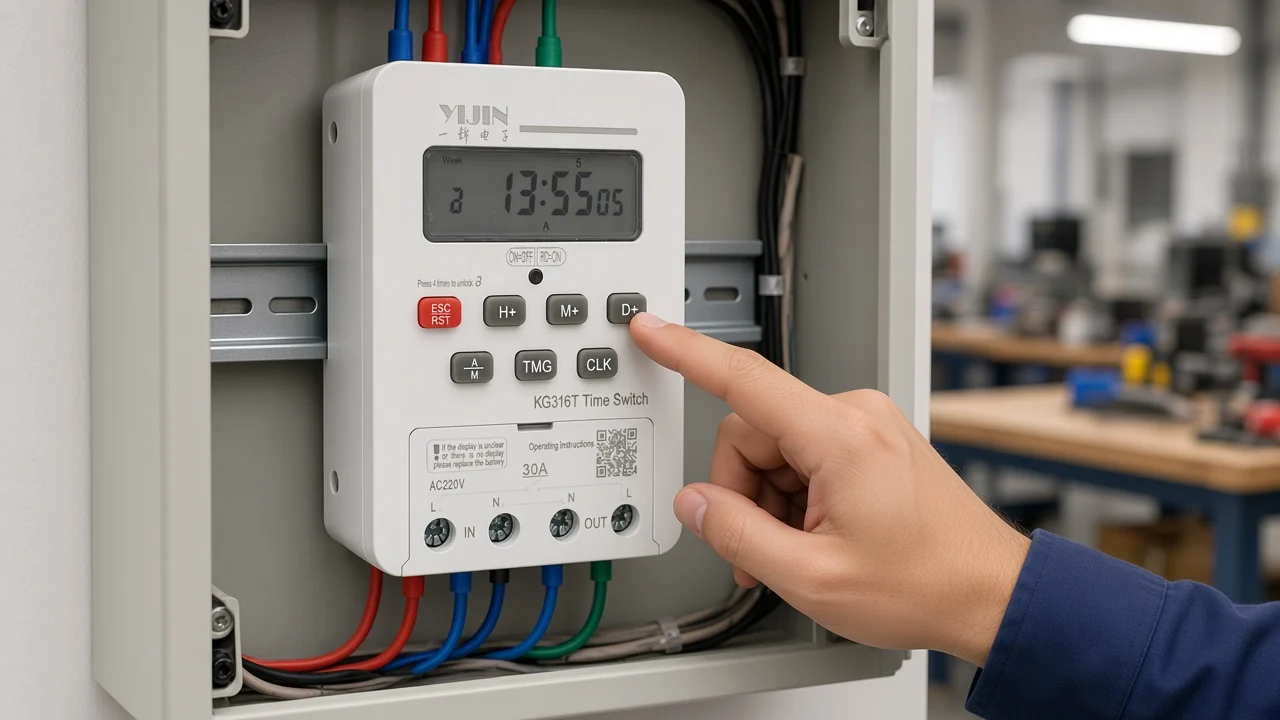
A digital time switch keeps time with a microcontroller and a crystal, then drives a relay. You enter ON and OFF as clock values, and many units let you attach those values to weekdays. That is a 7 day weekly programmable timer switch job, even when you happen to copy the same pair onto every day.
Countdown releases and astronomical/lat-long modules are different jobs again. They belong on Yijin’s timer switch hub and on the types of timer switch family map, not inside this name-decoding piece.
If you already know you want weekday grouping and leftover-event hygiene, use the 7 day weekly programmable timer switch specify article. Keep this page for the myth that “mechanical 24 hour” and “digital 24 hour” are the same hardware.
Yijin Does Not Catalog a Peg Wall Timer
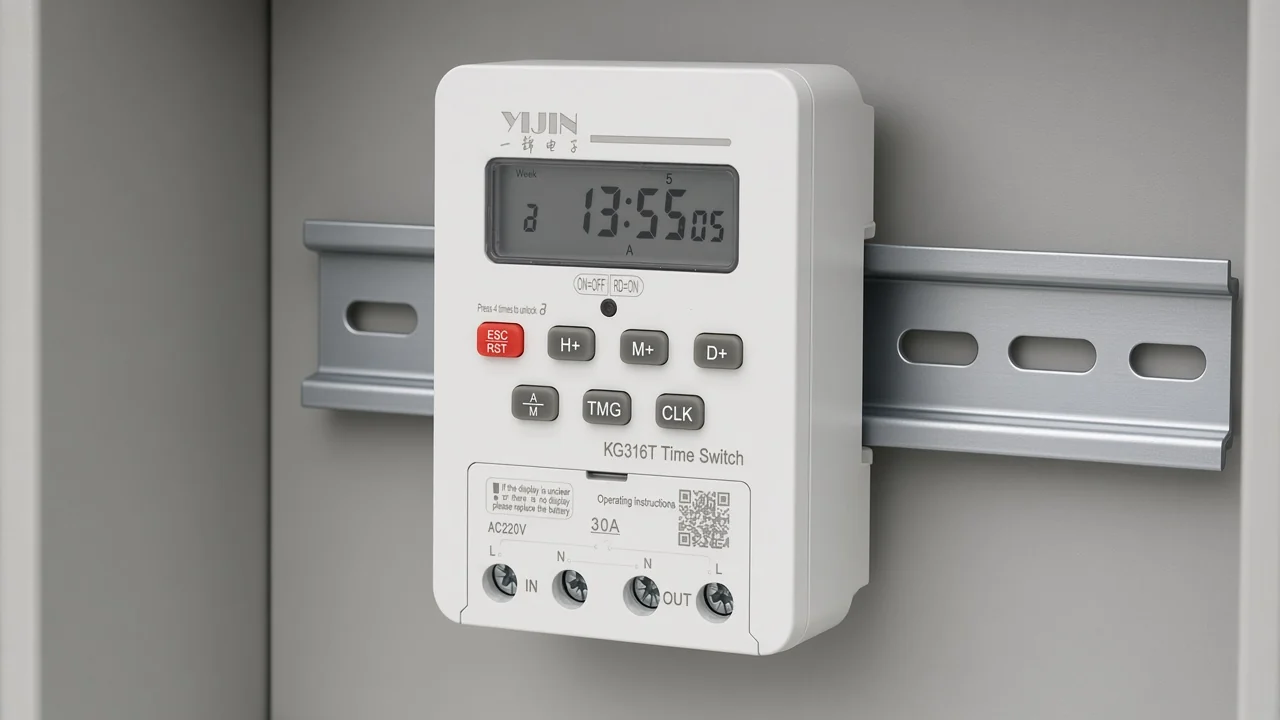
Live Timer Switch SKUs are digital time-control and countdown units. The live Timer Switch category lists KG316T, two KG316TG36mm modules, a Wi-Fi time-control switch, and YJDST countdown releases — no peg-and-dial wall timer.
That is the honesty cut US shopping SERPs never make. Home-center cards will happily sell a 120 V SPST box with segment pins. Yijin’s English catalog does not.
Do not translate a Woods- or Intermatic-style gray box onto a Yijin quote. Do not treat 220 V / 380 V page labels as a US 120 V in-wall listing, UL mark, or NEC approval. Those listings were not on the live KG316T page.
That boundary matters for US English B2B quotes. A panel builder can still use a digital DIN time-control switch on a control circuit. That is not the same paperwork as a listed 120 V in-wall mechanical timer from a US electrical distributor.
Product Recommendation: KG316T Digital Daily and Weekly Control
KG316T is the digital daily/weekly program substitute, not a mechanical peg timer. Use it when the reader’s real need is repeating clock on/off on a control circuit, and you can accept LCD keys instead of a rim of pins.
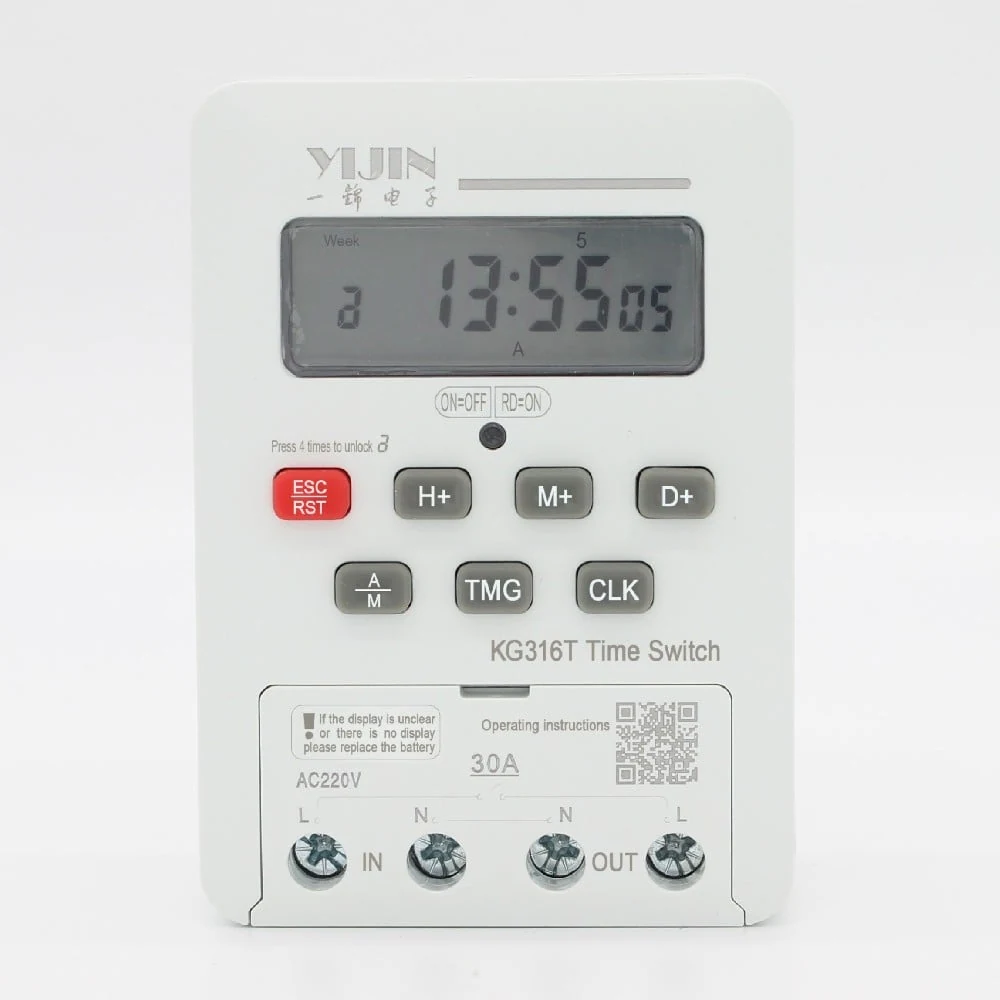
The live KG316T time control switch page states that switching times can repeat on a daily or weekly cycle. It allows up to 16 on/off actions per day. The minimum setting is 1 minute and the maximum setting is 168 hours.
| Peg-timer RFQ language | What KG316T’s page actually prints |
|---|---|
| Visual 24-hour peg dial | LCD, Timer / Set Week / Set Hour / Set Minute / Clock / Auto/Manual keys |
| Same hours every day | Daily cycle is a published option |
| Different days of week | Weekly cycle is a published option |
| Coarse pin blocks | Minimum setting 1 minute |
| Mains motor, reset dial after outage | Replaceable No. 7 / AAA battery; daily timekeeping error ≤ ±2 seconds |
Rated control supply voltage on that page is AC 50/60 Hz at 220 V and 380 V. Enclosure protection rating is IP50. Load-power labels are resistive 6 kW, inductive 1.8 kW, motor 1.2 kW, and lamp 0.9 kW.
Rated insulation voltage Ui is AC380V. Rated impulse withstand voltage Uimp is AC1.5kV. Ambient operating temperature is −5 ℃ to +40 ℃, with altitude ≤ 2000 m.
Mechanical life is ≥ 1,000,000 cycles. Electrical life is ≥ 100,000 cycles. The keyboard locks automatically for 15 seconds when unused.
Important: This is not a bench test or a product review, and KG316T is not sold here as a peg-and-dial wall timer — https://yijinele-group.com/product/kg316t-time-control-switch/
Skip KG316T when the specification sheet truly requires a visual peg dial, screw-on trippers, or a listed US 120 V mechanical box. Quote the printed daily/weekly fields instead of attaching a competitor tripper drawing.
Set unused event slots to the blank “–: –“ display the page describes, then place Auto after a manual off. Leftover ON events are a digital problem, not a peg problem, and they still waste a night-shift callout.
FAQ
What is a 24 hour mechanical timer switch?
It is an electromechanical daily time switch: a motor turns a 24-hour dial, and pins, segments, or trippers operate the contact. US retail copy still uses that name for boxed tripper timers.
Do mechanical timer plugs require being reset every 24 hours?
No. “Mechanical” refers to the switches and the geared dial, not a one-day wind-up that you must repeat. The usual reset is after a power outage, when time-of-day has drifted.
How do you set a 24 hour mechanical timer switch?
Align the pointer to the current time, then push pins or place ON/OFF trippers at the hours you want. Leave the manual lever in the timed position so the rim, not the override, runs the load.
What happens if power goes out on a mechanical 24-hour timer?
On typical mains-driven units the motor stops, so the clock is late by the outage length until someone resets the dial. Pegs usually stay; the clock does not.
Is a digital 24-hour program the same as a mechanical dial?
No. A digital program is stored clock events, often with 1-minute resolution and weekday grouping. A mechanical 24-hour dial is a physical rim that repeats one calendar day.
Does Yijin sell a mechanical 24 hour peg timer?
No. The live Timer Switch category lists digital KG316T-family time-control switches and YJDST countdown releases, not a peg wall timer.
Can KG316T replace a repeating 24-hour on/off need?
It can replace the clock schedule when you accept LCD daily or weekly programming, up to 16 events per day, and 1-minute settings. It does not replace peg-dial hardware or a US 120 V listed box.
Does IEC 60730-2-7 prove a Yijin SKU is certified?
No. IEC 60730-2-7:2026 names particular requirements for timers and time switches as a product class. It is not a KG316T certificate on Yijin’s product page.