 Yueqing Yijin Electronics Co., Ltd.




Can an AC Contactor Be Used for DC Loads?
No — do not treat a household AC modular sheet as a DC contactor. When buyers ask can ac contactor be used for dc, the honest fork is simple: use the AC contactor where AC control voltage and AC load categories match the printed sheet, and shortlist DC-rated switching or protection hardware for a true DC-duty ask. The sections below separate arc physics, utilization language, coil Us match, the YJC1 AC fit, and a DC navigation path that does not invent contactor DC ratings.
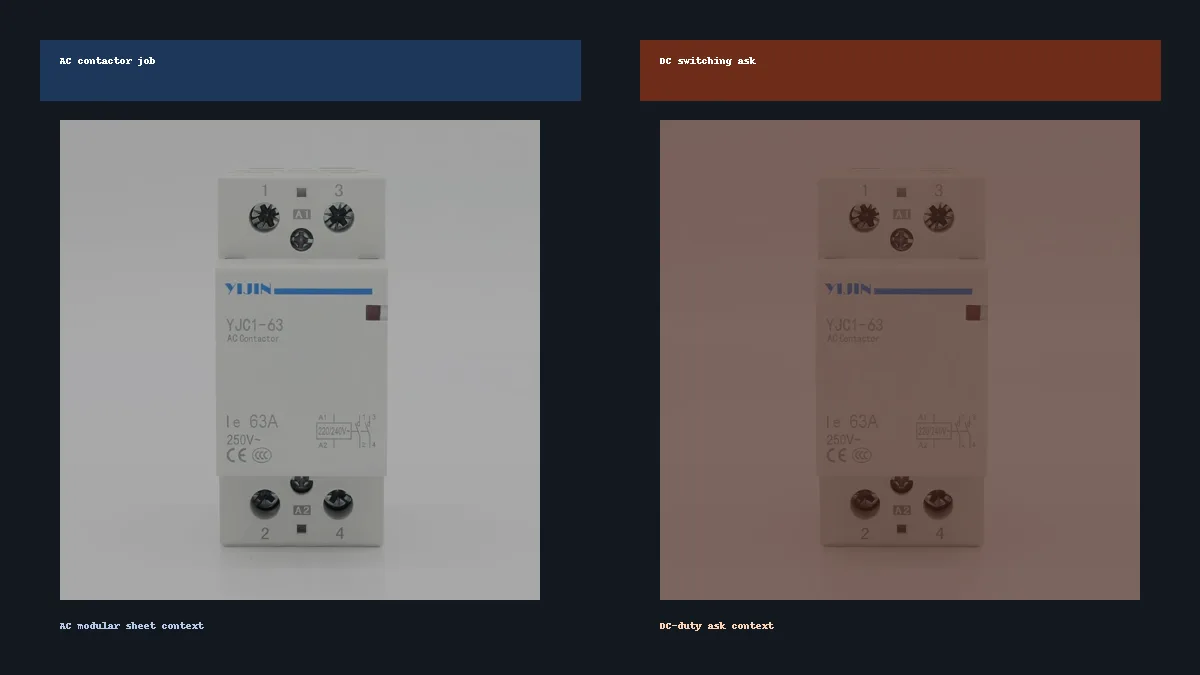
AC modular contactor sheets versus a DC-duty ask
An AC modular contactor sheet is built and labeled for alternating-current duty. A DC-duty ask — a DC load / DC circuit on the poles — means the contacts must make and break a unidirectional current without the AC waveform’s help. Searchers who type AC contactor for DC are usually stuck on that energy-form fork.
| Decision | AC modular contactor sheet | DC-duty ask |
|---|---|---|
| Energy form on the main poles | AC line / AC load | DC bus, battery, PV DC string, DC heater, DC motor |
| What the stamp must show | AC voltage, AC utilization category (for example AC-7a), coil Us | Printed DC voltage/current and DC utilization or DC device rating |
| Honest shortlist here | Household modular AC contactor on the contactor hub | DC-rated contactor alternative (when offered) or DC-rated protection such as a DC miniature circuit breaker family |
| Common failure mode | Treating “same amp stamp” as interchangeable across AC and DC | Forcing an AC body onto DC and hoping informal derates are enough |
In United States / English B2B procurement, that energy-form check is market context before anyone debates brand or rail width. Amp numbers that look familiar on an AC nameplate are not a license for DC interrupt.
Yijin’s live contactor hub is the AC modular contactor aisle for this site. It is not a DC contactor catalog.
Why AC zero-crossing does not save a DC break
AC arcs usually die at a zero crossing of the waveform. Arc / zero crossing behavior is why AC and DC contact sheets are not interchangeable. DC has no periodic zero, so an arc drawn when contacts open can persist, heat the poles, weld them, or start a fire.
Independent lab guidance on contactors used with DC supplies states that AC relay specifications do not imply similar DC performance, and that using an AC contactor to break a DC load risks fire or other catastrophic damage because the arc can persist indefinitely.
Tip: Contactors used with DC power supplies or loads must be specifically rated for DC operation; do not infer DC break capability from an AC stamp alone. Source: https://www.keysight.com/sg/en/assets/3124-1561/application-notes/Contactors-and-Power-Supplies.pdf
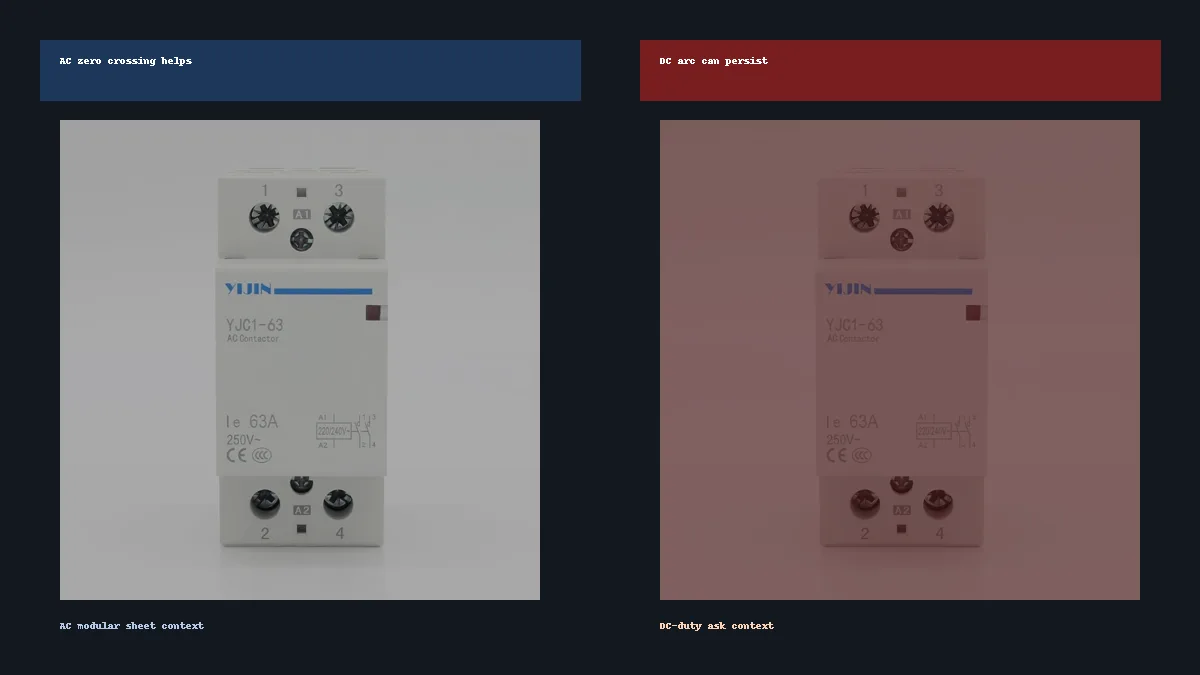
Community engineering threads make the same point without offering a safe universal conversion: the AC rating and the DC rating rely on different contact qualities, and a casual “about one-tenth the AC voltage” rule is not a general selection method.
AC-7a on the sheet is not a DC-1 license
Utilization categories describe the load duty the device was tested for. Utilization category AC-7a is a slightly inductive household / similar AC category — that is what an AC-7a contactor stamp means. Utilization category DC-1 / DC-3 language covers separate DC tables: DC-1 for non-inductive or slightly inductive DC loads and DC-3 for shunt-motor style DC duty when a manufacturer publishes DC main ratings.
A distributor FAQ on AC-1 / AC-3 starters and contactors lists clear reasons not to place an AC-rated contactor in a DC system: the manufacturer did not specify that duty, make/break expectations are harder on DC, and the AC body is not the arc-suppression design you need for DC.
If the sheet in front of you prints that household AC category and AC working voltage, read that as an AC remote-switch / main-circuit-control class — not as silent approval for those DC categories.
Coil Us match is not a DC contact license
Matching the coil supply to control voltage Us answers only the magnet side of the device. It does not rate the main poles for DC load current.
Field and forum questions often split into two different problems: (1) can I energize an AC coil from a DC control supply, and (2) can those contacts interrupt DC. Even when a coil can be made to pull in on DC with special care, AC contactors remain limited for switching DC current. Treat coil experiments and contact energy-form ratings as separate RFQ lines.
On a household modular AC sheet, the useful coil question is whether the control supply sits inside the printed Us close and release window for AC control — not whether the coil “kind of worked” on a bench DC supply.
Selection checklist before you shortlist hardware
Match energy form first, then category, then coil, then form factor.
- Energy form on the poles — AC load on AC sheet; DC load needs printed DC ratings.
- Utilization category — household AC class for AC duty; look for printed DC categories or an explicit DC device rating when the bus is DC.
- Control Us — coil supply inside the printed Us window for the magnet you actually ordered.
- Reject informal shortcuts — no universal AC-to-DC amp conversion; paralleling or seriesing poles does not automatically create a DC-rated break path.
- Form factor last — DIN rail TH35-7.5 width can be shared by AC contactors and DC MCBs; the rail does not change the energy form.
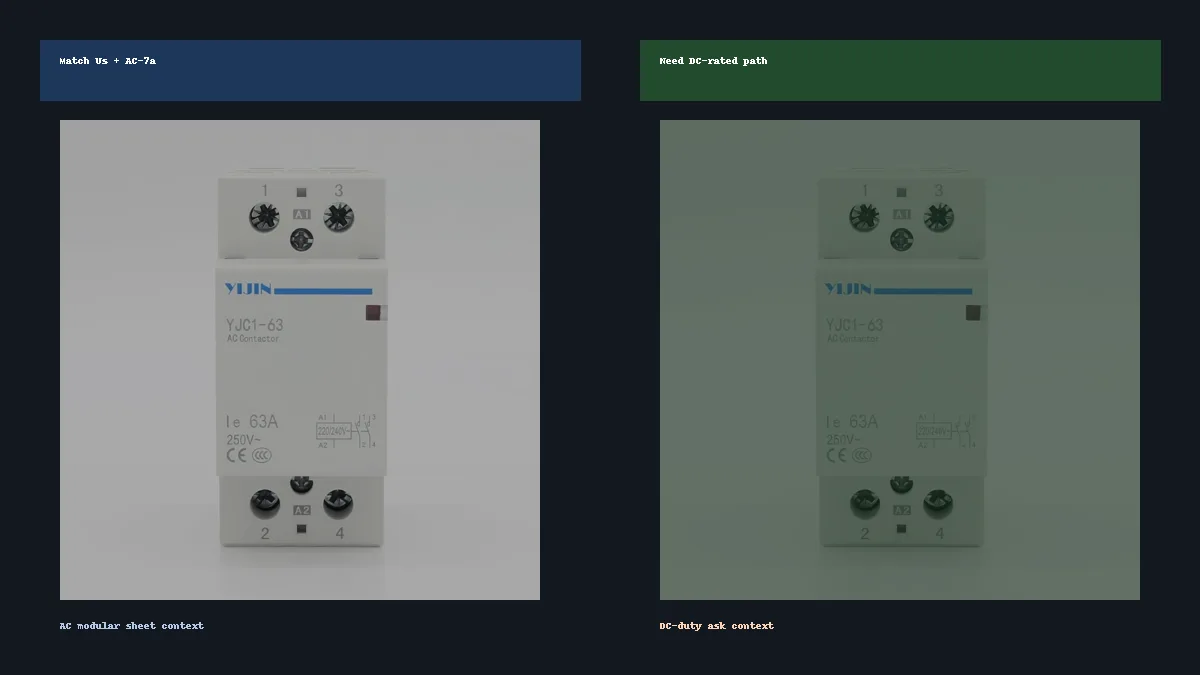
From the field: Working engineers on public threads reject a general “convert AC rating to DC” rule of thumb — if the manufacturer did not print a DC spec, do not invent one for production panels. Source: community language retained in research (Reddit AskEngineers / PLC threads; automated fetch often blocked; not linked here).
Product fit: YJC1-63 when the job stays AC modular
The YJC1-63 2P modular AC contactor fits when your job is household modular AC remote switching / main-circuit control under the printed AC sheet — not when you need a DC contactor.
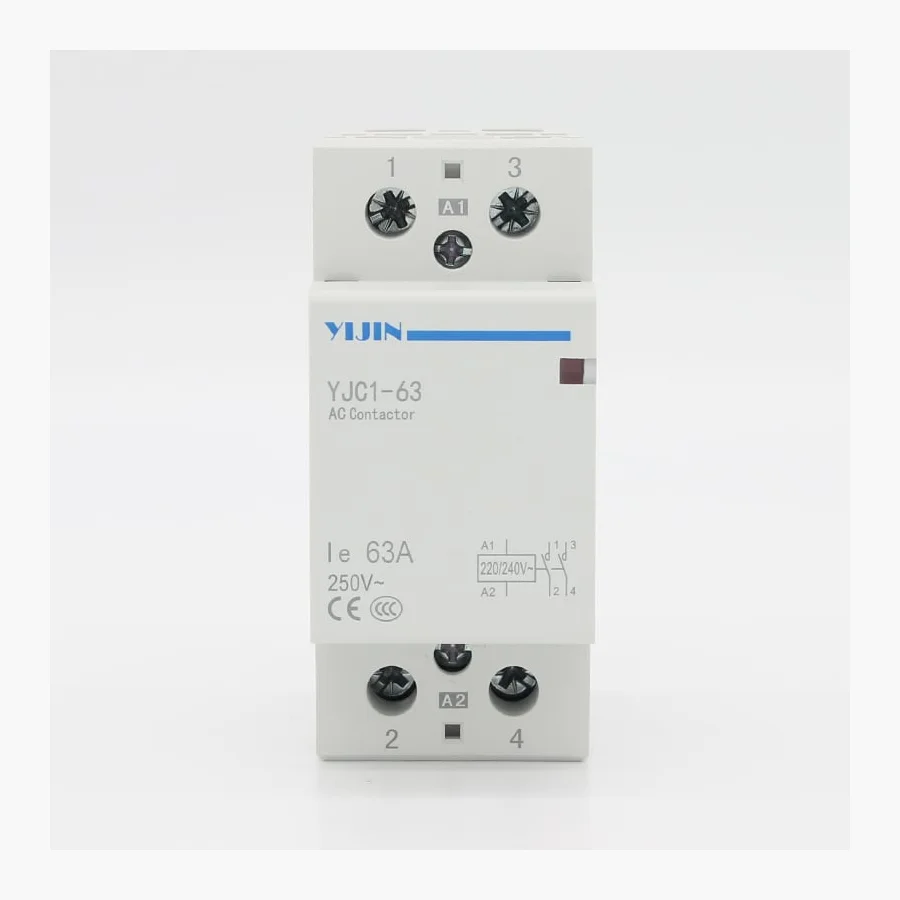
Live product prose frames the YJC-120/25/63 household AC contactor for power systems with AC 50 Hz (or 60 Hz) and a rated working voltage of 230 V. Under the AC-7a usage category it is used as a remote switch and main circuit control in circuits with rated working voltage up to 230 V for household appliances and similar applications. The page states compliance with GB17885 and IEC1095, mounting on a TH35-7.5 rail, a mechanical lifespan of not less than 1 million cycles, and an electrical lifespan of not less than 100000 operations.
| Printed item | YJC1-63 sheet (live page) |
|---|---|
| System frequency | AC 50 Hz (or 60 Hz) |
| Working voltage context | 230 V AC |
| Utilization category | AC-7a |
| Standards named | GB17885 and IEC1095 |
| Rail | TH35-7.5 |
| Coil Us close window | Reliably closes within (80%–110%) Us after the coil is heated to a stable state in the stated ambient range |
| Release voltage bounds | Not higher than 75% Us and not lower than 20% Us |
| Mechanical / electrical life | ≥1 million cycles / ≥100000 operations |
That is an AC modular selection path. It is not a claim that YJC1 is a DC contactor, UL Listed for US DC distribution, or dual-rated for DC contact break.
Open the contactor hub when the RFQ stays on AC modular duty and the printed Us window plus household AC category match the cabinet.
When the ask is DC-duty: shortlist DC-rated devices
If the poles must interrupt DC, leave the AC modular contactor sheet and shortlist hardware that prints DC ratings.
On this site, navigation honesty for DC protection points to the circuit breaker hub — a DC-oriented breaker aisle — and to sheets such as the YJB1Z-63 small DC circuit breaker. Live YJB1Z-63 prose covers circuits rated 63 A and below with DC rated voltage of 250 V and 440 V for overload and short-circuit protection in DC distribution systems, polarity “+” / “−” wiring attention, a permanent-magnet arc-extinguishing design with 10 kA short-circuit capacity language, TH35-7.5 mounting, and GB10963.2 / IEC60898-2. That is a DC MCB protection shortlist, not an invented DC contactor rating for YJC1.
If the project truly needs a DC-rated contactor (load switching under a DC utilization category), require a device page that prints those DC contact ratings. Do not relabel a household AC modular contactor to fill the gap.
Misfits that break the compatibility expectation
These shortcuts break the AC-sheet-versus-DC-duty compatibility ask and should be rejected before an RFQ ships.
Walk away from the following:
- Treating YJC1-63 as a DC contactor because it shares a DIN-rail form factor with DC devices.
- Informal “derate to twenty percent” or “one-tenth voltage” rules used as if they were manufacturer DC ratings.
- Assuming series or parallel poles create a DC break rating the sheet never printed.
- Confusing coil-on-DC bench tricks with contact DC interrupt capability.
- Cloning shopping or troubleshooting sisters (single-phase buyers guides, terminal maps, buzzing / not-pulling-in / missing control-voltage symptoms) when the real question is AC sheet versus DC-duty compatibility.
Keep the AC modular sheet for AC Us and household AC-category jobs. Keep DC-duty asks on DC-rated devices.
FAQ
Can an AC contactor be used for DC?
Not as a drop-in. Use an AC contactor where the printed AC voltage, AC utilization category, and Us window match. For DC contact switching or DC protection, shortlist devices that print DC ratings.
Why do AC contactors struggle on DC loads?
DC has no periodic zero crossing to help extinguish the arc, so contacts can weld or overheat when an AC body tries to break DC.
What does AC-7a mean on a household modular contactor?
AC-7a is a slightly inductive household / similar AC utilization category. It is not a DC-1 or DC-3 rating.
Can I power an AC contactor coil with DC?
That is a separate coil-supply problem from contact DC switching. Even if a coil can be forced to pull in, it does not license the main poles for DC interrupt. Prefer matching the printed Us window for the coil you ordered.
Does wiring poles in series make an AC contactor DC-rated?
No. Without a manufacturer DC rating for that connection method, series or parallel poles are not a substitute DC utilization category.
When should I open the DC breaker hub instead of the contactor hub?
When the job is DC distribution overload/short-circuit protection or any DC-duty ask that the AC modular contactor sheet does not print. Start at the circuit-breaker hub and read DC MCB sheets such as YJB1Z-63 for printed DC voltage, current, polarity, and interrupting language.
What Us window does YJC1-63 print?
After the suction coil is heated to a stable state in the stated ambient range, the contactor is described as reliably closing within (80%–110%) Us, with release voltage not higher than 75% Us and not lower than 20% Us.
Does the YJC1 page claim UL Listed DC use?
No. Quote only the printed AC scope, AC-7a, Us window, life figures, rail, and named GB/IEC standards. Do not invent UL or NEC compliance language.