 Yueqing Yijin Electronics Co., Ltd.




Wall digital labels vs rail clock events
A digital timer programmable time switch in US shopping language often means an in-wall LCD timer, while the KG316T page describes a DIN-rail weekly clock.
The wall digital replaces a decorator switch. The rail weekly clock stores panel events on a DIN module.
US buyers often mean an in-wall digital timer
US retail copy for this query usually points to plug-in or in-wall digital lighting timers with seven-day programming. Catalog photos of blank DIN modules sit in a different shopping class.
A time switch is a device that operates an electric switch controlled by a timer, and electronic versions store schedules in semiconductor timing circuitry.
Digital in-wall timer switches with a battery for uninterrupted timekeeping are a recognized wall-box form, so name the machine before anyone quotes a SKU.
From the field: An electrician installing four digital timer switches that required a neutral saw them chatter on fluorescent loads and asked whether to pick a different switch or “go with a time clock.” Source: Mike Holt Forum — digital timer switch turning off and on.
That thread treats a “digital timer switch” as an in-wall device. The “time clock” alternate opens the panel conversation.
Procurement teams that buy for both apartments and plant rooms hear the same retail phrase twice.
One request wants a hallway LCD faceplate. The other wants a board-mounted weekly clock for signs or process loads.
Separating those requests early saves a wrong SKU on the quote.
| Label on the quote | What the buyer usually gets |
|---|---|
| In-wall LCD, needs neutral | Decorator digital timer |
| Plug into an outlet | Plug-in lamp timer |
| Set Week / Set Hour keys on a rail module | Weekly stored clock events |
Plug-in, wall box, or DIN-rail time switch
Mounting class decides the shopping aisle before brand names do.
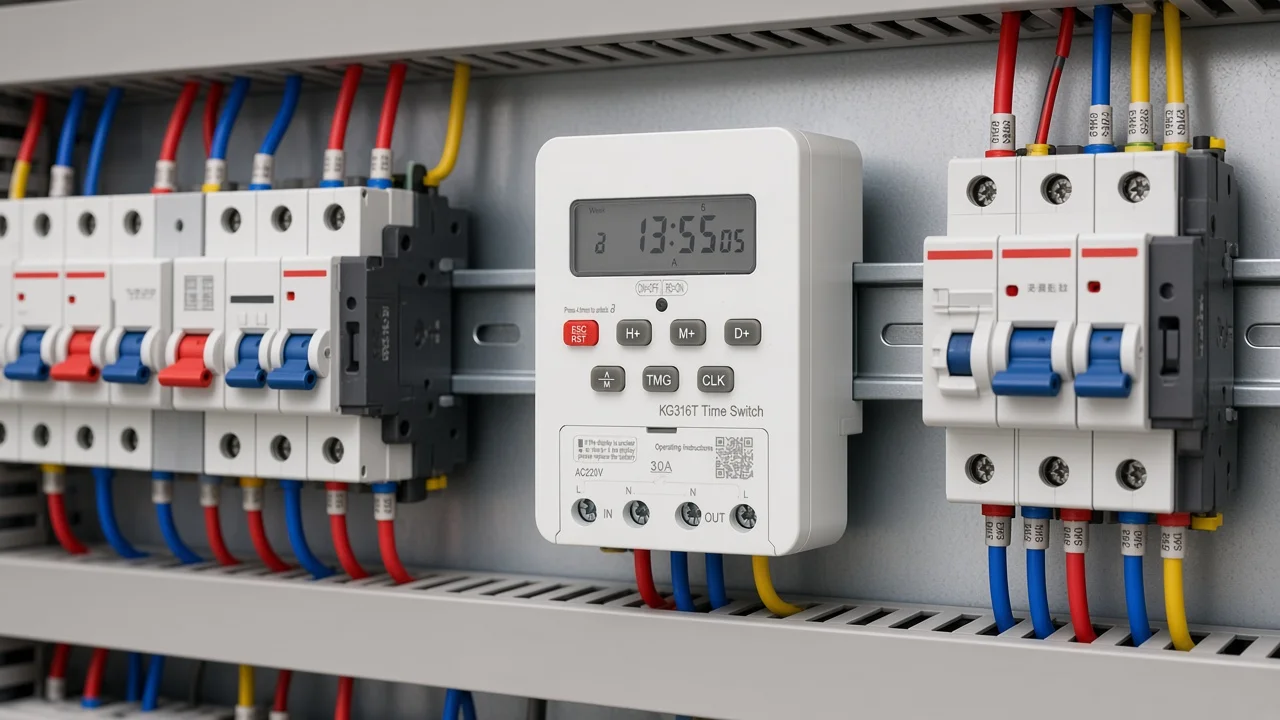
A plug-in timer sits on an outlet. An in-wall digital timer hardwires into a wall box and may need professional installation. A DIN-rail time switch snaps into a distribution board or control cabinet.
Panel builders snap modular timers onto a standardized top-hat rail that shares the board with breakers and contactors.
The common top-hat rail follows IEC/EN 60715 at 35 mm width, so the clock module stays in the distribution board instead of a decorator cover plate.
| Form factor | Typical place | What to check first |
|---|---|---|
| Plug-in timer | Outlet | Plug standard, wattage, indoor use |
| In-wall digital timer | Wall box | Neutral, box depth, load rating |
| DIN-rail time switch | Panel / cabinet | Module width, control supply, contact rating |
Selection guides keep wall timer switches for lighting and fan circuits, and DIN-rail timers for boards and OEM panels. The word “digital” alone does not prove either mount.
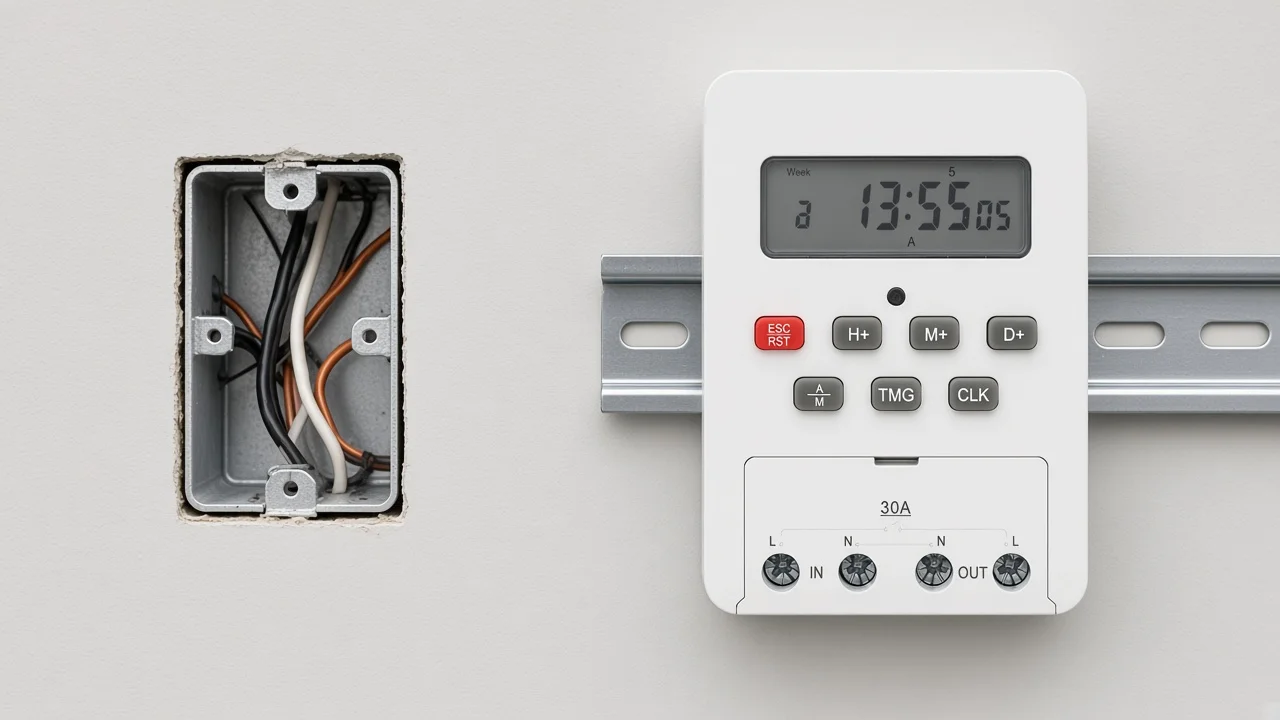
Digital minute programs vs mechanical pins
Digital schedules can hit the minute. Mechanical dial pins usually cannot.
A mechanical time switch in analog form uses a rotating drum with removable cam pins, and program resolution is typically fifteen to thirty minutes per pin position.
Digital electronic time switches use a quartz clock with an LCD display and pushbutton programming, with one-minute granularity common on weekly models.
Digital units can store many independent on/off commands across weekdays. Peg-and-cam drums stay limited by circumference and fiddly adjustments.
Use mechanical pins when the job is a simple repeating daily pattern and operators want a visual drum. Use a digital weekly clock when weekday and weekend rows differ, or when a one-minute edge matters.
Key-by-key programming steps stay on the product sheet. Here the only job is the resolution contrast.
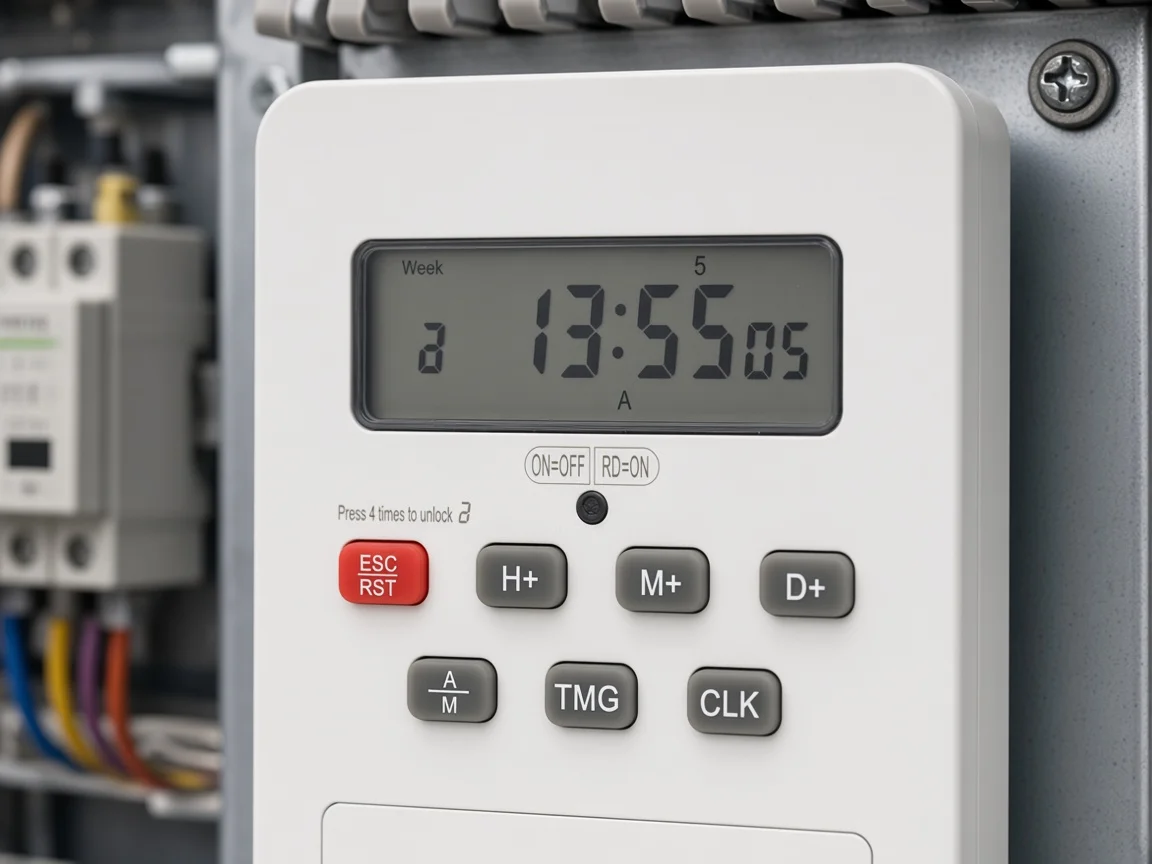
Weekly stored clock events are a panel job
A wall digital often replaces one switch on one lighting circuit. A rail weekly clock stores a weekly programmable schedule for panel control circuits.
Cyclical timers commonly use a twenty-four-hour or seven-day period, then repeat. That is schedule storage rather than a one-shot decorator countdown.
Indoor or panel timers can own lighting schedules without living outdoors. Community answers sometimes steer dusk goals toward an indoor timer with override instead of a weather-exposed photocell alone.
| Job story | Wall digital default | Rail weekly clock |
|---|---|---|
| Replace a hallway switch with a 7-day LCD | Fits the wall-box class | Wrong enclosure |
| Sign or process loads on a weekday table | Overkill in a decorator box | Fits panel control |
| Keep the timer out of weather | Possible with indoor wall units | Panel enclosure path |
When the operator language is “different Mon–Fri and weekend rows,” you are already in weekly stored clock events. When the language is “swap this Decora switch for an LCD,” stay in the wall-box aisle.
A sign contractor who needs lights off after midnight on weekdays and off earlier on Sundays is already describing a weekly programmable schedule. That schedule belongs beside contactors on a rail more often than it belongs behind a decorator plate.
Control supply, load power, and IP50 limits
Match the printed control supply and load columns before anyone quotes a panel SKU.
The KG316T time control switch page lists a rated control power supply of AC 50/60 Hz at 220 V and 380 V.
The same page lists load powers of resistive 6 kW, inductive 1.8 kW, motor 1.2 kW, and lamp 0.9 kW.
Rated insulation voltage Ui is listed as AC380V. Rated impulse withstand voltage Uimp is listed as 1.5 kV. Enclosure protection is listed as IP50.
| Printed line | How procurement should read it |
|---|---|
| Control supply 220 V / 380 V | Match panel control voltage before energizing |
| Resistive / inductive / motor / lamp kW | Stay inside the matching load column |
| Ui AC380V / Uimp 1.5 kV | Insulation and impulse figures from the sheet |
| IP50 | Panel enclosure rating for dry indoor boards |
A relay is an electrically operated switch. The KG316T construction uses a microprocessor, LCD display, and high-power relay output on a control-circuit product built for panel duty.
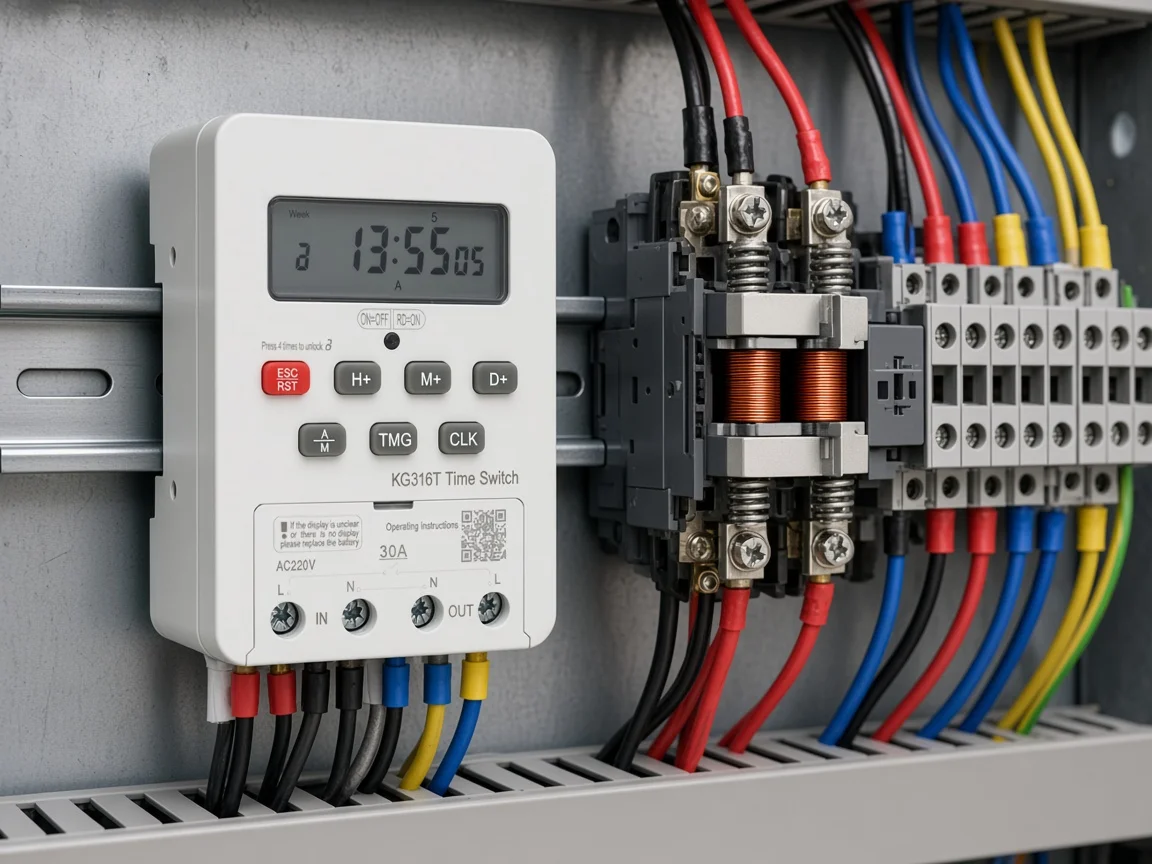
Product fit: KG316T rail clock, not a wall digital
Choose the KG316T time control switch when the job is DIN-rail / panel weekly stored clock events. Skip it when the only requirement is a US in-wall decorator digital timer.
Up to 16 on/off actions can be set per day. Switching times can repeat on a daily or weekly cycle.
The maximum setting is 168 hours and the minimum setting is 1 minute. Daily timekeeping error is listed as ≤ ±2 seconds.
The unit uses a No. 7 / AAA battery. Replace the battery regularly to avoid a dim or blank display.
| Printed capability | Honest reading |
|---|---|
| Up to 16 on/off per day | Stored clock events for panel control |
| Daily or weekly cycle | Week table on panel control supply |
| 1 minute / 168 hours | Event window from the sheet |
| AAA battery | Display backup practice on the page |
| IP50 panel module | Distribution-board enclosure class |
Browse the timer switch hub when you need the wider family. The live KG316T page stays silent on UL Listed status, so leave that claim off the quote.
For RFQ language, write the control supply, the expected weekday table, and the enclosure type on the same line. That short note keeps the rail clock path honest without borrowing wall-box marketing adjectives.
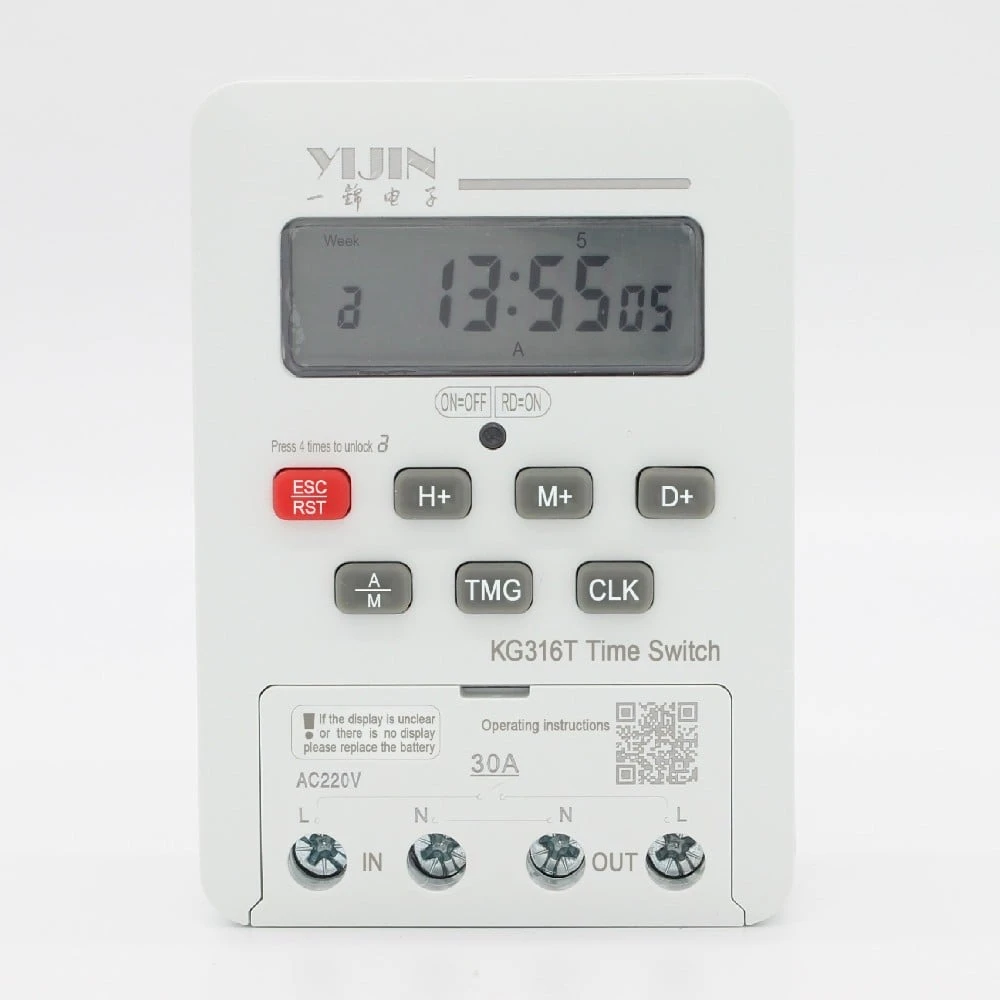
Do not force a rail clock into a decorator wall box
Wall-box digital jobs belong on wall-box hardware. A single-gang opening and a cover plate already tell you which aisle to stay in.
If the only mount anyone describes is a single-gang box and a cover plate, pause the panel SKU. The conversation belongs with decorator digital timers instead.
If fluorescent or LED loads already confuse an in-wall digital on a neutral-fed box, fix the wall SKU or drive a contactor. That remains a wall-circuit story rather than a rail-module swap.
If the enclosure is a distribution board with standard top-hat rail space and a weekday event table, the rail weekly clock is the honest path. Hallway wall boxes still buy the in-wall digital class.
Family map only: types of timer switch sketches the wider lineup while this page stays on label-versus-rail fit.
FAQ
What do US buyers usually mean by a digital timer programmable time switch?
They often mean a plug-in or in-wall digital lighting timer with seven-day programming. Retail guides frame those two mounts first. Panel DIN modules sit in a different aisle.
Is a DIN-rail digital timer the same as an in-wall digital timer?
No.
DIN-rail modules mount on IEC/EN 60715 rails inside panels.
In-wall digital timers hardwire into a wall box and often need a neutral. “Digital” names the electronics rather than the enclosure.
How is a digital time switch different from a mechanical dial timer?
Digital schedules commonly allow one-minute edges and many weekday rows. Mechanical pins typically sit on fifteen- to thirty-minute steps and a limited drum.
How many on/off events can KG316T store per day?
Up to 16 on/off actions can be set per day on the published KG316T sheet, with daily or weekly repeat.
What control supply voltages does KG316T list?
The page lists rated control power supply AC 50/60 Hz at 220 V and 380 V.
Is KG316T an in-wall decorator digital timer or UL Listed?
No. KG316T is described as a panel time-control switch with microprocessor, LCD, and relay output. The live page stays silent on decorator wall form and UL Listed status.