 Yueqing Yijin Electronics Co., Ltd.



AC Contactor Not Pulling In: Control-Circuit Scenarios That Explain No Pickup
An ac contactor not pulling in usually means the coil never seated the power contacts under a control call. In panel work that pattern is less often a mysterious load fault and more often a coil-supply scene: missing or weak control voltage, a mismatched coil rating, chatter on an unstable control path, or a burnt or bound magnet.
This article maps those application scenarios for modular AC contactors. For broader failure signs, see symptoms of a bad AC contactor. For a check-oriented pass/fail tree, see how to tell if an AC contactor is bad.
Product browsing starts at the contactor category.
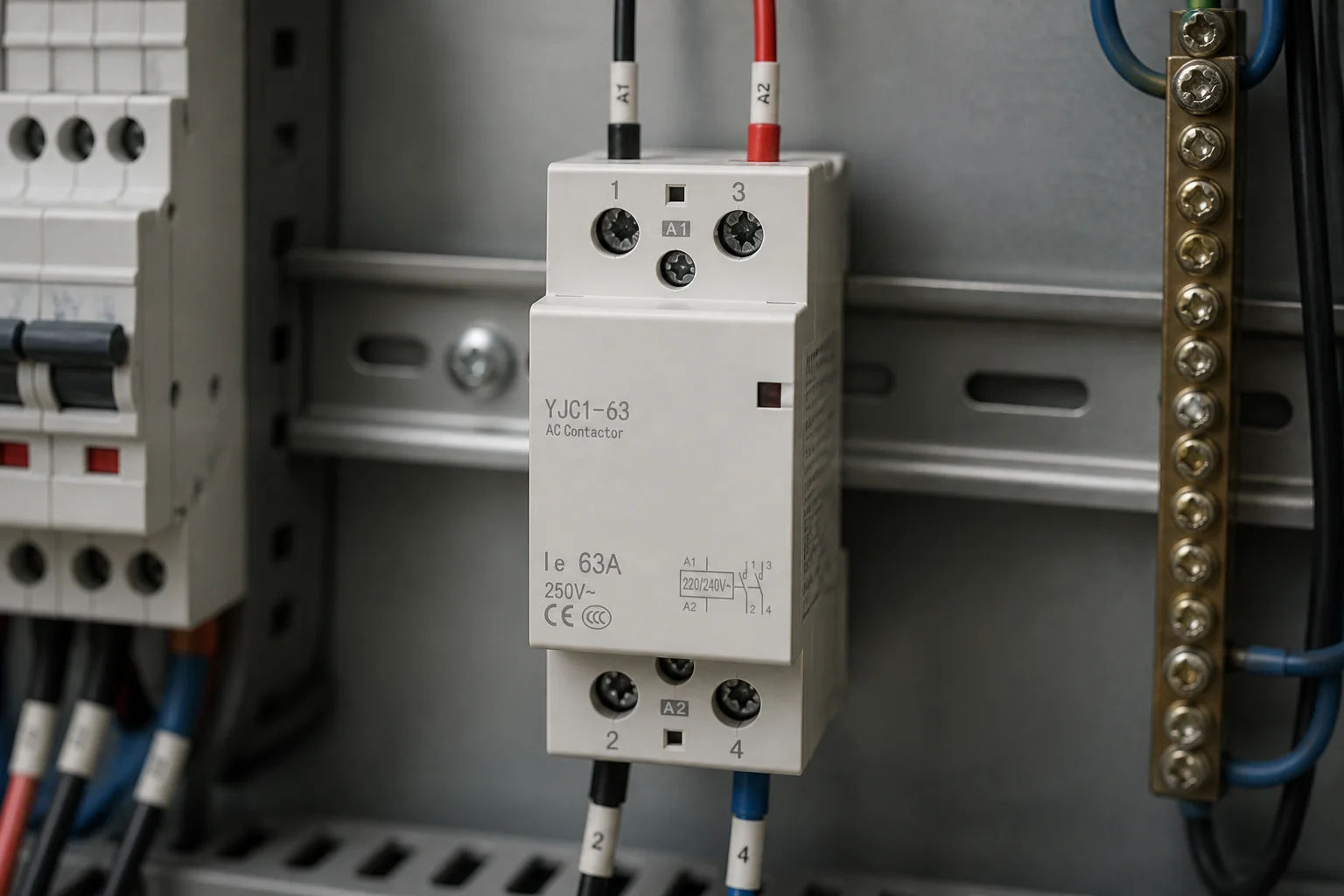
What “Not Pulling In” Means in a Panel Control Circuit
It means the coil never seated the power contacts under a control call.
A contactor is an electromagnet plus a set of power contacts. When the coil is excited, the armature / plunger pulls in and closes the poles that feed the load. If that magnet never seats, the load stays dark even though someone expected a start.
A useful field split is simple:
- Power path looks alive when forced: pressing the plunger by hand lets the motor or heater run. The line and load wiring can still be intact.
- Automatic pull-in fails: the control call never turns that magnet into a clean seat.
That “manual push works” scene is a classic control-circuit application problem, not proof that the compressor, pump, or heater is the root cause. It also is not a normal operating method. Treat a hand push as a diagnostic clue only, with power locked out before any contact with live parts.
Residential outdoor condensers often use about 24 V AC on the coil. Modular DIN-rail AC contactors in distribution panels may use a different rated control voltage Us. Do not assume every “AC contactor” coil is 24 V when you read HVAC videos.
| Panel scene | What it usually points to | What it usually does not prove |
|---|---|---|
| Load runs only while the plunger is held in | Coil/control path weak or open | That the power contacts are the first part to replace |
| Clean click, load still dead | Downstream load, wiring, or protection | That the coil failed to pull in |
| Buzz / rapid seat-and-drop | Unstable Us, loose control connections, dirt/shading issues | That the gearbox or motor “caused” the magnet to chatter |
| Us present on coil screws, silence | Burnt/open coil or mechanical bind | That the control transformer is healthy by default |
Scenario: Missing or Weak Coil Supply Voltage
If Us at the coil is missing or below the pickup window, the magnet will not seat.
Coil voltage is what engages and holds the device. Contactor coil voltage checks matter because industrial forum threads are blunt about this: swapping a starter or contactor without checking the coil voltage that keeps it engaged is how plants burn time and still hear the same chatter.
In a panel, weak or missing Us shows up in ordinary ways:
- A control transformer, interlock, or float/pressure contact is open, so the coil never sees a call.
- A loose ferrule or oxidized terminal drops voltage only under load.
- A long control run or undersized conductors sags Us when the coil inrush hits.
- A safety string (E-stop, overload auxiliary, door switch) opens the coil circuit while power poles still look ready.
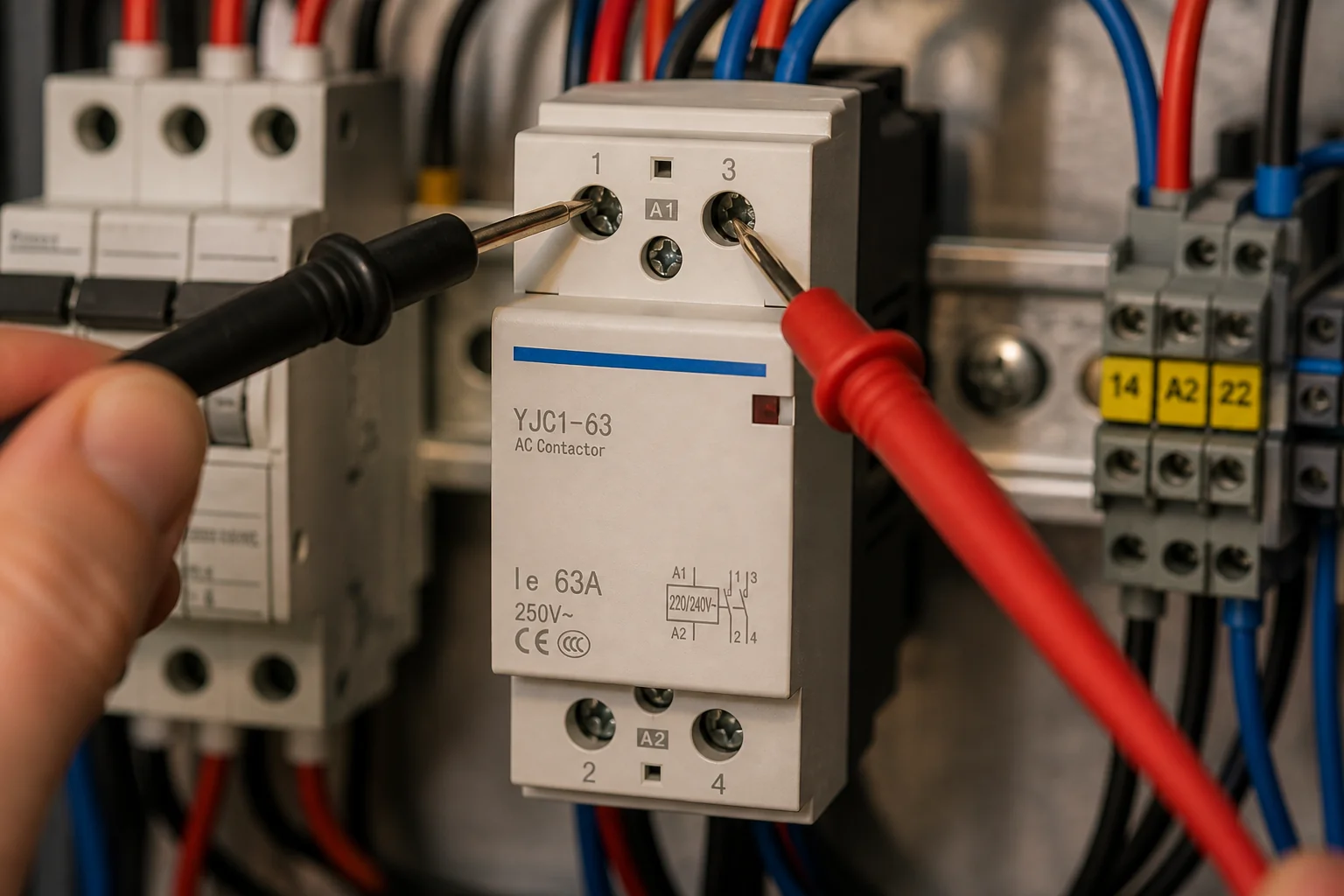
Yijin’s YJC1-63 2P Modular AC Contactor product page states that the contactor can reliably close at any voltage within (80%-110%) of rated control voltage Us, with release voltage neither higher than 75% Us nor lower than 20% Us, when Us is applied under the page’s ambient note.
That window is a first-party operating statement for that model line, not a substitute for measuring what your control circuit actually delivers at the coil screws. See the YJC1-63 2P Modular AC Contactor page for the full Action block.
If measured Us is absent, chase the control path before condemning the magnet. If Us is present but chronically low relative to the coil’s rated Us, expect no pickup or unstable hold even when the power contacts are still clean.
Scenario: Wrong Coil Voltage After a Retrofit or Swap
A coil built for a different Us will not pull in cleanly on your control supply.
Panels get rebuilt under time pressure. Someone matches the frame size and pole count, then discovers the replacement coil was ordered for another control voltage. The device may hum, refuse to seat, or overheat the winding.
Typical retrofit scenes include these mismatches. One common swap error is a 230 V coil landed on a lower control bus, so magnetic force never reaches a firm seat.
- A low-voltage coil lands on a higher Us and burns open after a short life.
- Auxiliary contacts or interlocking schemes change, so the coil only sees intermittent Us.
Wrong-coil scenarios look like “bad contactor” on the floor. The application fix is matching rated coil Us to the control supply that will energize it, then confirming poles and utilization category for the load. HVAC education that assumes a universal 24 V outdoor coil does not decide Us for a modular household AC contactor family.
Scenario: Chatter From an Unstable Control Path
Chatter usually points at coil voltage, connections, dirt/shading issues—not the load first.
AC contactor chatter is rapid seat-and-drop instead of a clean hold. On AC coils, shading features exist to reduce zero-crossing dropout; dirt, a damaged shading ring, or loose control connections can still leave the magnet unstable. Independent technical primers describe shading coils as a way to delay demagnetization and avoid chattering on AC magnets.
From the field: On Electrician Talk, electricians pushed past “the contactor is done” after a like-for-like bucket swap still chattered. The durable advice was to check coil voltage and the control circuit: “Chattering ALWAYS has to do with the control circuit, not the power circuit.” Power-side damage seen later is often the result of that chatter, not its cause.
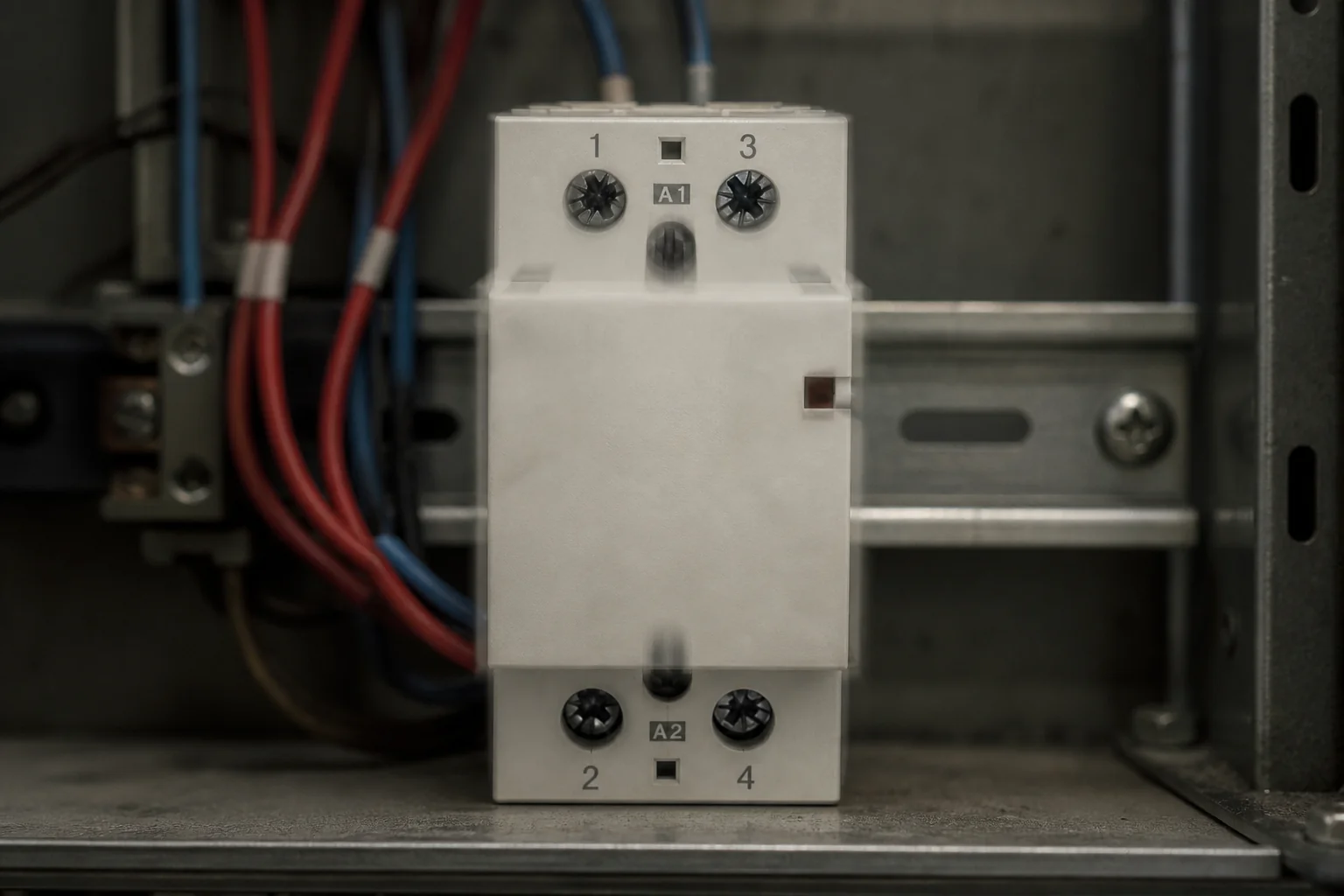
If chatter returns after a swap while the control wiring is unchanged, treat the control path as the scenario under test. Replacing another set of power contacts without stabilizing Us wastes parts and can chew contact faces again.
Scenario: Burnt Coil or Mechanical Bind With Voltage Present
Open/burnt coils and jammed armatures can leave Us on the terminals with no pickup.
Once you confirm the control call actually arrives at the coil screws, two coil-side scenes remain common:
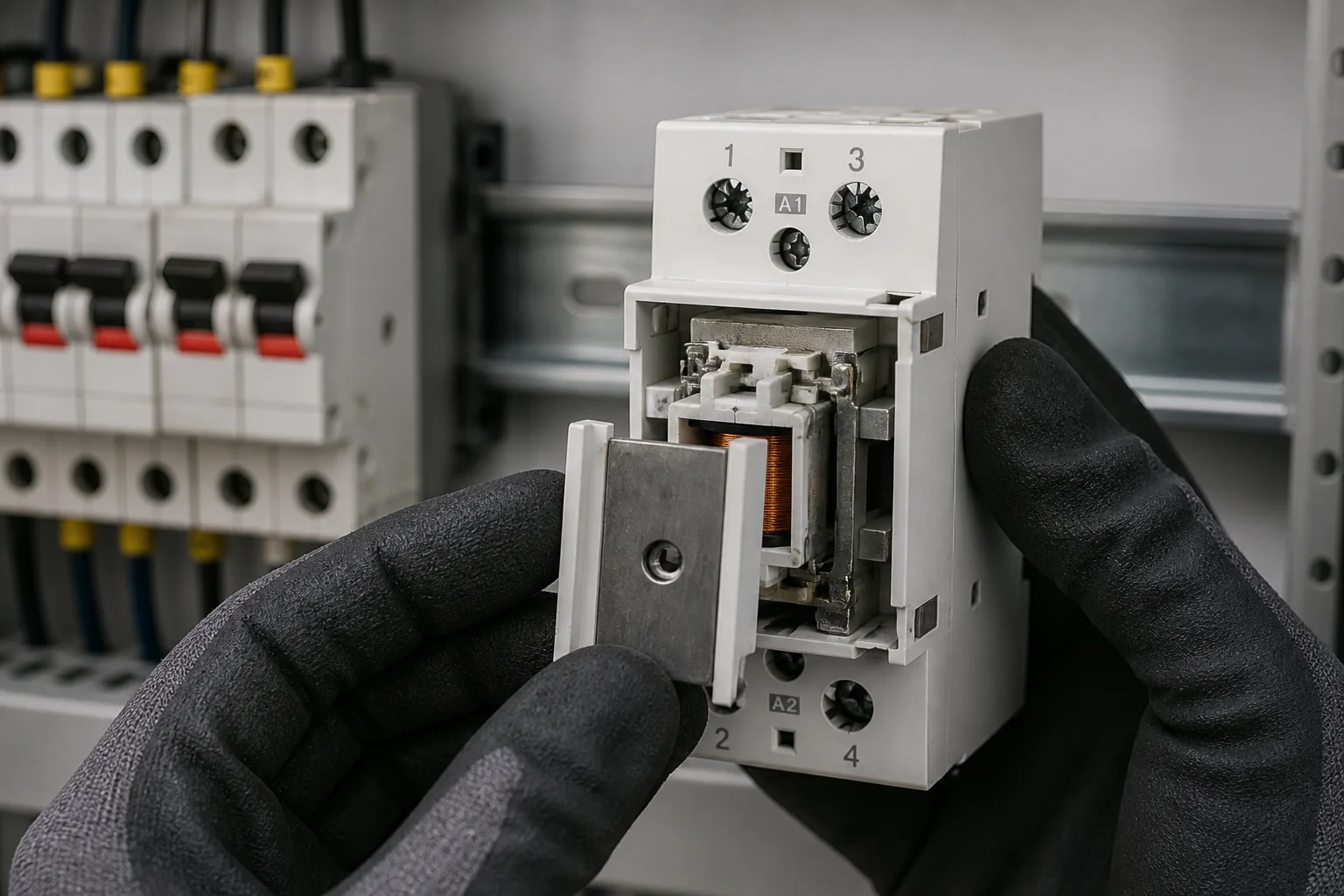
- Burnt or open coil: voltage is present, the magnet is silent, and the winding no longer builds a usable field. Overvoltage, age, and chronic chatter all feed this path.
- Mechanical bind: the armature is sticky from contamination, a bent carrier, or debris in the magnet face. Force may feel uneven if a safe, de-energized mechanical check is part of your shop practice.
Competitor HVAC guides sometimes publish ohm bands for outdoor coils. Those bands are not transferable to Yijin modular SKUs unless a Yijin page states them.
When a coil is confirmed failed, replace the contactor or coil assembly with matching Us, poles, and duty. Do not pick a random frame that almost fits.
Choosing a Modular AC Contactor After the Scenario Is Clear
Match poles, current, and coil Us before you order the next modular device.
After the coil-supply scenario is clear, shopping becomes concrete. Browse the contactor category, then confirm the live product page for poles, current, and control-voltage expectations.
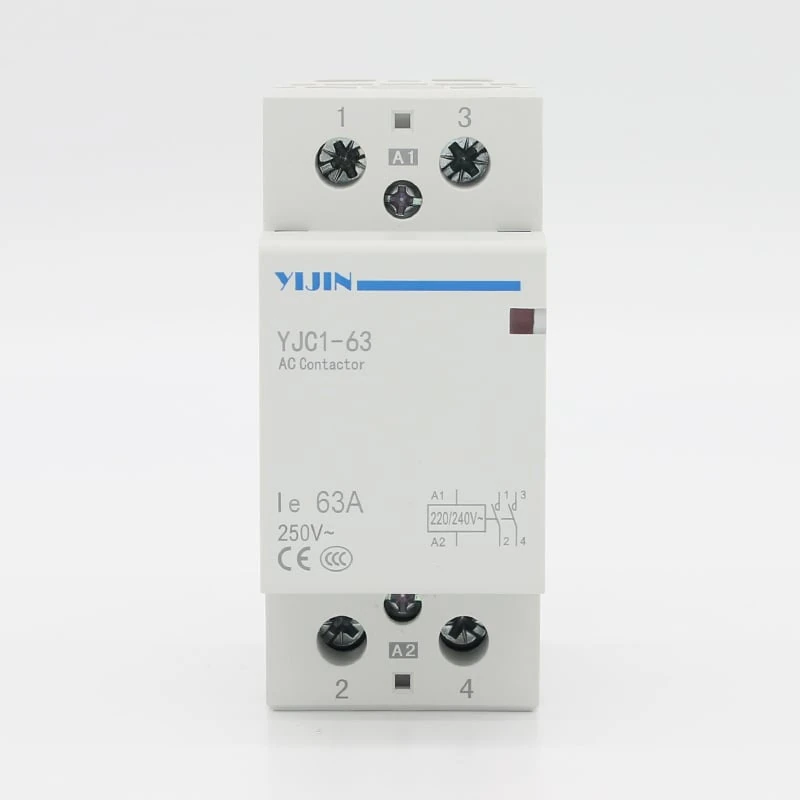
Primary recommendation: YJC1-63 2P Modular AC Contactor.
Page-stated facts useful for this topic appear below.
| Topic | What the YJC1-63 2P page states |
|---|---|
| Form / role | Modular AC contactor for remote switch and main-circuit control under utilization category AC-7a language on the page |
| System context | AC 50 Hz or 60 Hz, rated working voltage 230 V in the scope block |
| Coil operating window | Reliable close within (80%-110%) Us; release limits vs Us as quoted above |
| Standards named on page | GB17885 and IEC 1095 (first-party page claims) |
| Load note | Low inductance loads and household motor loads in household appliances and similar applications |
Family alternate: YJC-1-25 2P Modular AC Contactor (hyphenated slug). Verify current and poles on that page before you order.
Why this fits: once Us and control wiring are honest, a DIN-rail modular AC contactor with a published pickup window is the right procurement object for many household/similar panel loads. YJC1-63 fits AC-7a-oriented DIN-rail duty described on its product page.
Why not / not yet: control Us still missing or unstable; poles/current mismatched; you need a documented UL Listed / NEC claim that this package does not verify; you need a DC contactor or a specialty outdoor HVAC 24 V part outside this page’s claims.
A contactor still does not replace upstream short-circuit protection. Keep the correct breaker or fuse ahead of the poles.
Utilization category AC-7a describes duty class for slightly inductive household-style loads. Match category and current to the real load after the coil scenario is fixed.
FAQ
Can you manually push in a contactor?
Only as a brief diagnostic clue with power controlled and competent practices. If the load runs while the plunger is held, the power path may be intact and the coil/control path is the scenario to map. Do not leave a contactor hand-held as a running method.
What tells a contactor to pull in?
A control call applies rated control voltage Us to the coil. The electromagnet pulls the armature so the power contacts close. No Us, wrong Us, or a dead coil means no automatic pull-in.
Why does an AC contactor chatter instead of holding in?
Chatter usually traces to the control side: low or unstable coil voltage, loose control connections, contamination, or shading-related magnet issues on AC coils. Forum electricians treat chatter as a control-circuit problem first, not a reason to keep swapping power poles blindly.
Why is there voltage at the coil but still no pull-in?
Us on the screws with a silent magnet points to a burnt/open coil or a mechanical bind. Confirm the measurement is truly across the coil under a call, then replace or free the magnet assembly with matching ratings.
Does “not pulling in” always mean the contactor is bad?
No. Missing interlocks, open safety strings, wrong coil Us, and sagging control runs produce the same no-pickup symptom. Condemn the contactor after the coil-supply scenario is checked.
What Us window does the YJC1-63 page state for reliable closing?
The YJC1-63 2P product page states reliable closing within (80%-110%) of rated control voltage Us, with release voltage neither higher than 75% Us nor lower than 20% Us, under the page’s stated ambient note for that test condition.
Is a modular AC contactor a circuit breaker?
No. Contactors make and break under their rated duty; they are not short-circuit protective devices, so keep appropriate upstream protection.
When should I look at YJC-1-25 vs YJC1-63?
Compare live product pages for poles and rated current against your load. Both sit in Yijin’s modular AC contactor family; choose the SKU whose page matches the circuit, then confirm coil Us for your control supply.
References
- Contactor — Wikipedia
- Contactor — Construction, Operation, Application and Selection — Electrical Classroom
- Utilization categories — Wikipedia
- Chattering Contactors — Electrician Talk
Humanizer audit: PASS