 Yueqing Yijin Electronics Co., Ltd.



How to Tell If an AC Contactor Is Bad: Diagnostic Checks That Matter
You can settle how to tell if ac contactor is bad with a short pass/fail path: the contacts no longer make or break cleanly, the coil will not pull in on a valid control signal, or the mechanism chatters because the control side cannot hold it. A buzz alone is not a verdict. The sections below cover safety prep, how to separate coil vs contacts vs control voltage, the check sequence, how to read replace-or-fix results, and when a Modular DIN-rail contactor is the rational next step after a confirmed fail.
For a symptom catalog (won’t start, won’t stop, burn marks), see the companion article on symptoms of a bad AC Contactor. This page is the diagnostic path.
What “Bad” Means as a Pass/Fail Decision
A contactor is bad when it cannot make or break the load path cleanly under a valid control signal.
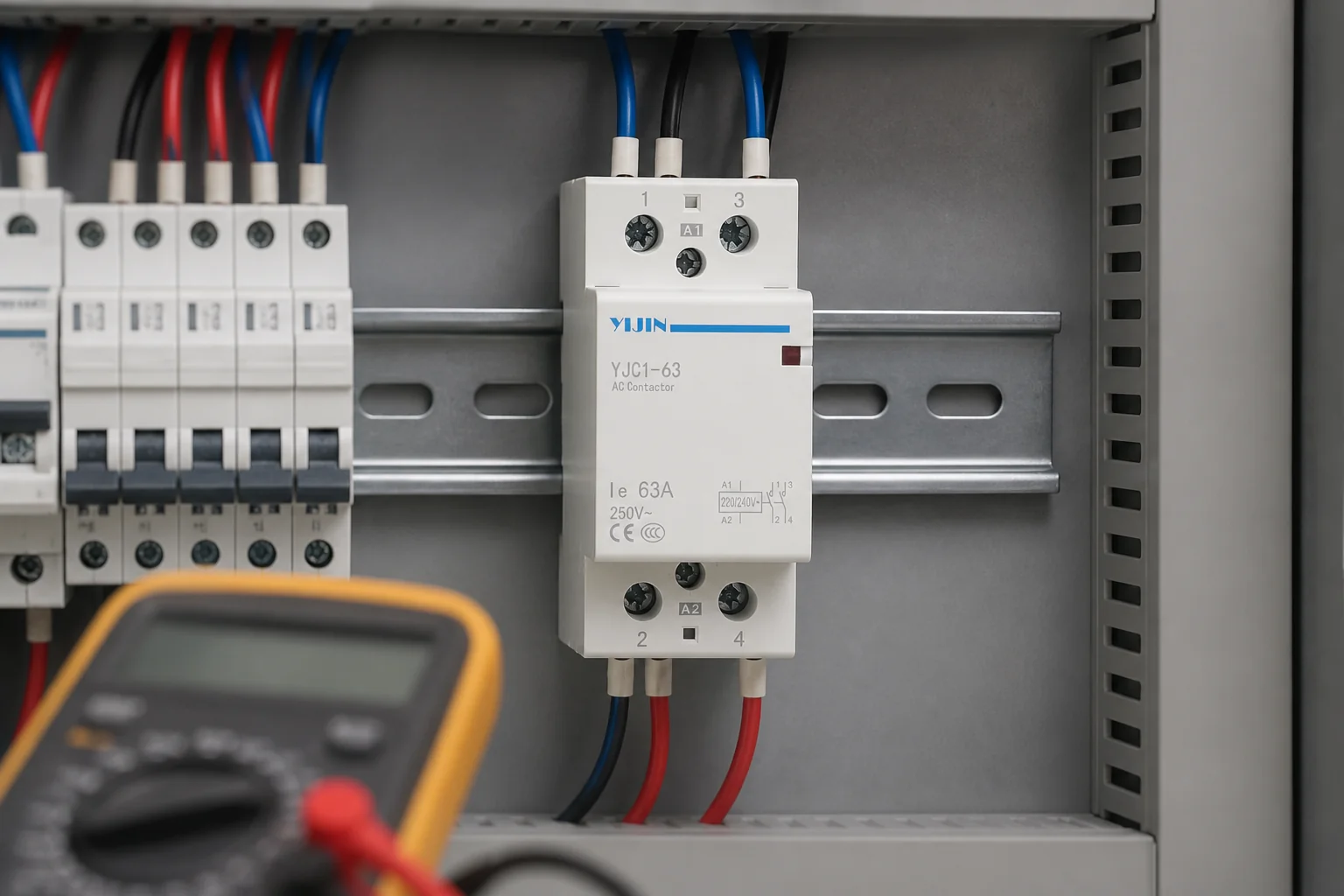
An AC contactor is an electromechanical switch: the coil builds a magnetic field that pulls the armature, the power contacts close, and a spring returns the contacts when the coil drops out. When that chain fails — stuck open, stuck closed, or unstable seating — the device fails the job even if the surrounding circuit looks busy.
Treat “bad” as a measured outcome, not a feeling. If the control voltage is wrong, the coil may be healthy and still refuse to pull in. If a downstream fault keeps welding new contacts, the last contactor you installed was a victim, not the root cause.
Keep one boundary clear from the start: a contactor switches load current under control; it is not a circuit breaker meant to interrupt short-circuit fault current.
Safety and Prep Before Any Contactor Check
De-energize for visual and mechanical inspection first; treat live line-side checks as qualified work only.
Before you touch covers or terminals:
- Lock out and verify zero energy on the circuit you will open for inspection.
- Wear eye protection and insulated gloves rated for the work.
- Photograph wiring before any disconnect so pole order is recoverable.
- Have a digital multimeter ready for resistance and voltage checks.
- Never use the contactor itself as the lockout disconnect for servicing.
Live voltage comparisons between line and load terminals are useful later in the sequence, but they are not a first move for an untrained reader. If you are not qualified for live panel work, stop after the de-energized visual pass and bring in someone who is.
Coil vs Contacts vs Control Voltage: Pick the Branch First
Separate coil, contact faces, and control supply before you condemn the device.
Three failure branches explain most “bad contactor” tickets:
| Branch | What fails | Typical tell |
|---|---|---|
| Power contacts | Make/break path | Pitting, welding, line present / load absent under a call-for-run |
| Coil / armature | Pull-in magnet or seating | Open or shorted coil reading; Plunger / armature works by hand but not electrically |
| Control voltage | Command that should hold the coil | Chatter after “new” contactor; low or unstable coil voltage |
Field threads on Electrician Talk repeatedly push the control branch first when chatter returns after a swap: coil voltage, loose control connections, dirt on pole faces, or a shading issue can mimic a “dead” contactor. Search-result checklists echo the same order — contacts, coil, control voltage, terminals — before parts fly.
If you skip this branch pick, you will keep buying contactors for a control problem.
From the field: When a replacement still chatters under load, electricians often treat chatter as a control-circuit problem first — verify coil voltage and connections before condemning another device. (Source: Electrician Talk — Chattering Contactors thread.)
Step-by-Step Checks: Visual, Coil, Line/Load, Plunger
Work visual → coil continuity → line vs load → manual plunger, and record each result. This is the practical core of checking ac contactor with multimeter work and testing ac contactor coil continuity before you buy another device.
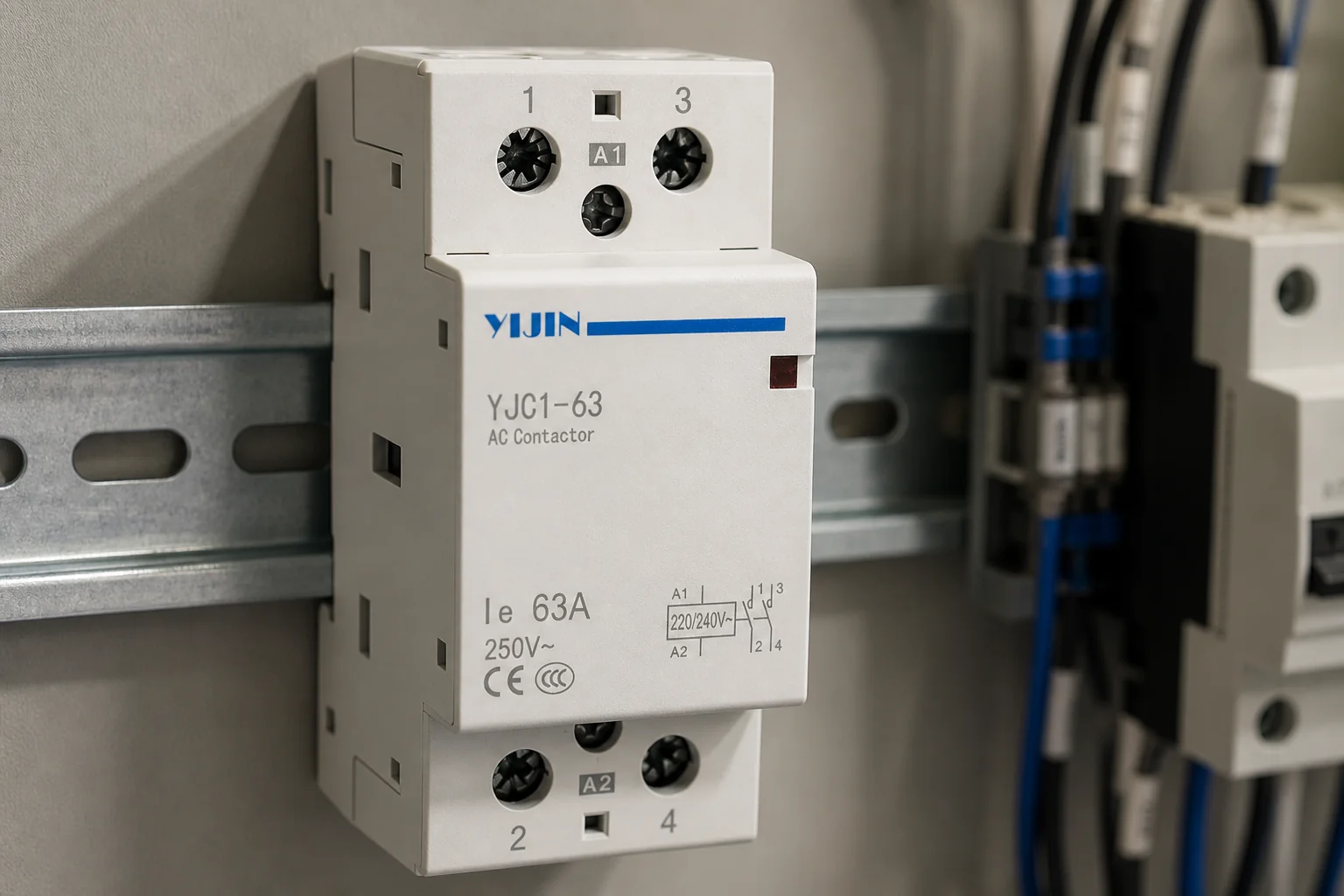
1) Visual and mechanical (de-energized)
With power verified off, inspect contact faces and the moving assembly.
Look for heavy pitting, carbon tracking, melted plastic, or contacts that look welded together.
Light discoloration can be normal aging; deep pits and slag are not. Confirm the Plunger / armature moves freely by hand without grinding.
2) Coil check (multimeter)
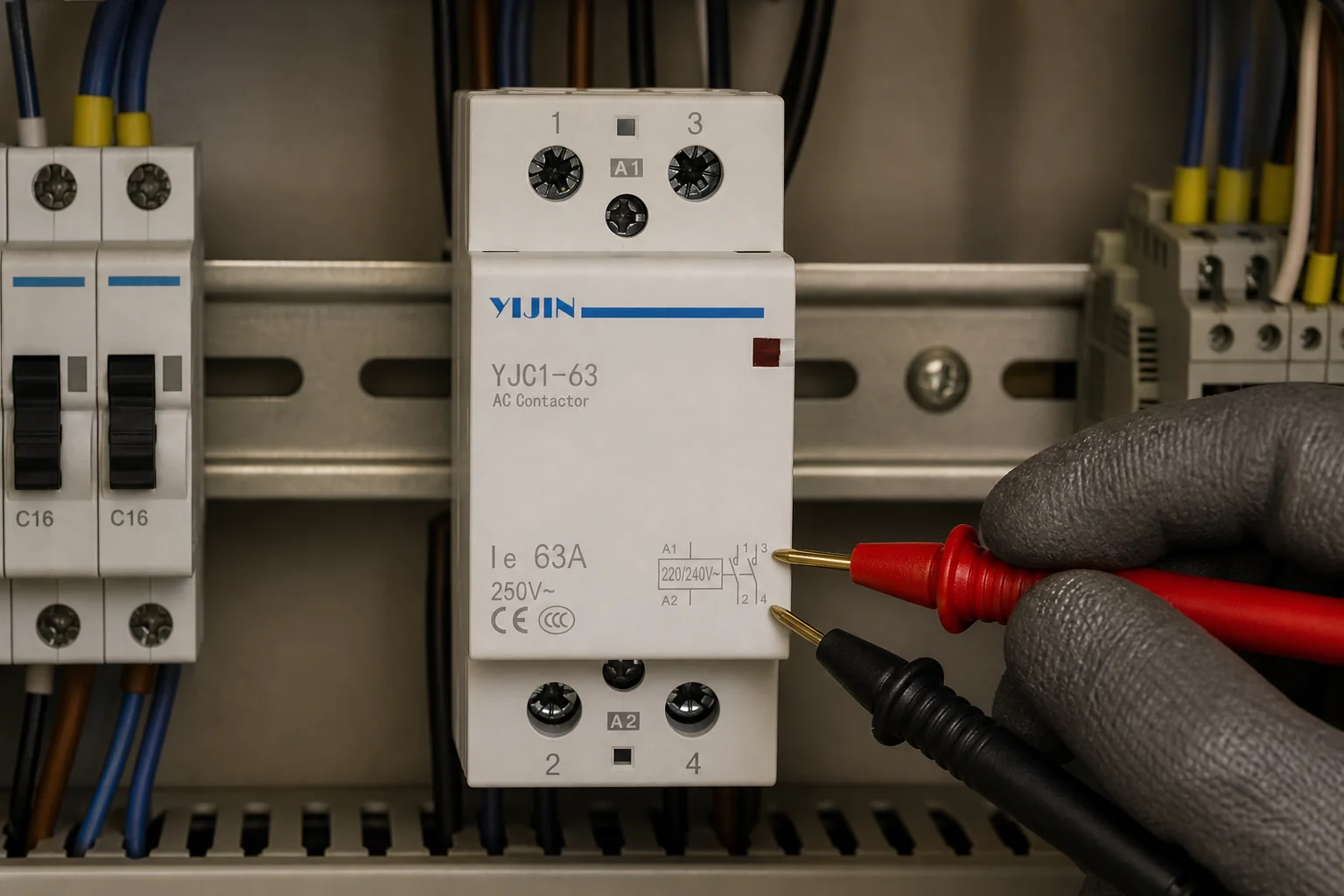
Set the meter to resistance and measure across the coil terminals.
Infinite / OL usually means an open coil. A near-zero reading usually means a shorted coil.
A finite reading only means the winding is continuous — compare it to the manufacturer’s published coil data when you have it.
Do not treat a competitor HVAC blog’s ohm band as a universal number for every brand, and do not invent a coil ohm or coil voltage for Yijin modular SKUs when the product page does not publish one.
3) Line vs load under a call-for-run (qualified live work)
When the control calls for run and it is safe to measure: line terminals should show expected supply; load terminals should show transfer when the contactor is closed.
Line present with load absent under a true call is a strong contacts-not-closing signal. If both sides look correct and the motor still refuses, look at capacitor, overload, or the load itself.
4) Manual plunger test
With procedures your workplace allows, pressing the plunger can separate branches.
If the load starts when the plunger is held and stops when released, the power path can close mechanically while the coil or control supply fails to hold it. If pressing does nothing, look past the contactor to wiring, capacitor, or the load.
| Check | Expected when healthy | Points to “device bad” | Points elsewhere |
|---|---|---|---|
| Visual faces | Clean enough to seat | Deep pits, weld, melt | Only light tarnish |
| Coil ohms | Continuous per manufacturer data | OL or ~0 Ω | Finite reading with bad control voltage |
| Line vs load on call | Load follows line when closed | Line OK, load dead | Both OK, load still dead |
| Manual plunger | Not required if electrical pull-in works | Starts only when pressed | Pressing does nothing |
How to Read Results: Replace the Contactor or Fix the Control Side
Replace when the device fails with known-good control; fix control or root cause when chatter or rewelding points elsewhere.
Replace the contactor when:
- Contact faces are welded or heavily pitted and cannot seat.
- Coil reads open or shorted.
- Line-to-load transfer fails while control voltage at the coil is confirmed good.
- The plunger path proves mechanical close works but the coil cannot hold under correct voltage — and the coil itself fails the continuity check.
Fix the control side or root cause when:
- A new contactor chatters the same way — measure coil voltage under load before buying again.
- Contacts keep welding after swaps — evaluate the motor / downstream fault and utilization match.
- You see ac contactor not pulling in but control voltage is low, missing, or collapsing when the load starts.
Important: A contactor is not a substitute for a locked-out disconnect during servicing, and it is not a circuit breaker for clearing short-circuit faults. Clear energy with the proper isolator first. (Source: Wikipedia Contactor — not intended to interrupt short-circuit current.)
When the failure mode is confirmed, move on to form factor and ratings — not another random outdoor HVAC look-alike by habit. For how failure signs present in the field before you meter, keep the symptoms article bookmarked; use this page for the pass/fail path.
After a Confirmed Fail: Select a Modular AC Contactor
Match poles and published modular family ratings — not an outdoor HVAC look-alike by habit.
Once diagnostics say the device is done, a Modular DIN-rail contactor is a rational replacement path for household and low-inductance panel applications published on the Yijin family pages. Browse the contactor category for the live SKU set, then match poles and current to the circuit you actually control. Match the Utilization category on the nameplate and product table to the load duty you are switching.
The live YJC1-63 family pages state a rated working voltage of 230 V under the AC-7a usage category for remote switch and main-circuit control, with rated working current wording up to 63 A on the 63 family, DIN-rail TH35-7.5 mounting, and GB17885 / IEC1095 compliance as printed.
Use the scan table below for the published family comparison.
| Published item (live product pages) | YJC1-63 family (for example 2P / 4P) | YJC-1-25 family (for example 2P) |
|---|---|---|
| Form factor | Modular DIN-rail (TH35-7.5) | Modular DIN-rail (TH35-7.5) |
| Rated working voltage | 230 V | 230 V |
| Usage category highlighted | AC-7a (also AC-1 / AC-7b rows in tables) | AC-7a (family wording) |
| Rated working current (family wording) | Up to 63 A | Lower-current modular option in the same household family |
| Standards stated on page | GB17885 / IEC1095 (as printed) | GB17885 / IEC1095 (as printed) |
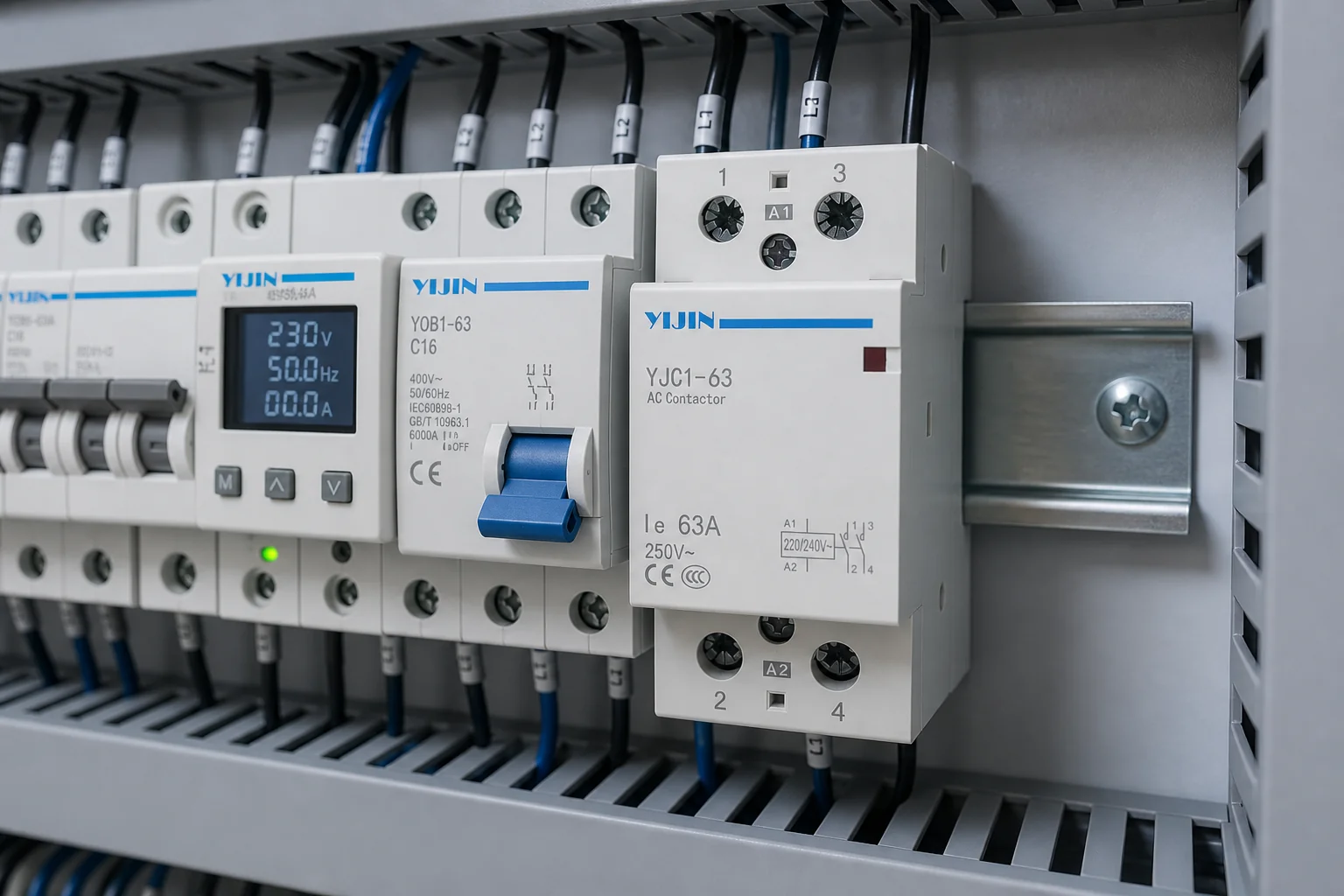
Primary recommendation after a confirmed fail for many single-phase panel replacements: YJC1-63 2P Modular AC Contactor.
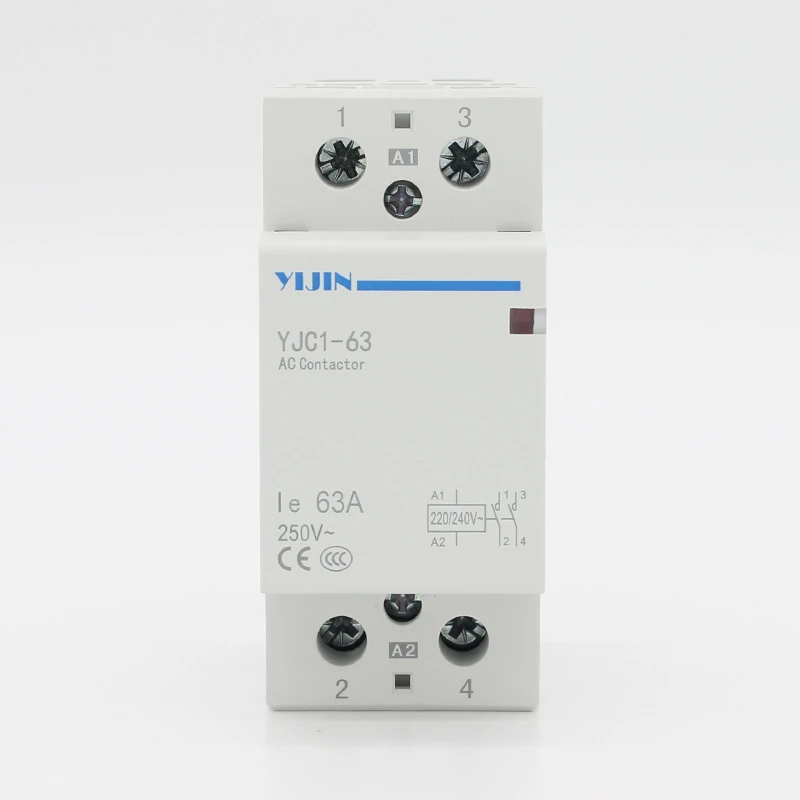
Choose YJC1-63 4P when the circuit needs four poles at the published family ratings, or YJC-1-25 2P when the published lower-current modular option fits the load. These pages do not publish coil voltage or coil ohms — do not invent them, and do not invent third-party listing claims for Yijin from this article.
If you need help matching poles and published utilization to a panel schedule, use the contact page with the ratings you measured and the fail mode you recorded.
FAQ
How do you test an AC contactor with a multimeter?
De-energize for coil resistance across the coil terminals, then — if qualified — compare line and load voltage under a call-for-run. OL or near-zero coil readings indicate a bad coil; line present with load absent points to contacts not closing.
Why does a contactor chatter even after replacement?
Chatter often follows the control circuit: low or collapsing coil voltage, loose control connections, or seating issues. Measure coil voltage under the same load before condemning the next device.
If the plunger works by hand but not electrically, is the contactor bad?
Often the coil or control supply is the problem. Confirm control voltage at the coil, then re-check coil continuity. If voltage is good and the coil is open or shorted, replace the contactor.
Will the fan or load run if the contactor is bad?
Stuck open usually leaves the load dark under a call-for-run. Stuck closed can leave the load running after the control signal ends. Behavior depends on which path failed.
Can I replace an AC contactor myself?
Only if you are qualified for the voltage involved and you lock out properly. Visual checks are one thing; live line/load measurements and panel rewiring are another.
When should I choose a modular DIN-rail AC Contactor after tests?
After the fail mode is confirmed and control-side causes are cleared. Then match poles and the published 230 V AC-7a modular ratings on the YJC family pages.
Is a contactor the same as a circuit breaker?
No. A contactor switches loads under a control signal.
A circuit breaker is intended to interrupt overcurrent and fault conditions.
Do not treat a contactor as the fault-clearing or lockout device.
Do pitted contacts always mean replace immediately?
Deep pitting, welding, or melting usually means the contact path is done. Light discoloration alone is not an automatic scrap decision — confirm seating and electrical transfer before you buy.
References
- Contactor — Wikipedia
- Utilization categories — Wikipedia
- Contactor — Construction, Operation, Application and Selection — Electrical Classroom
- Chattering Contactors — Electrician Talk
Humanizer audit notes (package only)
Patterns found: step blocks converted to short paragraphs + table; avoided source-first loops; no invented field story.
Second pass: no new facts added beyond research/brief.
Humanizer audit: PASS
Evidence callout present
From the field (control-side chatter) + Important (not a breaker / not lockout substitute).