 Yueqing Yijin Electronics Co., Ltd.




Match Printed AFD Terminals to the AFCI Breaker Wiring Diagram
An afci breaker wiring diagram for a US branch panel maps line, load, neutral, and pigtail landings on a listed combination type afci. That map is not automatic permission to invent the same marks on every arc-fault SKU. This article reads the US diagram language first, then checks the printed terminals on Yijin’s DIN-rail YJB1-63/AFD, then separates the two wiring classes before you buy.
What a US branch-panel AFCI breaker wiring diagram shows
A US branch-panel diagram for a typical pigtail-style AFCI lands the circuit hot on LOAD, the circuit white on LOAD NEUTRAL, and the factory white pigtail on the panel neutral bus, while LINE comes from the bus stab.
That is the picture searchers usually want under this keyword. Manufacturer instruction sheets for combination type afci breakers repeat the same four landings in plain language: coiled white pigtail to the neutral bar, load neutral to the silver LOAD NEUTRAL terminal, load hot to LOAD, then energize and press TEST.
Plug-on neutral designs keep the same job class but change the physical neutral interface. The visible pigtail disappears because the breaker contacts a neutral bus stab. The circuit load neutral still has to follow that breaker’s instructions — do not assume every brand lands neutrals the same way.
Keep the diagram inside its class. It describes listed US load-center AFCI hardware for covered 120 V branch work, not every device that mentions arc faults in a catalog title. LINE / LOAD labels in those drawings are panel-AFCI language, not a universal print for every arc-fault SKU.
If you still need the room-by-room code inventory after the diagram is clear, use the live sister note on where AFCI breakers are required instead of stretching this page into a location list.
Printed marks on the live YJB1-63/AFD face and figures
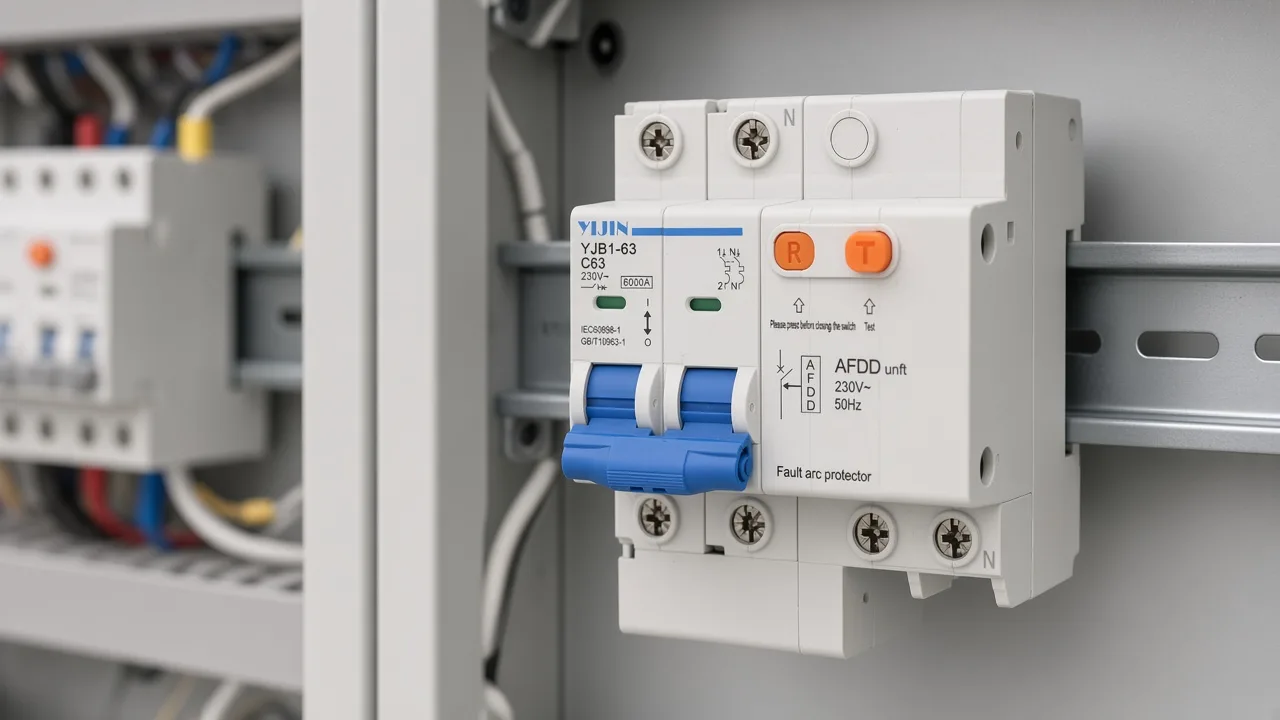
The live YJB1-63/AFD product photo shows schematic marks 1 and N on top, 2 and N on the bottom, plus housing N marks — and the product page does not print a US LINE/LOAD/pigtail branch-panel wiring diagram.
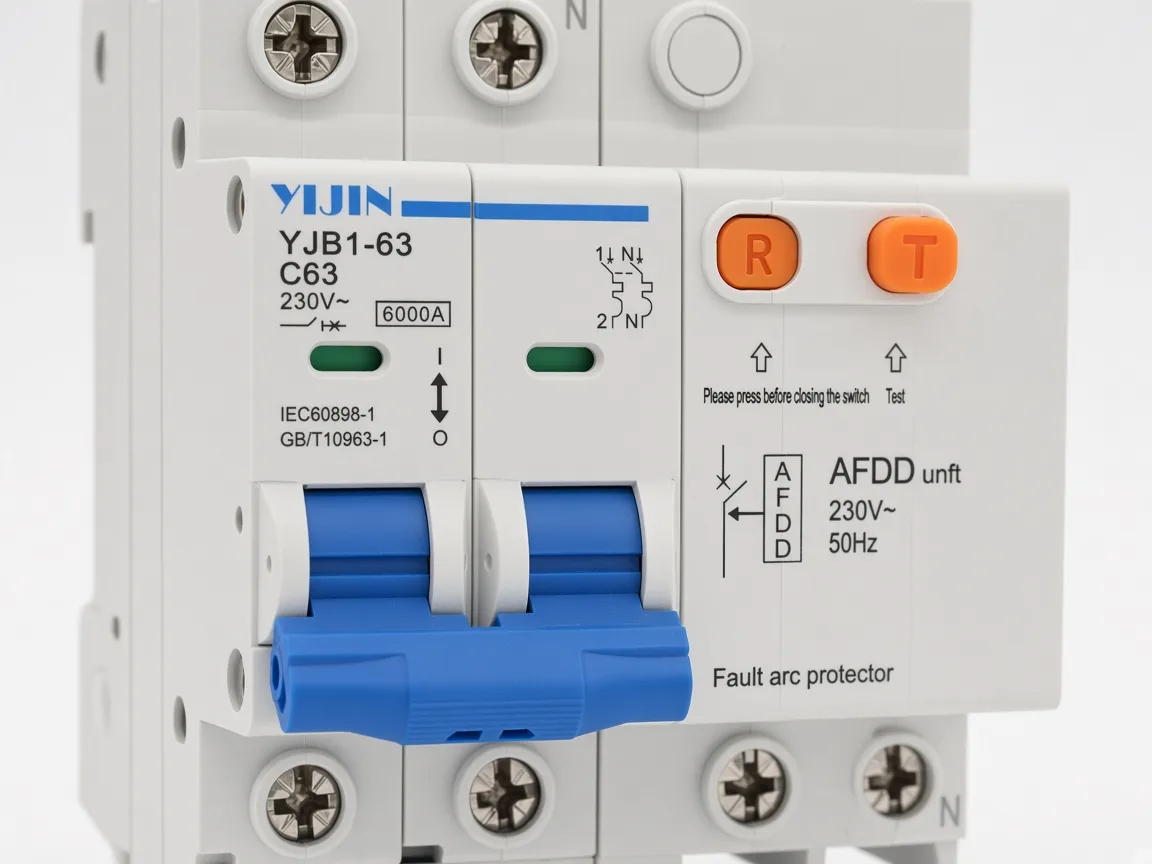
On the same live page, the device is described as an AFDD arc-fault protection circuit breaker assembled from a small circuit breaker and an arc fault protection module. Rated use on the page is AC 50 Hz, 230 V, with currents through 63 A, plus overload, short-circuit, and series/parallel arc protection. Installation method on the parameter table is standard rail installation.
The model-meaning figure on the page explains the YJB1-63/AFDD naming string. The size figure shows outline dimensions and screw ports without LINE, LOAD, or pigtail text. Those figures are useful for rail fit; they are not a substitute for a US panel AFCI connection drawing.
Do not invent LINE or LOAD labels because a Google diagram uses those words. If a mark is not printed on the live face or figure, leave it unstated.
Pre-check: diagram expectation versus printed AFD evidence
If your purchase decision depends on a US panel AFCI diagram, the printed YJB1-63/AFD evidence is a different wiring class and must not be forced into LINE/LOAD/pigtail language.
| Reader expectation from a US AFCI diagram | Printed / published evidence on YJB1-63/AFD | Pre-check result |
|---|---|---|
| LINE from panel bus stab into a load-center AFCI | No LINE label printed on the live face or size figure | Do not map the SERP diagram onto this SKU |
| LOAD hot terminal for the branch conductors | No LOAD label printed on the live page figures | Stop and re-class the job |
| LOAD NEUTRAL / load neutral landing on the breaker | Face schematic uses 1 / N / 2 / N style marks; housing shows N | Read the printed marks; do not rename them as US panel LOAD NEUTRAL |
| White pigtail to the panel neutral bus | No pigtail shown or described on the live product page | Different neutral interface class |
| UL 1699 combination AFCI in a US dwelling panel | Page cites GB/T31143 and rail installation; no UL 1699 claim on the live page | Not a documented UL branch-panel AFCI path |
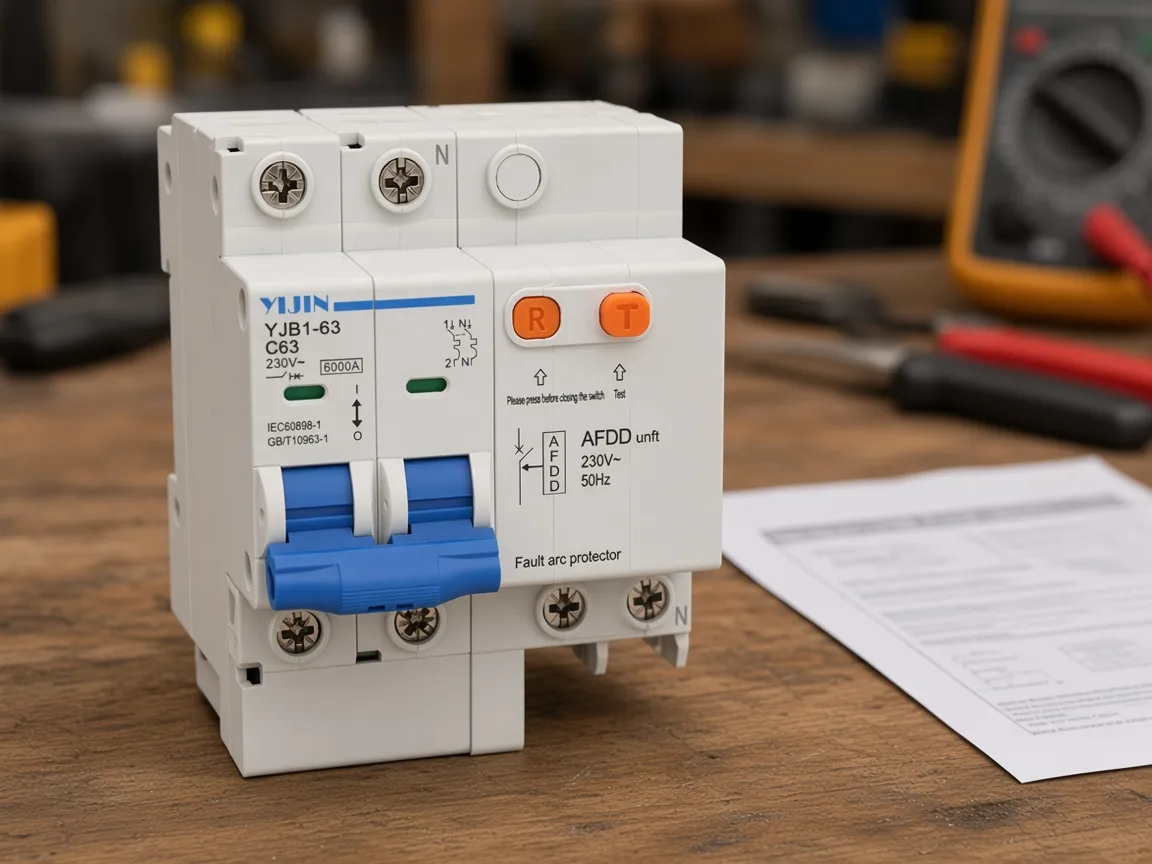
AFDD naming is related to arc-fault protection in many markets, but naming alone does not convert a DIN-rail assembly into a US load-center AFCI diagram. Run the table before tools or purchase orders move.
Why this is not a UL 1699 or NEC 210.12 knockout
UL 1699 and NEC 210.12 describe listed US branch AFCI means for covered dwelling circuits; the live Yijin pages do not evidence that listing or compliance path for YJB1-63/AFD.
UL 1699 catalog scope text covers AFCI devices for dwelling units with a maximum rating of 20 A on 120 V ac, 60 Hz circuits. NEC 210.12 education for dwelling units points to listed combination-type AFCI protection for covered 120 V, 15 A and 20 A branch circuits. Those references explain why US searchers expect a panel AFCI wiring diagram.
They do not authorize rewriting YJB1-63/AFD into that diagram. The product page publishes AC 50 Hz, 230 V, rail mounting, and GB/T31143.
Site facts for yijinele-group.com also record no verified UL Listed or NEC AFCI claim for this package. Treat any US bedroom-branch AFCI job as a listed panel-AFCI purchase path, not as this DIN-rail SKU.
This page is a terminal pre-check, not a panel-swap procedure. For install-sequence readiness on listed US hardware, use the live sister article on how to install AFCI breakers after the device class is already correct.
Neutral traps that break a panel AFCI wiring diagram
Shared neutrals and leaving the load neutral on the bar while only landing the pigtail are common ways a clean diagram fails once the cover is open.
From the field: On Electrician Talk, installers still report shared-neutral circuits as a hard stop for ordinary AFCI breaker expectations, and they stress that circuit neutrals belong on the breaker path the instructions show — not “cleaned up” onto the bar beside a lonely pigtail. Source: AFCI shared neutral thread.
Watch for three traps before you trust a one-line Google diagram:
- Shared or multiwire neutrals that the single-pole diagram never contemplated
- Plug-on neutral panels paired with pigtail breakers, or the reverse, without reading both labels
- Moving only the pigtail while the branch load neutral stays on the bar on a breaker that still requires that load neutral on its terminal
Those traps belong to US panel AFCI wiring. They are not a license to invent a pigtail story for the DIN-rail YJB1-63/AFD face.
Choose YJB1-63/AFD only for a DIN-rail AFDD wiring path
Use the YJB1-63/AFD arc fault circuit breaker when the specified architecture is DIN rail AFDD-class protection matching the page’s 230 V / 50 Hz / current ratings — not as a US panel AFCI substitute.
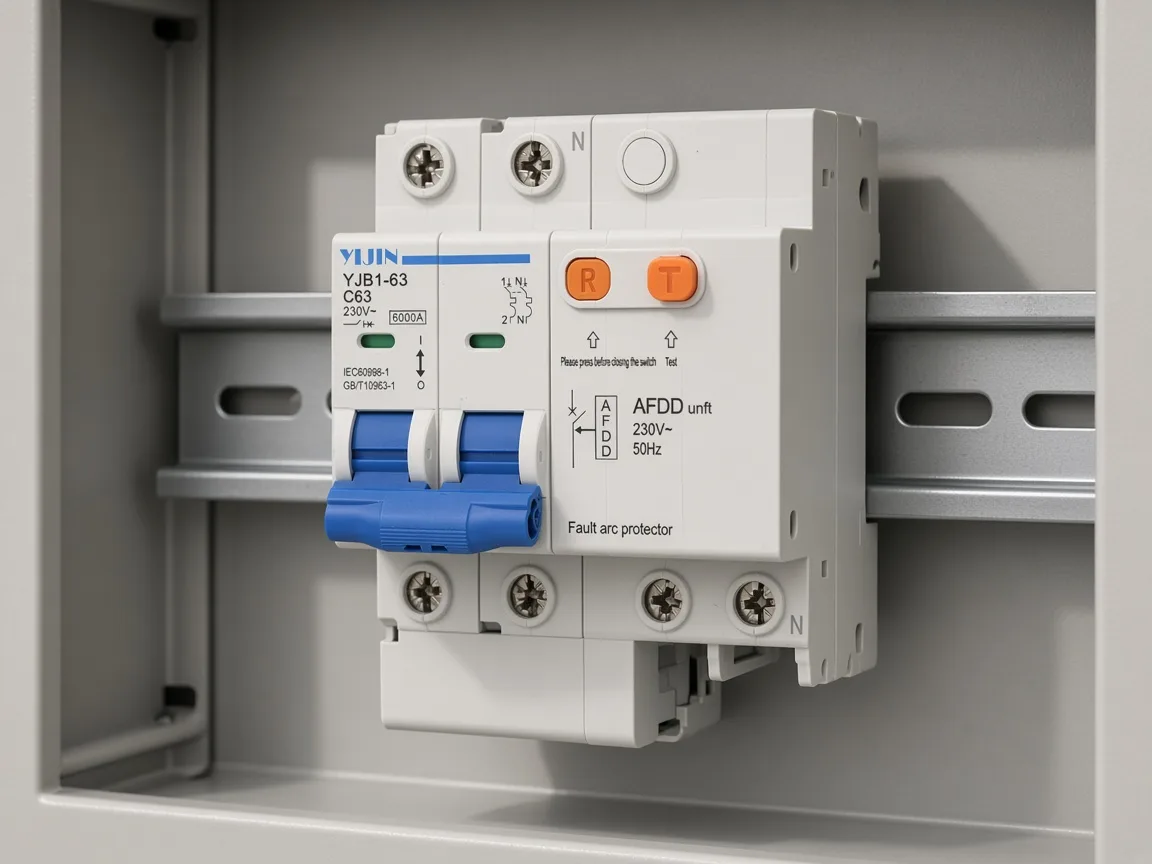
The live page states the AFDD unit is assembled from a small circuit breaker and an arc fault protection module. It lists overload, short-circuit, and arc-fault protection, including series arc / parallel arc coverage, for building and similar lines under the published ratings.
| Parameter on the live page | Published value |
|---|---|
| Model on table | YJB1-63/AFDD |
| Poles | 2P |
| Rated operational voltage | 230V |
| Rated current options | 10/16/20/25/32/40/50/63A |
| Rated frequency | 50Hz |
| Minimum series / parallel arc labels | Serial arc: 5; Combined arc: 75 |
| Standard named on table | GB/T31143 |
| Installation method | Standard rail installation |
| Protection grade | IP20 |
| Ambient temperature | -40℃~+75℃ |
| Altitude | 2000m |
| Mechanical life | >6000 times |
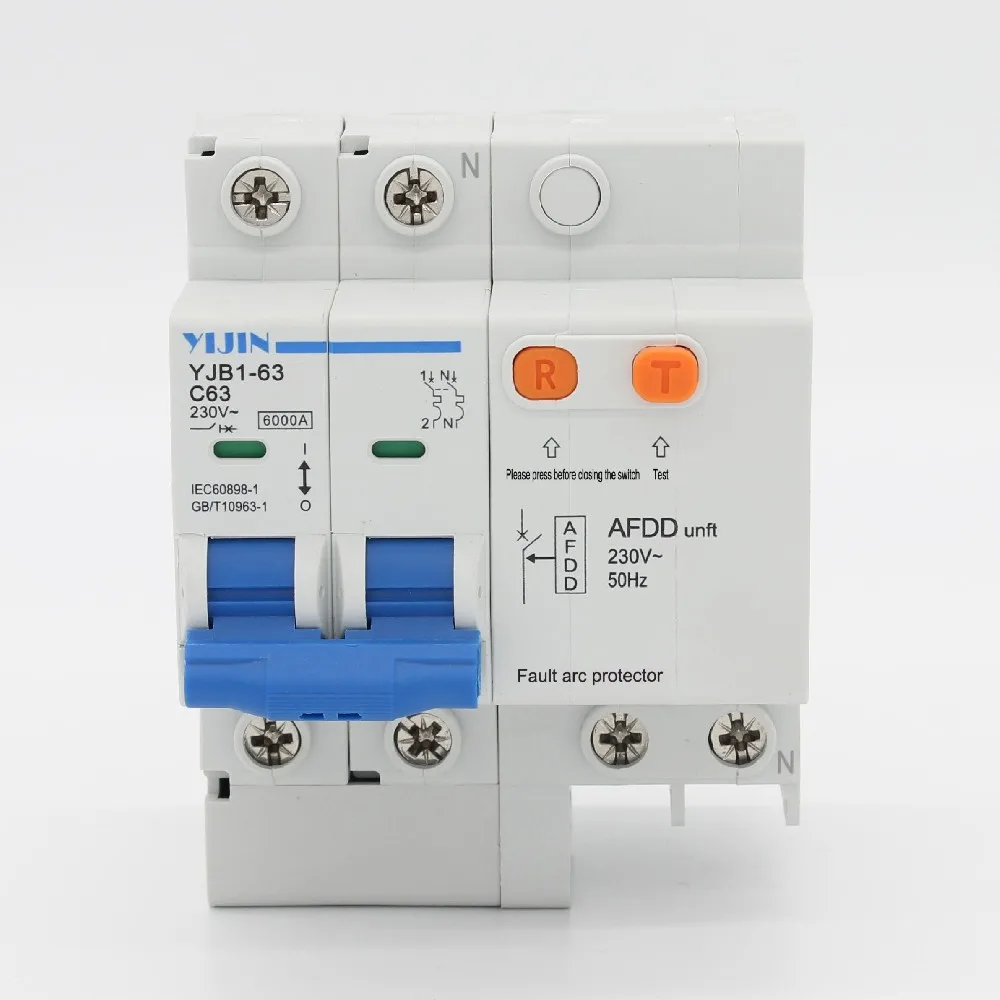
Choose this SKU after the diagram-versus-print pre-check says the job is rail-mounted AFDD-class work. Do not choose it to satisfy a US load-center AFCI wiring diagram, UL 1699 listing language, or NEC 210.12 dwelling-branch compliance claims the live pages do not make.
Browse the AFCI cluster hub at Others only for navigation among related devices. Keep the buying decision on the single product URL above when this wiring-class check is the reason for the click.
FAQ
Do AFCI breakers need a neutral?
Most US panel AFCI breakers need a neutral path for their electronics, either through a white pigtail to the neutral bus or through a plug-on neutral contact. Follow the breaker and panel labels for that path.
Where does the load neutral land on a US AFCI diagram?
On typical pigtail-style combination type afci breakers, the circuit load neutral lands on the breaker’s LOAD NEUTRAL terminal. Leaving that white on the bar while only moving the pigtail is a common miswire.
What is the white pigtail for?
The pigtail ties a pigtail-style AFCI to the panel neutral bus. Plug-on neutral breakers replace that visible lead with a bus contact, so the diagram changes even when the protection job stays in the same class.
Can a shared-neutral circuit use a standard single-pole AFCI diagram?
Usually no. Field threads treat shared neutrals as a topology problem for ordinary AFCI breaker expectations. Confirm the circuit before trusting a simple one-pole Google drawing.
Does YJB1-63/AFD print LINE/LOAD/pigtail like a US panel diagram?
No. The live product photo shows 1 / N / 2 / N style schematic marks and housing N marks. The page figures do not print a US LINE/LOAD/pigtail branch-panel wiring diagram.
Does YJB1-63/AFD satisfy NEC 210.12 or UL 1699 as a branch-panel AFCI?
The live product pages do not present UL 1699 listing or NEC 210.12 compliance for that use. Keep US listed branch-panel AFCI jobs on hardware that carries that evidence.
When is YJB1-63/AFD the right wiring path?
When the specification is DIN-rail AFDD-class protection matching the published 230 V, 50 Hz, and current ratings on the product page — after you reject a forced US panel diagram.
Is plug-on neutral the same diagram as a pigtail AFCI?
Same protection class, different neutral interface. Read whether your panel and breaker expect a pigtail screw landing or a plug-on neutral contact before copying either drawing.
References
- UL 1699 standard catalog scope
- IAEI Magazine discussion of NEC 210.12 AFCI means
- Industrial Control Academy arc-fault protection overview
- Electrician Talk: AFCI shared neutral
These sources support the US diagram-class education and the shared-neutral field warning used above.