 Yueqing Yijin Electronics Co., Ltd.
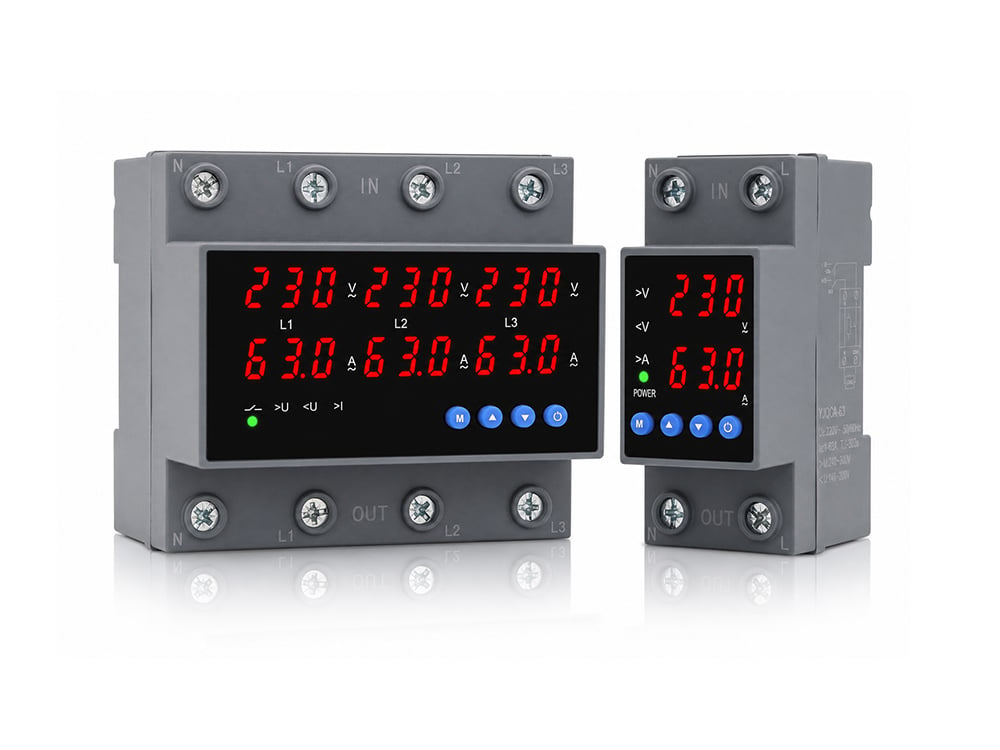



How to Install AFCI Breakers: Class and Wiring Readiness First
how to install afci breakers is a class-and-wiring readiness job first. Confirm US branch-panel AFCI versus DIN-rail AFDD, prepare neutrals, then pick hardware that matches the mount. The sections below map those gates for procurement readers before anyone opens a live enclosure.
Confirm the Device Class Before You Open the Panel
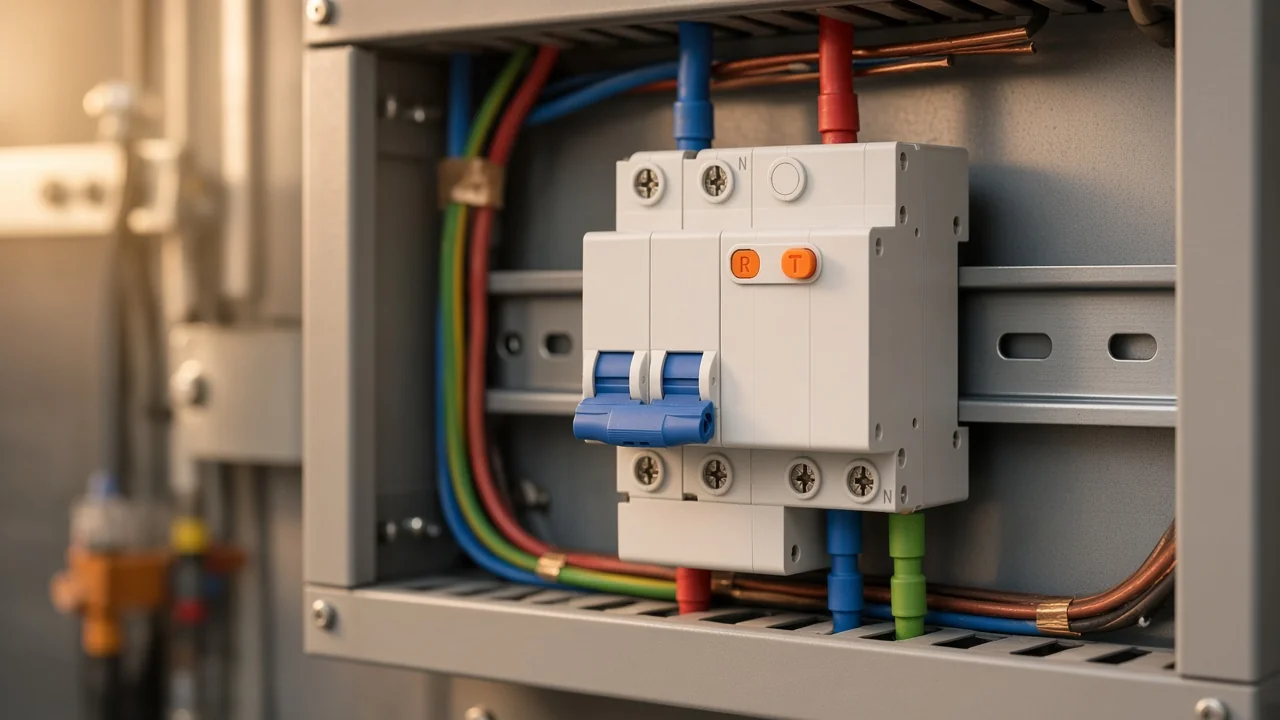
Confirm whether the job needs a listed US branch-panel AFCI or a DIN-rail AFDD-class device before tools come out.
Search results almost always show a residential load center: main off, cover off, breaker swap. That story fits many US dwelling and light-commercial branch circuits. It is not the only install class on the market.
An arc fault circuit interrupter in US practice is typically a combination-type device for branch-panel or receptacle protection under UL 1699 education and adopted NEC / NFPA 70 rules. An AFDD / DIN-rail arc fault device is the naming you see more often on modular distribution hardware. Related fire-risk job; different mount path.
If the takeoff says bedroom circuits in a US panel, shop a listed panel-family breaker for that bus. If the board is built around standard rail for building-like AC distribution, you are in AFDD-class territory. Yijin’s AFCI-related SKUs live under the Others category — treat it as a mixed aisle, not a US panel catalog.
| Decision cue | Branch-panel AFCI class | DIN-rail AFDD class |
|---|---|---|
| Typical mount | Load-center breaker slot | Standard DIN rail |
| Naming you will hear | Combination AFCI / UL 1699 education | AFDD / rail arc-fault breaker |
| Neutral interface | Pigtail or plug-on to panel neutral system | Per rail device instructions |
| Series / parallel arc language | Yes, on listed panel devices | Yes, on rail AFDD pages |
Yijin /others/ AFD pages |
Wrong class for this takeoff | Live YJB1-63/AFD family describes rail install |
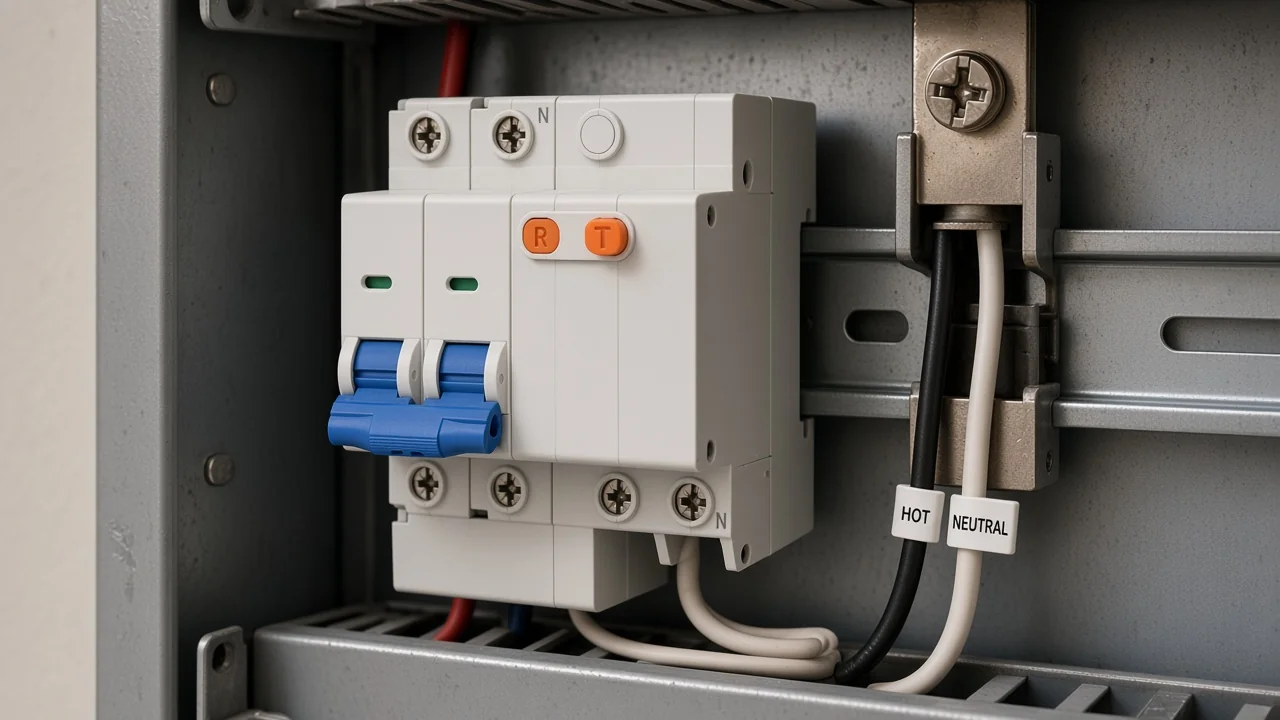
Branch-Panel AFCI Readiness Map
A listed panel AFCI job expects de-energized work, correct hot/neutral landing, and a TEST after energizing — not a casual snap-in.
US how-to consensus is a readiness map, not a DIY license. Before anyone reaches into a live branch panel / load center, the main is off, the cover is off, and conductors are voltage-tested clear.
The old breaker comes out only after its hot and white are identified. The replacement AFCI usually takes the circuit hot on the load power terminal and the circuit white on the breaker neutral terminal.
Many units also send a factory white pigtail to an open slot on the panel neutral bus; plug-on-neutral designs skip that coiled lead because they clip to a panel neutral bar. After the cover returns and power is restored, the TEST button is part of completion — not optional theater.
What readiness actually checks:
- Panel brand and bus family match the AFCI catalog for that enclosure.
- Pigtail versus plug-on style is known before the carton is opened.
- The circuit is identified end-to-end so the wrong hot/neutral pair is not landed.
- Torque and landing details follow the breaker and panel instructions.
- A qualified person owns the energized steps.
Load-Side Wiring Readiness: Neutrals, Pigtails, and Shared Circuits
Dedicated neutrals and the right pigtail or plug-on style matter as much as the breaker brand.
AFCI electronics watch the circuit path for arc signatures. That is why install quality is not only “does it snap onto the bus.”
The white conductor belonging to that branch normally lands on the AFCI so the device can see the load path. Neutral / pigtail units still need their factory white on the neutral bus. Plug-on units still need the circuit white on the breaker.
Shared neutral / multiwire layouts are the silent blocker. Field threads are blunt: typical AFCI breakers do not behave on a shared neutral the way a plain thermal-magnetic breaker might.
Electricians ask whether an AFCI receptacle at the first outlet can salvage a multiwire layout. Answers hinge on where the sharing happens and which device class is used. For planning, assume a dedicated hot/neutral pair unless the design and the chosen listed hardware explicitly support a multiwire arrangement.
From the field: Before you blame a brand-new AFCI for “nuisance” trips on first load, verify that two circuits are not borrowing one white. Shared or crossed neutrals show up again and again in trade discussions — including cases where a treadmill or other load only trips one bedroom AFCI while another circuit stays quiet.
Also keep AFCI and GFCI jobs distinct. Some AFCI breakers include ground-fault protection at equipment thresholds; that is not the same as personnel GFCI protection.
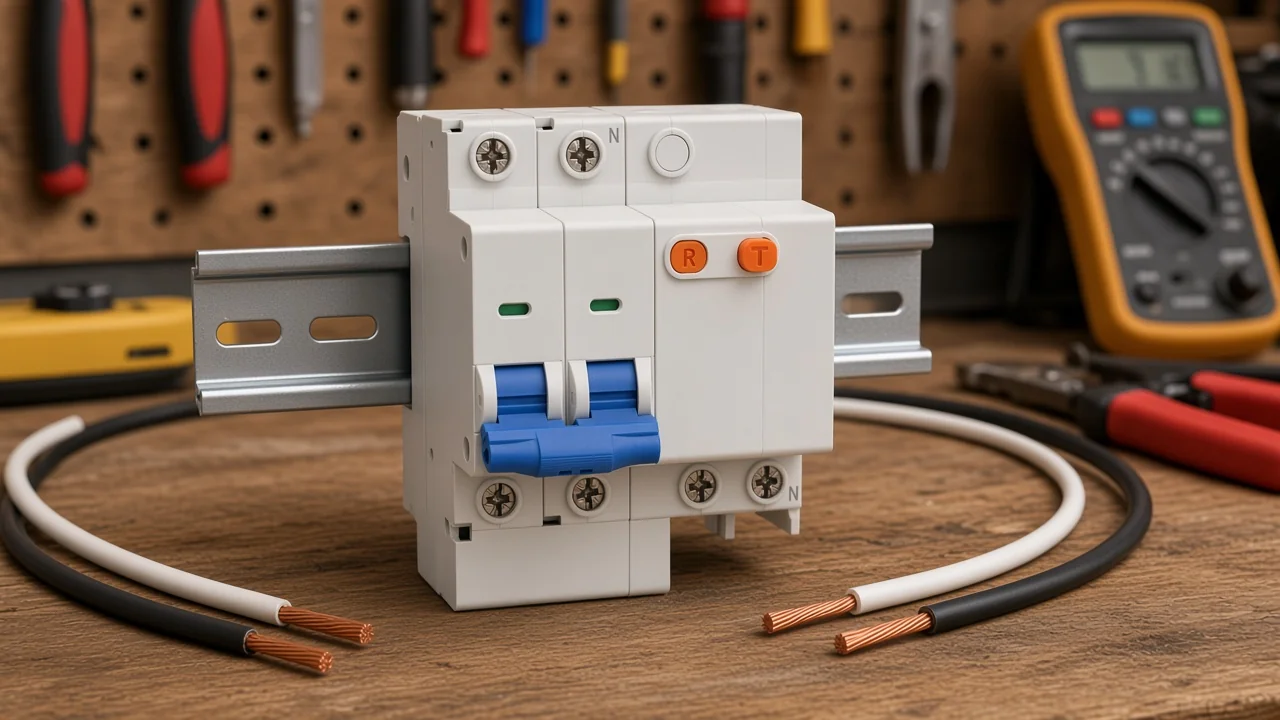
When DIN-Rail AFDD Is the Install Class
Choose DIN-rail AFDD when the distribution design mounts arc-fault protection on standard rail under that product class.
Rail-mounted AFDD-style breakers belong in boards built around DIN hardware: building distribution, similar-use lines, and specs that call for arc-fault plus overcurrent in a modular footprint.
The install readiness questions change. Instead of bus stabs and panel branding, you confirm rail space, pole count, voltage and frequency, and whether the design wants arc-only or arc-plus-leakage monitoring.
Calling a rail AFDD an “AFCI” in a US residential panel takeoff creates a false equivalency. Education sources treat AFCI and AFDD as related ideas across markets without making the listings interchangeable.
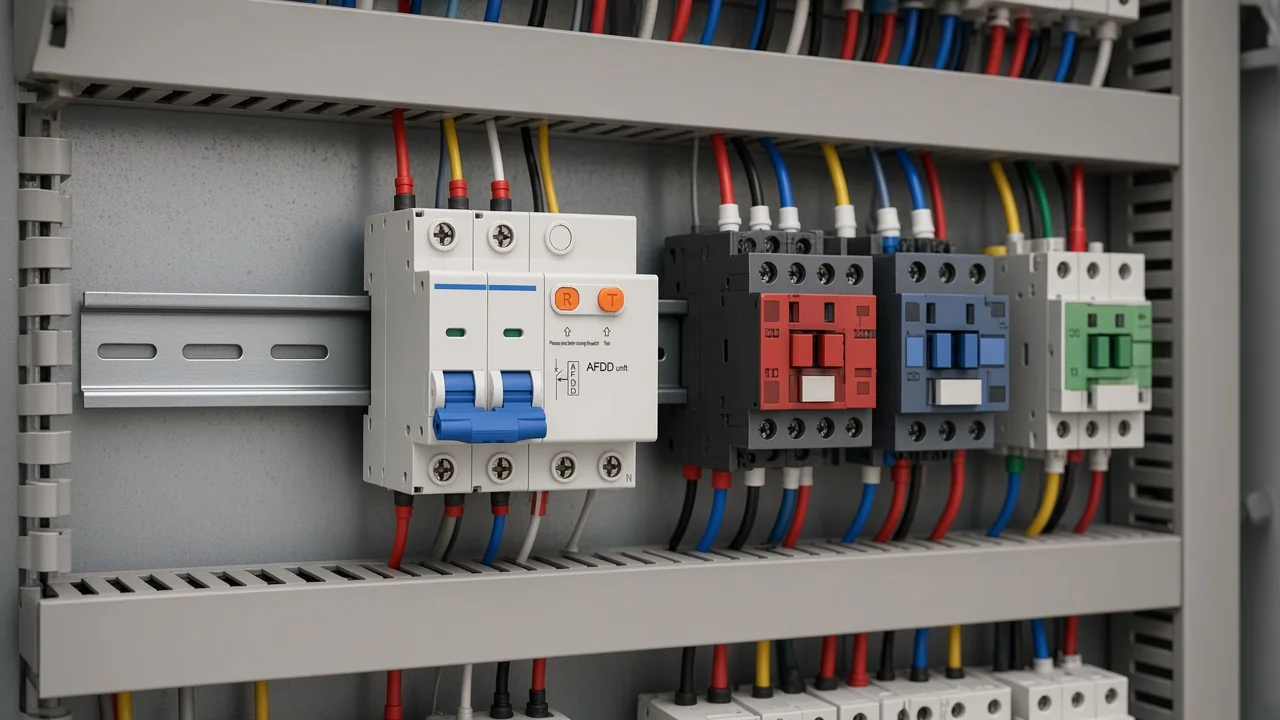
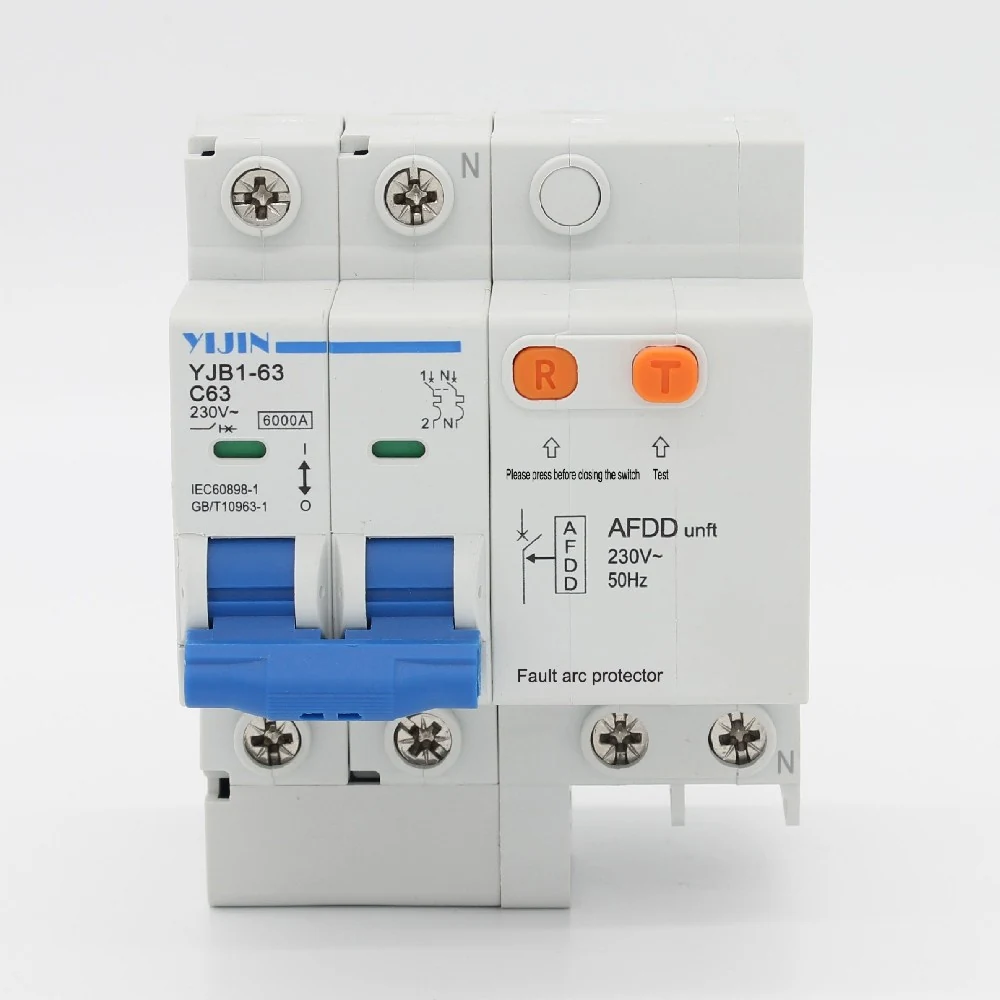
Which Yijin AFD Product Fits the Install Path
YJB1-63/AFD fits DIN-rail AFDD-class specs on the product page; SMG is a detector path; none are evidenced as US panel UL AFCI.
When the install class is DIN-rail AFDD for AC distribution lines, start with the live YJB1-63/AFD arc fault circuit breaker.
The product page describes an AFDD assembly of a small circuit breaker plus an arc-fault module, with overload, short-circuit, and series/parallel arc-fault protection.
It states AC 50 Hz, rated voltage 230 V, rated currents through 63 A, GB/T31143, C/D release characteristics, IP20, and standard rail installation. Those readiness facts matter for a rail board — not a US branch-panel stab pattern.
If the specification also wants leakage monitoring on the same rail footprint, review the YJB1-63/AFD Circuit Breaker with Leakage Arc Fault. The page keeps the AFDD framing and adds leakage monitoring with window indication and a leakage test feature, still on standard rail.
If the project needs detection and alarm/monitoring rather than a breaker swap, the YJ-AFD-SMG Fault Arc Detector is a different path: an independent fault-arc detector referencing GB14287.4-2014, with audible/visual alarm, mute/test/reset, and communication options.
| SKU | Install class on page | Use when | Wrong class for |
|---|---|---|---|
| YJB1-63/AFD | Standard rail AFDD-style breaker | 230 V / 50 Hz rail board needs arc + OCP within page ratings | US branch-panel AFCI takeoff |
| YJB1-63/AFD with leakage | Rail AFDD + leakage monitoring | Spec calls for leakage monitoring with arc fault | Personnel GFCI by default |
| YJ-AFD-SMG | Independent fault-arc detector | Alarm/monitoring and linkage are the job | Breaker replacement for panel or rail OCP |
Browse the wider cluster from Others after the class decision is locked. Confirm rail versus panel class with the project engineer before ordering.
Pre-Power Checklist for Either Install Class
Before energizing, confirm class match, conductor landings, shared-neutral absence, and a planned TEST or alarm check.
Use this as a gate:
- Class match: listed US branch-panel AFCI for panel jobs; DIN-rail AFDD or detector for rail/monitoring jobs.
- Identity: circuit labeled; hot and neutral pair confirmed; multiwire sharing ruled out or explicitly designed.
- Landing: pigtail or plug-on style completed per device; load hot and load neutral on the correct terminals; rail devices seated per instructions.
- Environment: for Yijin rail devices, stay inside the published environmental and altitude notes on the product page.
- Completion check: panel AFCI → TEST after energizing; detector path → test/reset and communication checks per the SMG page.
If any row fails, stop. A second breaker will not fix a shared neutral, and a rail AFDD will not satisfy a listed panel AFCI takeoff.
FAQ
Do AFCI breakers need a neutral?
Usually yes. Combination AFCI breakers need the circuit’s white on the device so sensing can see the load path, plus a pigtail to the neutral bus unless the breaker is a plug-on-neutral design.
Do I need AFCI outlets if I have an AFCI breaker?
Not automatically. A listed AFCI breaker can protect the branch; AFCI receptacles are an alternate means in code education. Stack devices only when the design calls for it.
Where do arc-fault breakers need to be installed?
In US practice, required locations expand across NEC cycles for dwelling areas and are jurisdiction-dependent. Confirm the adopted code and the authority having jurisdiction rather than treating a blog room list as universal law.
Can I install an AFCI breaker on a shared neutral?
Plan on no for typical AFCI breakers. Shared or crossed neutrals are a recurring field failure mode; fix topology or choose a listed approach that explicitly supports the circuit arrangement.
Is a DIN-rail AFDD the same install as a US panel AFCI?
No. Related arc-fault job, different mount and listing class. Keep the names honest instead of swapping them by label alone.
When does YJB1-63/AFD fit an install job?
When the design is DIN-rail AFDD-class work matching the product page: AC 50 Hz, 230 V, currents through 63 A, standard rail installation, with series/parallel arc plus overcurrent protection as described on the page.
What is YJ-AFD-SMG for if it is not a panel AFCI?
It is an independent fault-arc detector for alarm and monitoring paths under its product description — useful when detection and signaling are specified rather than a breaker replacement.
Does a fridge need AFCI and GFCI protection?
That depends on location rules and the adopted code cycle. Some areas and device types overlap; dual-function devices exist. Treat it as a code/application check, not a one-line internet answer.
References
- Wikipedia: Arc-fault circuit interrupter (install-class context)
- Industrial Control Academy: Arc fault protection systems overview
- IAEI Magazine: What changed for AFCIs in the 2014 NEC
- Engineering Mindset: AFCI breaker basics for installers
- ExpertCE: How an AFCI breaker detects arcs
- Mike Holt Forum: How AFCI devices work in the field
- Electrician Talk: AFCI shared-neutral install questions
Humanizer self-audit (Draft Agent YJ-DRF-AGT-20260910-01)
- Patterns found: boundary-formula density — reduced repeated “not UL / not substitute” loops to one product opening + table column.
- Split long paragraphs; steps moved to numbered list / bullets.
- Secondary keywords placed: arc fault circuit interrupter; AFDD / DIN-rail arc fault; AFCI shared neutral via “shared neutral” + pigtail sections.
- Entities named in prose: Neutral / pigtail; Shared neutral / multiwire; Branch panel / load center; NEC family naming; Series / parallel arc.
- No invented torque; second pass removed parallel “This means” closers.
- Evidence callout present: From the field (shared neutrals).