 Yueqing Yijin Electronics Co., Ltd.




Which Dwelling Spaces Sit on the AFCI List
The 2023 dwelling extract names kitchens, family rooms, dining rooms, living rooms, parlors, libraries, dens, bedrooms, sunrooms, recreation rooms, closets, hallways, laundry areas, and similar areas. People searching where are afci breakers required are sorting that list against bathroom areas, garages, and outdoors. A laundry area sits on the list with the bedrooms, while a house bathroom is a different case from a dormitory bathroom.
Dwelling rooms named on the 2023 required list
The 2023 dwelling extract names fourteen locations, and bedrooms are only one of them. An arc-fault circuit interrupter on a dwelling unit branch circuit follows NEC 210.12, not a bedroom-only habit left over from the first code cycle.
Electrical License Renewal’s 2023 text moves that old paragraph into a numbered list under 210.12(B). The rooms are kitchens, family rooms, dining rooms, living rooms, parlors, libraries, dens, bedrooms, sunrooms, recreation rooms, closets, hallways, laundry areas, and similar areas.
Yes, afci breakers are required in bedrooms. They are also required for the kitchen and the laundry area on that same list. A parlor, a library, a den, a sunroom, a recreation room, a closet, and a hallway are named too.
| Named location | How the 2023 extract lists it |
|---|---|
| Kitchens | Item 1 |
| Family rooms | Item 2 |
| Dining rooms | Item 3 |
| Living rooms | Item 4 |
| Parlors | Item 5 |
| Libraries | Item 6 |
| Dens | Item 7 |
| Bedrooms | Item 8 |
| Sunrooms | Item 9 |
| Recreation rooms | Item 10 |
| Closets | Item 11 |
| Hallways | Item 12 |
| Laundry areas | Item 13 |
| Similar areas | Item 14 |
The 1999 text started with bedroom outlets. In 2002 the word receptacle dropped out of that bedroom rule, so a light or a ceiling fan in a bedroom counted as an outlet. Wikipedia’s history then records a 2008 exception set that still left laundries and kitchens out, and a 2014 addition that brought kitchens and laundry rooms in.
EC&M’s 2016 answer already shows the 2014 dwelling list with kitchens and laundry areas on it. One means named there is a listed combination-type AFCI installed to protect the entire branch circuit. The 2023 restructuring keeps the room family and changes the section layout, so older letters such as 210.12(A) for the room list should not be copied onto the 2023 page.
Similar areas is the fourteenth item, and it is a judgement the extract does not fill with extra room names. A home office, a mudroom, or a finished basement may be treated as similar by an inspector, but those names are not printed in the 2023 list read for this article.
Stairways stay off the printed list. The named hallway item is the one to use.
The practical form of are afci breakers required by code is this adopted section. Jurisdictions still choose the edition they enforce.
Spaces the 2023 extracts leave off that list
Bathroom areas, garages, and outside are the off-list outlets named in the 2023 summary. Mike Holt’s 2023 newsletter says AFCI protection is not required for outlets in bathroom areas, garages, or outside, then repeats the fourteen dwelling locations for the circuits that are in scope.
| Space | What the 2023 summary does with it |
|---|---|
| Bathroom areas in a dwelling | Named as outlets where AFCI protection is not required |
| Garages | Named as outlets where AFCI protection is not required |
| Outside | Named as outlets where AFCI protection is not required |
| Unfinished basement | Not named in that off-list sentence |
| Attic | Not named in that off-list sentence |
| Stairway | Not named; hallways are the listed circulation space |
A contractor timeline that says the 2020 code added garages does not match this 2023 summary. The summary still leaves garage outlets off the required side. Use the summary, not the conflicting year table.
A garage light can still land on an AFCI circuit when the run starts in a bedroom or passes through a hallway or a laundry area. NEC Mastery’s 2020 discussion calls the garage and the bathroom conspicuously absent, then says the requirement follows the circuit. Absence from the room list still leaves that pass-through case open.
From the field: Most of what you think is optional is required in 2014. Of the items you did mention, the bathroom, garage, attic, or unfinished basement are not required (in general) there can be a few circumstances where a particular circuit may still need protected. — https://forums.mikeholt.com/threads/where-to-not-use-afci.120545/
That forum sentence is a 2014 argument. It refuses a blanket skip. Attics and unfinished basements stay off the 2023 summary’s exclusion line, because that line does not name them.
Walk the hallway before you mark the garage as a free space. If the only switch for that garage light sits in the hallway, the listed room is already on the circuit.
The ampere and voltage cut that keeps a room circuit in or out
Only some branch circuits inside a listed room fall under the dwelling rule. The 2023 dwelling extract applies to 120 V, single-phase, 10 A, 15 A, and 20 A branch circuits supplying outlets or devices in those rooms.
Mike Holt’s 2023 summary states that same dwelling list for 15 A or 20 A, 120 V circuits. Read the two sentences side by side. The continuing-education extract adds 10 A.
The newsletter summary does not repeat 10 A. A 2026 statement of Section 210.12 still describes 15 A and 20 A, 120 V circuits in that room family, on the AFCI Safety fast-facts page.
Keep the dated statements apart. Leave the 10 A sentence in place when another page omits it. The device itself, in the 2023 lead-in, shall be listed and installed in a readily accessible location.
A 240 V compressor circuit is outside the 120 V qualifier those extracts use. The room can be a kitchen and the breaker can still sit outside this particular rule because the voltage does not match. That mismatch is a circuit fact.
Combination-type AFCI protection at the origin is the means the 2014 answer highlights for the whole branch. Later text still allows other listed means, including an outlet device at the first outlet when the wiring method meets that means.
This page stops at the location decision and leaves installation methods to the electrician on site.
What changes when wiring in a listed room is extended
Untouched wiring is not rewritten by the newest text. Extended, modified, or replaced wiring in a listed area is the trigger in the 2023 summary.
If 15 A or 20 A, 120 V branch-circuit wiring is extended, modified, or replaced in an area named in the dwelling, dormitory, or other sleeping-occupancy rules, the summary calls for an AFCI circuit breaker or an AFCI receptacle at the first receptacle outlet. The short exception is extension wiring less than 6 ft long when no outlets or devices, other than splicing devices, are added. Conductors inside an enclosure, cabinet, or junction box are left out of that length.
An older house can keep existing bedroom and living-room circuits until that wiring is the thing being changed. The fast-facts page makes the same point in adoption language: the stricter level is typically required in new construction that is subject to the latest adopted edition.
House age by itself is not the switch. The work in a listed room is the switch.
A panel swap that does not extend those circuits is a question for the authority having jurisdiction. The summary’s own reply on a panel-upgrade comment is to check that authority. The sentence in the code summary is the extension rule.
A laundry-area circuit that is replaced during a remodel falls under the listed room plus the extension rule. A garage circuit that is replaced, and that never enters a listed room, stays on the off-list side of the 2023 summary.
A dormitory bathroom is a different occupancy decision
A dormitory bathroom is on the 2023 dormitory list even though a dwelling bathroom area is not. Dormitory coverage in that summary is also a 15 A or 20 A, 120 V rule, and the locations are bedrooms, living rooms, hallways, closets, bathrooms, and similar rooms.
The dwelling unit list and the dormitory unit list share bedrooms, hallways, and closets. They do not share the bathroom answer. Copying the house rule into a dormitory, or the dormitory rule into a house, swaps the outcome.
The same summary then names other sleeping places under 210.12(D). The other sleeping occupancies in the summary use the same 15 A or 20 A, 120 V cut. Those places are guest rooms and guest suites of hotels and motels, patient sleeping rooms in nursing homes and limited-care facilities, and sleeping quarters in fire stations, police stations, ambulance stations, rescue stations, ranger stations, and similar locations.
None of those lines repeats the dwelling list. A hotel guest room is separate from a parlor even when both have a bed. The occupancy heading decides which list you open.
Put the garage back in the dwelling column after you finish the dormitory check. Garage outlets stay in the 2023 dwelling off-list sentence unless the circuit also serves a named dwelling room.
Select the YJB1-63/AFD for a standard-rail building line, not a US dwelling AFCI slot
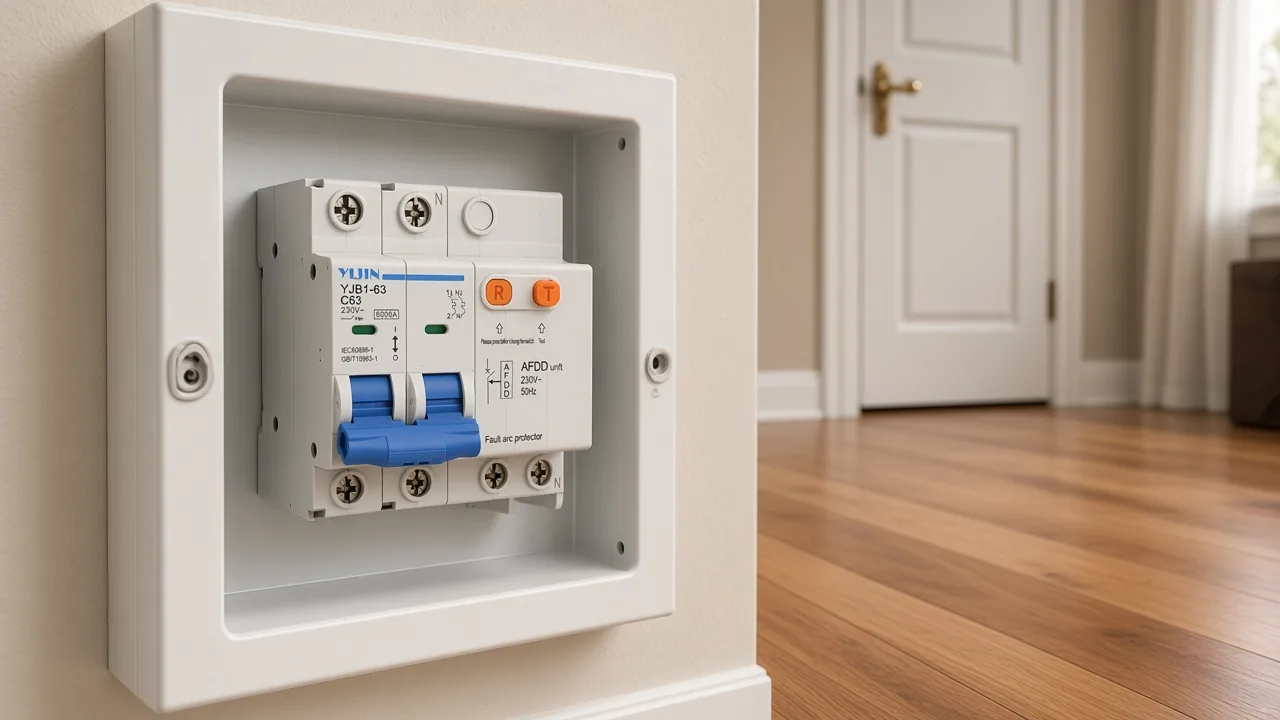
Select this standard-rail device for the building lines on its page, not as the breaker that meets the US dwelling list. The YJB1-63/AFD arc fault circuit breaker is assembled from a small circuit breaker and an arc fault protection module.
The page rates YJB1-63/AFD at AC 50 Hz and 230 V, with current up to 63 A. It states overload protection, short-circuit protection, and both series arc faults and parallel arc faults, for buildings and similar use lines.
Installation on the page is standard rail. The standard row reads GB/T 31143.
That page does not present a UL listing, and it does not present this SKU as a means of protection under NEC 210.12. A US dwelling plan that needs a listed AFCI breaker for a 120 V bedroom or kitchen circuit is looking for a different device. The arc-fault products category is the cluster home for this hardware, not a substitute for the room list above.
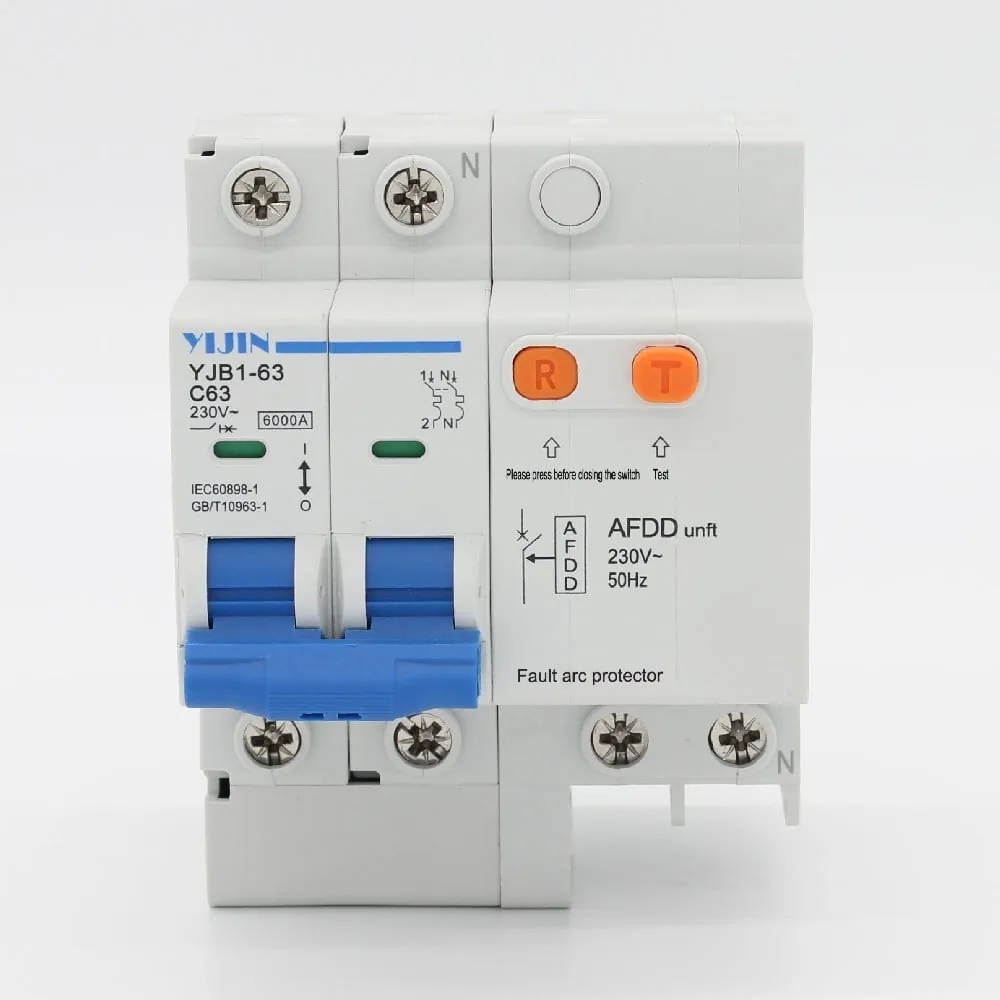
Buyers who already know the US room list still need a voltage check before they treat any rail device as the panel answer. On a 230 V building line that matches the page, the module-plus-breaker assembly is the fit. On a 120 V dwelling branch circuit, the fit is a listed AFCI means the page does not claim to be.
FAQ
Where do you not need AFCI breakers?
The 2023 summary names outlets in bathroom areas, garages, or outside. A circuit that passes through a kitchen, hallway, bedroom, or other named room can still carry the requirement into a garage or a bathroom.
Does a refrigerator require an AFCI breaker?
The extracts read here do not name a refrigerator exemption. A 120 V kitchen circuit that supplies the refrigerator outlet is in a named room. Nuisance tripping is a field complaint, including on rewiring threads, and it does not delete the kitchen from the list.
Why is AFCI not required in bathrooms?
For a dwelling, the 2023 summary says bathroom-area outlets are not required to have AFCI protection. That sentence is about dwelling bathroom areas. It is not the dormitory sentence.
Are AFCI breakers required in older homes?
Existing circuits stay as they are until the wiring in a listed area is extended, modified, or replaced, or until the local adoption says otherwise. New construction under the adopted edition is the case the fast-facts page highlights.
Are AFCI breakers required for a dormitory bathroom?
Yes. The 2023 dormitory list in the same summary includes bathrooms, along with bedrooms, living rooms, hallways, closets, and similar rooms.
Are all breakers in a dwelling AFCI breakers?
No. The extracts limit the dwelling rule to 120 V branch circuits at the ampere values they state, in the named locations. Garage, bathroom-area, and outside outlets are the off-list group in that summary.
Are AFCI breakers required for lighting circuits?
A light in a named room is an outlet or device on that circuit, which is why the 2002 bedroom change pulled lights in. Location detail for luminaires is already covered in do lights need AFCI protection. Shock protection is a separate rule, covered beside this topic in AFCI versus GFCI.
References
- Electrical License Renewal, 2023 NEC 210.12 continuing-education extract: 210.12 AFCI Protection
- Mike Holt, GFCI and AFCI based on the 2023 NEC: newsletter
- Wikipedia, historical US room-list notes: Arc-fault circuit interrupter
- EC&M, Mike Holt’s 2014-cycle answer, 8 December 2016: Code Q&A: AFCI Requirements
- AFCI Safety, edition statement and adoption note: Fast facts
- Mike Holt’s Forum, 2014 field debate on spaces left off the list: Where to NOT use AFCI