 Yueqing Yijin Electronics Co., Ltd.




When a 3 Way Light Timer Switch Fits a Two-Location Circuit
A 3 way light timer switch is a wall timer built to replace one switch in a two-location lighting circuit that already uses travelers. Most US search results point to decorator or rocker timers with SPDT-style 3-way marketing, not to a panel rail module. The sections below separate that wall-timer class from a DIN-rail time switch, then show when the KG316T time control switch is the better recommendation.
What a 3 way light timer switch actually is
A 3 way light timer switch is a wall device meant to replace one switch in a two-location lighting circuit. Shoppers use that phrase when a stair, hallway, or garage light already has a three-way switch at each end and they want a schedule or countdown in one box.
Retail results for this query cluster around in-wall digital timers and smart wall switches. Those products compete on programs, dusk/dawn modes, and single-pole/3-way labeling.
They remain wall-box hardware. A panel timer switch on a rail is a different mounting and terminal job even when both devices turn lights on and off by time.
How travelers define a true two-location circuit
Travelers are the ungrounded conductors that let two locations switch the same light. In a conventional three-way switch pair, those travelers run between the two boxes while each switch also has a common terminal for line or load.
US code education for Article 404 states that 3-way and 4-way switching is done on the ungrounded circuit conductors, not by switching the grounded neutral. If your box only has a hot, a switched hot, and a bare ground with no second traveler path, you are not looking at a standard two-location traveler circuit.
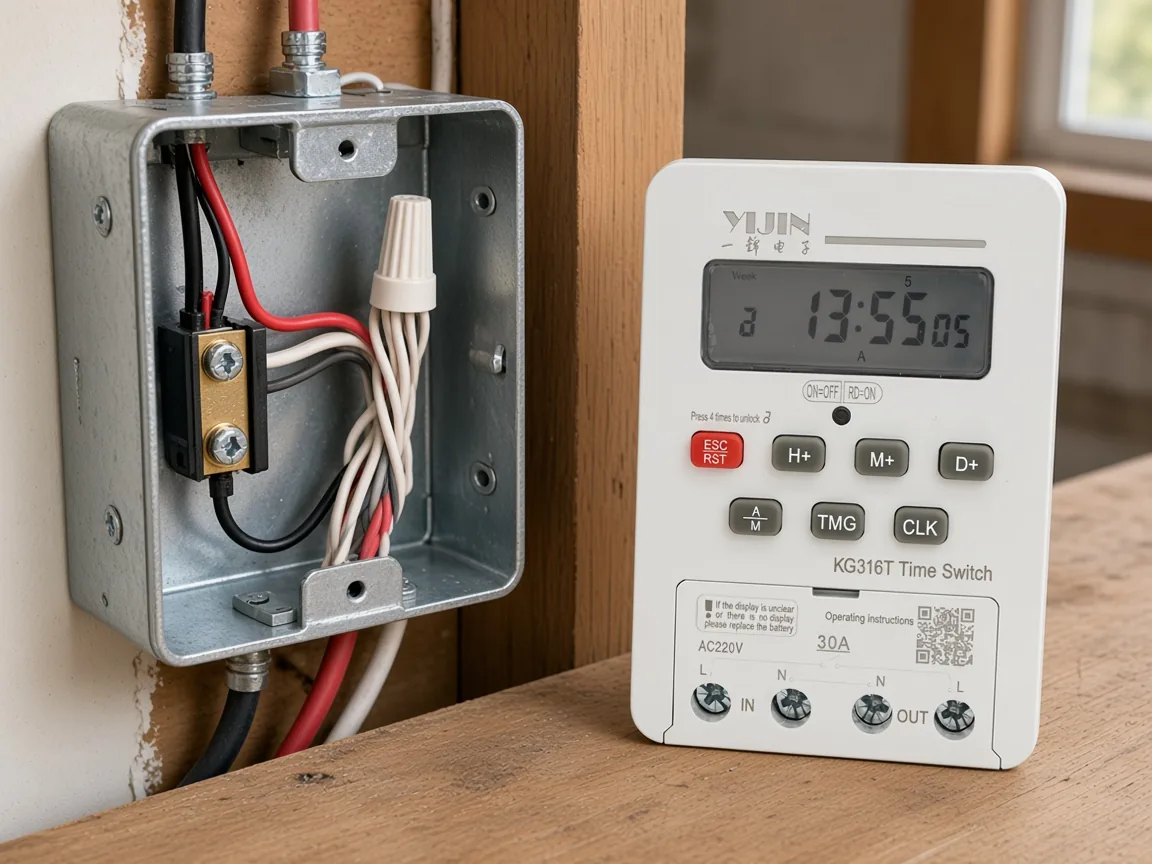
That distinction matters before you buy any programmable timer switch. A wall timer marketed for 3-way use expects traveler-related terminals or a companion path. A rail time-control switch expects supply and load terminals in an enclosure.
Why many electronic 3-way timers need a neutral
Many digital or smart 3-way timers need a neutral wire in the wall box for their electronics. NEC educational summaries for 404.2(C) explain why lighting switch locations in bathrooms, hallways, stairways, and habitable rooms are expected to have a grounded conductor available, with a multi-location exception that only one visible switch location may need it.
Older dead-end three-way boxes often lack that white bundle. Electricians on Mike Holt’s forum note the same gate when a digital wall timer such as an Intermatic EJ600-class device is proposed: the model still needs a neutral available. If the timer needs line-to-neutral power and the box has no grounded conductor, choose a no-neutral 3-way timer or move the timed control to a location that has one.
Wall traveler timer versus a rail time switch
A traveler-rated wall timer and a DIN-rail time switch solve different mounting and terminal jobs. The wall product stays in a decorator opening and keeps two-location control through travelers, a jumper, or a brand companion remote. The rail product mounts on a 35 mm guide rail and switches a control or load circuit through printed IN/OUT terminals.
| Decision point | Wall 3-way / SPDT timer | Rail time-control switch |
|---|---|---|
| Mounting | US wall box, decorator/rocker form | Panel or enclosure on 35 mm rail |
| Two-location path | Travelers, jumper, or companion remote | Not a wall traveler replacement |
| Neutral expectation | Common for digital/smart models | Follow the product’s supply wiring |
| Typical search language | 3 way light timer switch | Time control switch / timer switch |
| Example first-party SKU | Outside the assigned rail SKU | KG316T time control switch |
Use the wall column when the reader’s pain is “keep both hallway locations working and add a schedule.” Use the rail column when the load should be timed from a panel feed, outdoor lighting contactor circuit, or other enclosure control point.
Checklist before you buy a wall 3-way timer
Confirm travelers, common, neutral, and whether a companion remote is required before you buy. Open both boxes with power off and mark the common wire on each existing three-way switch before anything is removed.
- Identify the two traveler conductors and the common terminal at the location you plan to replace.
- Check for a neutral wire bundle if the digital timer instructions require one.
- Read whether the brand needs a matching companion remote instead of leaving a standard three-way toggle on the other end.
- Confirm the timer’s 3-way instructions cover your line-side or load-side box, including any jumper at the remote location.
- Reject unlisted 4-way intermediate boxes unless the timer documentation expressly supports that topology.
From the field: One Mike Holt thread on digital timer traveler terminals shows a homeowner trying every Line/Load/Traveler permutation on a Defiant digital timer after jumpering the remote three-way switch. The failure mode was terminal identity, not “more programs.” Mark common and travelers first.
If the checklist fails because the job is really panel-fed scheduled control, stop forcing a wall timer into the search and move to a rail time-control switch.
When the KG316T rail time switch fits instead of a wall timer
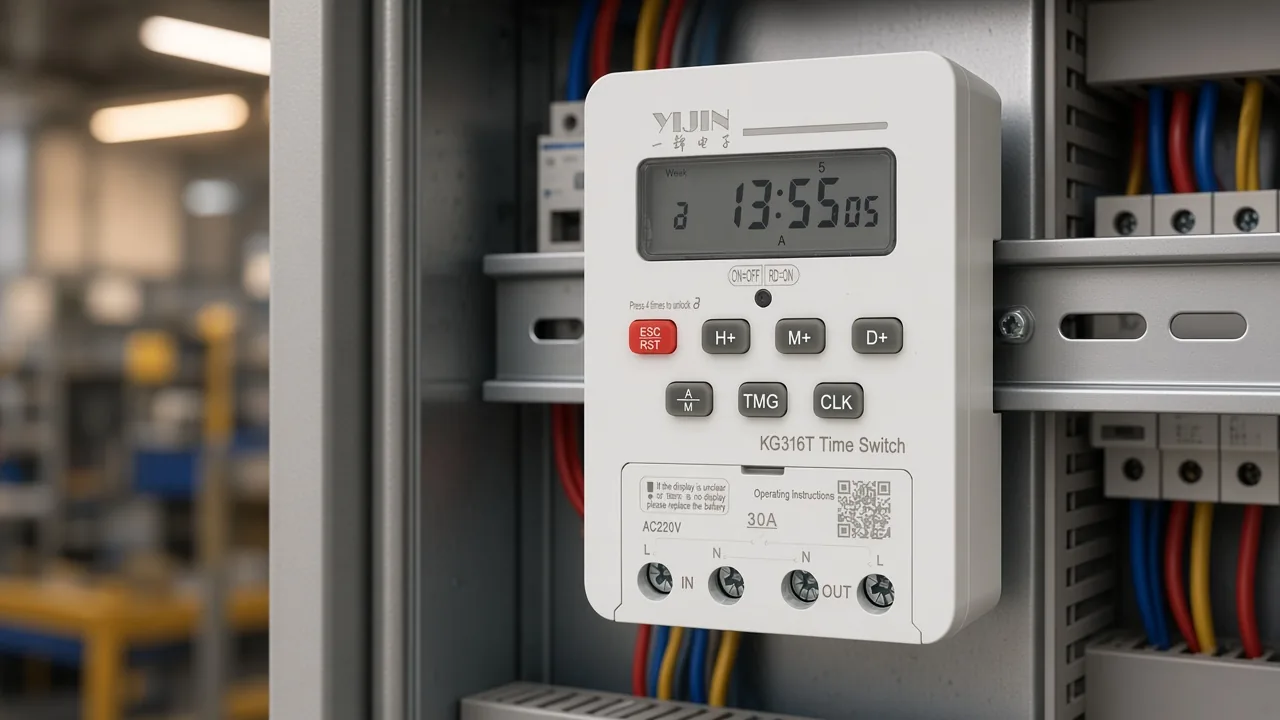
Choose the KG316T time control switch when you need panel or rail scheduled control within its printed ratings, not a decorator 3-way replacement. The live product page presents KG316T as a time-control switch for AC 50/60 Hz control circuits, with 35 mm standard guide rail installation and IN/OUT wiring for direct load control or an AC contactor coil path.
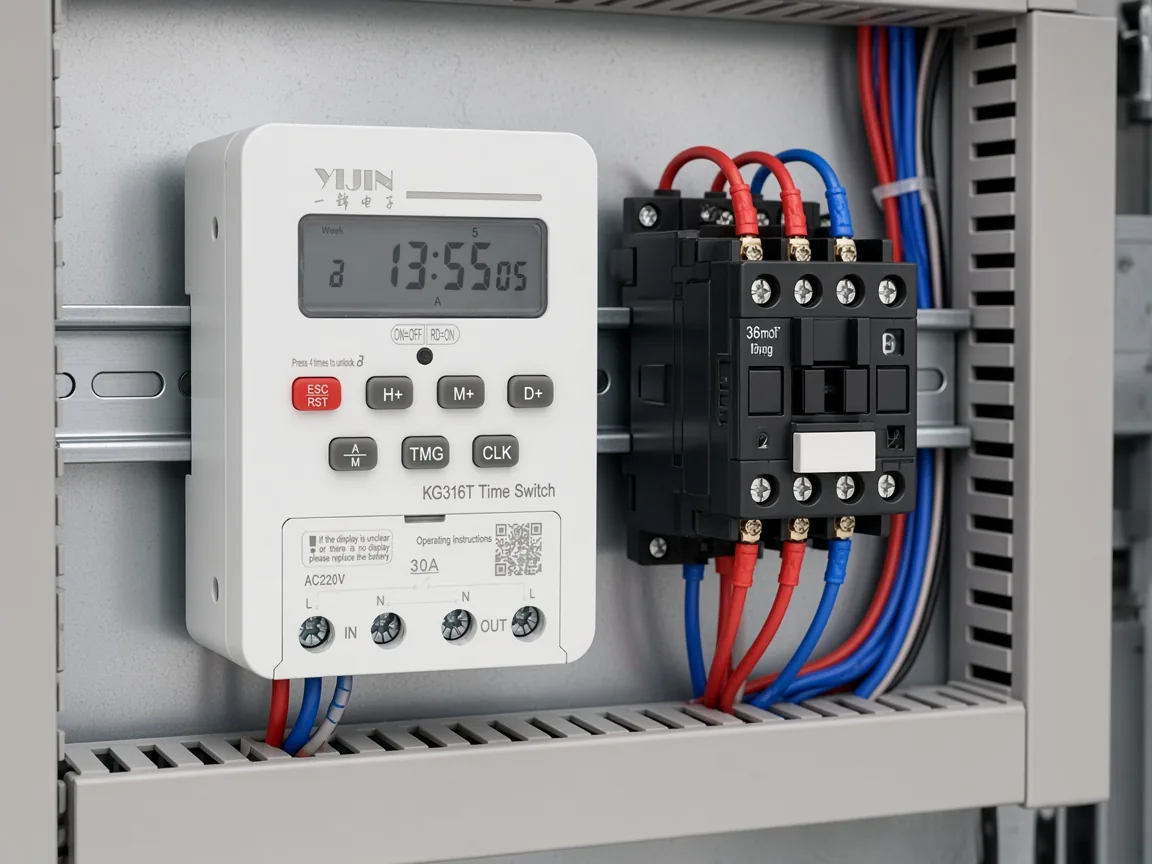
That is the fit boundary. The live page does not print traveler terminals, a US wall-box 3-way diagram, or a UL listing. Do not treat KG316T as a drop-in for a hallway three-way switch search.
The same page prints the control-supply and load figures below. Match your circuit to these values before you specify the SKU.
| Printed item | Value on the KG316T page |
|---|---|
| Control supply US | AC 50/60 Hz: 220 V, 380 V |
| Rated insulation voltage Ui | AC 380 V |
| Resistive / inductive / motor / lamp load | 6 kW / 1.8 kW / 1.2 kW / 0.9 kW |
| Programs | Up to 16 on/off actions per day; daily or weekly cycle |
| Setting range | Minimum 1 minute; maximum 168 hours |
| Enclosure / ambient | IP50; −5 ℃ to +40 ℃; altitude ≤ 2000 m |
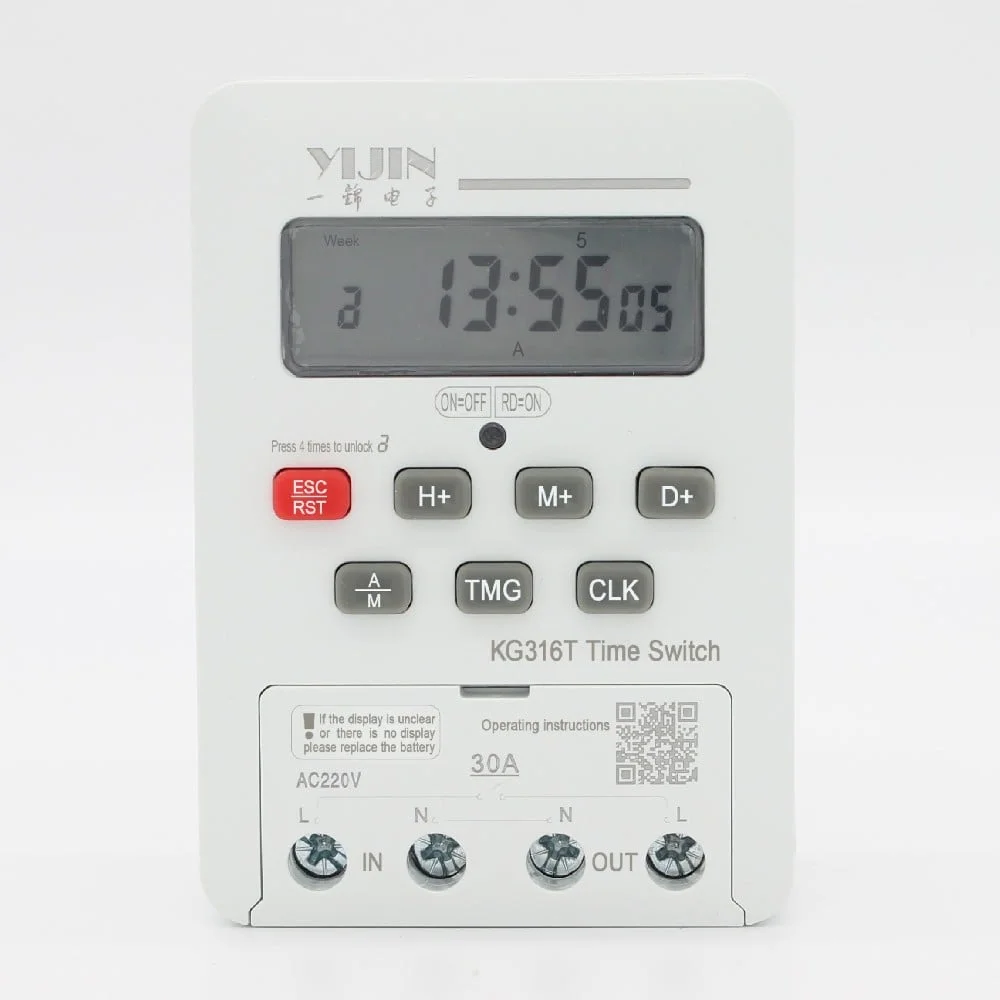
KG316T is a digital timer switch with an LCD, replaceable AAA battery backup, and high-power relay output on the product description. Use it when a rail enclosure is the right place for the schedule and the load stays inside those printed limits. For wall-box wiring practice on other timer classes, see the live cluster notes on how to install a timer switch for lights and timer switches for LED lights without treating those pages as 3-way traveler instructions for KG316T.
FAQ
Can you put a timer on a 3-way light switch?
Yes, when the timer is rated for 3-way use and you follow its line/load/traveler or companion instructions. A panel rail timer is not the same answer as a wall 3-way timer.
Is there a dedicated 3-way timer switch?
Yes. US retail results show many in-wall digital and smart timers marketed for single-pole/3-way or SPDT use. Confirm travelers, neutral, and companion requirements on that exact model.
Do 3-way timers need a neutral wire?
Many electronic models do. Check the instructions and the box for a grounded conductor; some specialty no-neutral 3-way timers exist, but digital/smart units often require neutral.
What are travelers on a 3-way circuit?
Travelers are the ungrounded conductors between the two three-way locations. They are not neutrals and should not be treated as spare whites for timer power.
Can a DIN-rail KG316T replace a decorator 3-way wall switch?
No as a drop-in wall replacement. The live KG316T page shows rail mounting and L/N IN-OUT control wiring without traveler terminals or a US 3-way wall diagram.
Why do some timers require a companion remote?
Some electronic multi-location timers keep two-location control only with the brand’s matching companion remote, not with a leftover mechanical three-way toggle.
What lamp load figure does KG316T print?
The live page lists lamp load as 0.9 kW, with separate resistive 6 kW, inductive 1.8 kW, and motor 1.2 kW figures.
For weekly program depth on rail timers outside the traveler-wall decision, keep the focus on the printed daily and weekly cycle limits above rather than cloning a separate weekly-timer buyer guide.