 Yueqing Yijin Electronics Co., Ltd.




Why lamp watts mislead a timed LED circuit
A timer switch for led lights closes and opens a lighting circuit on a clock. The steady watts printed for lamps do not describe the short gulp an LED driver takes as it wakes.
Search results for this phrase are mostly decorator wall timers and plug-in boxes. The notes below stay with a rail time switch, the lamp line on its parameter list, and the difference between running power and startup current.
A Decorator Wall Timer Is a Different Device
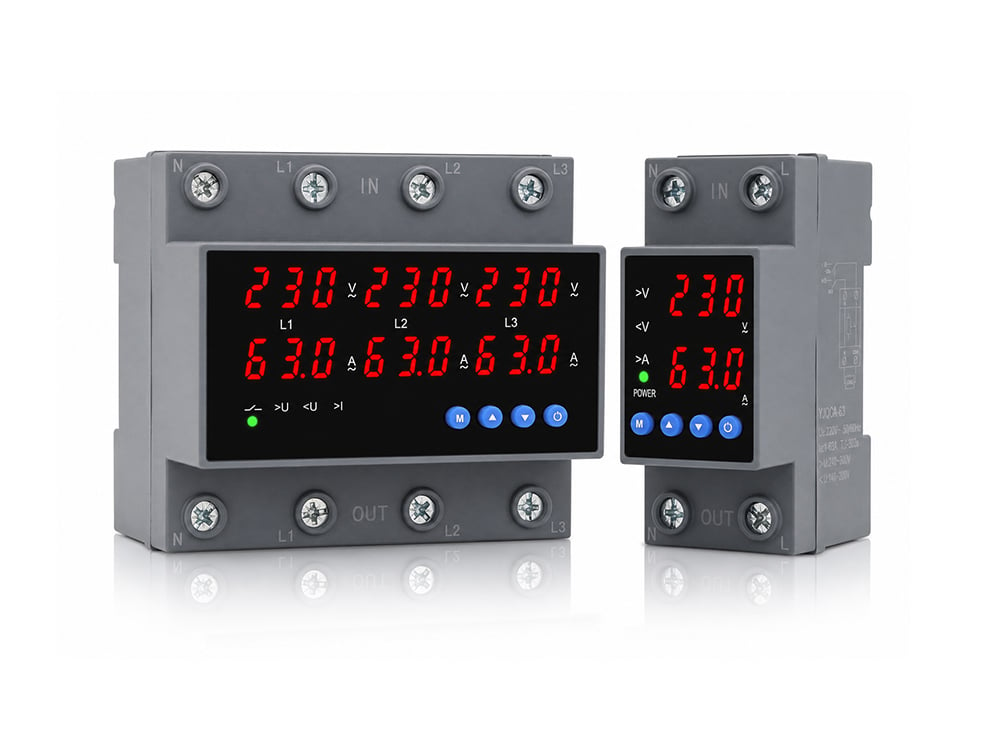
The pages that rank here sell in-wall countdown buttons, 7-day wall programmers, and lamps with a schedule built into the bulb. KG316T is a different object: a control-circuit time switch that clips to a DIN rail and drives a relay.
A digital timer switch for led lights, in the related-search sense, often means a decorator keypad that replaces a household rocker. Cards on the same results page say programmable light switch timer for that wall device.
Those boxes are built for a residential wall opening. Many of them offer a short countdown rather than a week of stored clock events.
KG316T stores clock events for street lamps, neon, advertising signs, broadcast gear, and other loads the product page names. It takes its own control supply. That arrangement is unlike a series timer that sits in the hot wire and borrows a trickle through the lamp so the timer itself can stay awake.
Series timers are why some LEDs stay lit after the dial says off. The lamp never presents the resistive path the timer expected, so the timer cannot finish the break.
A relay with its own supply does not need that trickle. Reading a wall-timer listing as if it were this module mixes two wiring jobs.
People also meet timer bulbs, where the schedule lives in the lamp and the wall switch only marks the start of the day. That product never lands in a panel.
Outdoor WiFi boxes and spring-wound 24-hour dials are covered on the outdoor WiFi timer and 24-hour mechanical timer notes. This one is about lamp-load timing on the non-WiFi rail switch.
Steady Lamp Watts Hide the Driver Startup Pulse
Running watts are what the lamps draw after they are already on. LED drivers can pull a short startup current while their input capacitors charge, and that pulse is easy to miss if the only number on the desk is lamp watts.
Inrush current is the name for that switch-on peak. Power converters often draw far more current for a moment than they draw in steady running, because the capacitors look like a short until they charge.
An LED driver is that kind of converter. The pulse is brief, and it still passes through whatever relay or switch closed the circuit.
Forum users who gang several LED supplies onto one switch describe the same split. Running current looks modest. The published startup figures on the supplies look large, and the worry is the sum of those pulses, not the sum of the running watts.
One older bench story is simpler: relay contacts weld shut because a capacitor inrush exceeded what the contacts were made to close.
Important: LED drivers can pull a short startup current above the steady lamp watts, and a lamp-power line is not that pulse measurement — Inrush current.
No KG316T inrush figure is printed on the product page. Copying an ampere example from someone else’s driver would invent a test this module did not receive. The honest statement is the direction of the risk: startup can sit above steady lamp current, and the page does not quantify it.
A shed owner with a row of LED high-bays ran into the practical version of this. The lamps were left on, a wall timer looked attractive, and the LED watt rating on the switch was much lower than the incandescent rating.
Replies pushed the timer toward a contactor that actually carries the lamps. That is user practice, not a lab result for this SKU.
The Lamp Line Is a Ceiling, Not a Test
Lamps get their own line on the parameter list, separate from heaters and motors.
Load power on the page is resistive 6 kW, inductive 1.8 kW, motor 1.2 kW, and lamp 0.9 kW.
Read the lamp load line as the ceiling for lamps. It sits well below the resistive load line because lamps, especially electronic ones, are harder on contacts than a heater of the same running watts. Treat 0.9 kW as the most the page allows for lamp power while the lamps are in normal operation.
The four lines are repeated here for scanning.
| Load class | Power line on the page |
|---|---|
| Resistive | 6 kW |
| Inductive | 1.8 kW |
| Motor | 1.2 kW |
| Lamp | 0.9 kW |
No pulse width, peak ampere, or NEMA 410 claim sits beside the lamp line. If the drivers in the circuit are known to spike hard, the steady ceiling is only the first screen.
The page also says that where a failure could hurt people or cause large loss, the user should leave margin and add protection such as a second circuit.
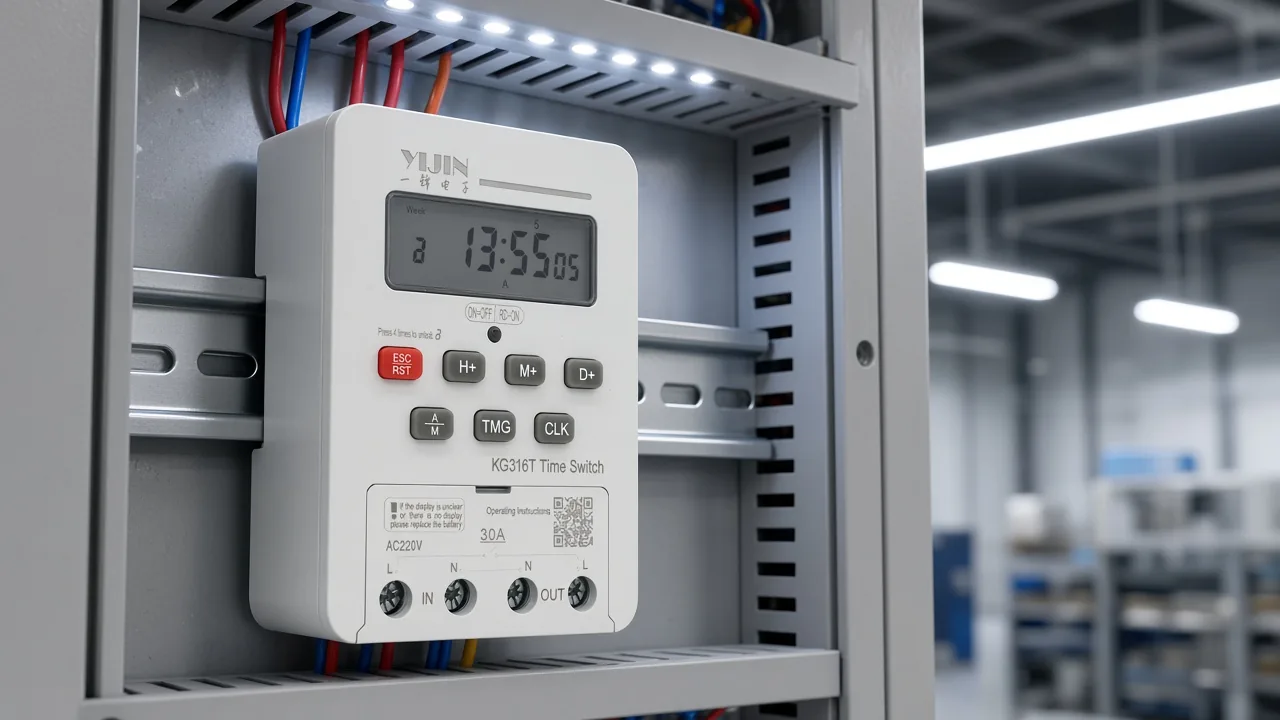
Add the lamp watts the drivers will actually run, not the marketing equivalent watts on a retrofit bulb. A group of signs can sit under the lamp ceiling on running power and still say nothing about the startup pulse. One driver already near that ceiling leaves no room for extra fixtures.
Mechanical life is listed at 1,000,000 cycles or more, and electrical life at 100,000 cycles or more. Those cycle counts describe contact endurance under the page’s load classes. They do not replace an inrush test.
Daily and Weekly Events Are Not a Countdown Button
Wall countdown timers turn a load off after a short press-button interval. KG316T keeps a clock and a list of on and off events that can repeat every day or on chosen weekdays.
The shortest step is 1 minute, and the longest span is 168 hours.
Daily timekeeping error stays within 2 seconds. Weekly correction can add or remove up to 28 seconds.
Up to 16 on/off pairs can be stored for one day. Unused slots are left blank so they do not fire.
| Program item | What the page allows |
|---|---|
| Events per day | Up to 16 on/off pairs |
| Repeat | Daily or a chosen set of weekdays |
| Shortest step | 1 minute |
| Longest span | 168 hours |
| Daily clock error | Within 2 seconds |
| Weekly correction | Up to 28 seconds |
Those rows restate the program limits in the sentences above.
The keypad locks after 15 seconds without a press. Unlocking takes four presses of Cancel/Restore, then the week, hour, and minute keys set the clock and each event.
A replaceable AAA battery holds the display when the supply is gone. A blank screen is the page’s cue to change that cell, not a sign that the relay logic has been redesigned.
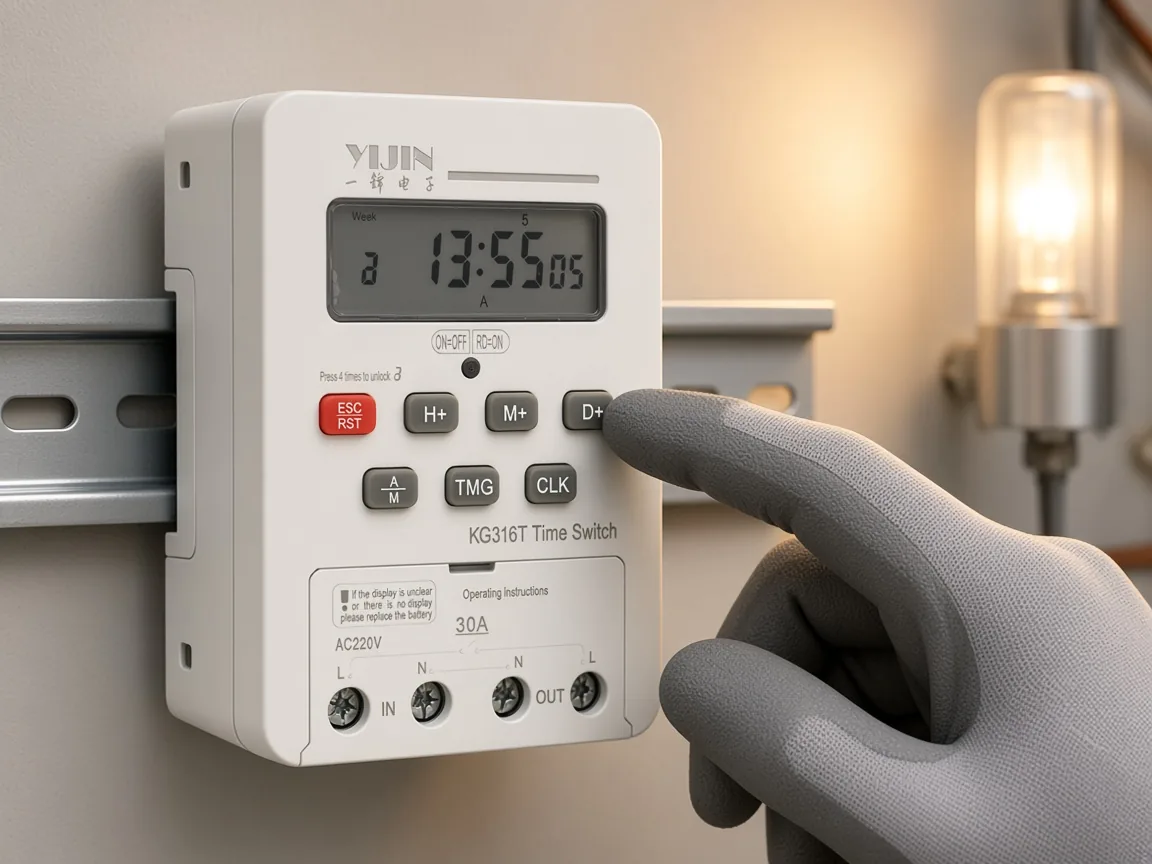
A sign shop that wants the same storefront lamps on at 17:00 and off at 23:00, Monday through Saturday, is using the weekly cycle. A countdown rocker cannot hold that pattern across a week. The timer switch category holds the other rail timers if the job is astronomical dusk tracking rather than a stored clock.
Supply, Enclosure, and Altitude Change the Fit
Voltage, enclosure, and site height decide whether the module can live in the panel.
Rated control supply on the page is 220 V and 380 V at 50 Hz and 60 Hz.
Rated insulation voltage Ui is 380 V, and rated impulse withstand Uimp is 1.5 kV.
The supply has to stay inside 85% to 110% of that rated voltage. Altitude on the same list stops at 2000 m.
Ambient temperature runs from -5 C to +40 C. The enclosure is IP50, pollution degree 3, and the operating notes exclude rain, snow, corrosive gas, and conductive dust. A wet sign cabinet or a roof kiosk without a proper outer box is outside that enclosure note.
The National Electrical Code is the installation benchmark across the United States. Inspectors use that code book on building work.
Nothing on the KG316T page is a UL mark or an NEC evaluation. Buyers in that market still follow the local code and the authority having jurisdiction. The product page does not do that job for them.
When the indicator lights on time and the relay stays still, the page points at a supply that is too low. That is a supply problem, not a programming mystery.
Terminal screws need to be tight so a high current does not heat the joint. The page also says the unit should not be installed or taken apart while the supply is connected.
Where the KG316T Fits a Timed LED Lamp Circuit
Match the published clock, the lamp ceiling, and the room around the panel.
Use the KG316T time control switch when a control circuit must turn LED lamps on and off on a stored daily or weekly clock, the running lamp power sits inside the 0.9 kW ceiling, and the supply, altitude, temperature, and dry enclosure match the page.
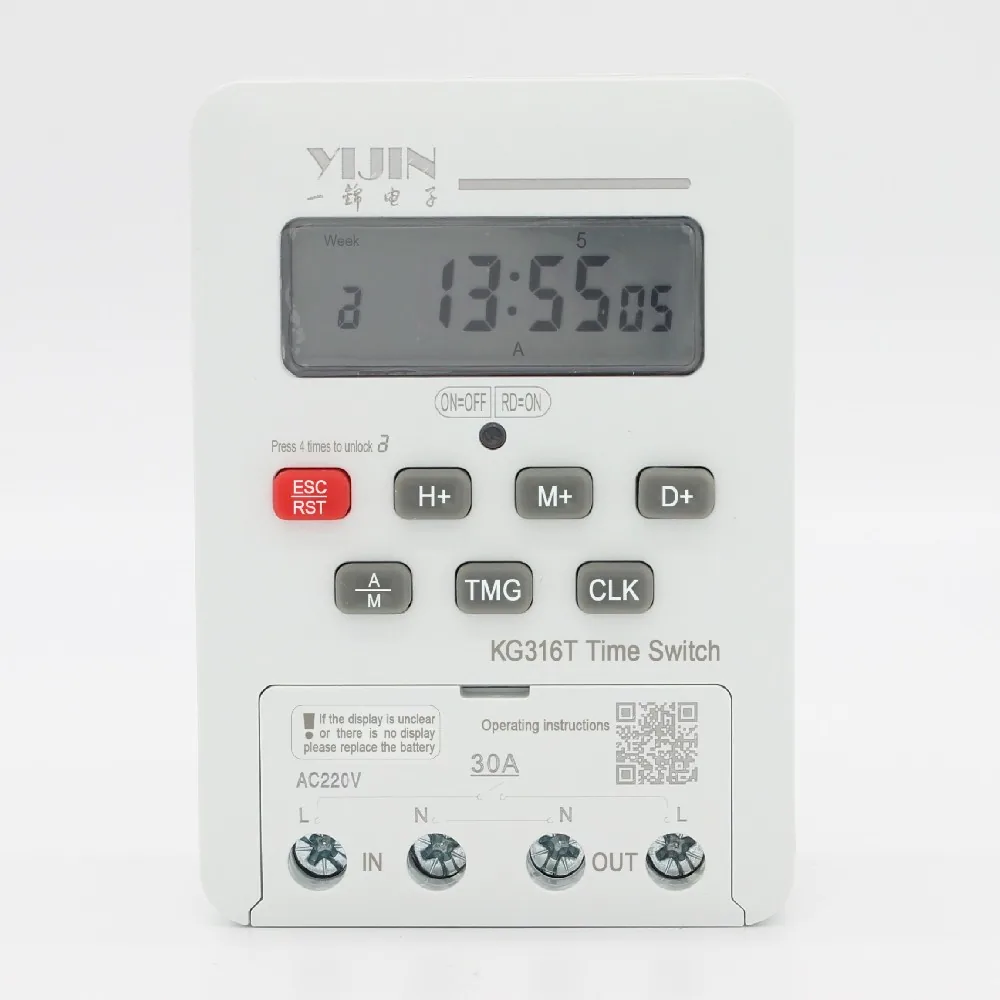
Walk away when the task is a decorator in-wall timer, a dimmer, a 3-way traveler, a plug-in outdoor box, or the WiFi version of this family. Dimming is outside what this relay does. A traveler between two wall locations is a different switch.
The housing is a panel module rather than a plug-in outdoor box. The WiFi SKU is a separate product and was not the one read for these figures.
Also walk away when the drivers are already near the lamp ceiling and their startup behavior is unknown. The page invites margin where a failure could injure someone. A contactor ahead of a very large lamp group, the pattern electricians describe for big LED bays, is a different design from landing every driver directly on this relay.
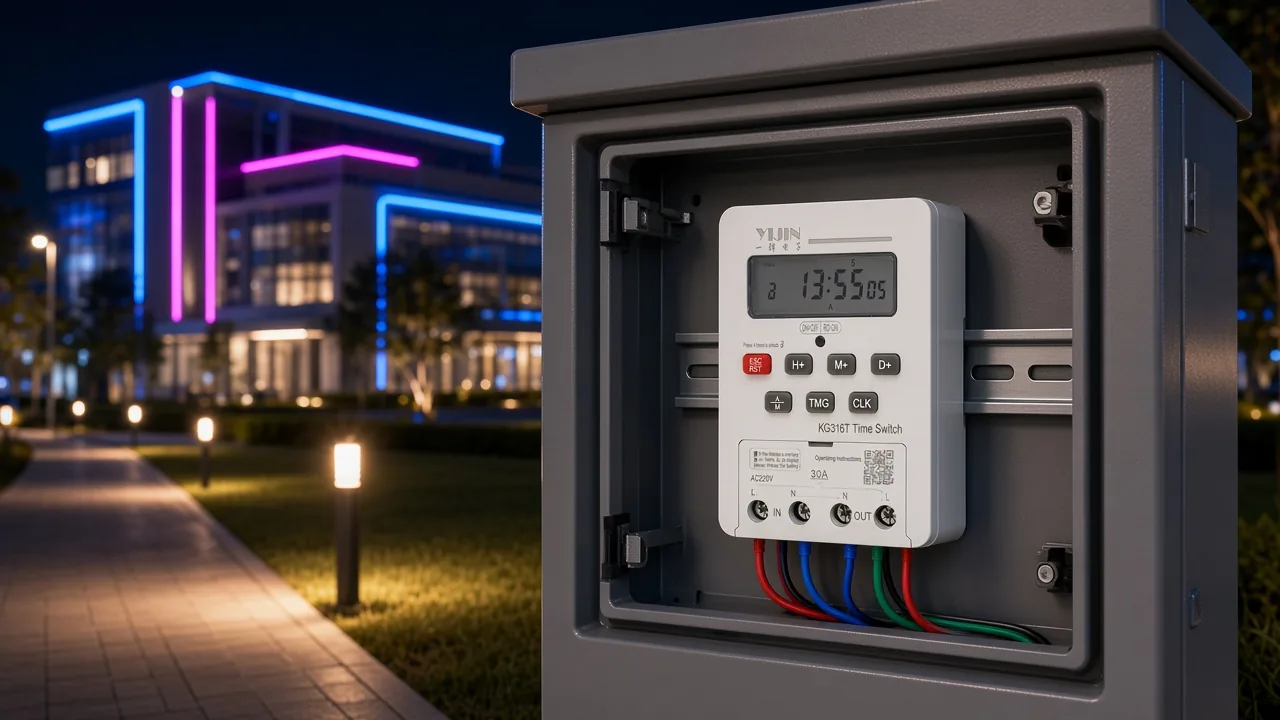
The module is a scheduler with a published lamp ceiling. Soft start remains unpromised for drivers that merely sit under that ceiling.
FAQ
Can you use a timer with LED lights?
Yes, when the timer actually switches the circuit and the running lamp power stays inside the lamp line. LEDs are a poor match for a series timer that tries to power itself through the bulb.
Do you need a special timer for LED lights?
You need a timer whose listing matches lamps, or a relay that does, and you need to treat startup current as its own question. A higher incandescent watt rating on a wall device does not answer that question.
How do you put a timer on your LED lights?
On this hardware the timer sits in the control circuit and the lamps are the relay load, inside the lamp ceiling and the supply window. That is a panel decision, not a rocker swap in a US wall box.
What kind of timer can I use to turn my lights on and off?
For a repeated weekday schedule, use a clock that stores on and off events, which is what KG316T does. A countdown button only runs a short interval and then stops.
Why can a relay that looks fine on steady watts still weld on LED drivers?
The contacts close into the capacitor charge of the drivers, which can exceed the running current for a moment. Users describe contacts that stick after that pulse. This page does not publish the pulse this relay was tested against.
Does the KG316T dim LED lamps or serve a 3-way traveler?
It switches the load fully on or fully off at the stored times. It does not dim, and it does not replace a traveler between two switch locations.