 Yueqing Yijin Electronics Co., Ltd.



Surge Protection Devices for Industrial Applications on Live Board Cards
Surge protection devices for industrial applications belong on the incoming AC of a switchboard or machine panel as Class II DIN-rail modules, rather than a desk strip with extra outlets. Below you will read the live Yijin AC family cards, see when C40 sits between D20 and B60/B80, and keep YJSCB-40 as backup context.
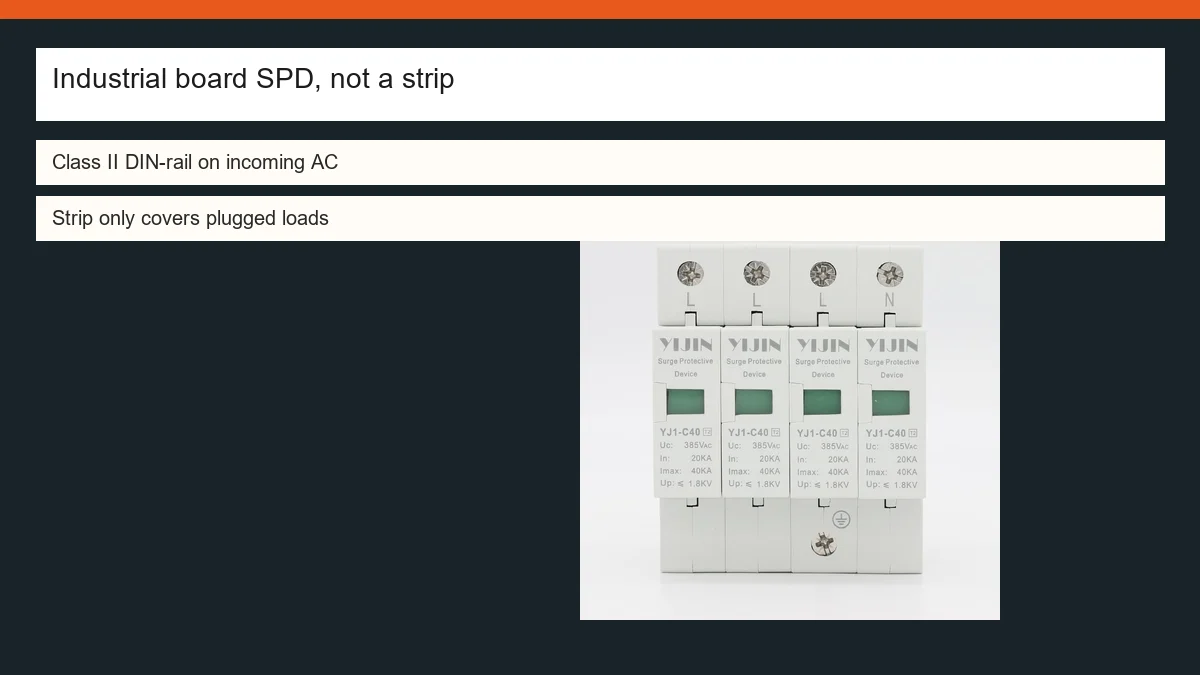
The industrial Class II SPD conversation starts with that board seat, then the printed card.
US readers should treat IEC/GB-style Class II wording and 50–60 Hz labels as product-page language. Those labels are separate from a UL 1449 or NEC approval stamp.
What Industrial Buyers Mean by a Board-Level SPD
A board-level SPD is a parallel DIN-rail module on incoming AC for the panel bus, rather than a desk accessory.
Procurement searches for industrial hardware still land on Type catalogs and shopping bricks. The useful object for a switchboard or OEM panel is a surge protection device that clamps transients on the supply feeding PLCs, drives, and control power.
Training pages also remind readers that switching of motors, transformers, and high-current loads creates short spikes inside the plant. Storms alone do not explain why the incoming rail seat exists.
Browse the surge protection device hub after you know which printed card matches the board.
A DIN-Rail Class II Module Is Not a Strip Protector
Training books treat Type 3 / plug-in as a supplement; the industrial first layer is a rail module.
A DIN-rail surge protective device mounts on a 35 mm rail and connects in parallel at the panel. A surge-protecting power strip only watches what is plugged into its receptacles.
Insurer loss-control notes describe Type 3 as a cord-connected, secondary layer. IET training puts Type 2 at sub-distribution boards and says Type 3 sits close to a load only after a Type 2 device is already present.
From the field: Plant threads describe layered DIN-rail suppressors on incoming panel power, and a failed first device still leaving downstream PLC or VFD gear intact — Electrician Talk, Replacing blown SPDs.
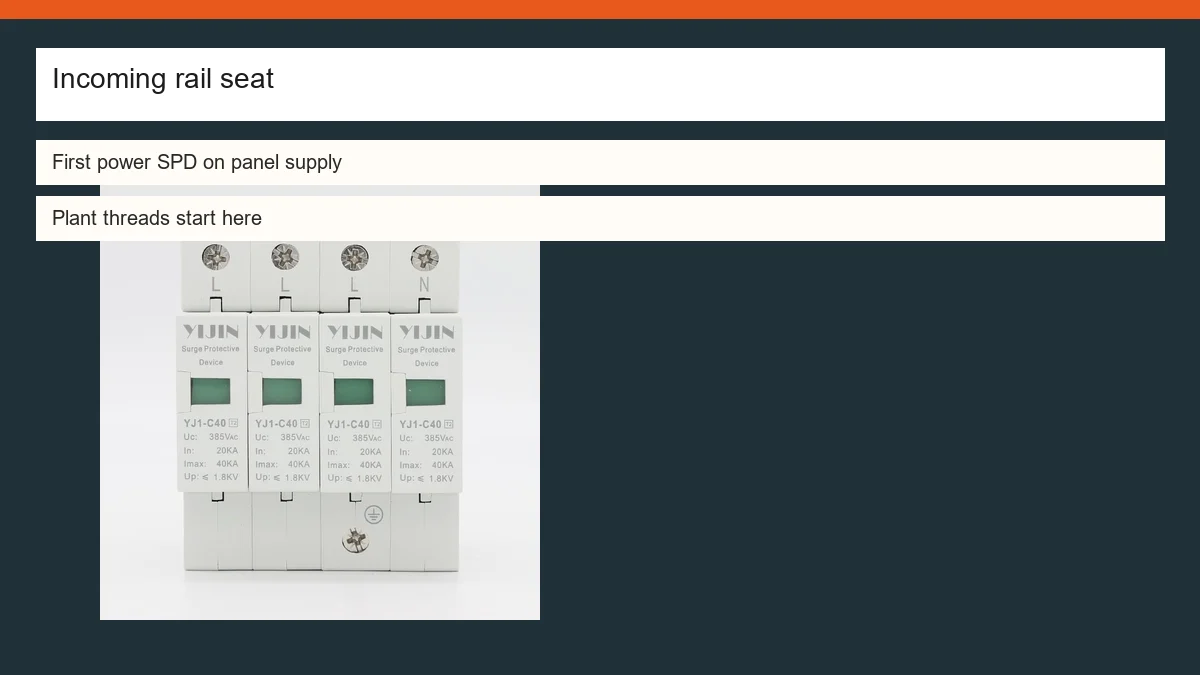
The contrast table below keeps the two seats separate.
| Seat | What the buyer actually covers | What it leaves out |
|---|---|---|
| Board-module Class II / educational Type 2 | Incoming AC of a switchboard or machine panel | Devices that never share that bus |
| Plug-in / educational Type 3 | Equipment in that strip or receptacle | Hardwired PLC, VFD, and other panel loads |
An OSHA question about construction-site strips still leaves you reading Uc, In, Imax, and Up on a Class II card for a listed machine panel.
What Live Yijin AC Class II Cards Print for AC Boards
Live cards print Class II, Uc, In, Imax, Up, poles, and series rows for 380 V and below language.
Product introductions on this AC family state suitability for TT, IT, TN-S, N-C-S and related systems at AC 50 Hz or 50–60 Hz, 380 V and below. Target market / market context for this explainer is the United States; those page labels stay IEC/GB-style wording rather than a US listing sentence.
On the live Yijin Class II cards covered here, maximum continuous operating voltage Uc (L-N) prints as 385 V, with Uc (N-PE) 255 V where that row appears. Nominal discharge current In is the 8/20 μs figure for repeated duty; maximum discharge current Imax is the maximum 8/20 μs declaration on the same Class II card. Voltage protection level Up is the let-through printed beside those kA rows.
Housing rows that mention UL94 V-0 describe plastic flammability. Prefer the parameter block when application copy conflicts with the table.
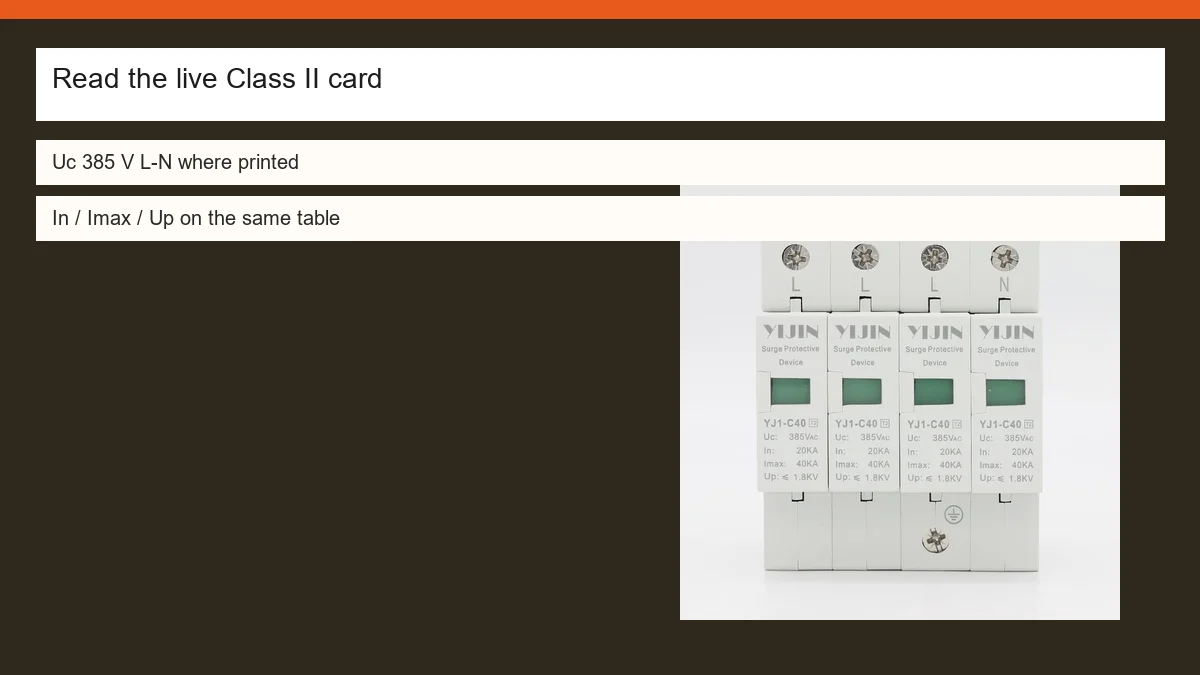
Read the Un row next to those continuous-voltage figures.
YJ1-C40 prints Un 220V AC 50Hz on its table. Sibling cards in this set print Un 220V AC 50-60Hz. Both stay in the 380 V and below introduction language.
Green/red windows and optional remote signaling also appear on the live cards. Those status features help maintenance see a spent module without treating the housing flammability mark as an SPD listing.
When C40 Fits Versus D20, B60, or B80
C40 is the mid printed card; D20 is smaller discharge/Up; B60/B80 raise Imax and Up.
Reading the same live family tables, limiting voltage steps with the discharge card: YJ1-D20 at 1.5 kV, YJ1-C40 at 1.8 kV, YJ1-B60 at 2.0 kV, and YJ-B80 at 2.4 kV. A larger Imax alone does not buy a kinder clamp for every load.
| Model | In (8/20) | Imax (8/20) | Up | Printed series row |
|---|---|---|---|---|
| YJ1-D20 | 10 kA | 20 kA | 1.5 kV | 16A/6kA |
| YJ1-C40 | 20 kA | 40 kA | 1.8 kV | 32A/10kA |
| YJ1-B60 | 30 kA | 60 kA | 2.0 kV | 63A/35kA |
| YJ-B80 | 40 kA | 80 kA | 2.4 kV | 63A/35kA |
YJ1-D20 prints In 10 kA, Imax 20 kA, and Up 1.5 kV on its Class II table. YJ1-B60 prints In 30kA and Imax 60kA with a series recommendation of 63A/35kA. On the YJ-B80 card, the table model YJ1-B80 shows In 40 kA and Imax 80 kA with Up 2.4 kV.
All four cards list 1P/2P/3P/4P. Pole count still has to match the board wiring; the family scan here stays on the printed discharge and Up trade-off.
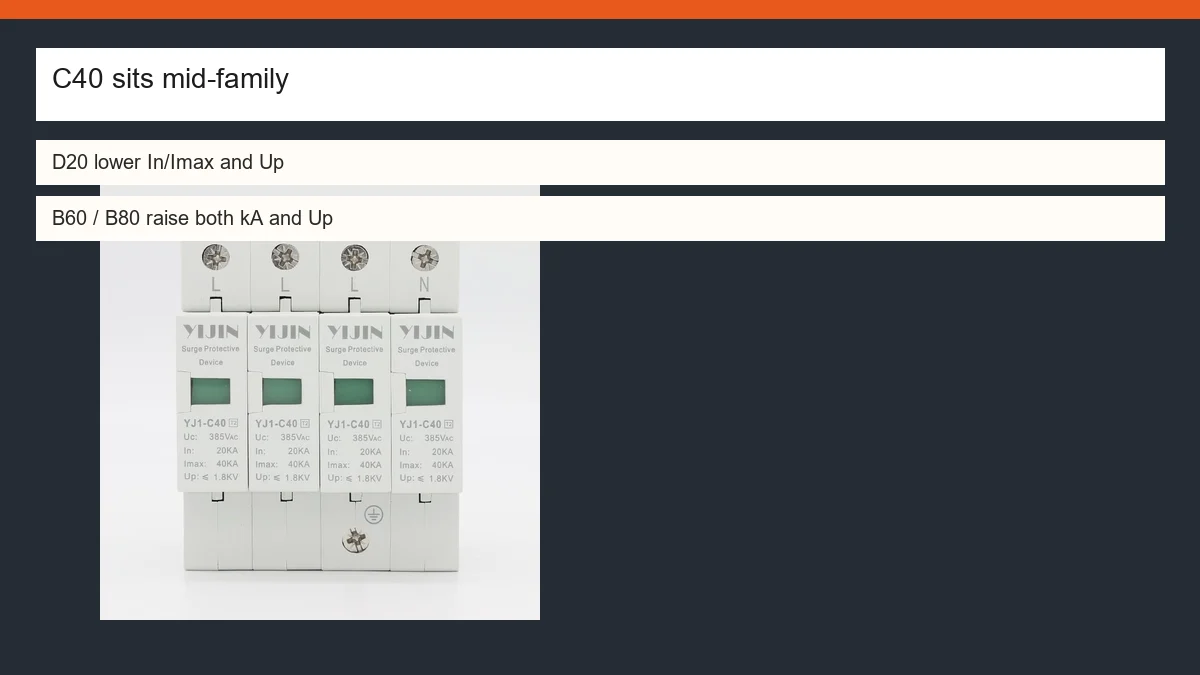
Keep the family scan on those four cards.
A sizing worksheet that starts with Uc before kA lives in a separate article. Three-phase pole language lives in the 3-phase surge protection device note. Those spines stay outside this family explainer.
Why a Backup Protector Sits Beside the Family
YJSCB-40 is a series backup device beside the Class II card, rather than a substitute In/Imax row.
The YJSCB-40 SPD backup protector prints cooperation with Class I (T1) / Class II (T2) SPD language and ≤60kA (8/20) cooperation on its table.
Rated working voltage Ue is 230V. The power-frequency trip value prints as 3A. Power frequency short-circuit current breaking capacity Icn prints as 65kA.
Use that card when the project wants a dedicated backup conversation beside the SPD. Its kA options stay separate from the Class II In/Imax row you already picked.
Select YJ1-C40 as the Industrial Board Product
Start with YJ1-C40 when the mid Class II AC board card is the job.
When the industrial board needs a mid Class II card with Uc 385 V L-N, In 20 kA, Imax 40 kA, and Up 1.8 kV, start with the YJ1-C40 surge protector. For YJ1-C40, that printed series recommendation is 32A/10kA.
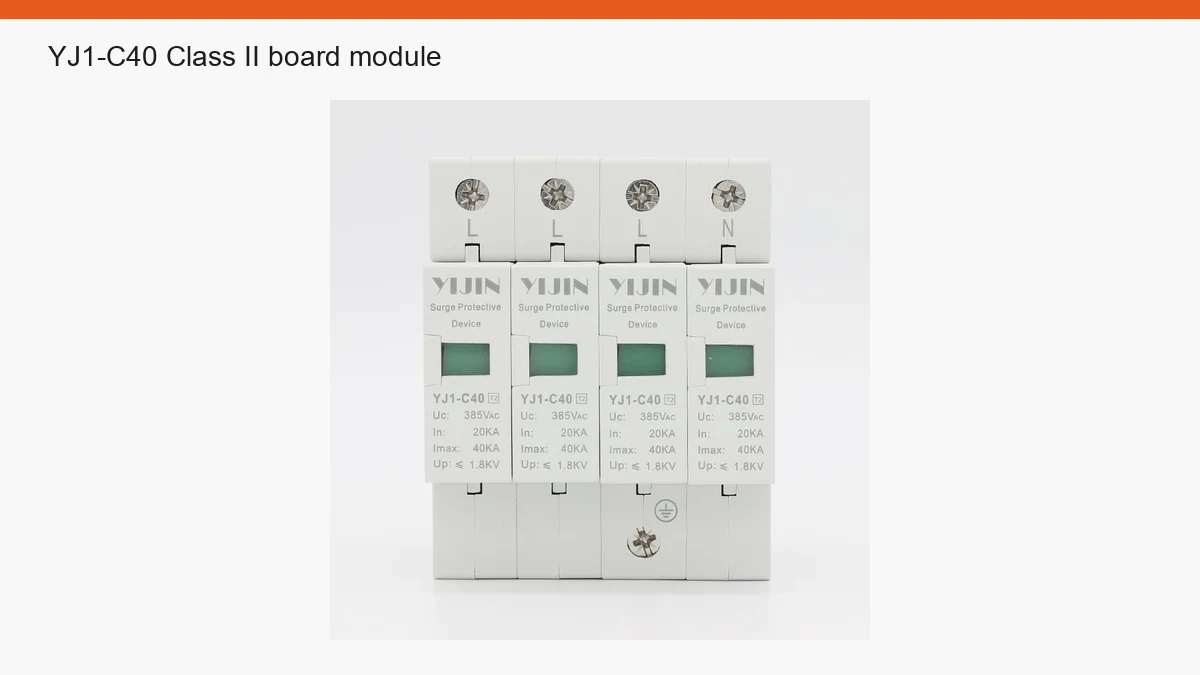
Sibling steps stay on the printed tables.
Step to YJ1-D20 when the board wants In 10 kA / Imax 20 kA and Up 1.5 kV. Step to YJ1-B60 or YJ-B80 when the printed higher In/Imax cards are the real ask and the higher Up values are acceptable.
Skip C40 when the job is a UL 1449 Type 1 service listing, a DC string seat, or a strip-only outlet plan. Confirm the live table before you freeze a bill of materials.
FAQ
Is an industrial SPD the same as a surge-protecting power strip?
No. A board-module Class II device sits on incoming panel AC. A strip only protects what is plugged into it.
Do live Yijin cards print a UL Type listing?
No. The live family prints Class II experiment language.
That wording differs from a UL 1449 Type 2 listing. Housing UL94 V-0 marks are plastic flammability rather than SPD listing.
What systems language do the AC Class II intros use?
Product intros for these AC Class II modules name TT, IT, TN-S, and N-C-S style systems at 380 V and below.
When is YJ1-D20 a better card than C40?
Choose YJ1-D20 when the board wants In 10 kA / Imax 20 kA and Up 1.5 kV.
When would a buyer step to B60 or B80?
Choose YJ1-B60 or YJ-B80 when the board wants the higher printed In/Imax cards and accepts their higher printed Up values.
What is YJSCB-40 doing if it is not the SPD?
Treat it as the family’s backup protector card: the table prints Class I (T1) / Class II (T2) cooperation language and ≤60 kA (8/20) cooperation.
Are Type 3 devices enough for a machine panel?
No. Educational Type 3 / plug-in layers supplement a board device. They leave the incoming rail module still required.
Does OSHA “allow surge protectors” decide the board module?
No. Workplace rules about relocatable taps leave Uc, In, Imax, and Up on a Class II card as a separate read.
References
- IET Wiring Matters — Surge Protective Devices (SPDs), November 2023 — Type 2 at sub-distribution; Type 3 only as a supplement; switching transients from industrial loads.
- NICEIC / Professional Electrician — Types of surge protective devices — Class I 10/350 versus Class II 8/20 selection factors for board seats.
- Electrician Talk — Replacing blown SPDs — layered DIN-rail and panel-mount suppressors on industrial power paths.
- Electrician Talk — Surge protection at panel ratings — forum thread arguing board ampacity is not the SPD Imax picker.