 Yueqing Yijin Electronics Co., Ltd.
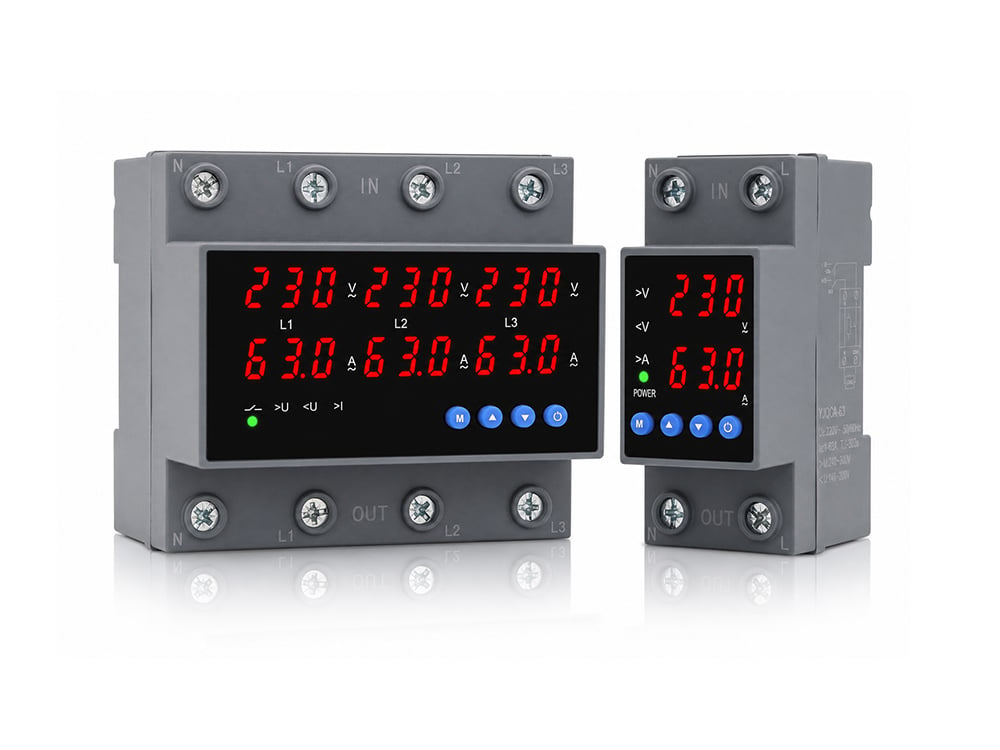



3 Phase Surge Protection Device — Multi-Pole SPD Family for Three-Phase Boards
A 3 phase surge protection device is a multi-pole surge protective device that covers the live paths — and often the neutral — in a three-phase distribution board, not a plug-in strip on one outlet. This article maps that job against single-phase modules, explains Type 1/2/3 labels as location education, walks the live YJ1 / YJ-B Class II family, and points to a practical mid-range starting SKU.
What a 3-Phase Surge Protection Device Actually Protects
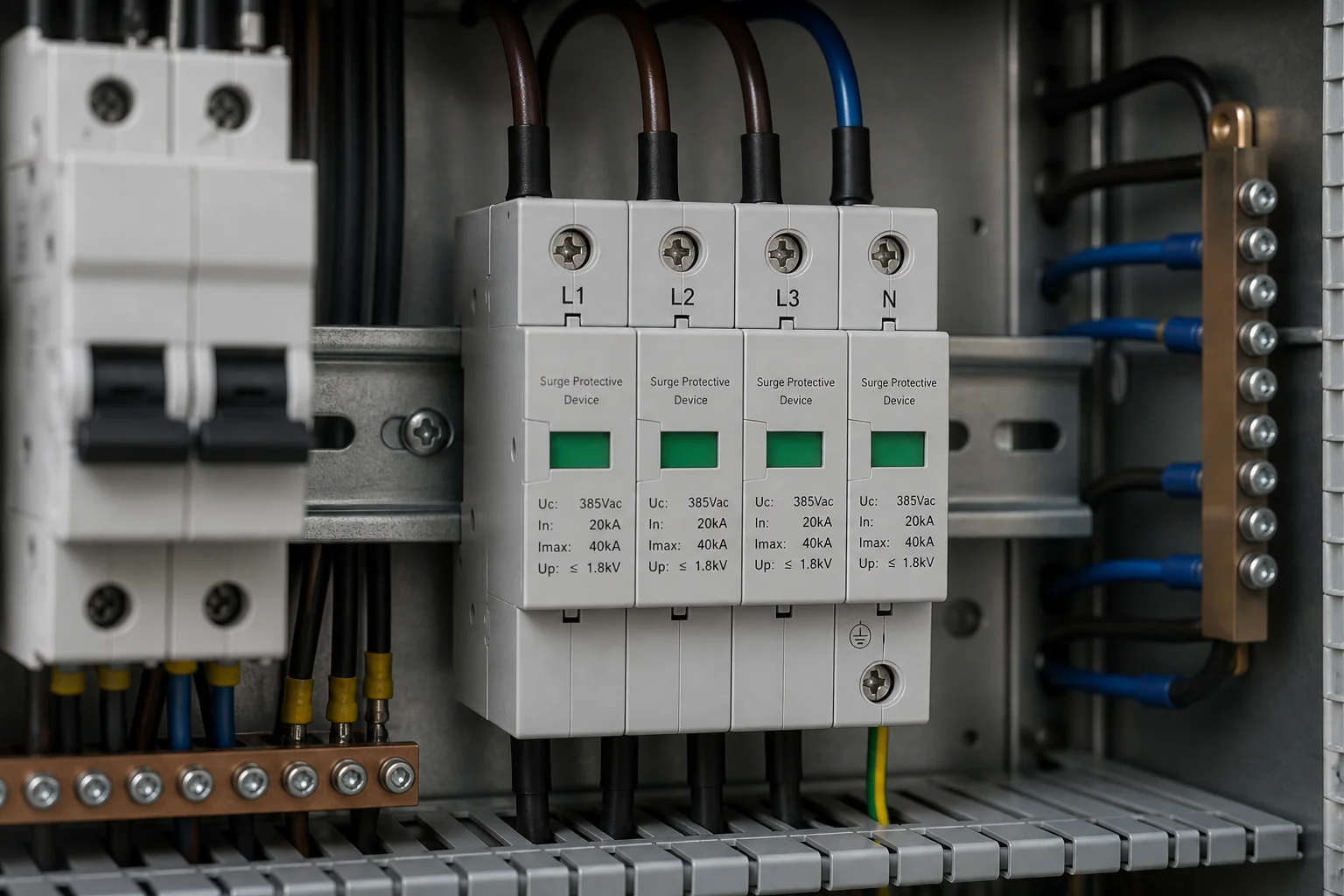
It protects three-phase distribution paths from short microsecond spikes — not one outlet. Encyclopedia wording treats a surge protective device (SPD) as equipment that limits very short voltage spikes on AC circuits, including nearby lightning and similar transient events. A plug-in surge protector at one receptacle is a different product class.
On a three-phase board, those spikes can stress L1, L2, L3, and often N-to-earth paths at once. A consumer strip sitting at one receptacle never covers the whole board zone the way a hardwired multi-pole SPD does.
Yijin’s Surge Protection Device category frames the job as protecting equipment from transient overvoltage caused by lightning strikes and switching operations. That category language matches panel-level DIN rail SPD intent, not appliance-cord protection.
Three-Phase vs Single-Phase: Why Pole Count Matters
Three-phase service needs multi-pole coverage matched to whether neutral is separate. A single-phase SPD typically covers one live-neutral (or live-earth) pair; a three-phase board still has two other live conductors that can carry surge energy.
Live YJ1 / YJ-B product tables list 1P/2P/3P/4P options on the same Class II SPD family. That pole configuration is how buyers match topology: three live legs alone, or three live legs plus a neutral path, depending on the earthing system and drawing.
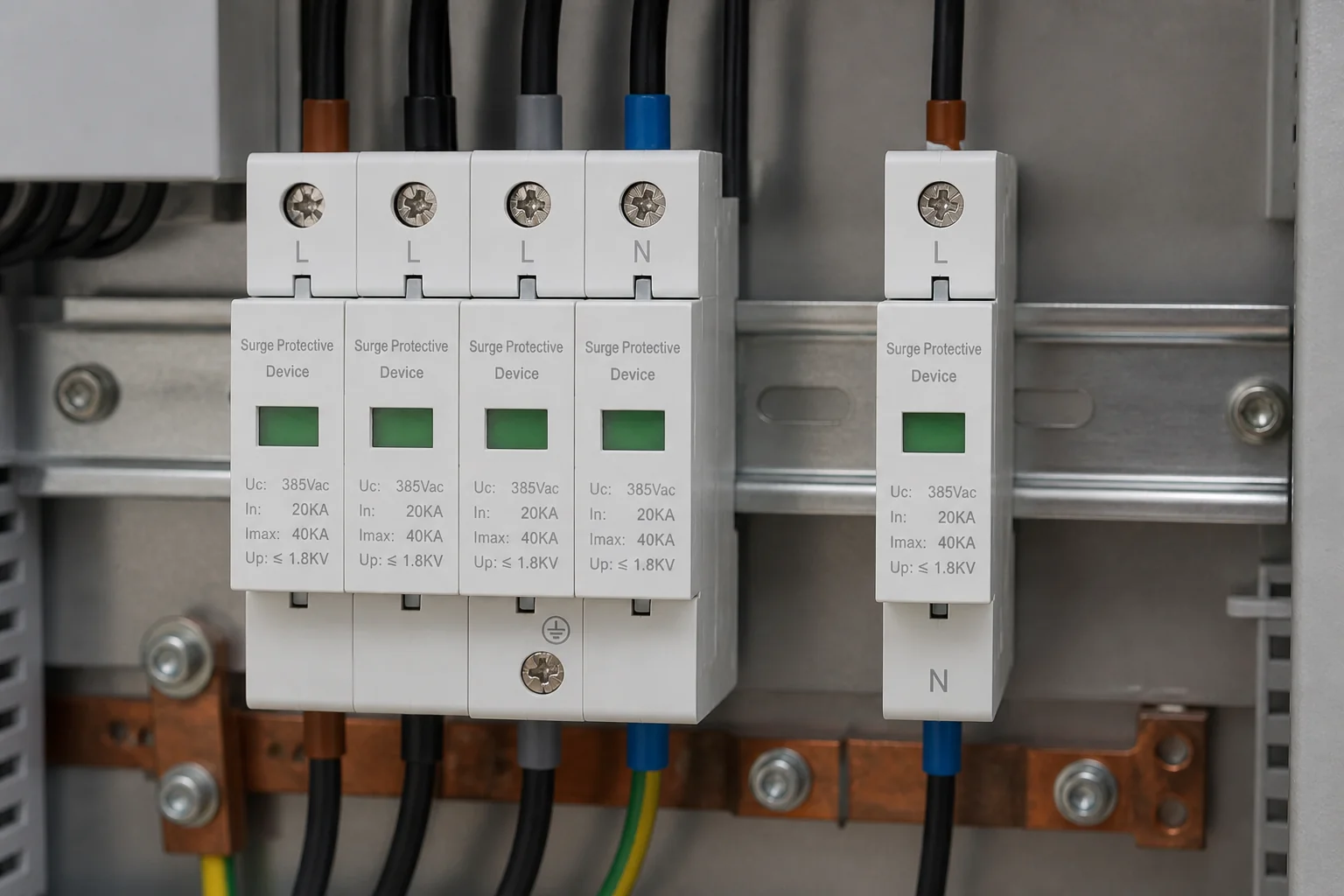
Practical buyer language from competitor education (research-only) maps TN-S / TT style four-wire systems toward 4-pole / 3P+N style coverage and TN-C or three-wire delta toward 3-pole coverage. Yijin product intros list suitability for TT, IT, TN-S, and N-C-S systems at AC 50 Hz (or 50–60 Hz on some SKUs), 380 V and below — still leave the final pole choice to the project drawing.
Do not “cover” a three-phase board by parking one single-phase module on a convenient breaker and hoping the other phases are fine. Incomplete conductor coverage is a topology miss, not a minor accessory gap.
Type 1, Type 2, and Type 3 Language: Education, Not a Yijin Listing
Type labels are location classes in UL/NEMA education. YJ1 pages state Class II / 8/20 μs test language and an IEC61643-1 design basis. NEMA’s low-voltage SPD overview describes Type 1 / Type 2 / Type 3 as location classes: Type 1 as permanently connected protection against external lightning or utility switching, Type 2 as permanently connected protection against residual and internally generated surges, and Type 3 as point-of-use cord, plug-in, or receptacle devices.
IEEE Technology Navigator material likewise frames SPDs around clamping and diverting surge current, and notes UL 1449 Type classes by installation location alongside IEC 61643 / IEEE C62 standards language. Use that as literacy — not as a sticker already proven on a Yijin nameplate in this package.
| Education label | Usual location story | What Yijin pages in this family actually print |
|---|---|---|
| Type 1 | Service entrance / high external exposure | Not printed as a UL Type 1 listing on the reviewed pages |
| Type 2 | Distribution / branch panels | Not printed as a UL Type 2 listing; pages use Class II experiment tables |
| Type 3 | Point-of-use / plug-in | Not the DIN-rail Class II family story |
| Class II (8/20 μs) | IEC-style test class on these tables | Printed In / Imax values on YJ1 / YJ-B parameter tables |
Housing rows that say plastic meets UL94 V-0 describe material flammability. That line is not a UL Listed SPD claim, and this package does not establish NEC compliance for Yijin SPDs.
YJ1 and YJ-B Family Map for Three-Phase Boards
The live Class II family offers 1P–4P modules across C40, B60, D20, integrated, and B80. Shared series copy places them on a DIN rail 35 mm mount with a failure indication window that shifts green to red, plus optional remote signaling contacts. Application text also uses lightning protection zone (LPZ) interface language for where those modules sit in a board stack.
Across these pages, Un is stated around 220 V AC, Uc (L-N) commonly 385 V, and response time ≤25 ns. Application text points to floor distribution boxes, telecom rooms, elevator and VFD control rooms, hospital monitoring rooms, and similar electronic loads — still inside the published AC ≤380 V series scope.
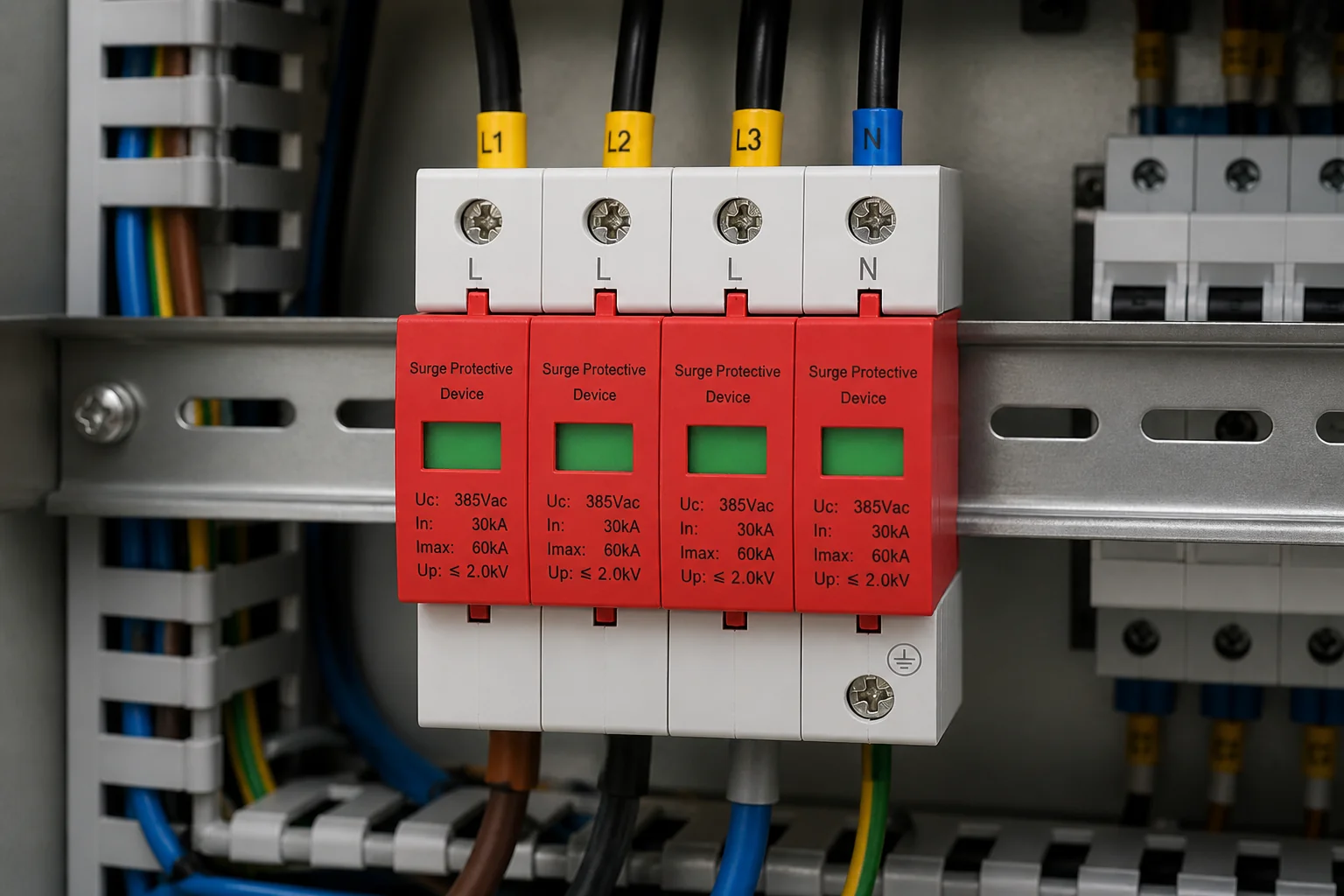
Family parameter scan.
| Model | Poles (page) | In (kA) | Imax (kA) | Up (kV) | Notes from page |
|---|---|---|---|---|---|
| YJ1-C40 | 1P/2P/3P/4P | 20 | 40 | 1.8 | Mid Class II workhorse |
| YJ1-B60 | 1P/2P/3P/4P | 30 | 60 | 2.0 | Higher table discharge class |
| YJ1-D20 | 1P/2P/3P/4P | 10 | 20 | 1.5 | Lower In/Imax, lower Up |
| YJ-B80 | 1P/2P/3P/4P | 40 | 80 | 2.4 | Highest table Imax in this set |
| YJ1 integrated | 1P/2P/3P/4P | 10–40 | 20–80 | 1.8 | Replaceable unit on a kept base |
Scan the table for the published Class II discharge class that matches the board role.
Reading Uc, In, Imax, and Up on the Family Tables
Match Uc to system voltage and compare In/Imax/Up across siblings before buying. Maximum continuous operating voltage Uc is the steady voltage the table allows; In is the nominal 8/20 μs discharge current; Imax is the maximum 8/20 μs discharge current; voltage protection level Up is the clamped level associated with the test.
A plant that feeds 480 V three-phase Delta into a protector whose clamp or continuous rating sits below the real system voltage is asking the device to operate as a load. Electrician Talk contributors describing 480 V Delta service with 400 V nominal / 440 V clamping arresters reported repeated failures until the rating rose above the transformer output.
When you scan the YJ1 family table above, treat each row as a published Class II snapshot — not an invitation to invent Type 1 Iimp figures the pages do not print. Prefer the parameter table when application marketing copy and the table disagree.
Board Placement, LPZ Language, and Short Leads
Keep the module close to the protected bus and trim the leads. Mount on a 35 mm rail near the protected bus with the shortest practical leads. Yijin series copy describes equipotential connection roles at LPZ interfaces and lists DIN-rail installation as the mounting method.
From the field: On Electrician Talk, installers debating “top of panel” folklore kept returning to a simpler rule — keep SPD leads as short as possible, with lead-style products trimmed and free of sharp bends when the manufacturer says so (SPD location in panel). Placement theater loses to inductance discipline.
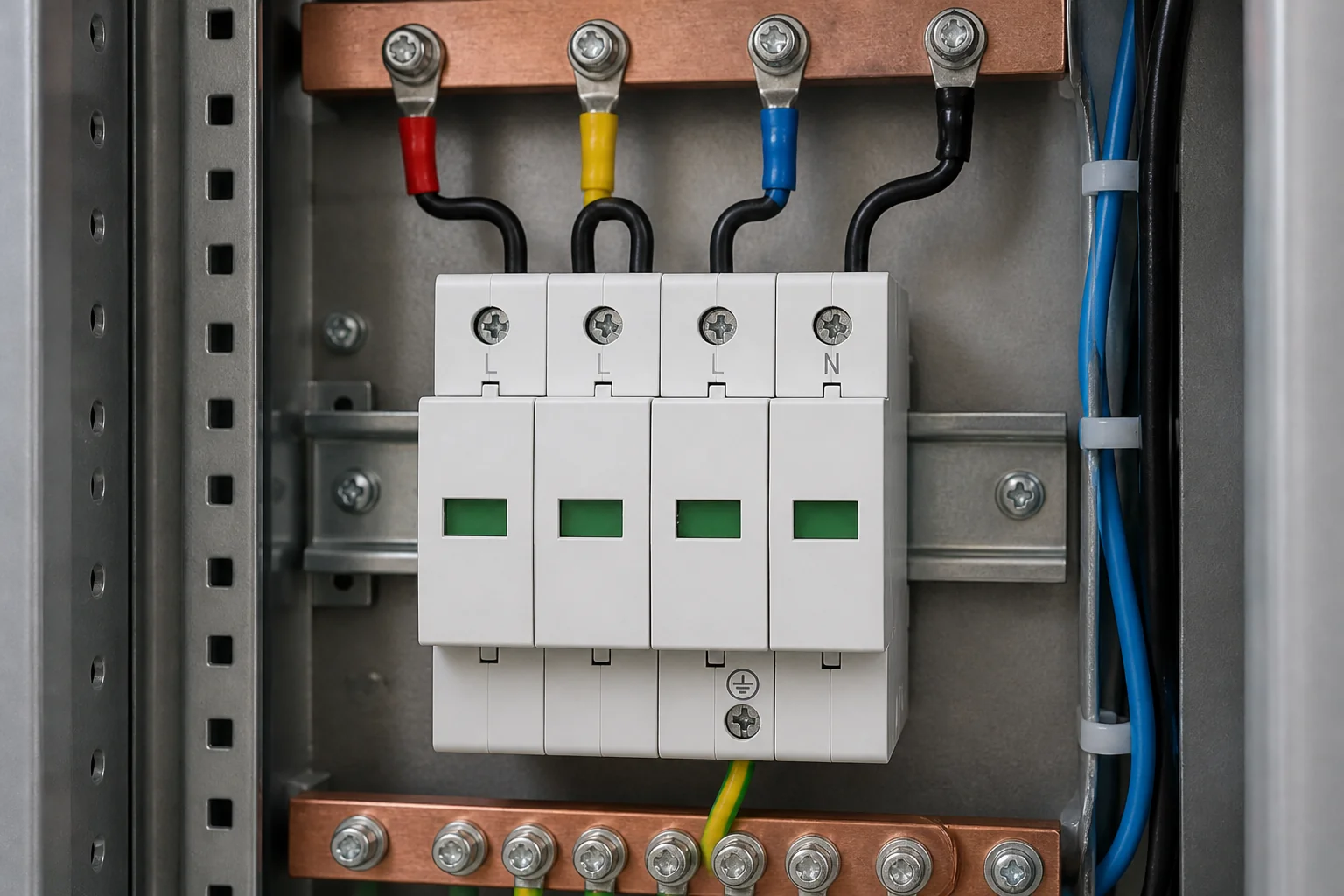
Failure indication on these modules is visual: green for normal, red for fault after the internal failure release opens. Remote signaling contacts are optional on the tables — useful when a BMS or alarm circuit must watch SPD status without opening the door every week.
YJ1-C40 Product Fit for a Mid Class II 3P/4P Role
YJ1-C40 is the practical mid Class II starting point when the board needs 3P or 4P options. The YJ1-C40 surge protector publishes In 20 kA, Imax 40 kA, Up 1.8 kV, Uc (L-N) 385 V, and the full 1P/2P/3P/4P menu.
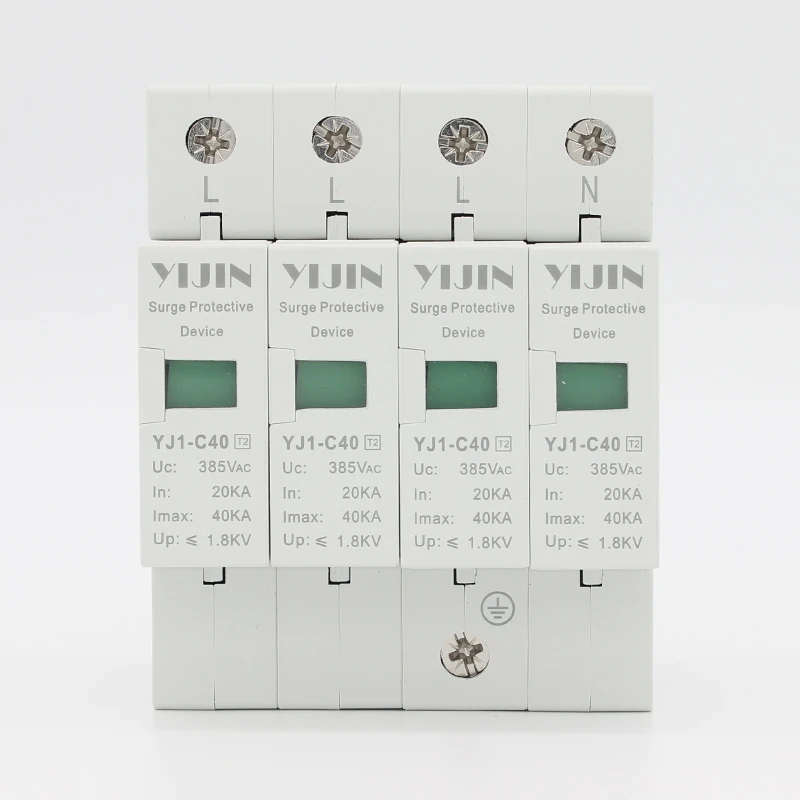
Choose a sibling instead when the drawing needs a different published discharge class: YJ1-B60 or YJ-B80 for higher table In/Imax, YJ1-D20 for a lower In/Imax and lower Up, or the YJ1 integrated module when replaceable cartridges on a kept base matter more than a one-piece body.
Do not treat C40 as a UL Listed / NEC-compliant shortcut. The page’s design-basis line cites IEC61643-1 and GB18802.1; it does not hand you a verified US listing package. After the parameter check, return to the surge protection device hub to compare siblings side by side.
FAQ
What is a 3 phase surge protection device?
It is a multi-pole SPD intended to limit short transient overvoltages across three-phase distribution paths in a panel or board, rather than a single plug-in strip at one receptacle.
Do three-phase panels need 3P or 4P SPDs?
It depends on the earthing and whether a separate neutral path must be protected. Yijin family tables offer both 3P and 4P options; match the pole count to the project drawing instead of defaulting to whichever module is in stock.
Is a Class II YJ1 the same as a UL Type 2 SPD?
No automatic equivalence. Type 1/2/3 language in UL/NEMA education is a location class story; YJ1 pages print Class II experiment tables and IEC61643-1 design-basis wording without a verified UL Type listing in this package.
Can I protect a three-phase board with one single-phase SPD?
Not as a complete topology. One single-phase module covers one conductor pair; the other live paths remain uncovered unless additional poles or modules are specified correctly.
What do In, Imax, Uc, and Up mean on the YJ1 table?
Uc is maximum continuous operating voltage; In and Imax are 8/20 μs discharge currents on these Class II tables; Up is the voltage protection level tied to the test. Read them per SKU from the product table.
Why do short leads matter for SPD performance?
Forum electricians treat lead length as a first-order performance issue because long pigtails add inductance that fights the clamp path. Trim to the shortest practical run the manufacturer instructions allow.
Why might an SPD fail on a three-phase Delta system?
If the continuous or clamp rating sits below the real system voltage, the device can operate when it should simply wait. Community Delta examples show undersized voltage ratings failing repeatedly until the rating rises above the transformer output.
Which YJ1 model is a practical starting point for a 3/4-pole Class II board role?
YJ1-C40 is the mid Class II starting point in this article: 20 kA In, 40 kA Imax, 1.8 kV Up, and explicit 1P–4P options. Move to B60/B80, D20, or integrated when the published table needs a different class or form factor.