 Yueqing Yijin Electronics Co., Ltd.




The Trip Is Not This Rail
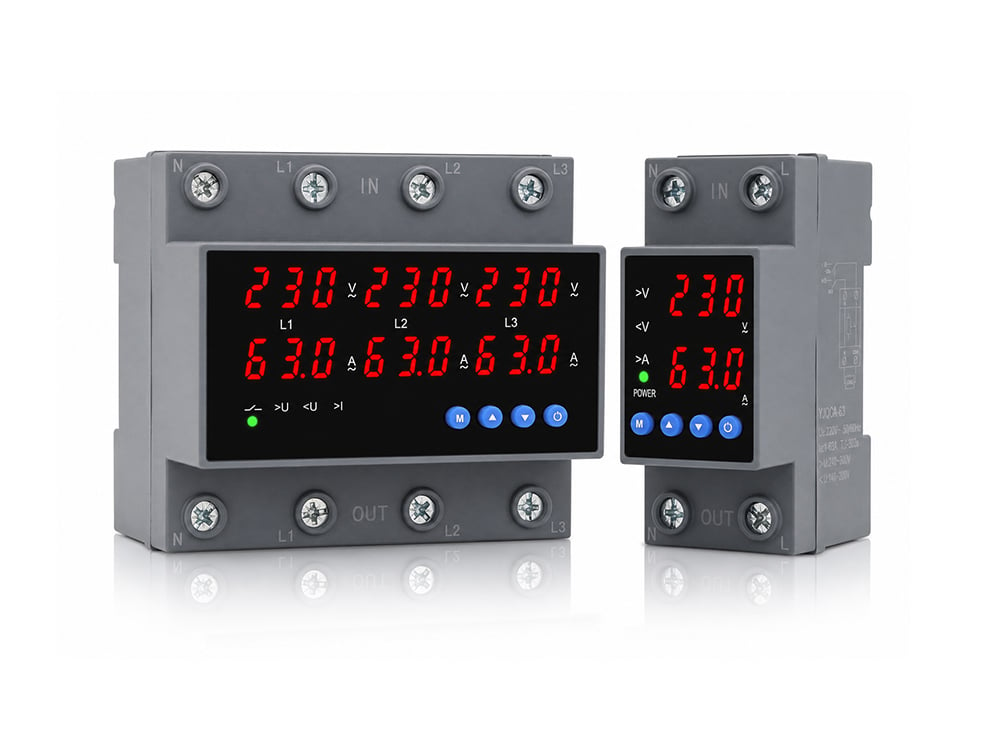
what causes an arc fault breaker to trip in United States English search is usually a branch-panel AFCI reacting to real arc or wiring hazards, appliance signatures misread as arcs, or plain overload — not the same story as a standard-rail AFDD parameter sheet overseas. The sections below split US real-versus-nuisance buckets, wiring and load drivers, bounded diagnostics, and the printed YJB1-63/AFD rail facts so procurement readers stop mixing device classes.
What US Searchers Mean When an Arc Fault Breaker Trips
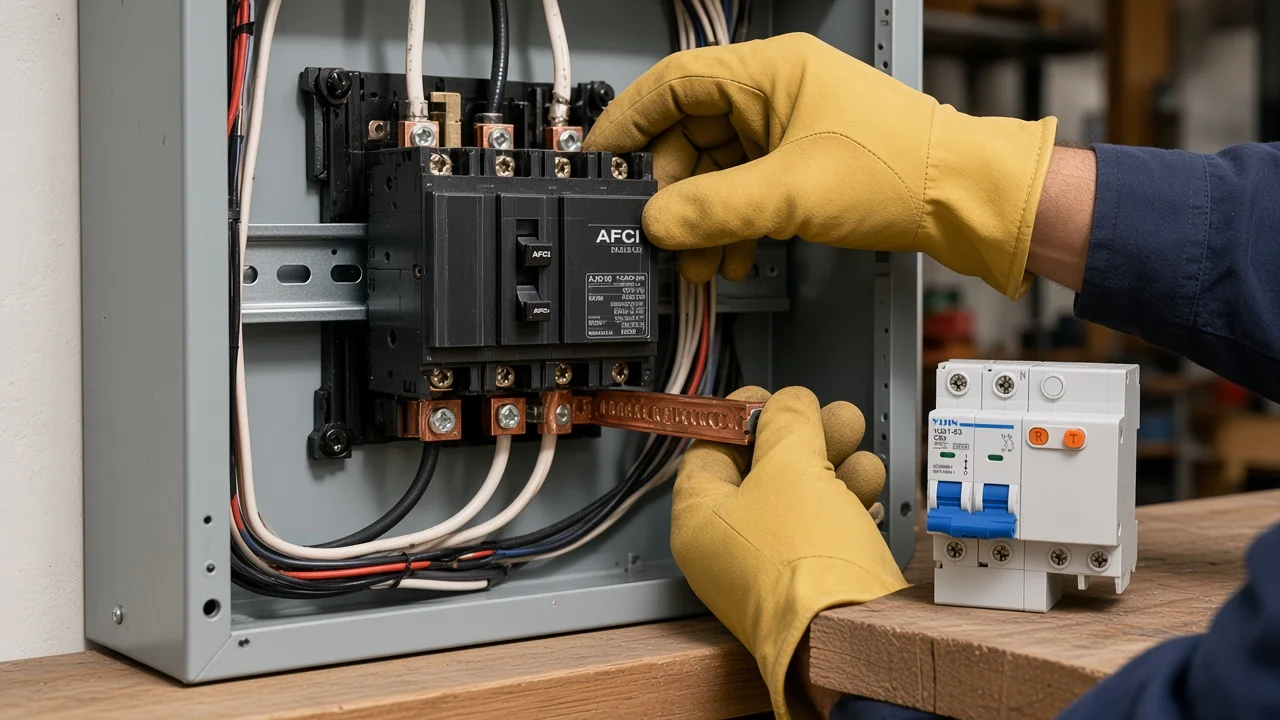
US contractors and homeowners who ask why an arc fault breaker keeps tripping are usually describing a listed branch-panel AFCI in a load center — not a DIN-rail AFDD module clipped onto standard rail overseas.
Live US search consensus — contractor education, manufacturer explainers, and the rendered AI Overview snapshot from October 2026 — groups answers into two buckets before anyone swaps hardware.
Real hazard explanations include loose or damaged conductors, series and parallel arc faults, ground-to-neutral faults, improperly shared neutrals, and moisture in boxes or devices.
Nuisance explanations include aging or noisy appliances, branch overload, and wiring installation errors that still need correction even when the arc signature looks like “sensitivity.”
That split matters because what causes an arc fault in a US bedroom branch is a wiring-and-load diagnostic question. It is not automatically a catalog line on an overseas rail AFDD product page.
AFCI and AFDD naming overlaps across markets, but US practice centers on panel-mounted branch hardware with hot and neutral routed through the device. Many other regions document AFDD-style breakers on DIN standard rail at different nominal voltages and frequencies.
Browse the mixed AFCI cluster at Others for navigation, but classify the trip cause in this article before you reorder breakers.
Real Hazard Causes — Series Arcs, Parallel Arcs, and Damaged Insulation
Real trips trace to fire-risk arcing or insulation failure — not merely an annoying motor signature.
Series arc faults occur along a damaged or loose segment in the normal conductor path — think a cracked cord, a loose terminal, or a backstab / push-in termination that intermittently sparks on one leg.
Parallel arc faults occur across unintended paths between conductors — line-to-neutral, line-to-ground, or line-to-line contact that can release extreme heat quickly.
US education sources teach both geometries so field staff do not label every trip “nuisance” and leave damaged insulation in place.
Damaged insulation, frayed appliance cords, and loose outlet screws belong in the real-hazard column even when the homeowner only notices random trips under load.
| Trip pattern (US field language) | Likely real-hazard driver | First check |
|---|---|---|
| Random trips under load with buzzing at a device | Loose termination or series arc along one conductor | Tighten terminations; replace damaged cords |
| Immediate trip when a specific outlet is used | Parallel arc or compromised insulation at that box | Inspect device and conductors |
| Trips after physical damage to cable | Insulation breach along the run | Trace damage; repair conductors |
| Backstab-only outlets on aging devices | Intermittent series arcing at push-in connections | Move to screw terminals where permitted |
Combination-type AFCI education under general US references often cites roughly 5 A series-detection context for combination-class devices versus roughly 75 A branch-feeder arc thresholds — US UL 1699 naming only, not Yijin table figures.
Wiring and Configuration Trip Drivers on US Branch Circuits
Shared neutrals, ground-to-neutral faults, and mis-landed neutrals explain many “why does my AFCI breaker keep tripping?” calls that have nothing to do with a defective breaker.
A shared neutral on a multi-wire branch circuit can confuse AFCI current sensing when neutrals from different hots are tied together downstream of the protection point.
A ground-neutral fault — including a ground wire contacting a neutral screw on a receptacle — can trip ground-fault logic inside many AFCIs, not only arc detection.
Mis-landed load neutrals are a classic panel mistake: pigtails on the bus while circuit whites never moved onto the AFCI neutral lug defeats monitoring and can trip immediately.
| Wiring/configuration driver | Typical trip behavior | Field note |
|---|---|---|
| Shared neutral / MWBC mis-wire | Trips at energize or when paired loads run | Plan dedicated hot-neutral pairs for typical single-pole AFCIs |
| Ground on neutral screw | Often immediate trip | Continuity from ground to neutral at devices |
| Load neutral left on bus only | Immediate trip or no meaningful protection | Move circuit neutral to AFCI lug |
| Neutral borrowed in multi-gang switch boxes | Intermittent trips | Trace neutrals per circuit |
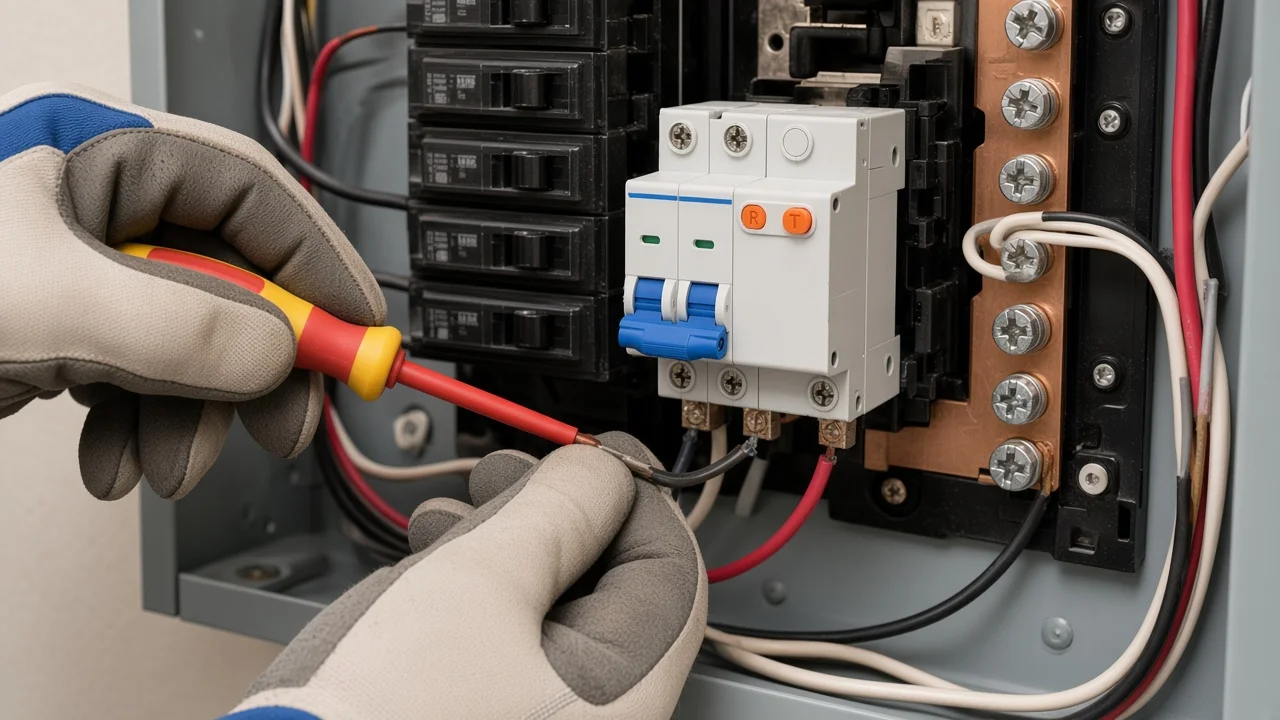
For the US install job vocabulary — pigtail, load neutral, TEST — see the sister article on afci breaker installation without retracing its checklist here. For myth-heavy “problems” language, see arc fault circuit breaker problems as a lateral link only.
Nuisance Trips From Motors, Electronics, and Overload
Arc fault breaker nuisance tripping is the label US contractors use when the wiring is sound but the breaker reacts to load signatures — brushed motors, some dimmer and LED combinations, power strips, or exercise equipment.
Vacuum cleaners, treadmills, and hair dryers appear repeatedly in US education articles because motor load (vacuum/treadmill) signatures — motor brush arcing and inrush — resemble hazardous waveforms to microprocessor AFCIs.
Plain overload still trips AFCI breakers even though arc detection is the marketing headline — too many devices on one branch is still a thermal trip cause.
Voltage sag and swell, repetitive motor noise, and some electronic loads can also push a static factory algorithm to trip; AFCIs do not “learn” the home over time.
| Load or condition | Nuisance versus real | Practical isolation step |
|---|---|---|
| One appliance always present when tripping | Often nuisance signature | Unplug that device; try another branch if safe |
| Trip only when multiple loads run | Overload or shared-neutral interaction | Reduce load; verify neutral routing |
| New dimmer or LED retrofit | Electronic noise signature | Swap lamp type or dimmer model |
| Random trips across many loads | Suspect wiring class first | Return to wiring table before blaming nuisance |
Quick Diagnostic Cues When an AFCI Keeps Tripping
Trip timing narrows the cause class faster than replacing the breaker on guesswork.
An instant trip at energize with nothing plugged in usually points to wiring, ground-neutral, or neutral landing faults — not a haunted vacuum.
A trip that appears only when one device runs suggests appliance signature or overload on that branch.
GFP inside AFCI designs often add a ground-fault detection component on the order of 30 mA class in common US discussions — so some “arc” trips are actually ground-path events.
From the field: On DIY Stack Exchange, holding the TEST button: an instant trip is treated as a ground-fault class problem, while a trip after about two seconds points toward arc-fault logic — Source: https://diy.stackexchange.com/questions/58170/how-can-i-resolve-tripping-problems-with-cafci
Bounded troubleshooting — not a full NEC manual — follows US SERP consensus: verify neutral landings, check for shared neutrals, inspect backstabs, unplug loads one at a time, and swap the breaker only to isolate a defective unit after wiring checks.
Signature detection education sometimes cites an arc energy band between 10 kHz and 100 kHz in vendor white papers — context for why motors confuse algorithms, not a Yijin laboratory claim.
What the YJB1-63/AFD Printed Sheet Specifies for Rail AFDD
The live YJB1-63/AFD product page describes a standard-rail AFDD assembly — not a US load-center nuisance-trip catalog.
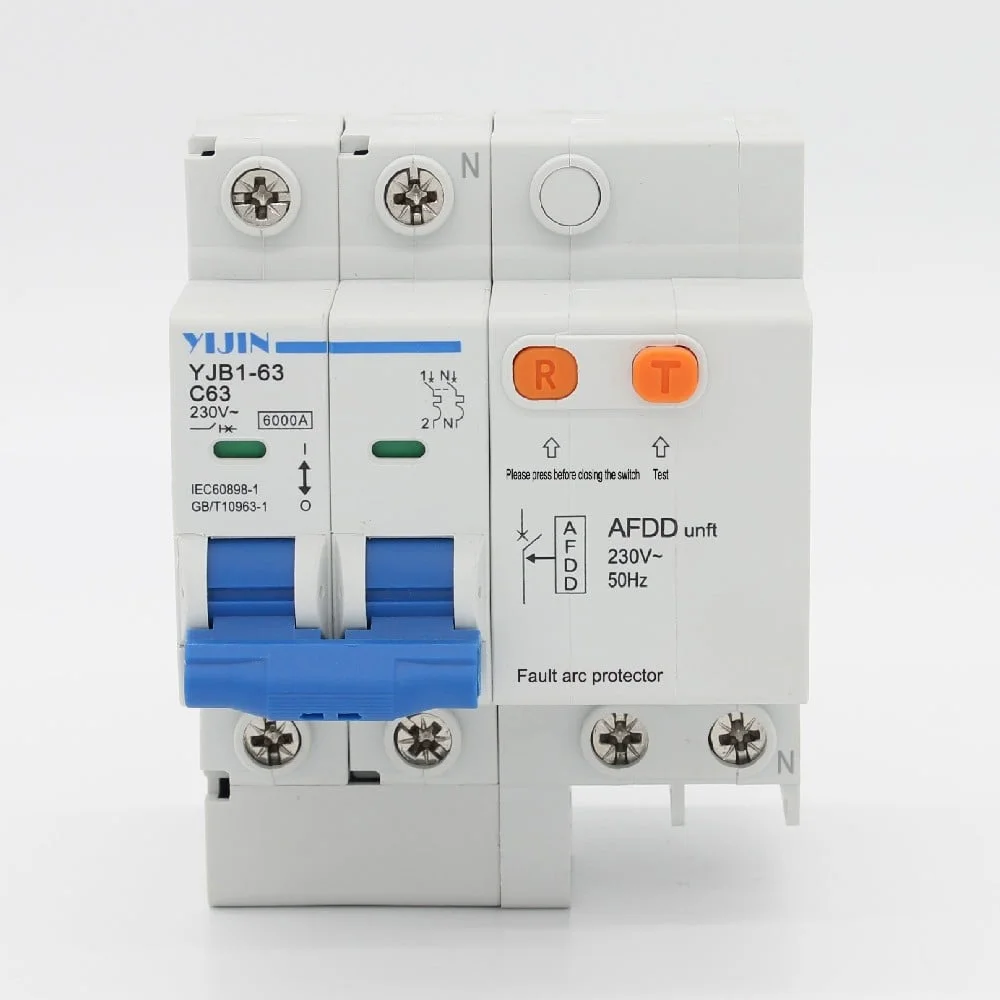
On the live page, YJB1-63/AFD is documented as an AFDD assembly pairing a small breaker body with a dedicated arc-fault module. Printed scope covers overload, short-circuit, and both series and parallel arc-fault conditions.
For trip-cause readers, the decisive lines are the electrical ratings block: AC 50 Hz, rated operational voltage 230 V, 2P poles, rated currents through 63 A, standard GB/T31143, release characteristics C and D, rated short-circuit breaking 4.5 kV as printed, rated impulse withstand 4 kV, protection grade IP20, ambient −40℃~+75℃, altitude 2000 m, pollution degree II, mechanical life greater than 6000 operations, and installation method standard rail installation.
Minimum arc labels on the page include serial arc 5 and combined arc 75 as printed. Those figures belong to this SKU table only.
Footer notes on the same page require a qualified electrical operator and power-off / insulation measures before service — an install boundary, not a field test proving US vacuum motor signatures will trip this module identically.
| YJB1-63/AFD line (live product page) | Value as printed |
|---|---|
| Installation method | Standard rail installation |
| Rated frequency | 50 Hz |
| Rated operational voltage | 230 V |
| Poles | 2P |
| Rated current options | 10 A through 63 A |
| Standard cited | GB/T31143 |
| Protection grade | IP20 |
| Rated short-circuit breaking | 4.5 kV |
| Ambient temperature | −40℃~+75℃ |
| Altitude | 2000 m |
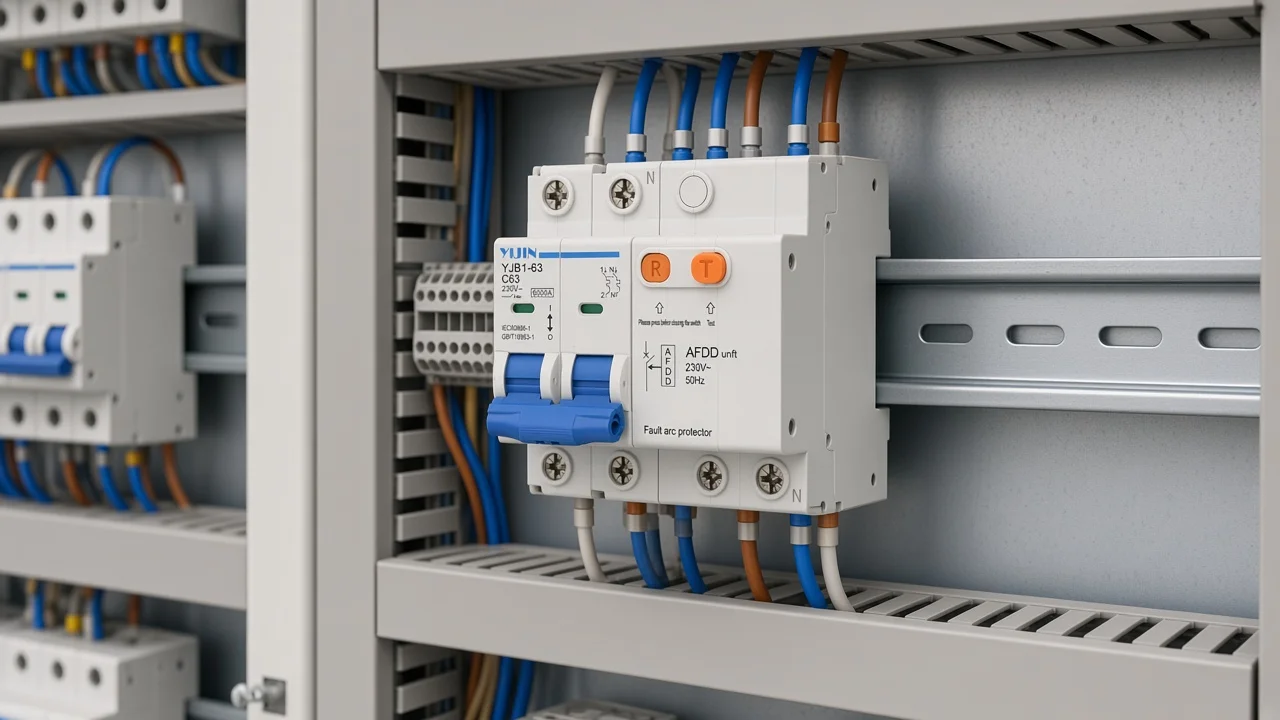
US AFCI Trip Drivers Versus Rail AFDD Printed Scope
US panel AFCIs and the Yijin rail sheet answer different architecture questions even when both mention arc faults.
US branch-panel AFCI trip education assumes a load-center device monitoring hot and neutral paths in typical 120 V branch work and 60 Hz instruction contexts — shared neutrals, GFP components, backstabs, and motor loads from US residential gear.
The YJB1-63/AFD sheet targets standard rail mounting, publishes 50 Hz and 230 V class ratings, and cites GB/T31143 — without presenting a US bedroom nuisance-trip test list on the live page.
| Decision cue | US branch-panel AFCI trip context | YJB1-63/AFD printed rail sheet |
|---|---|---|
| Primary reader question | Why did this bedroom AFCI trip? | What does this rail AFDD spec sheet claim? |
| Mount | Load-center breaker slot | Standard rail installation |
| Neutral path | Pigtail / plug-on panel neutral system | Per rail device marks and page table |
| Frequency context | 60 Hz in US instruction PDFs | 50 Hz on product page |
| Voltage context | 120 V branch work in US guides | 230 V rated operational voltage on page |
| Trip cause list source | SERP, forums, contractor education | Page-printed protection scope only |
| Yijin as US listed branch AFCI | Shop listed US panel catalog | Not evidenced on live Yijin pages |
Use this table at quote review: if the customer story is US arc fault breaker nuisance tripping from a Google bullet list, the rail row is the wrong class unless the project specification explicitly calls for that AFDD architecture.
When YJB1-63/AFD Fits Your Architecture — and When It Does Not
Specify YJB1-63/AFD arc fault circuit breaker when the design is DIN-rail AFDD-class protection that must match the published 50 Hz, 230 V, and current ratings on the product page.
Do not quote this SKU against a US NEC branch AFCI bedroom retrofit as a verified UL Listed panel substitute. Fact package 1.1 and opened Yijin pages show no listing path for that use case.
Do not map US trip-cause bullet lists onto this SKU as proof it will behave like a US panel AFCI in every motor-load scenario.
When the architecture matches, the page gives enough rail parameters — GB/T31143, IP20, C/D releases, and arc scope text — to align procurement with the comparison table above.
Choose this SKU only after the trip-cause versus sheet contrast confirms rail AFDD is the specified class. US nuisance-trip support calls still belong on listed branch-panel AFCI hardware your AHJ recognizes.
FAQ
Why do arc fault breakers trip so easily?
Because microprocessor AFCIs react to both real arc and wiring faults and to load signatures that resemble arcs — motors, dimmers, and some electronics — plus overload and ground-path events on many models.
Why does my AFCI breaker keep tripping?
Repeating trips usually mean an unresolved wiring class (shared neutral, ground-neutral contact, mis-landed neutral), a real arc source (loose termination, damaged insulation), a dedicated nuisance load, or overload — not always a “bad breaker.”
How do I troubleshoot an arc fault breaker that keeps tripping?
Start with trip timing, neutral landings, and ground-neutral checks; unplug loads one at a time; inspect backstabs and shared-neutral layouts; swap the breaker only after wiring isolation — bounded steps, not a full code manual.
Can I replace my arc fault breaker with a regular breaker?
Where the adopted NEC edition and local rules require AFCI protection on that branch, swapping to a standard breaker can remove required protection — ask a qualified electrician and the AHJ; this article does not provide jurisdiction-specific code tables.
What causes an AFCI breaker to trip with no load?
Instant trips with nothing plugged in often indicate wiring, ground-neutral, or neutral landing faults rather than appliance nuisance — the same class community threads emphasize for “trips immediately” reports.
Is nuisance tripping the same as a fire hazard?
Not always — nuisance trips can occur on sound wiring with noisy loads — but repeated unexplained trips still deserve inspection because real series and parallel arc sources also trip the same device.
How is YJB1-63/AFD related to US AFCI trip causes?
It is rail AFDD-class hardware with page-printed arc scope and the same rail ratings summarized in the product table above — related terminology, not interchangeable proof that US bedroom trip stories apply field-for-field.
Is YJB1-63/AFD UL Listed for US NEC branch AFCI?
Opened Yijin product pages in this package carry no UL Listed branch-panel AFCI evidence for US bedroom branches. Route those jobs to catalog breakers whose listing documents match the AHJ ask.
References
- AFCI Safety — what is AFCI
- Arc-fault circuit interrupter — Wikipedia
- IAEI Magazine — NEC 210.12 AFCI means
- Industrial Control Academy — arc-fault protection
- DIY Stack Exchange — CAFCI tripping timing
These sources support the US arc taxonomy, the AFCI versus AFDD naming split, and the field diagnostic timing pattern cited above.