 Yueqing Yijin Electronics Co., Ltd.




Type 1 SPD Installation: Service Class vs Board Modules
A type 1 spd installation puts a type 1 spd at the service origin, where the listing may allow a line-side seat as well as a load-side seat. A load-side board module and a plug-in outlet device are later seats in the same cascade. This page walks those seats, then maps the live Yijin cards that a buyer can actually open.
The useful split is placement class first, catalog card second. Electricians argue about which side of the main the service device should land on. Catalog pages argue in kilamperes.
Those are different conversations.
What a Type 1 Install Class Means at the Service
A Type 1 SPD belongs at the origin of the installation, for example the main distribution board. That is the seat IET consumer guidance gives the type. The job is to meet the incoming transient where the supply enters, before floor boards and desk equipment see the full event.
The test idea behind that seat is a lightning-current impulse, not a short 8/20 board pulse. NICEIC education on BS EN 61643-11 describes three classes. The Class I test described there uses a 10/350 μs current impulse.
The Class II test uses the nominal discharge current In with an 8/20 μs impulse. The Class III test uses a 1.2/50 μs voltage wave combined with an 8/20 μs current wave.
Type 1 language shows up when the building has a lightning protection system, or when an overhead line can take a direct strike. NICEIC places that device as close as practical to each origin or service entry. A city building on an underground feed, with no structural lightning system, is a different exposure.
The class follows the exposure, not a wish for a bigger number on a label.
A typical voltage spike in that encyclopedia description lasts 1 to 30 microseconds. A metal-oxide varistor, the clamp Wikipedia describes, stays quiet at normal voltage and conducts once the spike crosses its threshold. That is why an SPD sits in parallel with the load.
A breaker in series with the load handles overcurrent. It does not clamp a microsecond spike.
Combined test classes also exist. Combined Type 1 and Type 2 modules exist in the standards literature and often land in consumer units in the IET note. A combined mark is a test claim on that device.
Buyers cannot paste a combined mark onto a card that only prints a Class II experiment.
Line-Side Capable Versus a Load-Side Panel Seat
The practical tension is which side of the service disconnect the service device occupies. One Electrician Talk reply says a Type 1 SPD can sit on either side of that disconnect, and that the device works in parallel rather than as a series filter on the meter. Another electrician on the same thread refuses the line-side landing because the unit has to be replaced after a heavy surge season, and a live line-side replacement is a bad job.
From the field: Electrician Talk — “Even though it is listed as such, I think it is foolish to install the surge protection ahead of the service disconnect. It is a component that needs to be replaced… how do you replace it safely?”
That disagreement is the install decision. A line-side capable class can be discussed ahead of the main when the listing and the utility arrangement allow it. Many crews still prefer the load side of the service equipment so the device can be isolated for replacement.
Listed Type 1 sheets from other makers, such as Eaton’s BSPD Basic models, also say line side or load side. That sheet is an example of how a listed Type 1 instruction talks. It is not a Yijin wiring diagram.
Wiring distance still matters at this seat, for a different reason than lead length. Category C loads on that page sit less than 30 feet from the service entrance and can be exposed to 20 kV and 10 kA. That figure is a location-category model on the encyclopedia page.
It is not a nominal discharge current on a Yijin card, and it is not a dwelling-code In rating. It does explain why the origin seat is the harsh one. Farther down the feeder, the building wiring itself adds impedance and the remaining energy is smaller.
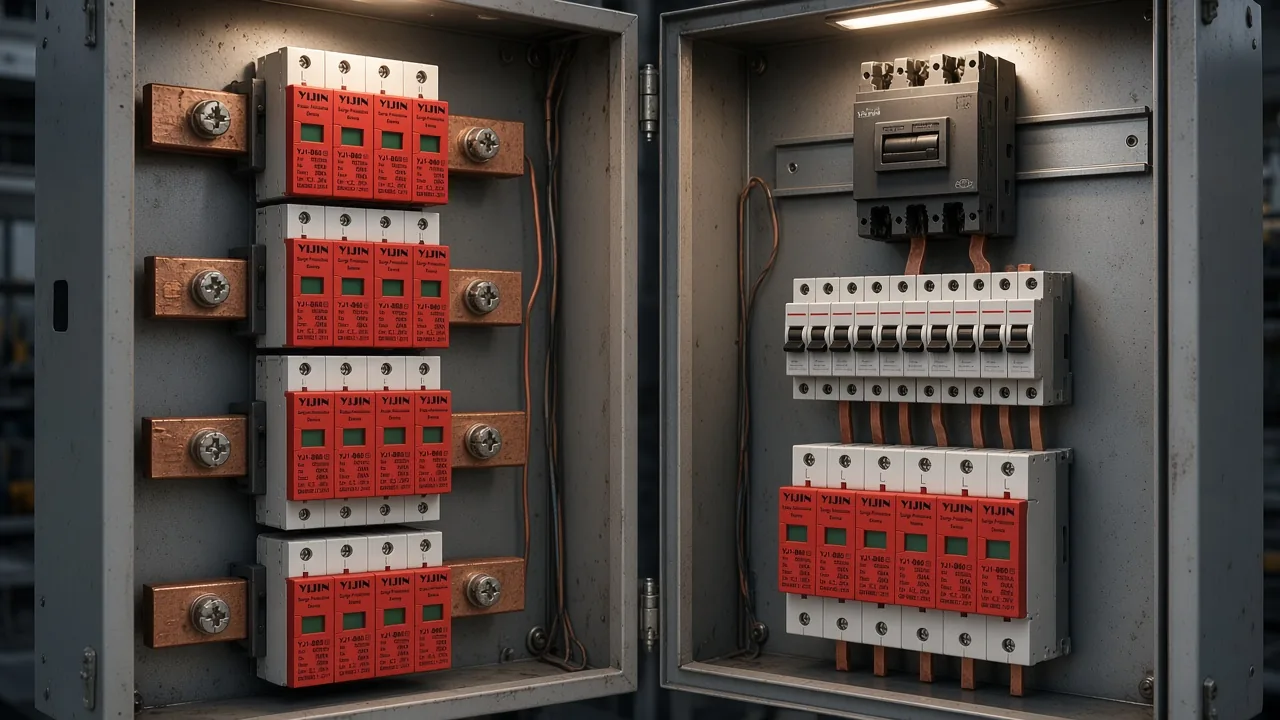
If the outdoor enclosure has no place to land leads, crews on that thread move the device to the first indoor panel. Minnesota practice cited there accepts that downstream panel when the outdoor disconnect has no SPD provisions, and they still treat the device as serving the dwelling. Local adoption varies.
The buyer question to take to an electrician is simple: where can this device be isolated, and is that seat still the service origin the class was chosen for?
Type 2 Boards and Type 3 Outlets Do Different Jobs
A Type 2 SPD sits at sub-distribution boards. IET consumer guidance is that plain. The board seat catches what the origin device let through, plus switching spikes born inside the building from motors, transformers, and some lighting.
A type 2 spd is the usual DIN-rail conversation on a floor panel. It is a different seat from a type 1 spd, even when both modules look like red cartridges on a 35 mm rail.
A Type 3 SPD belongs close to the protected load, and only as a supplement to a Type 2 device already upstream. Plug strips, outlet modules, and equipment-end clamps live here. They are the wrong tool for the service entrance.
NICEIC says the same thing in installation language: Type 3 only where Type 1 and/or Type 2 devices are already present.
| Seat | Where it sits | Test language buyers hear | Job it leaves open |
|---|---|---|---|
| Type 1 SPD | Origin, such as the main distribution board | Class I, 10/350 μs lightning-current impulse | Board and outlet devices still have residual and internal spikes |
| Type 2 SPD | Sub-distribution / floor board | Class II, In with an 8/20 μs impulse | Point-of-use equipment still wants a closer clamp |
| Type 3 SPD | Next to the load | Combination wave, 1.2/50 μs voltage with 8/20 μs current | Cannot stand in for the origin device |
City electricians on Electrician Talk ask the cascade question in plain language. One opener wants to know how a Type 2 stacks against a Type 1 for surges from outside the house, and whether people always cascade. A reply frames three zones: the utility, the service, and the point of use, and says adjacent zones should both be covered.
Forum replies use user language, not a standard clause. The picture still helps: one service device does not retire the floor board, and a floor board does not retire a sensitive drive or PLC at the end of a long run.
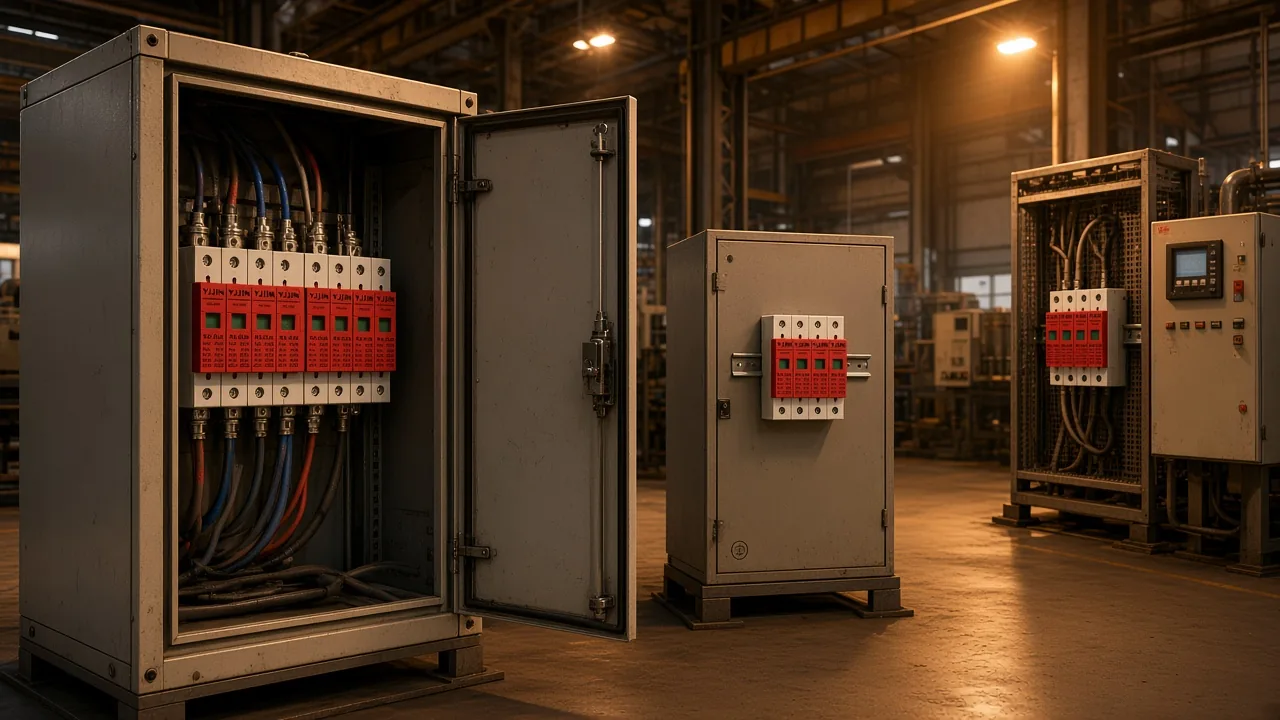
Coordination stays the remaining buyer word. IET says devices from different manufacturers should be checked for compatibility when more than one seat is used. A service assembly from one maker and a DIN-rail module from another can both be correct classes and still be a poor pair if their clamping levels fight.
Ask the electrician who will land them, not a blog paragraph, to confirm that pair.
Short Leads and the Backup Disconnect Conversation
The SPD path is parallel. Extra inches of conductor become extra impedance during a fast front, so the voltage left on the bus rises even if the module itself is a decent clamp. Keep phase, neutral, and grounding leads short and as straight as the enclosure allows.
Avoid coils and hairpin bends. Electricians and code commentary agree on that point, then stop. No single centimetre figure belongs on a Yijin card, and no Yijin torque chart is published here.
Whether an extra breaker or fuse is required is a manufacturer-instruction question. IET Wiring Matters, writing on BS 7671, says short-circuit protection of an SPD may be inside the device or external to it. Some constructions reach a safe open end-of-life on their own.
Others fail toward a short and need an upstream overcurrent device to finish that opening. A green-to-red thermal window is easy to confuse with that job. The window flags overheating.
It is not the short-circuit disconnector.
An external device in series with the SPD also has a cost. The same IET article notes the extra voltage drop on that series element, which raises the effective protection level seen by equipment downstream. Adding a backup breaker “just in case” is not free performance.
If the maker’s instructions already rely on an internal disconnector, a second series device can worsen the clamp while making isolation easier. Isolation for maintenance is a real reason crews still add one. Performance is the reason they keep it as short and as close as the instruction sheet allows.
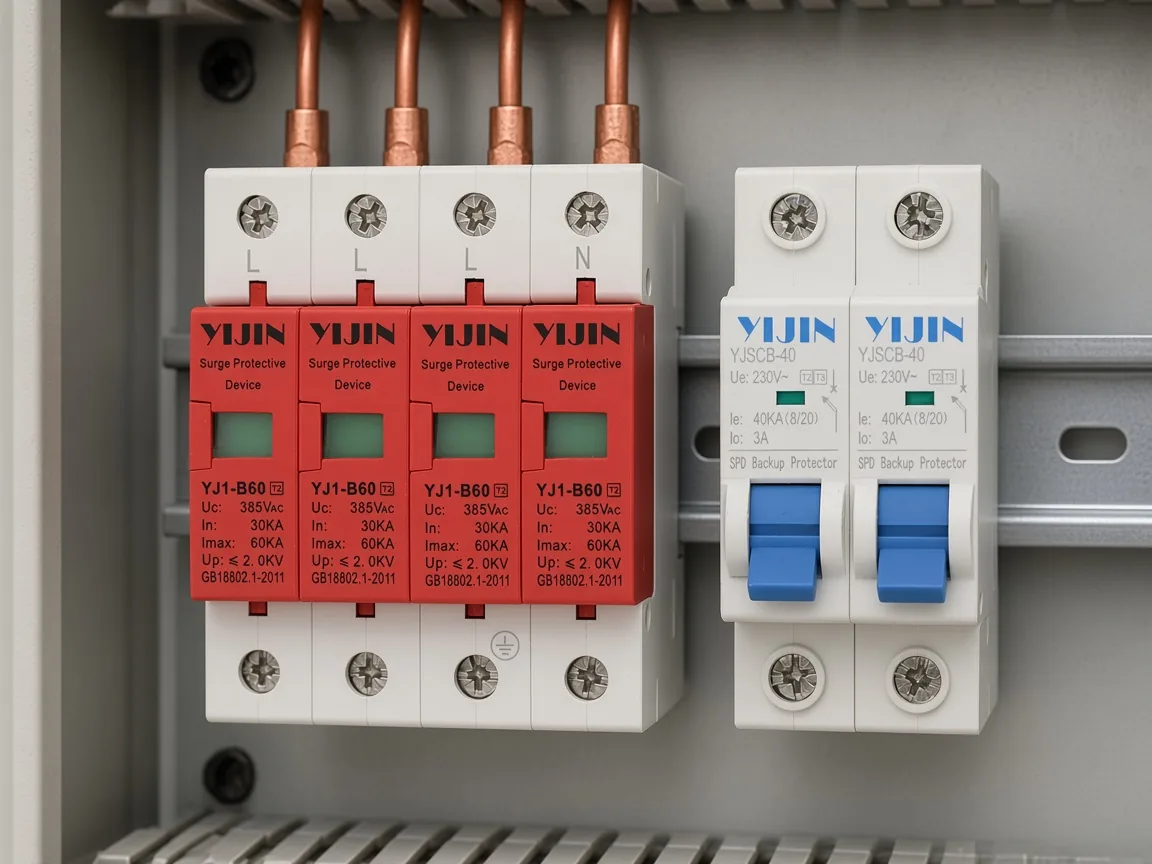
Yijin’s live answer to that backup question is a separate product, not a hidden claim on the clamp modules. The YJSCB-40 SPD backup protector page describes backup protection for SPDs used at first, second, and third stages. The YJSCB-40 page states a lightning impulse current of 25kA 10/350 μs and 100kA 8/20 μs without interruption, and a power-frequency trip above 3A.
The YJSCB-40 spec block lists Ue 230V and a power-frequency short-circuit breaking capacity of 65kA. The page also says the protector matches T1 and T2 SPD pairing. Read that sentence as a claim about the backup device.
It does not convert the clamp modules into a listed Type 1 assembly.
Live Class II Modules Beside a Type 1 Question
The surge category on this site is the parent shelf: surge protection devices. The four live URLs that belong in this conversation are Class II modules and one backup protector. None of the three clamp pages states UL Type 1, NEC service listing, or an Iimp figure.
Wikipedia lists IEC 61643-11 as the low-voltage power SPD standard that replaces IEC 61643-1. The live module pages cite IEC61643-1 and GB18802.1 as the design basis. That older citation stays as written.
The catalog text is left as printed.
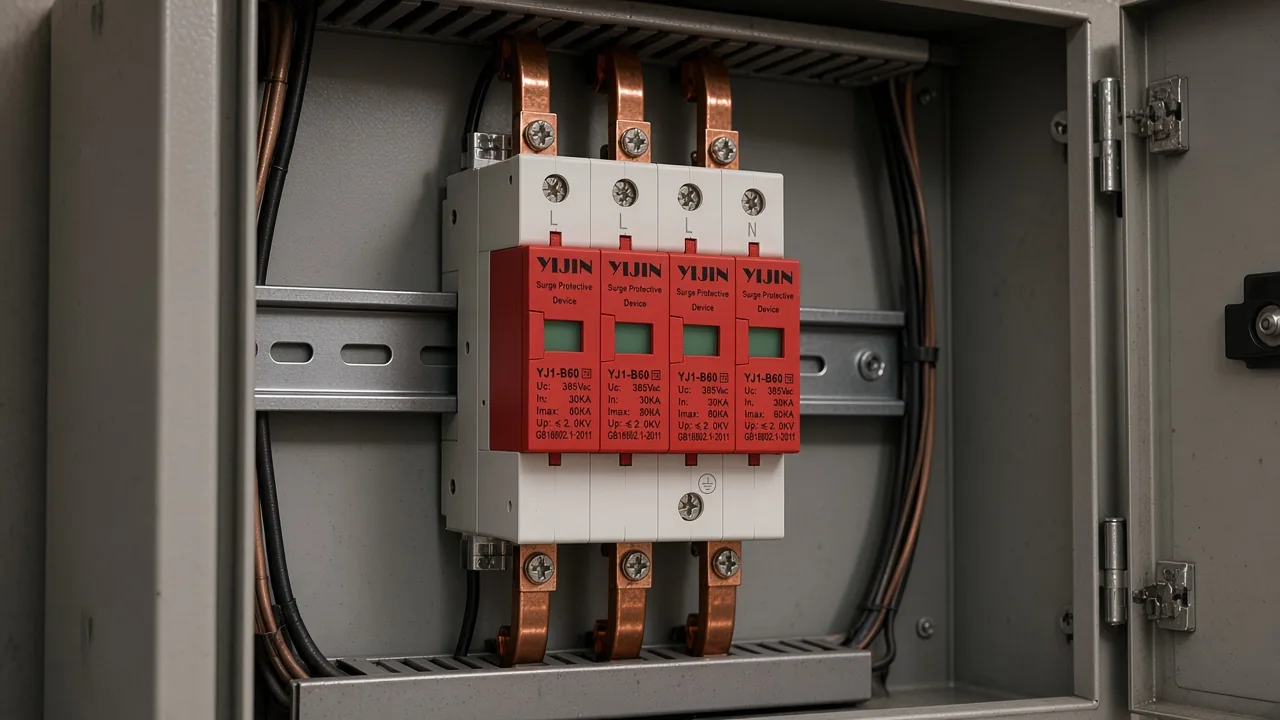
YJ1-B60 is the card whose application text talks like a first-level device. It is installed, in the page’s words, at the junction of LPZ0B, LPZ1, and LPZ2, as first-level power surge protection in high lightning-risk areas. The experimental category on the spec block is still Class II.
The published product photo shows T2 on the cartridge face, which matches that Class II block and is the opposite of a Type 1 mark.
YJ1-C40 uses the same Class II heading and a lighter discharge pair. Its application text points at floor distribution boxes, computer rooms, telecom rooms, elevator rooms, and household boards in dispersed villas. That is a board seat.
It is the wrong card to send someone who has already decided they need a service-origin class.
YJ-B80 carries the highest 8/20 maximum discharge current of the three. The page title is YJ-B80. The spec block labels the model YJ1-B80.
Order from the URL you mean, and ask the supplier to confirm which label ships. The application paragraph reads like the C40 floor-board list, not the B60 first-level sentence. A larger Imax does not move the card into a Type 1 install class.
| Live card | Page class | Spec-block discharge (8/20 μs) | Up | How the page talks about place |
|---|---|---|---|---|
| YJ1-B60 | Class II, pressure limiting | In 30kA / Imax 60kA | 2.0kV | First-level, LPZ junction, high lightning-risk areas |
| YJ1-C40 | Class II, pressure limiting | In 20kA / Imax 40kA | 1.8kV | Floor boards, equipment rooms, villa distribution boxes |
| YJ-B80 / spec label YJ1-B80 | Class II, pressure limiting | In 40kA / Imax 80kA | 2.4kV | Floor boards and equipment rooms |
| YJSCB-40 | Backup protector; page says it cooperates with Class I (T1) and Class II (T2) | Withstand language 25kA 10/350 μs and 100kA 8/20 μs | — | Series backup for SPD stages, not the clamp itself |
Pole count is on each card as 1P, 2P, 3P, or 4P. Match the system. A three-phase board question is a different article.
The class question here does not change because the rail holds four poles.
The module pages say the housing plastic meets UL94 V-0. That phrase describes the plastic. A UL 1449 SPD listing, which Wikipedia treats as the listing framework used where the NEC adopted that edition, is a separate mark.
Absence of that listing language on these pages is the fact to take into a US submittal.
YJ1-B60 Fit After the Class Decision, With a Backup Device
After sorting the Type 1 class, the honest Yijin look-up lands on the card that already uses first-level language, read as a Class II module. The YJ1-B60 spec block lists Uc (L-N) 385V AC, a nominal discharge current of 30kA (8/20 μs), a maximum discharge current of 60kA (8/20 μs), and Up of 2.0kV. That same card lists a response time of ≤25ns, a recommended series device of 63A/35kA, and conductors from 4-35 mm².
Available poles run 1P through 4P. Window indication is green for normal and red for fault. Remote signaling is optional.
Mounting follows the page spec. Rail is 35 mm.
The page’s recommended series device is the place the backup conversation starts on this card. The YJ1-C40 spec block lists a nominal discharge current of 20kA (8/20 μs), a maximum discharge current of 40kA (8/20 μs), and Up of 1.8kV.
The YJ-B80 spec block lists a nominal discharge current of 40kA (8/20 μs), a maximum discharge current of 80kA (8/20 μs), and Up of 2.4kV. Those two stay on the table for lighter or heavier board seats, not as substitutes for the first-level wording on B60.
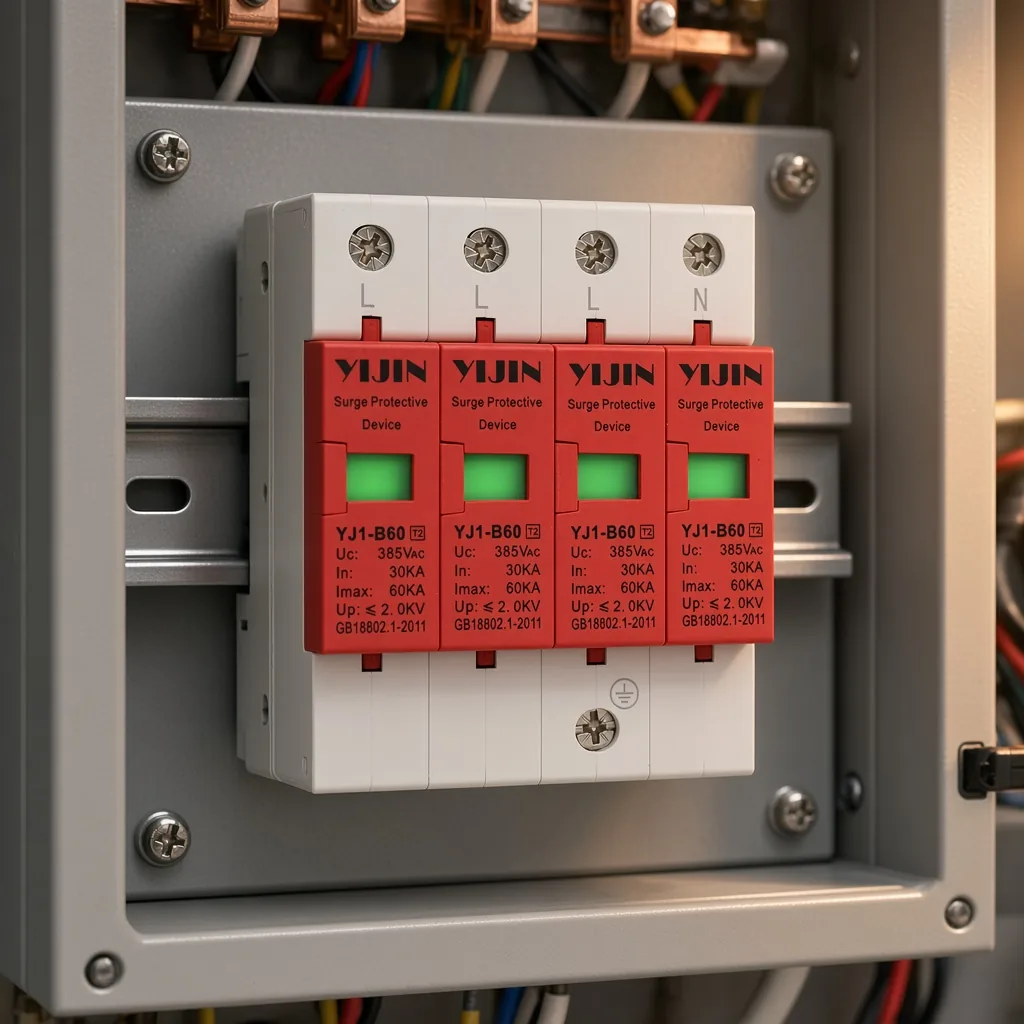
Open the YJ1-B60 surge protector when the project is asking for a first-level board module in a high lightning-risk area and the spec block above matches the system voltage. Pair it with the YJSCB-40 page when the question is the series backup device, including the page’s T1/T2 matching sentence. If the project instead needs a listed service-entrance Type 1 assembly with a US instruction sheet, these URLs do not close that submittal.
They close a Class II module conversation that started because someone said “type 1” and needed the seats sorted first.
FAQ
Does a Type 1 SPD always need its own breaker?
No. Some constructions carry internal short-circuit protection and the maker says an extra series device may be omitted. Others need an external fuse or breaker.
IET treats that as a manufacturer-instruction question. On this site, the YJSCB-40 page is the backup device written for that job, with a power-frequency trip above 3A. A green status window is thermal indication, not that backup.
Can a Type 1 device sit on the load side of the service disconnect?
Yes, in the way electricians on Electrician Talk describe a Type 1 seat: either side of the service disconnect, with many crews preferring the load side so the unit can be replaced without working ahead of the main. The class is still the origin seat. A floor board far downstream is a Type 2 conversation even if the module looks similar.
Is a DIN-rail Class II module the same install class as a service Type 1?
No. Class II on the live Yijin cards tracks an 8/20 discharge test. A Type 1 install class tracks a 10/350 lightning-current test and an origin placement when direct-strike exposure is the reason.
A 35 mm rail and a red cartridge do not move a card from one class to the other.
Why do electricians still cascade if a service device is already there?
Because the service device and the floor board see different leftovers. External lightning and utility switching hit the origin. Motors and other internal switching create spikes farther in.
Electrician Talk users talk about utility, service, and point-of-use zones for that reason. IET still places Type 3 only as a supplement after Type 2, which only makes sense if the upstream seats exist.
What does the YJSCB-40 page claim about T1 and T2 matching?
The page says the backup protector meets T1/T2 SPD matching and that it cooperates with Class I (T1) and Class II (T2) experiment categories. It also states 25kA 10/350 μs and 100kA 8/20 μs without false trip. Those sentences describe the backup device.
They do not list YJ1-B60, YJ1-C40, or YJ-B80 as Type 1.
Does a UL94 V-0 housing mark mean the SPD is UL Listed?
No. UL94 V-0 on these pages is a plastic flammability phrase. A UL 1449 SPD listing is a different mark, and these product pages do not state it.
A US submittal that needs a listed Type 1 assembly has to be answered with that listing, not with the housing resin.
Should a point-of-use protector sit on the same job as the service device?
No. Point-of-use is the Type 3 seat, close to the load, and it only supplements devices already upstream. A desk strip cannot take the service-origin job, and a service device does not replace a clamp sitting next to a sensitive drive if the run between them is long.
References
- Surge protector, Wikipedia, on SPD naming, spike duration, and location categories.
- Surge Protective Devices (SPD), IET consumer guidance, on Type 1 at the origin, Type 2 at sub-boards, and Type 3 only as a supplement.
- Do SPDs require an overcurrent protective device?, IET Wiring Matters, on internal versus external SPD overcurrent protection and series voltage drop.
- Types of Surge Protective Devices and their use in electrical installations, NICEIC via Professional Electrician, on Class I and Class II test impulses and Type 1 placement at the origin when direct-strike exposure applies.
- Where do you install your type 1 surge protectors?, Electrician Talk, on either-side placement and the replacement objection to a line-side landing.
- Residential type 1 vs. Type 2 SPDs in a city?, Electrician Talk, on cascading service and point-of-use protection.