 Yueqing Yijin Electronics Co., Ltd.




What ABC and ACB Phase Sequence Labels Actually Designate
abc and acb phase sequence are two written designations for the two directions a three-phase supply can rotate in, and neither string is evidence of a wiring error. Only two rotations exist; everything else in the argument is naming. The harder question — who fixed the letters used at your site, from which viewpoint, and what you write on an order because of it — is the one the search results keep skipping.
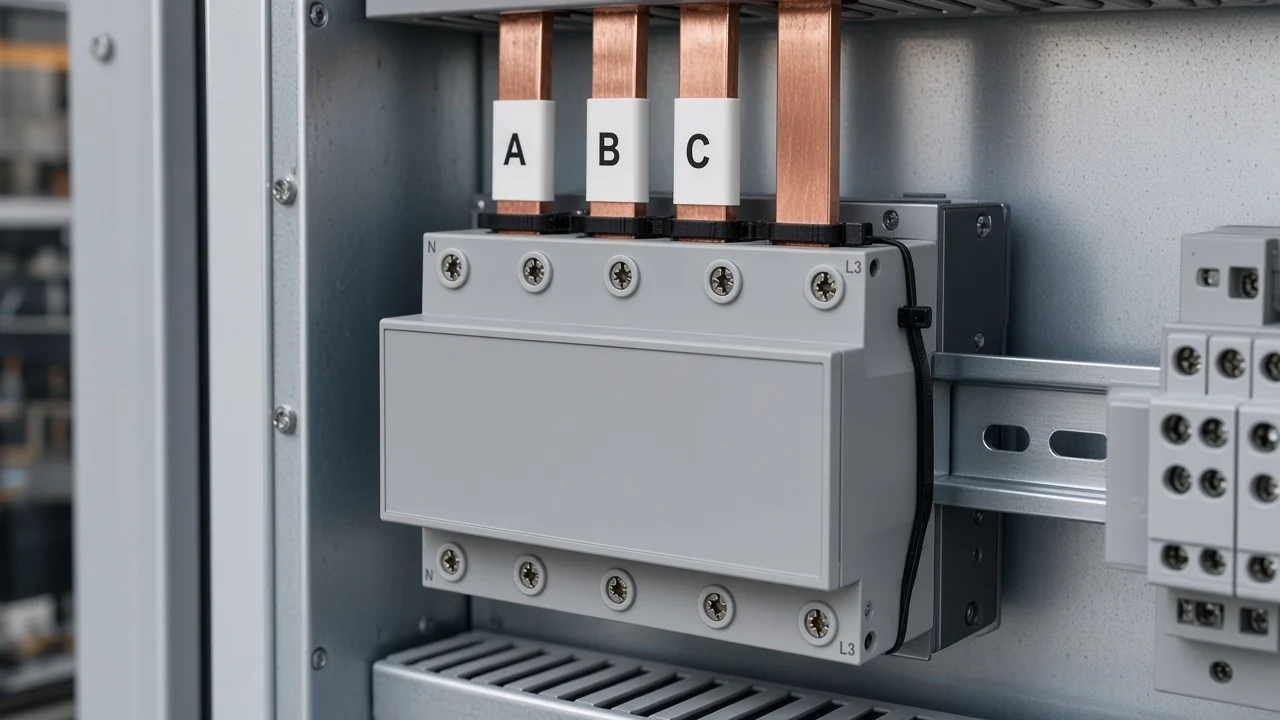
ACB Does Not Mean the Panel Is Wired Wrong
An ACB label records the rotation a site decided to write down, and perfectly healthy switchgear carries it every day. Practitioners on the Mike Holt forum put it flatly: “ABC or ACB is simply the order in which the phases reach there positive maximum.” The same thread describes phase rotation as “really arbitrary” in the grand scheme of things.
The belief has a traceable origin, and it is the phrase negative sequence. In symmetrical components analysis, a positive sequence set of currents produces a normal rotating field, a negative sequence set produces a field with the opposite rotation, and a zero sequence set produces a field that oscillates without rotating. That is a decomposition used in fault studies.
Borrowing those words for a site label is where the trouble starts. One responder in the same forum thread draws the line explicitly: “Here, the word ‘sequence’ has a meaning unrelated to the use of the same word in the phrase, ‘negative sequence.'” A plant running ACB is simply a plant whose drawings start counting somewhere else.
Important: the symmetrical-components meaning of negative sequence has nothing to do with the letters on your one-line — “ABC or ACB is simply the order in which the phases reach there positive maximum” — Mike Holt forum, positive vs negative sequence thread.
What does go wrong is a separate matter, and it is mechanical. Electrical Engineering Portal calls phase sequence “one of the most confusing concepts in the electrical engineering” and says it is often confused with motor rotation, which is the real casualty when two conductors get swapped.
What the Letters in ABC and ACB Actually Designate
The letters name peak order. Phase sequence is the sequence in which the phase voltages reach their peak values with respect to time, so the designation answers exactly one question: which line arrives first, which second, which third.
Teaching texts pair each order with a direction of travel. CircuitBread’s three-phase study guide describes the abc or positive sequence case as the rotor turning counterclockwise, with Van leading Vbn and Vbn leading Vcn, and the acb or negative sequence case as the rotor turning clockwise, with Van leading Vcn and Vcn leading Vbn.
Field vocabulary runs alongside the textbook vocabulary. Most technicians say phase rotation; the power-engineering publisher Voltage Disturbance points out that phase sequence, not phase rotation, is the term defined in the IEEE dictionary it cites as IEEE 100-1984, while treating both as names for the same property.
One detail matters more than it looks. A designation is always read against a chosen reference waveform — the NJIT ECE 449 laboratory text names waveform 1 as the reference at zero degrees, with the others at minus 120 degrees and minus 240 degrees — so the letters describe an order relative to a starting point somebody picked.
Why the Same Rotation Can Be Written ABC, BCA, or CAB
Move the reference phase and the same physical rotation acquires a different spelling. Nothing in the copper changes; the person writing the label simply starts counting from a different conductor.
A substation protection engineer asked the Electrical PE Review community why anyone would build a system with B or C as the first phase, having met neighbouring entities running “BCA” and “CAB” systems while his own was an “ACB” system. The instructor’s reply reframes the whole ABC vs ACB argument: “There really are only two different phasing arrangements, counterclockwise and clockwise rotation.”
The list that follows in that thread is the part worth pinning to a drawing: “The following are all examples of positive sequence: ABC BCA CAB. These are all the same thing.”
| Written designation | Rotation it names | What the spelling alone does not tell you |
|---|---|---|
| ABC | Positive sequence | Which conductor the writer treated as the reference |
| BCA | Positive sequence | That it is identical to an ABC system |
| CAB | Positive sequence | That it is identical to an ABC system |
| ACB | Negative sequence | Anything about the health of the installation |
| CBA | Negative sequence | Whether C was chosen as the zero-degree reference |
| BAC | Negative sequence | Whether the reader and the writer faced the same way |
The second reason the spelling drifts is that a balanced system hides the difference from instruments that measure size rather than order. The NJIT laboratory text makes the same point about magnitudes, which are unaffected by a reversal of phase sequence, so a voltmeter sweep across a swapped board looks entirely normal.
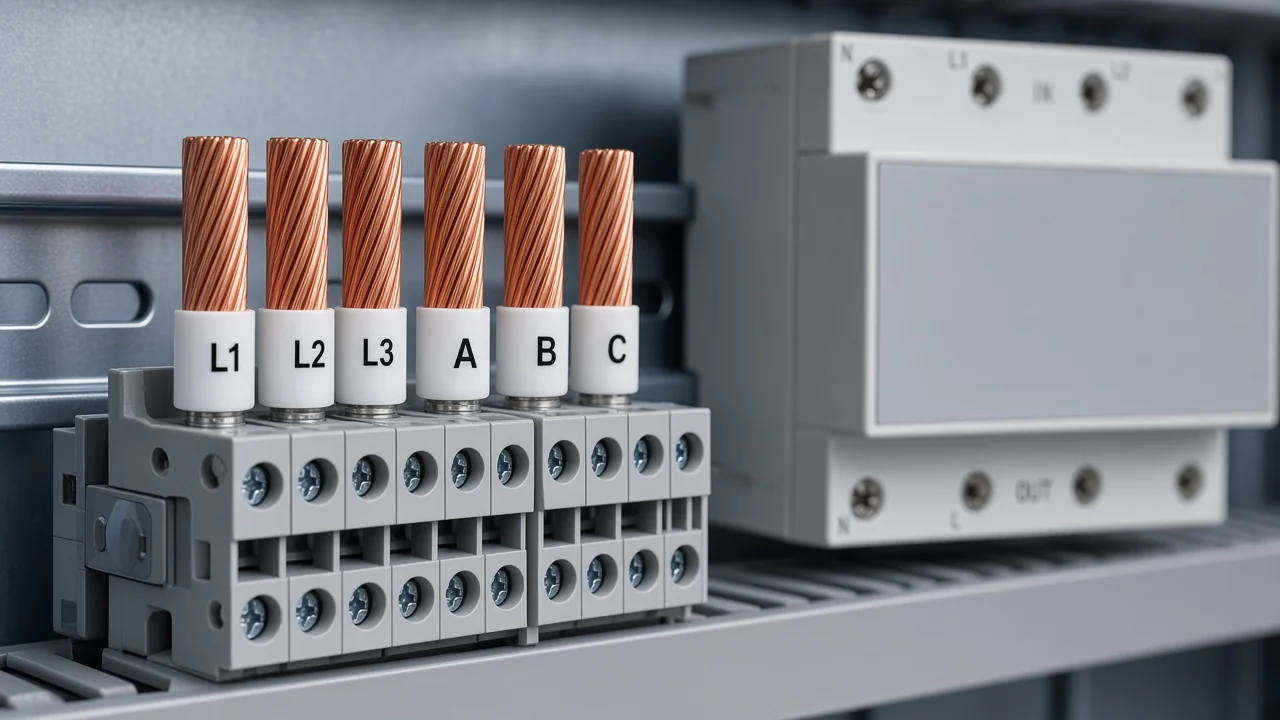
ABC, A-B-C, and L1-L2-L3: One Property, Several Labelling Habits
Every region encodes the same property, and each does it with its own alphabet. Letters, line numbers, colour codes and transformer terminal marks all end up describing one ordering, which is why a single project can carry four different-looking labels for one rotation.
Wikipedia’s three-phase article notes that wiring for three phases is typically identified by colours that vary by country and voltage, and that three-phase loads such as motors connect to L1, L2 and L3. Commissioning teams working in the line-number style write the forward order as L1-L2-L3 and the reverse order as L1-L3-L2.
Transformer marks are a different animal again. In the Electrical PE Review thread, one responder explains that a CBA label may describe bushing phasing rather than rotation, because designations such as H1-H2-H3 and X1-X2-X3 identify winding terminals and do not by themselves specify which phase lands where.
| Label style | Where it is authoritative | What it actually fixes |
|---|---|---|
| A-B-C letters | Utility and plant one-line drawings | The rotation the site has adopted in writing |
| L1-L2-L3 numbers | Panel wiring, terminal blocks, motor connections | Which terminal a conductor lands on in sequence |
| ABC / ACB strings | Interconnection and paralleling discussions | The direction of travel, once a reference is stated |
| Bushing marks such as H1-H2-H3 | Transformer nameplates and terminal drawings | Winding terminal identity, not rotation |
| Colour identification | Field work inside one country’s wiring rules | Local conductor identity, which travels badly abroad |
Inconsistent labelling across switchboards is not harmless housekeeping. When two boards in one building disagree, fault diagnosis slows down, because the person reading the records has to work out which document was written from which starting point before touching anything.
Why Two Engineers Read Opposite Sequences From One Drawing
A phasor diagram becomes readable only once its rotation convention and the reader’s viewing position are both stated. Leave either out and two competent engineers will disagree about a drawing that is technically correct.
The TestGuy wiki holds a clean example. An engineer asks why a colleague reads an interconnection drawing as A-B-C when he reads it as A-C-B, and wonders “is there some convention where some engineers think the phasor arrows rotate in the graphic, while others think the rotation arrow actually rotates around the phasor arrows?”
Replies settle it by naming the missing convention first: “In the diagram, the CCW rotation is the convention,” after which “according to this phasor diagram, the rotation is ACB.” Electrical Academia states the same rule generally — with counterclockwise phasor travel, the order is the order in which the phasors pass the reference axis.
Viewing position is the second hidden variable, and a test-engineering exam question weaponises it. A utility defines its horizontal bus as ABC left to right facing the customer with ABC rotation, while the customer defines the same bus as ABC left to right facing the utility with CBA rotation; both labels are accurate, and one respondent notes the trick is precisely the words “facing the utility” or “facing the customer”.
How a Site Fixes Its Designation and Records It
One designation gets chosen, then carried without deviation onto drawings, panel legends and switch labels. The choice itself is arbitrary; the consistency afterwards is what keeps a site readable.
In practice the decision is inherited rather than made. The incoming utility arrangement, the reference conductor used on the original drawing set, and the transformer terminal marks together decide what the first engineer wrote, and every later document copies it.
Recording it is the cheap half of the job. Yijin’s YJFT-125 4P page describes a “label window for clear labeling of power sources” on the front of the switch, which is exactly where the source designation belongs so that the next person opening the board reads it before touching a handle.
Three places need to agree before a project hands over: the one-line drawing, the panel legend, and the physical marking at the terminals. When those three disagree, the label stops being information and becomes a guess with a printed border around it.
When a Generator and the Utility Arrive With Opposite Designations
Here the naming argument finally acquires teeth, because two sources must physically match before they are ever connected together. Wikipedia states the rule without softening it: two sources of three-phase power must not be connected in parallel unless they have the same phase sequence.
A poster on the Mike Holt forum arrived with the textbook version of the problem — a utility labelled A-B-C and generators labelled A-C-B, both described as clockwise. The replies are consistent: “ABC phase sequence is not the same as ACB”, and “what is most important is same phase sequence from each unit being connected together in the paralleling effort”.
The practical remedy is a conductor swap rather than an argument about paperwork. One responder spells it out: if the utility wires are A, B and C and the generator wires are a, b and c, one workable connection is A-a, B-c and C-b.
The advice that closes the thread is the one to keep: “Put a rotation meter on the generator if you can.” Wikipedia makes the same point from the other direction, noting that where absolute phase identity is not needed, phase rotation test instruments identify the rotation sequence in one observation.
Two honest boundaries belong here. Yijin’s catalogue holds no phase rotation tester and no measuring instrument of any kind, so a commissioning team still buys that separately — and for how the sensing itself works, the detection methods are covered in our article on the 3 phase sequence detector circuit rather than repeated here.
Specifying Phase Sequence When You Select or Order Switchgear
State the designation your site already uses, then state the hardware around it. Yijin’s YJFT-125 4P page lists what an order has to carry: “the ordering unit must specify the form and characteristics of the switch, voltage level, current level, number of poles, operation mode and quantity, etc.”
Pole count is where the sequence question becomes commercial. The live Transfer Switch category lists manual YJFT-63 and YJFT-125 families in 1P, 2P, 3P and 4P alongside the automatic conversion switch, so a three-phase-plus-neutral job and a single-phase job are answered by different pages in the same range.
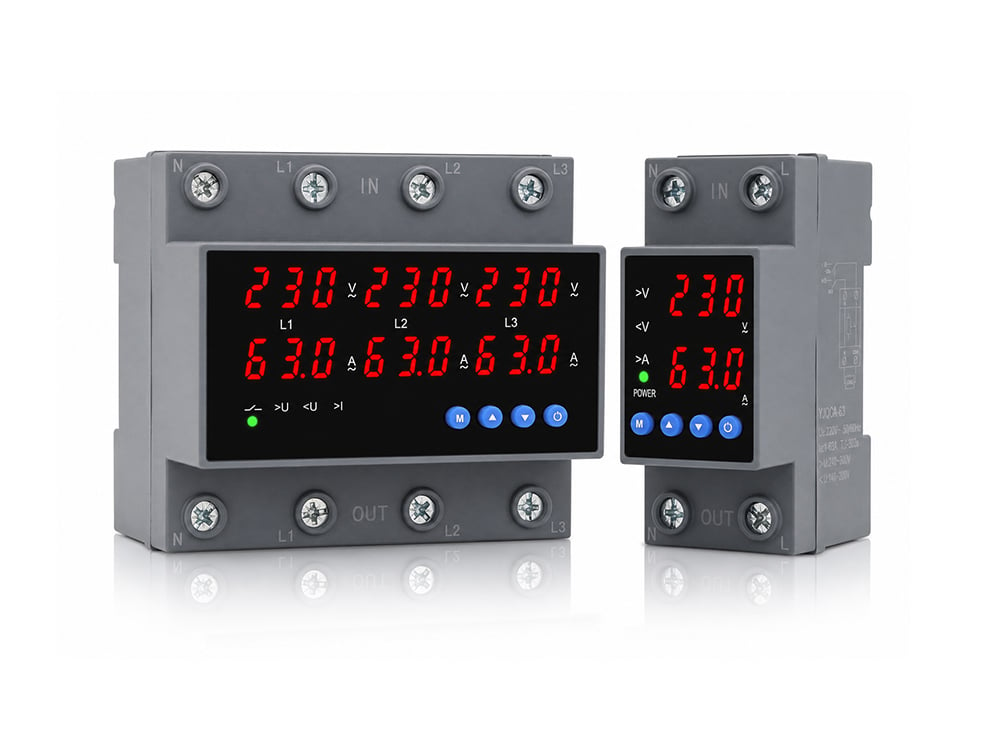
If the output order itself has to be dealt with automatically, the relevant live model is the YJVA3-1 automatic phase sequence conversion switch. Its page states that when there is a phase sequence fault in the line, the phase sequence conversion switch automatically detects and switches to the normal phase sequence power supply output.
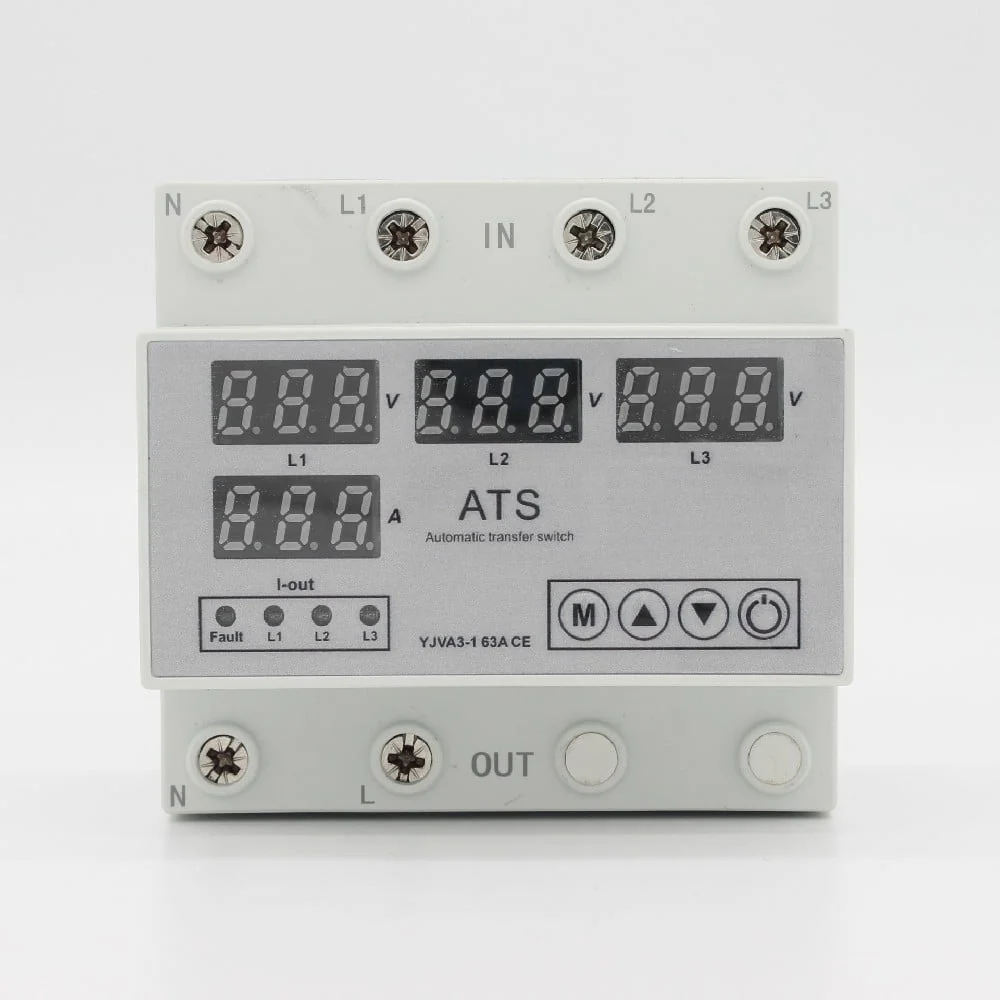
The page also states that the overvoltage value, undervoltage value, overcurrent value and output phase sequence can be set and selected by the user, and adjusted to the local actual situation. That settable output order is the reason this model belongs in a naming discussion at all.
| Printed parameter | Page-stated value |
|---|---|
| Number of product poles | 3P+N |
| Rated voltage | AC230V |
| Rated current | 3A~63A adjustable (default 63A) |
| Frequency | 50Hz/60Hz |
| Undervoltage action cut-off value | 140V-200V adjustable (default 170V) |
| Overvoltage action cut-off value | 240V-300V adjustable (default 270V) |
| Phase sequence switching detection time | OFF-1s~500s adjustable (default 10 seconds) |
| Lifespan | More than 100000 times |
Values in that table are the ones printed on the product page, and nothing beyond it is claimed here — no listing marks, no tested switching performance, no ratings carried over from another model. If a project needs a pole count or current level that the listed pages do not show, the contact form on the product page is the quickest route to ask.
FAQ
How do you know if phase rotation is correct?
You measure it rather than read it off a label. Where absolute phase identity is not required, a rotation test instrument identifies the order in a single observation, which is why the standing forum advice to anyone reconciling a generator against a utility is to put a rotation meter on the machine instead of trusting two nameplates.
Is ACB the same as negative sequence?
The words overlap and the meanings do not. ACB names the clockwise rotation as written at a particular site, while negative sequence in symmetrical components describes a computed current set that produces a field of opposite rotation — a fault-analysis quantity that exists in the maths of an unbalanced system, not a verdict on your switchboard.
What is L1, L2, and L3 in 3 phase?
They are line numbers for the three phase conductors, and three-phase loads such as motors connect to L1, L2 and L3. The numbers do the same job as the letters A, B and C: L1-L2-L3 written in that order describes the forward rotation, and L1-L3-L2 describes the reverse.
Why would a site use a reference phase other than A?
Usually because something upstream decided it. A protection engineer who raised this question had neighbouring entities running BCA and CAB systems, and the answers pointed to two causes: another conductor being taken as the zero-degree reference, or a label that was really describing transformer bushing phasing rather than rotation.
Does a VFD care about ABC or ACB?
On its input, generally no. The rotation direction of the motor is set by the drive output rather than by the incoming order, which is why Voltage Disturbance lists variable-frequency drive inputs among the cases where rotation is not important — direct-on-line machines and paralleled sources are where it still matters.
Can relabelling a panel fix a rotation problem?
No, and it makes the next fault harder to find. Rotation is changed by reversing two conductors, not by editing a legend, and inconsistent labels across switchboards are exactly what slows fault diagnosis down when someone arrives months later with a drawing that disagrees with the copper.
Does Yijin sell a phase rotation meter?
No. The live catalogue covers transfer and phase-sequence conversion switching hardware, so rotation meters, phase rotation testers and other commissioning instruments have to come from an instrument supplier.
Which YJVA3-1 setting covers output phase sequence?
Output phase sequence is one of the user-settable values named on the product page, alongside the overvoltage, undervoltage and overcurrent values. The page also lists a phase sequence switching detection time adjustable from OFF and 1s to 500s with a default of 10 seconds, so how long a fault must persist before the output moves is a setting rather than a fixed figure.
References
- CircuitBread study guide: three-phase circuits and the abc / acb sequences
- NJIT ECE 449 Power Systems Laboratory 3: phase sequence and reference waveforms
- Electrical Engineering Portal: proper phase sequence for motors and generators
- Voltage Disturbance: phase rotation and phase angle
- Wikipedia: symmetrical components
- Wikipedia: three-phase electric power
- Electrical Academia: phase sequence in a three-phase system
- Electrical PE Review community: BCA and CAB versus CBA and BAC sequence systems
- Mike Holt forum: positive vs negative sequence
- Mike Holt forum: phase sequence rotation confusion
- TestGuy wiki: phase sequence from a phasor drawing
- TestGuy forum: utility versus customer phase rotation