 Yueqing Yijin Electronics Co., Ltd.




4 Pole Rotary Isolator Switch Inside the HD11F Knife Family
A 4 pole rotary isolator switch is a four-pole isolator that opens three phases and the neutral together on one handle. US catalogs usually mean an enclosed cam rotary for that job. Yijin does not sell that cam box; the live 4-pole member of the same isolation family is the HD11F-250/4 4-pole knife isolator.
This family walk names the IEC design variants, shows how four poles work, then reads the HD11F open-knife architecture, AC-20B duty, 3P versus 4P frames, and the live ratings.
The Rotary Search Term and the IEC Isolator Family
US and UK search results for a 4 pole isolator switch are almost all enclosed rotary-handle boxes. IEC 60947-3 still treats those boxes as one design among several disconnectors, not as the only legal shape of a 4 pole disconnect switch.
The same standard note lists a rotary switch disconnector, a cam-operated switch, and a knife-switch disconnector as names that follow the mechanism. A buyer who pastes a UK IP65 cam SKU into an RFQ is asking for four-pole isolation; the hardware behind that SKU is still a choice of form.
US shops already split the language. Mike Holt contributors call disconnects knife-blade, rotary selector, or breaker-style contacts, which is field slang rather than a Yijin listing.
Yijin’s isolating switch catalog is the knife member of that family: HD11F and HK18 open knife isolators. There is no cam-operated rotary isolator on that hub, so HD11F-250/4 is the honest 4P map, not a relabeled yellow handle.
Four Poles, Four Conductors on One Handle
Four poles open L1, L2, L3, and the neutral together. Earth stays on its own terminal and is not a switched pole.
That is why a 4-pole three-phase isolator is specified on a 3ph+N feeder. A 3-pole frame opens the three phases and leaves the neutral on a solid bar.
A pole is one switched path through the device. Four poles means four of those paths share the handle, which is the whole point of a 4 pole disconnect switch on a four-wire supply.
Distributors write the same idea as TPN: three poles plus a fourth neutral pole. The search term “rotary” is the handle style; the electrical job is still four conductors.
Use that reading when a single-phase feeder shows up with a 4P box in the truck. Two poles can carry line and neutral, but the family is built for 3ph+N, and spare poles need a label so nobody lands a phase on a floating contact.
HD11F Open-Knife Architecture in That Family
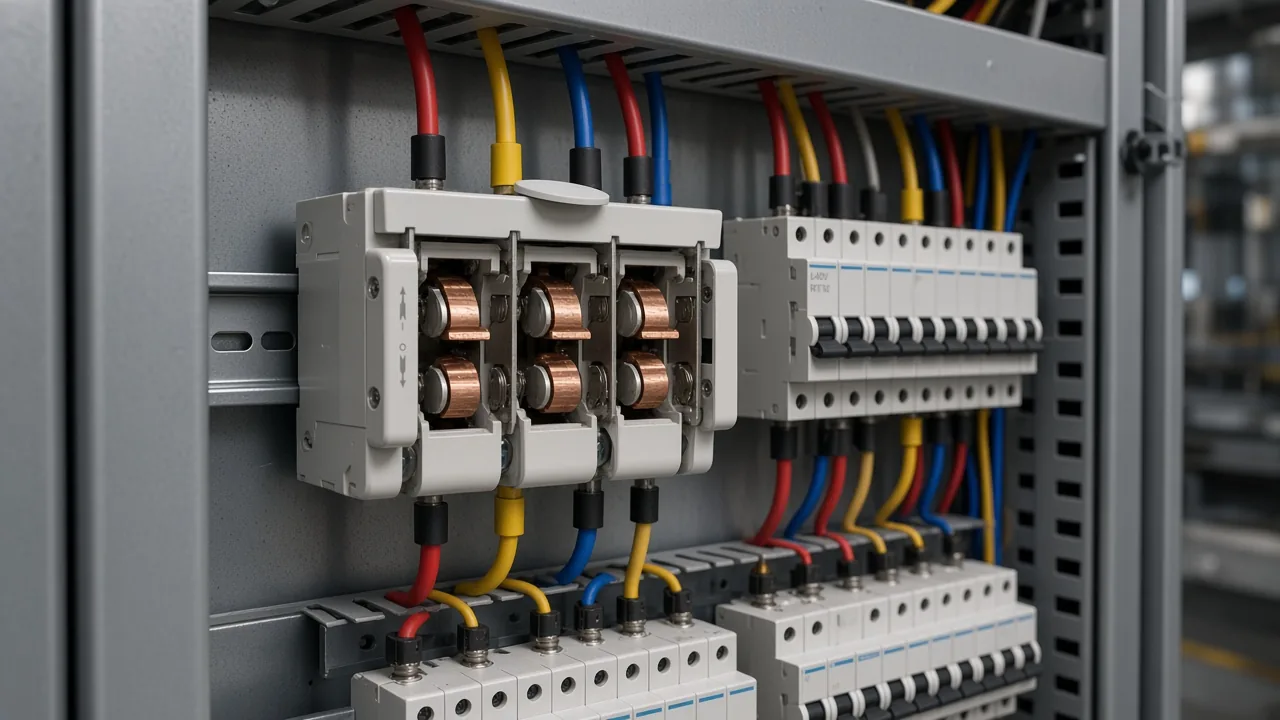
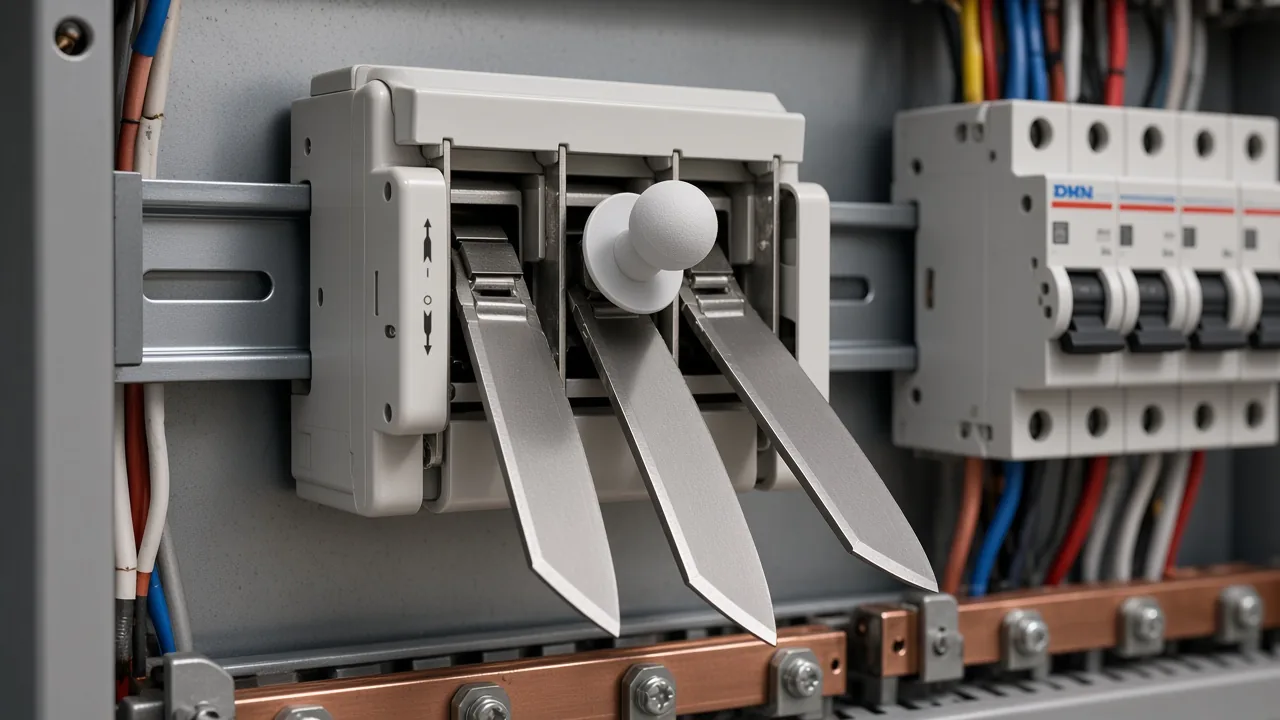
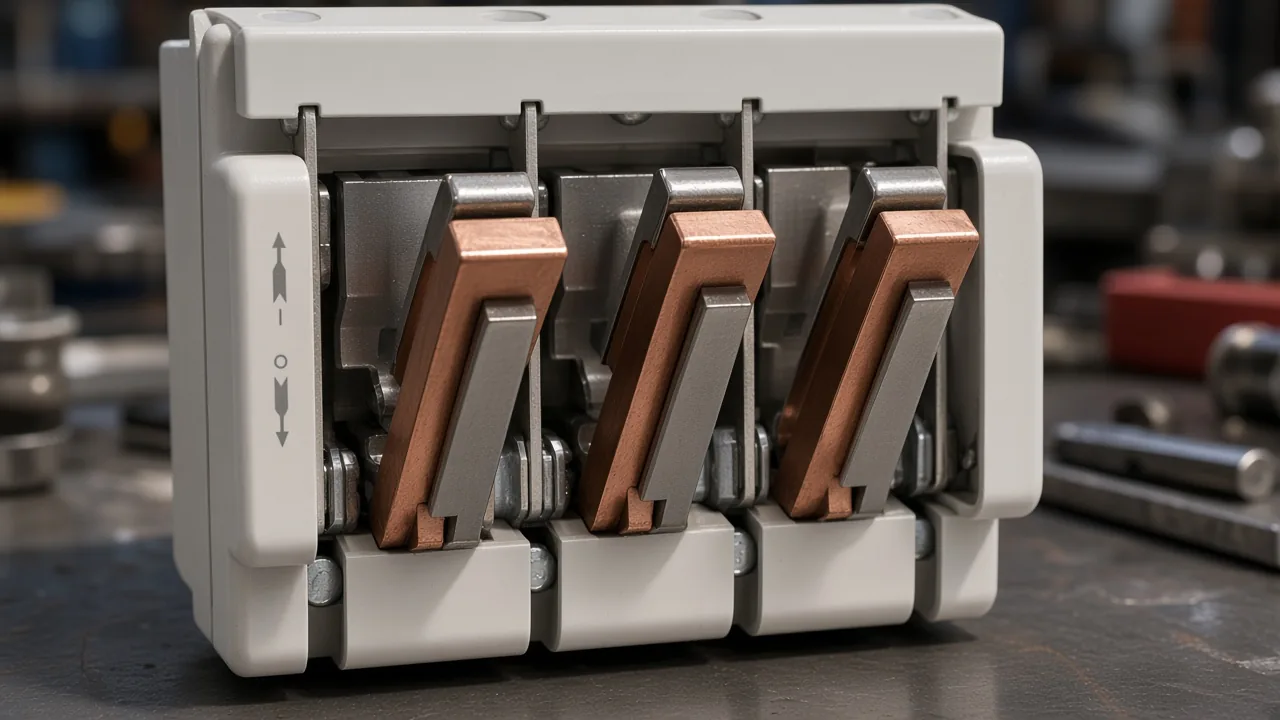
HD11F is an open knife switch isolator. Linked blades drop into jaws under a protective opening, which is the knife-switch disconnector in IEC language rather than a barrel cam.
The series is for infrequent manual connection, disconnection, and isolation on AC 50 Hz circuits with rated voltage up to 400 V. Operation is under no-load.
Tin-plated jaws stay visible in the open position. The live page specifies GB/T14048.3, with IEC 60947-3. That is first-party standard language for the series, not a third-party certificate PDF.
Construction notes on HD11F are tin-plated blades and holders, an anti-misoperation opening, and thickened copper parts. Rated impulse withstand voltage is 8 kV on both the scope copy and the parameter table.
If you need a first look at blade-and-jaw geometry without the rotary search overlay, the sibling note on what a knife switch is stays on form. This page stays on the 4P family seat HD11F occupies.
AC-20B No-Load Duty in the HD11F Family
Utilization category AC-20B on HD11F means no-load isolation. Open the knife after a breaker or contactor has already stopped current.
An isolator, or disconnector, is built for a visible or verifiable open path. It is not a circuit breaker and it is not a load-break switch-disconnector unless the utilization category says so.
The handle belongs in OFF before anyone touches the load side.
Enclosed rotary catalogs that rank for this keyword often publish AC-22A or AC-23A on-load figures.
Niglon’s IS404 4-pole rotary sheet, for example, lists AC-22A and AC-23A at 40 A. That is a different duty than HD11F’s AC-20B.
US code talk already treats many high-ampere knife switches as isolation-only devices that must not be opened under load. HD11F’s own table is stricter still: AC-20B, no-load, infrequent manual use.
From the field: Installers argue whether the fourth pole should switch the neutral, and they already warn that isolators are not for switching under load. https://www.diynot.com/diy/threads/fourth-pole-on-isolator.599384/
OSHA lockout practice then treats that open isolator as an energy isolating device held in OFF. HD11F is the isolation contact set; it is not sold here as a UL 98 enclosed rotary with a factory padlock hasp.
3P and 4P Frames: HD11F-250/3 versus /4
Order HD11F-250/4 when the feeder is three-phase plus a neutral that must open with the phases. Order HD11F-250/3 when only three poles are required.
The live table lists both 3P and 4P under model HD11F-250/4 (or /3). The fourth pole is the switched-neutral path, not a spare earth.
Forum wiring shows the trap. Some rotary boxes also have a solid unswitched N bar next to earth, so a crew can land neutral on the link and never use pole four.
If all four poles open together without an early-make/late-break neutral, a 230 V load on a 400 V system can see a nasty voltage while the neutral is the first to go. Dedicated 3P+N rotary kits mark that pole for a reason; HD11F simply sells /3 and /4 as separate frames.
Do not treat /4 as a DC polarity block. HD11F is an AC 50 Hz knife family. PV 4P rotary handles in shopping carousels are a different product stack.
HD11F-250/4 Parameter Map
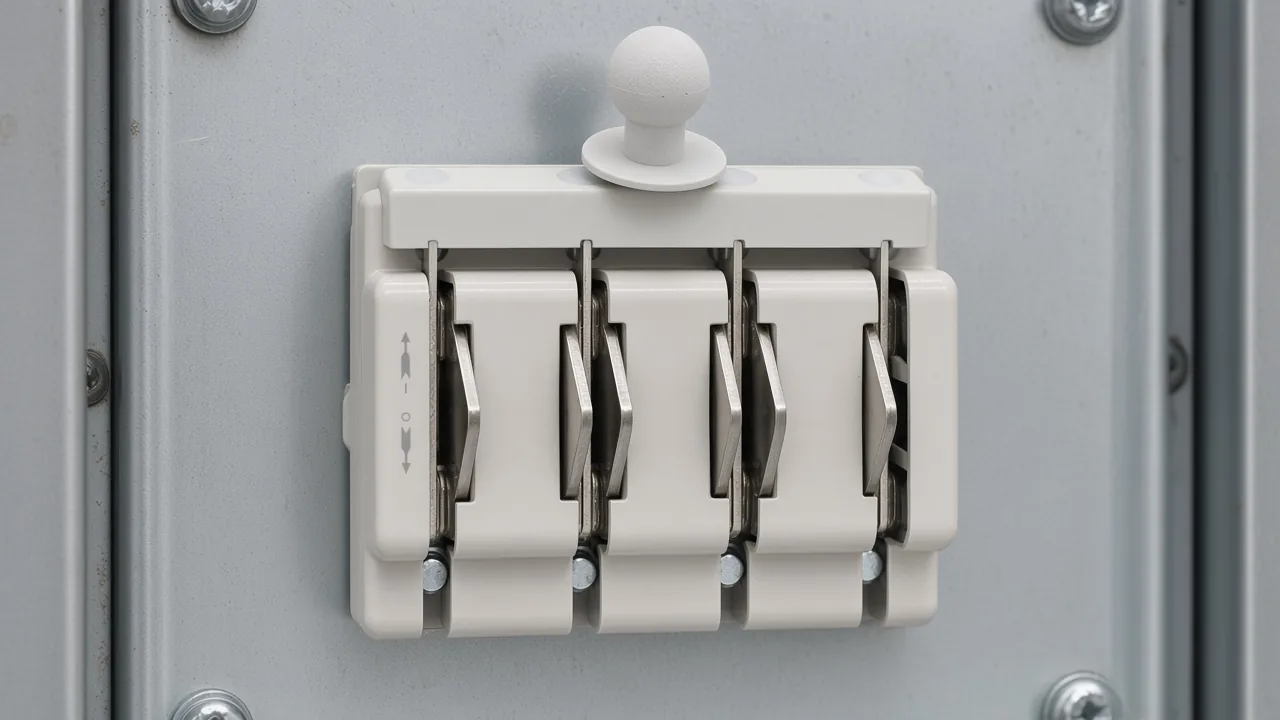
The live HD11F-250 table is the family card for both pole counts. Scan it before you copy a 32 A IP65 rotary SKU into the same line of a bill of materials.
| Parameter | HD11F-250 live value |
|---|---|
| Model | HD11F-250/4 (or /3) |
| Poles | 3P, 4P |
| Rated working voltage Ue | 400 V |
| Rated insulation voltage Ui | 1000 V |
| Agreed heating current Ith | 250 A |
| Rated working current Ie | 160 A, 180 A, 200 A, 225 A, 250 A |
| Frequency | 50 Hz |
| Rated impulse withstand voltage Uimp | 8 kV |
| Utilization category | AC-20B |
| Rated short-time withstand current Icw | 3 kA |
HD11F-250 carries Ue 400 V, Ui 1000 V, Ith 250 A, and Uimp 8 kV at 50 Hz. Working current options are 160 A through 250 A.
Short-time withstand is 3 kA. Mechanical life on the table is written as ten thousand times.
Ambient air on the same page shall not exceed +70 °C or fall below −25 °C, with a 24-hour average not above +35 °C. Installation altitude shall not exceed 2000 m, and the published pollution degree is level 3.
The switch is for a location without rain or snow invasion. That is another reason it is not a drop-in for an outdoor IP65 rotary enclosure.
| Family form | What the handle does | What Yijin catalogs |
|---|---|---|
| Enclosed rotary / cam isolator | Turns a barrel or cam to open four poles, often in an IP65 box | Not in the live isolating-switch list |
| Open knife isolator | Linked blades into jaws, 3P or 4P | HD11F-250/3 and HD11F-250/4 |
| Circuit breaker | Stops overcurrent | A different device; keep it upstream of AC-20B isolation |
IEC 60947-3 covers switches, disconnectors, switch-disconnectors, and fuse-combination units up to 1000 V AC. HD11F sits in that class as a knife disconnector on AC-20B, not as a listed US safety switch.
Product recommendation: HD11F-250/4 for 4-Pole Isolation
Specify HD11F-250/4 when the job is four-pole AC isolation on the HD11F knife family. The /4 suffix is the 4P order form; keep current, voltage, and pole count on the same line as the model.
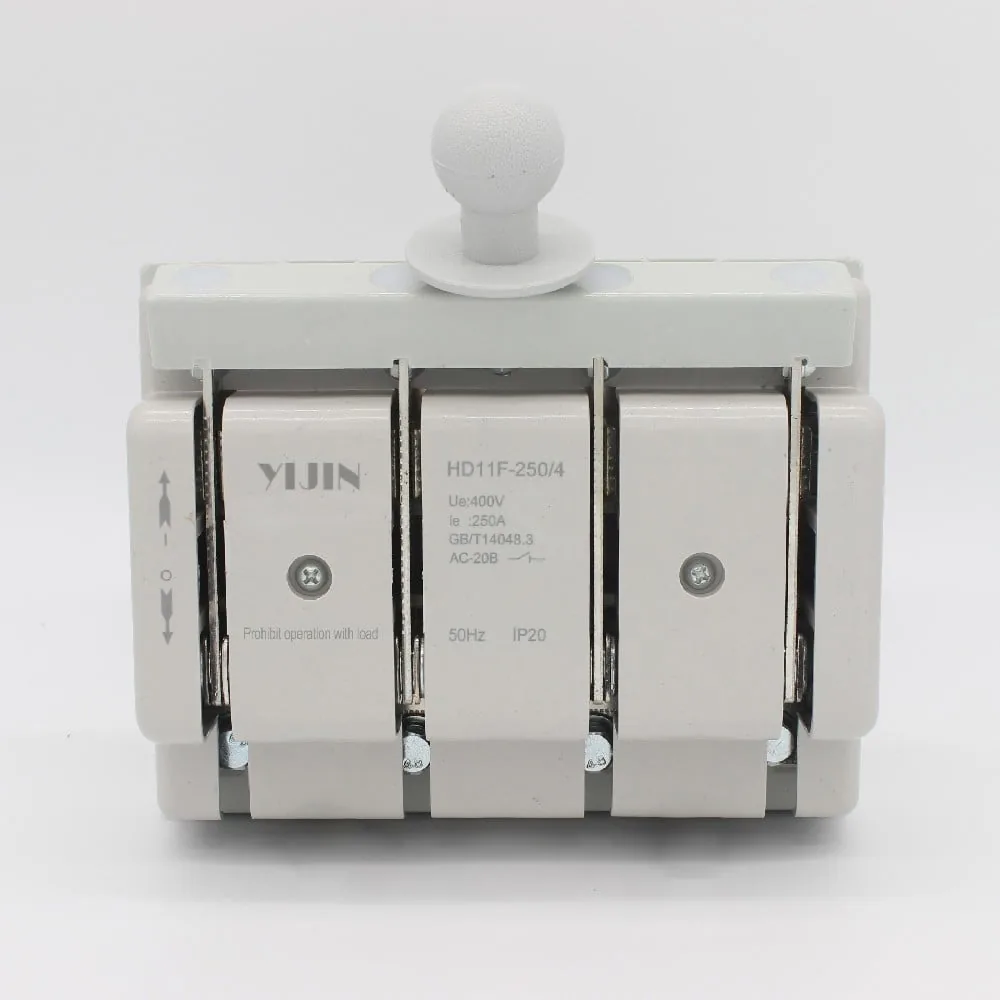
Use it after an upstream protective device has already killed load current. Infrequent manual isolation of a 3ph+N feeder is the seat; daily on-load motor starting is not.
Skip HD11F when the specification is an enclosed IP65 cam rotary, a UL-listed 4 pole disconnect switch, on-load AC-22/23 breaking, or DC PV isolation. Those are other families.
The isolation purpose itself — a verified open path for service — is covered on what an isolator switch is used for. Come back here for the 4P family map, then open the HD11F product page. Contact only if the order needs a pole-count confirmation.
FAQ
What is a 4 pole rotary isolator switch?
It is a four-pole isolator, usually sold in US/UK search as an enclosed rotary, that opens three phases and the neutral together. In Yijin’s catalog the matching 4P isolation member is HD11F-250/4, a knife-switch disconnector, not a cam handle.
Does a 4-pole isolator always switch the neutral?
Four poles can switch the neutral, and that is the usual 3ph+N reading. Some boxes still offer a solid unswitched N bar, so crews must land the conductor on the pole they actually intend to open.
Can a 4-pole isolator serve a single-phase feeder?
Two of the four poles can carry line and neutral. The unused poles should stay empty and labeled; the family is still a 3ph+N device.
Does HD11F-250/4 use a rotary cam?
No. HD11F-250/4 is an open knife isolator. Yijin does not catalog a cam-operated rotary isolator.
Why is HD11F listed AC-20B when rotary catalogs show AC-22?
AC-20B is no-load isolation on the HD11F table. AC-22/AC-23 figures on enclosed rotary sheets are on-load duties and are not HD11F ratings.
Can this isolator replace a circuit breaker?
No. A disconnector isolates; a circuit breaker interrupts fault and overload current. Keep both jobs on the drawing.
Is HD11F for DC positive/negative isolation?
No. HD11F is specified for AC 50 Hz. A PAA question about positive or negative belongs to DC isolators, not this family.
What ambient and altitude window does HD11F publish?
Ambient air −25 °C to +70 °C, 24-hour average not above +35 °C, altitude not above 2000 m, pollution degree 3, and no rain or snow on the switch.
References
- IEC 60947-3:2020 — Low-voltage switches, disconnectors, switch-disconnectors; rated voltage not exceeding 1000 V AC.
- IEC 60947-3 preview, Note 2 — Rotary, cam-operated, and knife-switch disconnector design names.
- Disconnector — Off-load isolation versus circuit breakers; lockout provisions.
- OSHA 1910.147 — Lockout of energy isolating devices in the OFF position.
- Fourth pole on isolator — Switched-neutral fourth pole and no-load isolator practice.
- Disconnect switches — US field split of knife-blade, rotary, and breaker-style disconnects.