 Yueqing Yijin Electronics Co., Ltd.



What Is a Knife Switch and How Isolation Works
A knife switch is a manual electrical switch whose hinged metal blade engages fixed contact jaws to complete a circuit and lifts away to open a visible air gap. If you are asking what is knife switch hardware in low-voltage work, that hinged-blade form is the core answer—then poles, throws, and duty rating decide whether it is only for isolation or something people casually call a “disconnect.” Below you will get the definition, poles and throws, isolation versus protection, US naming habits, and when an HD11F or HK18 AC-20B knife isolator is an honest fit.
What a knife switch is
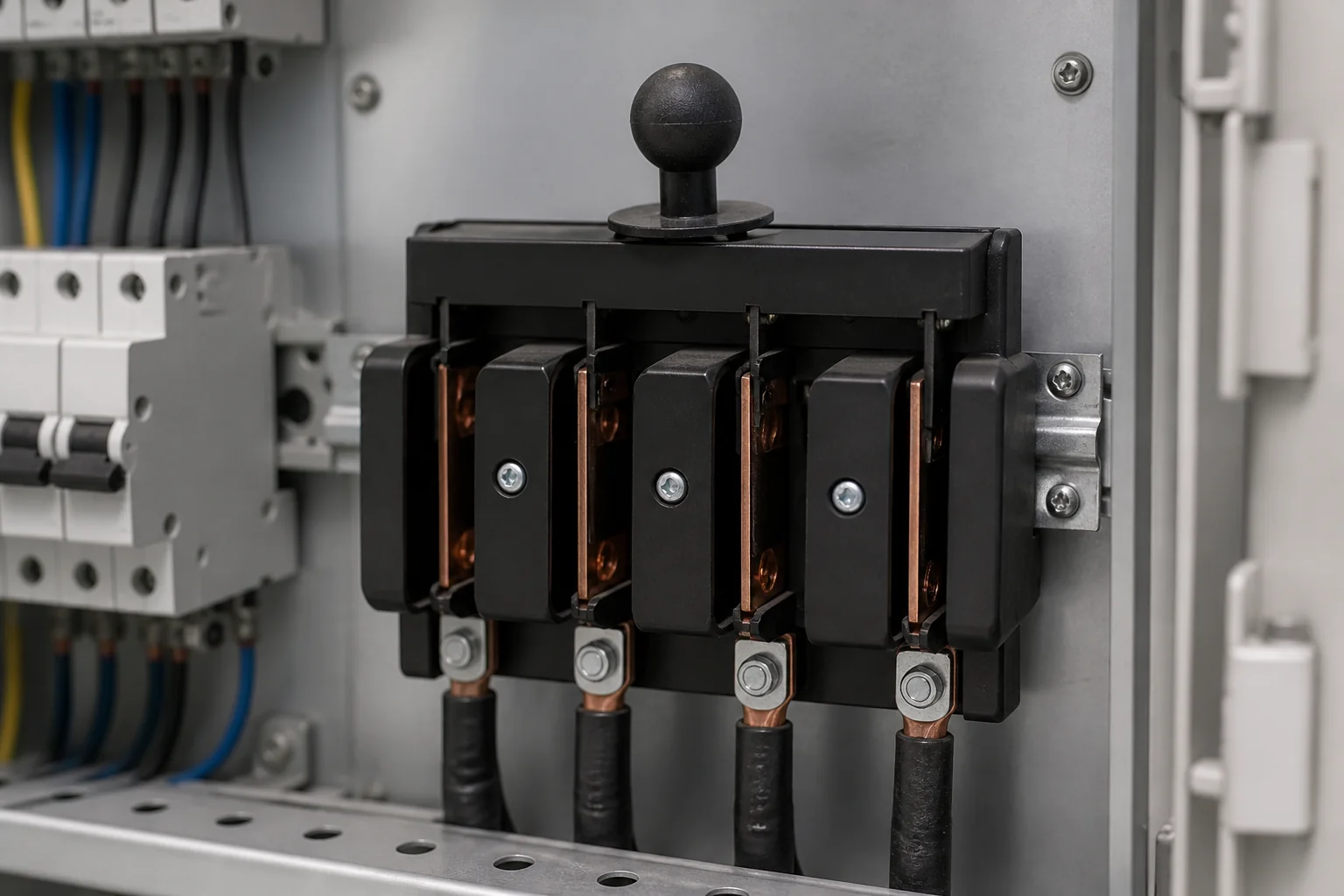
A knife switch is a hinged metal blade that pushes into fixed jaws to make a circuit and lifts out to break it, leaving an open you can see. The hinge and jaws sit on an insulated base, and the blade is operated by an insulated handle so the operator is not gripping live metal.
That visible open is why the form still shows up in teaching labs and in isolation hardware language. When the blade is out of the jaw, the air gap is the confirmation that this path is mechanically open—after the rest of the circuit has been made safe by the correct upstream procedure.
In distribution and panel work, modern products often enclose the contacts and add protective covers. The operating idea stays the same: a blade-style contact that opens a clear path for isolation when the device’s duty rating allows it.
Blade, jaw, hinge, and handle — the working parts
The hinge, blade, contact jaws, and insulated handle/base are the parts that create the make-break action. Naming those four pieces makes poles, throws, and duty ratings easier to read on a datasheet.
- Blade (knife): the moving conductor that carries current when seated in the jaw.
- Jaw (clip/slot): the fixed contact that receives the blade.
- Hinge: the pivot that lets the blade swing between open and closed.
- Insulated handle and base: keep the operator off live metal and hold the assembly mechanically.
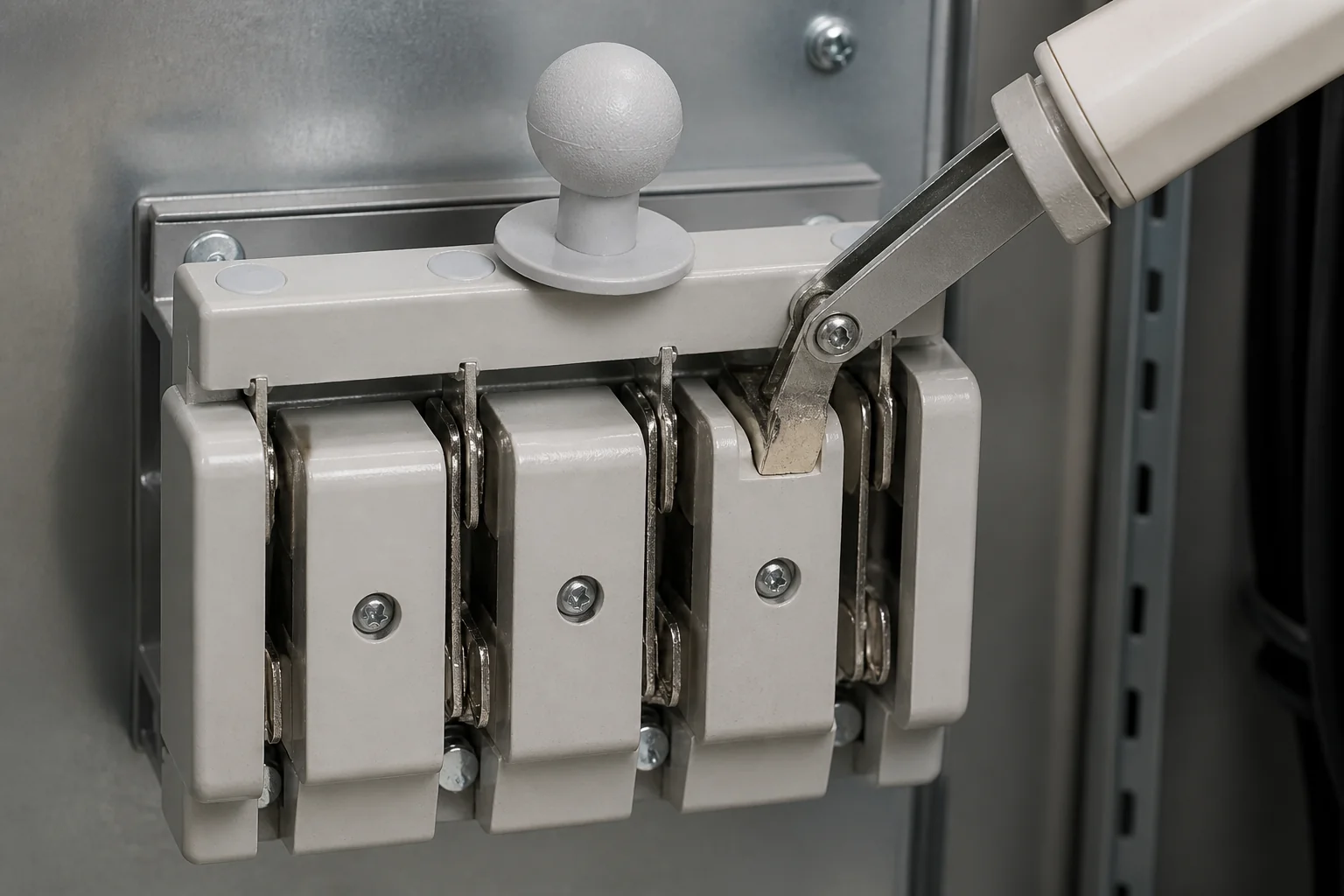
Single-throw designs engage one set of jaws for a simple on/off path. Double-throw designs place the hinge between two jaw sets so the blade can feed one path or the other. Multi-pole assemblies put several blades on one handle so several conductors open or close together.
Important: Opening a basic knife switch while current is still flowing can draw an arc across the separating contacts. Keep isolation-rated knives on no-load operation unless the product is rated for load switching. Sources: Wikipedia Knife switch; Process Solutions on fused knife disconnects.
Poles, throws, and common knife-switch types
Poles count how many circuits the switch controls together; throws count how many output positions each pole can take. Pole / throw vocabulary turns a vague “knife switch” label into a topology you can order and wire.
| Label | Meaning in practice | Typical knife-switch use |
|---|---|---|
| SPST | One pole, one throw — simple on/off for one circuit | Lab demos; single-conductor isolation |
| DPST | Two poles, one throw — two circuits open/close together | Simultaneous isolation of two lines |
| DPDT | Two poles, two throws — each pole selects between two outputs | Transfer / changeover topologies |
| Single-throw | Blade engages one jaw set | On/off isolation path |
| Double-throw | Blade can engage either of two jaw sets | Select between two paths |
| Multi-pole | Several blades share one handle | Isolate multiple conductors in one motion |
A three-pole or four-pole knife used in low-voltage distribution often exists so line and neutral (or three-phase conductors) open together. The handle motion is shared; the electrical paths stay separate per pole.
A double-pole double-throw buying matrix is a separate selection job. Here the goal is definition and duty, not a DPDT shopping clone.
Isolation duty versus a circuit breaker
Isolators open a visible path for isolation; circuit breakers automatically interrupt overcurrent—those jobs stay separate. The knife switch vs circuit breaker question is really “isolation cue versus automatic protection.”
| Job | Knife isolator / disconnector | Circuit breaker |
|---|---|---|
| Primary purpose | Manual isolation / connect-disconnect per duty rating | Automatic overcurrent protection |
| Typical cue | Visible open or clear off position | Trip unit / handle trip indication |
| Arc duty | Many isolation knives are off-load (for example AC-20B) | Designed to interrupt fault/load current within rating |
| Role split | Isolation plan | Protective device |
In electrical engineering language, an isolator / disconnector is there to ensure a circuit can be de-energized for service. It is not built as a stand-in for a breaker’s fault interruption. Pair isolation hardware with the protective devices your system already requires.
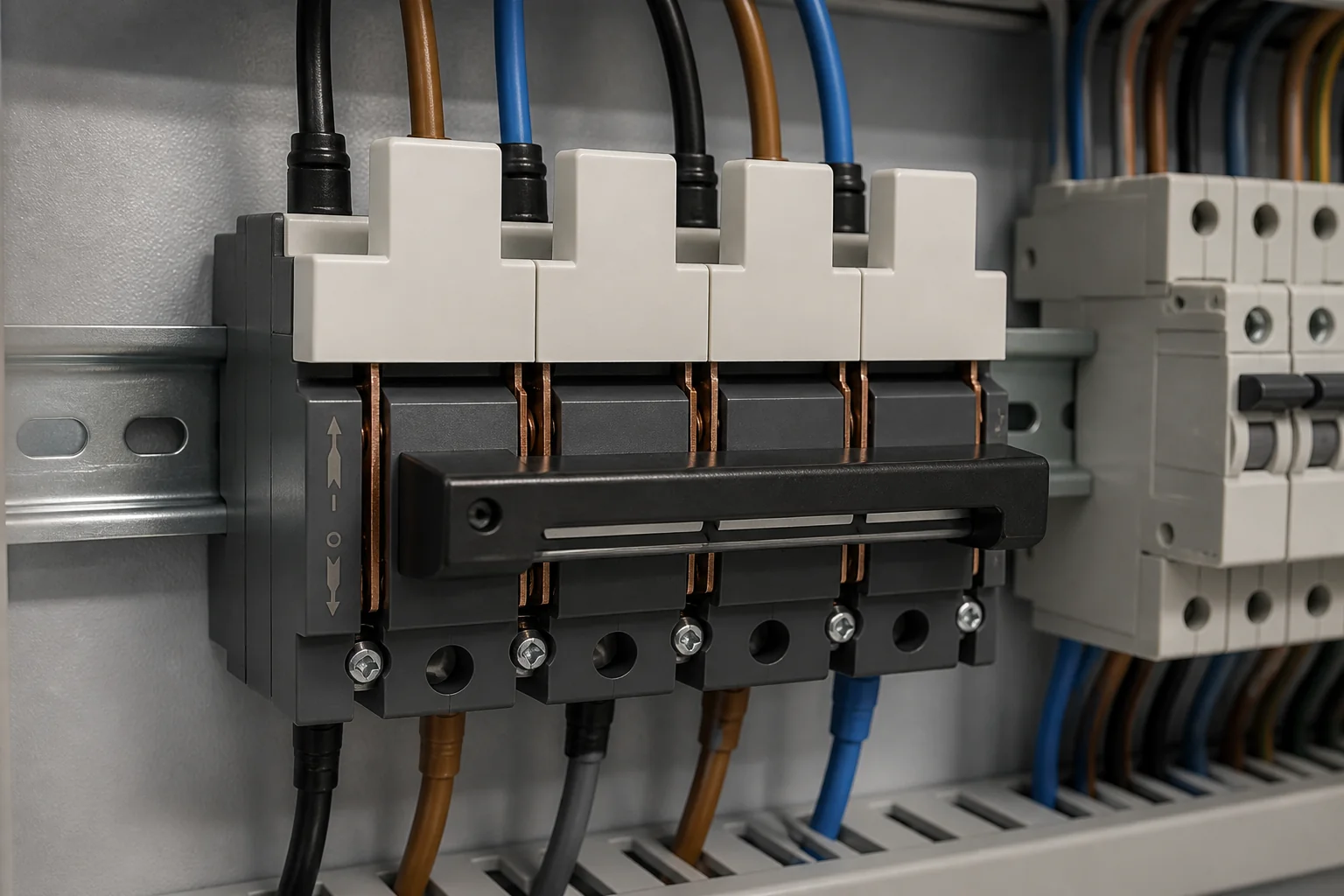
When procurement language says “add a knife switch,” ask whether the job is visible isolation after the load is off, load-break switching, or automatic protection. Mixing those jobs is how people end up opening the wrong device under load—or expecting a knife to trip like a breaker.
What “knife switch” means in US practice
“Knife switch” can mean an open-type device in code talk or slang for an enclosed blade disconnect—listings still matter. US electricians often say “knife-type” for a disconnect whose blades open when you turn an external handle, including an enclosed safety switch / fused disconnect with blades you can verify through a window or door.
That slang is useful for field conversation and risky for specification. Open-type knife switches and enclosed blade disconnects are different product classes in UL category talk.
NEC commentary about knife switches has historically targeted open-type devices and their load-opening limits at high ampere ratings. An enclosed disconnect listed for load break is still a different class from a lab-style open knife or an IEC AC-20B isolation knife.
For a United States buyer evaluating imports, keep two habits:
- Ask what the device is rated to do (isolation only vs load break vs protection).
- Avoid reading marketing words—“knife,” “disconnect,” “PV”—as proof of a local listing.
Yijin knife isolators discussed below are presented without a UL Listed or NEC-compliance claim. If your project requires a listed outdoor HVAC disconnect or a UL-98 enclosed switch, specify that hardware class separately.
When an HD11F or HK18 knife isolator fits
HD11F and HK18 are AC-20B no-load isolation knives for protected indoor duty, without a claimed UL outdoor disconnect listing. After you understand the form and the isolation job, these first-party examples show what a modern protective-opening knife isolator publishes on its product page.
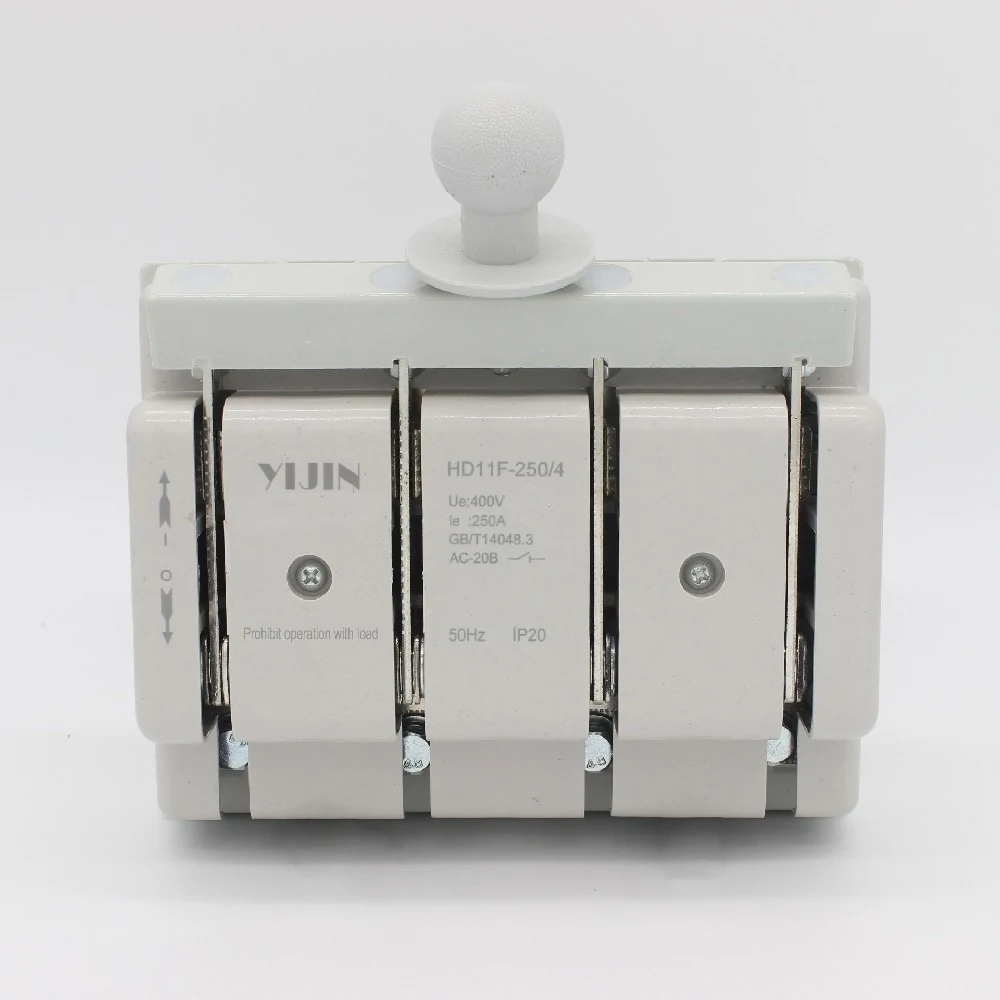
Primary recommendation: HD11F-250 protective opening knife switch.
| Parameter | HD11F-250 (published) | HK18-125 (published) |
|---|---|---|
| Rated operational voltage Ue | 400 V | 400 V |
| Rated insulation voltage Ui | 1000 V | — |
| Rated working current options | 160 / 180 / 200 / 225 / 250 A | 63 / 80 / 100 / 125 A |
| Frequency | 50 Hz | 50 Hz |
| Impulse withstand Uimp | 8 kV | 6 kV |
| Utilization category | AC-20B | AC-20B |
| Short-time withstand | Icw 3 kA | Icw 1.89 kA; Icm 2.69 kA (page) |
| Standards cited on page | IEC60947-3 / GB/T14048.3 | IEC60947-3 / GB/T14048.3 |
| Working conditions note | No rain or snow invasion; altitude ≤2000 m; pollution degree 3 | Same family of indoor/protected conditions |
On the HD11F-250 page, rated operational voltage Ue is 400 V, with working-current options from 160 A through 250 A, Uimp 8 kV, utilisation category AC-20B, and Icw 3 kA. On the HK18-125 page, Ue is also 400 V, with working-current options from 63 A through 125 A, Uimp 6 kV, and AC-20B duty.
AC-20B on these pages means infrequent manual connection, disconnection, and isolation under no-load. Operate them that way. Mount them where ambient and humidity stay within the published window, without rain or snow invasion.
Alternate model: HK18-125 type knife switch for photovoltaic applications. It remains AC-20B page language for the same isolation duty. The “photovoltaic” series name does not create an outdoor NEC PV disconnect listing.
Browse the Isolating Switch category for related knife isolators. That hub also lists other device types; a WiFi breaker or reclosing protector is a different product class from the knife switch defined above.
Choose HD11F/HK18 when you need an IEC-framed AC isolation knife for protected locations and you will keep operation off-load. Choose a different listed outdoor disconnect or breaker when the job is weather-exposed load-break, automatic protection, or a code-mandated listed means of disconnect for US field equipment.
FAQ
What is a knife switch in simple terms?
It is a manual switch with a hinged metal blade that seats in contact jaws to turn a path on and lifts out to open a visible gap.
What parts make up a knife switch?
A hinge, one or more blades, fixed jaws, and an insulated handle/base. Multi-pole versions share one handle across several blades.
What do poles and throws mean (SPST, DPST, DPDT)?
Poles are how many circuits move together. Throws are how many positions each pole can select. SPST is simple on/off; DPST opens two circuits together; DPDT adds a second throw path per pole.
Is a knife switch the same as a circuit breaker?
No — a knife isolator provides manual isolation per its duty rating, while a circuit breaker provides automatic overcurrent protection, so one role does not replace the other.
Can a knife switch be used as a disconnect?
Sometimes—when the specific construction, utilization category, and any required listing match the disconnect job. An AC-20B isolation knife is for no-load isolation, not a generic outdoor HVAC disconnect claim.
Are knife switches safe to operate under load?
Only if the device is rated for that duty. Basic and AC-20B isolation knives should be operated with the circuit unloaded. Opening under load can arc and damage contacts or injure the operator.
What does utilization category AC-20B mean on HD11F/HK18?
On the published HD11F and HK18 pages, AC-20B marks no-load connect/disconnect/isolation duty for infrequent manual operation. Follow that boundary.
Are Yijin knife switches UL Listed or NEC compliant?
No UL Listed or NEC-compliance claim is made here for Yijin knife isolators. Treat US code and listing language as project requirements to verify with listed hardware when your authority having jurisdiction requires it.
References
- Knife switch — Wikipedia — form factor, single-/double-throw, multi-pole, load-opening arc and shock hazards.
- Disconnector — Wikipedia — isolator/disconnector as off-load isolation versus breakers.
- Knife Switches — UpCodes — code-portal summary of knife-switch ampere thresholds for isolation-only use.
- Disconnect Switches — Mike Holt Forum — field slang for “knife-type” disconnects and visible blades.
- The Fused Knife Disconnect — Process Solutions — visible blade separation and lockout practice for panel main disconnects.