 Yueqing Yijin Electronics Co., Ltd.



3 Phase Fused Isolator Switch — When Fused Class Fits vs Knife Isolator Sheets
A 3 phase fused isolator switch combines three-phase isolation with integral fuse overcurrent protection in one assembly. This article maps that fused class against switch-fuse naming, US fusible safety switch labels, and honest fit for Yijin AC-20B knife isolators — including when isolation-only hardware is enough after upstream protection.
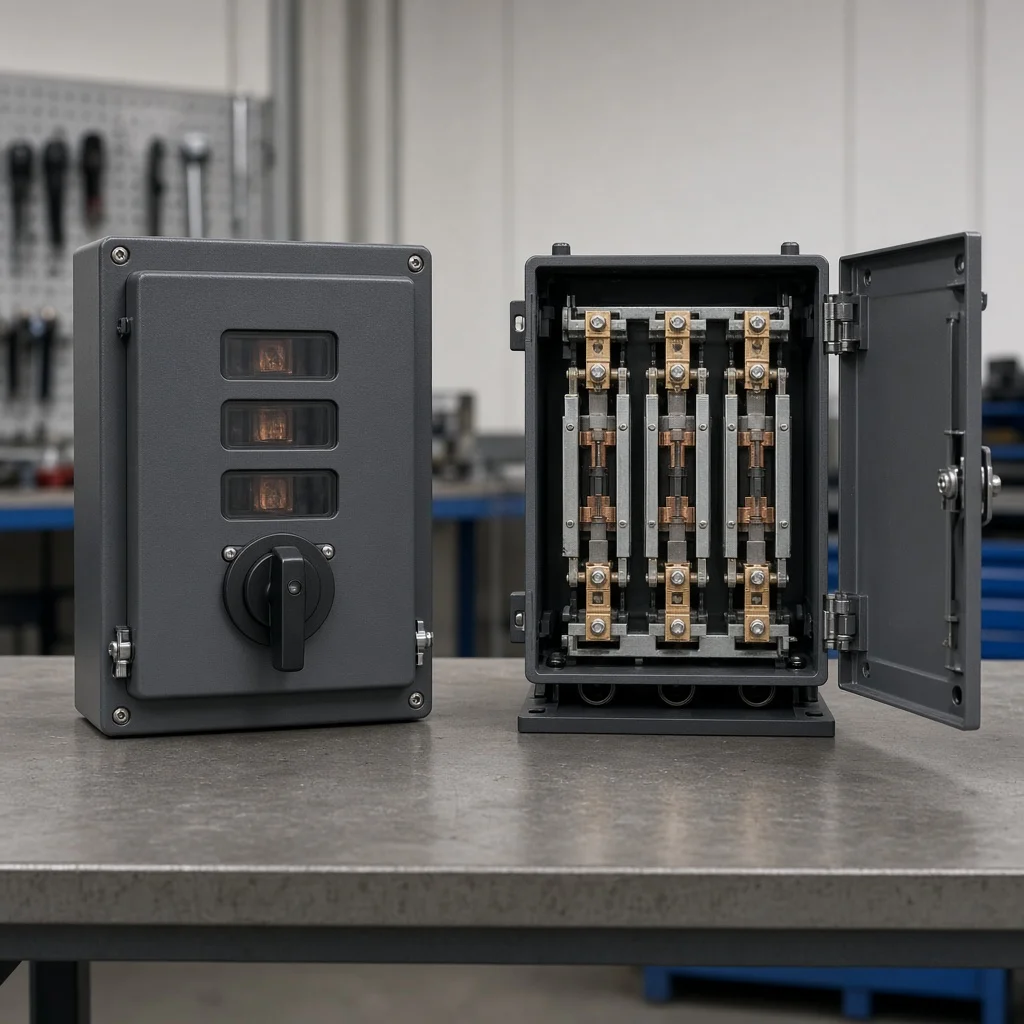
What a 3 Phase Fused Isolator Switch Actually Combines
It combines three-phase isolation with integral fuse overcurrent protection in one assembly.
In buyer language, “fused isolator,” “switch fuse isolator,” and “fuse-switch disconnector” usually point at the same job: open all three phases for service, and keep a local Overcurrent protective device (OCPD) — the fuse — inside that same unit. The fuses clear overload or short-circuit current at that point; the switch mechanism creates the isolation break.
Switch-fuse / TP&N fused switch catalogs describe the same fused-isolation family under IEC/UK naming.
That is different from an isolation-only Isolator / disconnector. Isolation-only hardware opens the circuit for maintenance but does not carry fuse clips or fuses of its own.
Upstream breakers or separate fuses must already protect the conductors and equipment.
Three-phase wording matters because the handle typically operates three poles together (or three poles plus neutral on TP&N designs). Procurement teams searching this keyword are rarely looking for a single-phase fused connection unit on a lighting spur.
When Integral Fuses Belong at the Isolator
Choose fused when local fuse OCPD is required at that point; choose isolation-only when upstream OCPD already covers the load.
| Decision point | Fused isolator / fusible disconnect | Isolation-only isolator |
|---|---|---|
| What is inside | Switch plus fuse holders / fuses | Switch / knife mechanism only |
| Overcurrent protection | Local fuse OCPD at the isolator | Must already exist upstream |
| Typical fit | Feeder or machine needs local fuse sizing, fuse characteristics, or listed fusible disconnect class | Branch already correctly protected; local isolation / LOTO handle needed |
| Field expectation | Specs that call for fused isolator, switch-fuse, or fusible safety switch | Specs that only need a disconnecting means beside protected equipment |
From the field: On a three-phase oven already fed by correctly sized overcurrent protection, electricians on Mike Holt’s Forum often conclude the local disconnect does not automatically need fuses — source: fused and non-fused disconnects thread. Fused hardware still makes sense when the equipment calls for fuse protection, when local fuse sizing is the practical OCPD choice, or when available fault current and short-circuit ratings force a fused assembly.
A fused disconnect vs isolator decision is really an OCPD placement decision. If the panel breaker already matches the load and conductors, adding fuses at the isolator can be redundant. If the upstream device is too large for that single load, or the nameplate demands fuse protection, integral fuses belong at the isolator.
Do not treat “three-phase” as proof that fuses are mandatory. Phase count describes the poles you open; fuse presence answers a separate protection question.
US Fusible Safety Switch Labels vs Switch-Fuse Names
US catalogs often say fusible safety switch / UL 98 fusible disconnect; UK/IEC catalogs often say switch-fuse — both point at fused isolation.
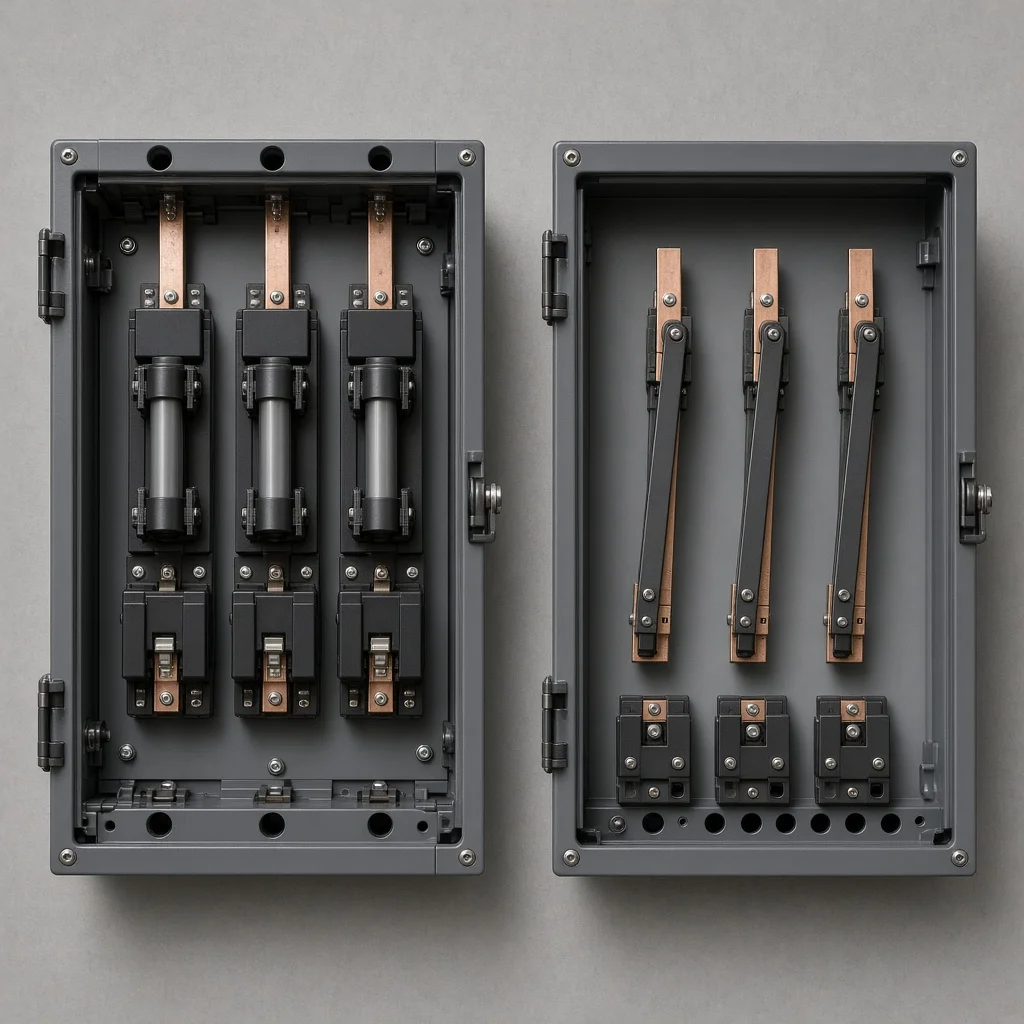
US shopping results for this keyword lean hard toward enclosed fusible safety switches and three-pole fused disconnects sold through electrical distributors. In that market, a fusible safety switch 3 phase request usually means an enclosed multi-pole switch with fuse clips, often with NEMA enclosure typing for indoor or outdoor duty.
Elsewhere, especially in UK and IEC merchandising, the same fused-isolation idea appears as TP&N fused switches or switch-fuse isolators. Those products still combine manual isolation with built-in fuse protection, even when the brochure never uses the US “safety switch” phrase.
UL 98 fusible disconnect language is a common US listing class for panel and industrial fusible switches. It is a market class cue for buyers who must purchase listed fused hardware — not a claim about Yijin knife isolators.
When a drawing says “fused isolator,” translate the label to the local catalog family first. Then confirm ampere rating, fuse class, pole count, enclosure, and whether the project actually needs local fuses or only a disconnecting means.
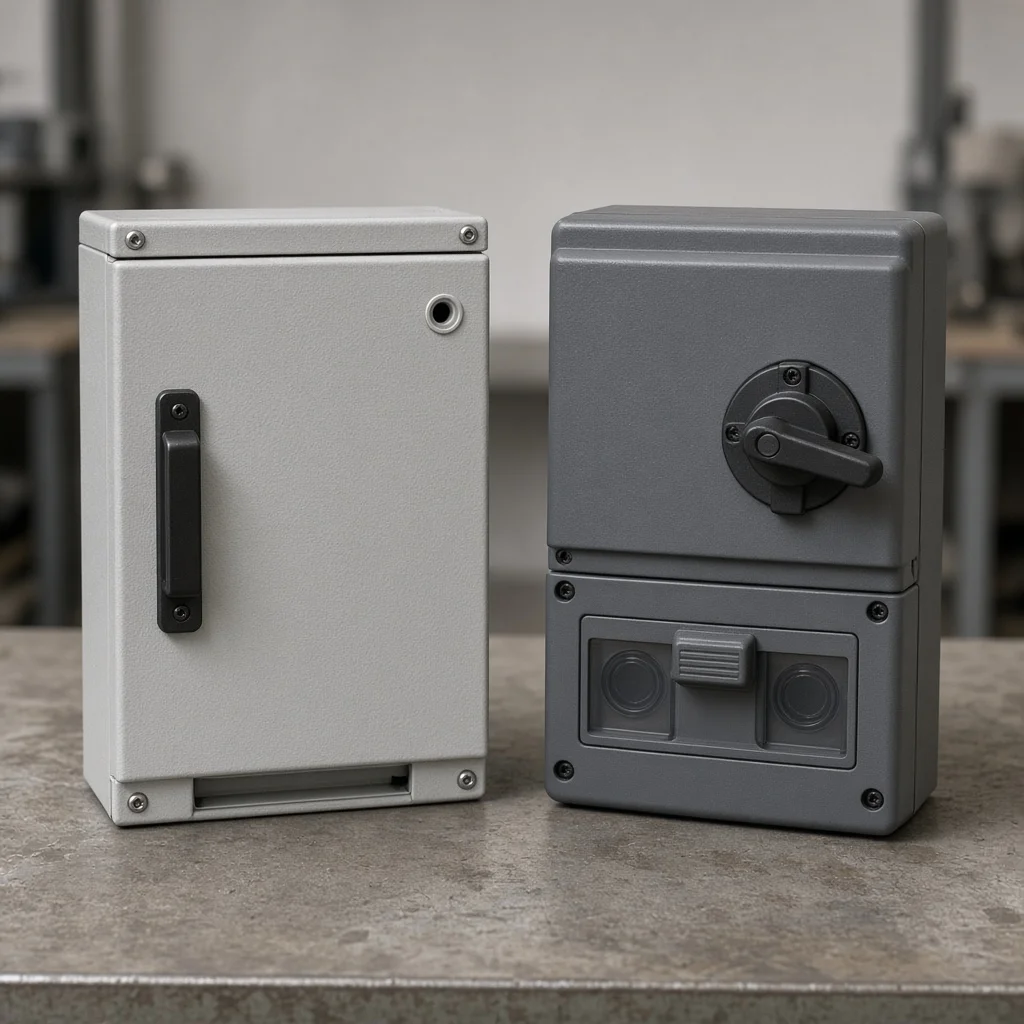
The naming contrast above is for label literacy, not a product substitution chart.
Off-Load Isolation Duty Still Applies
Even fused assemblies follow their utilization category; many isolators remain off-load devices unless rated otherwise.
A disconnector’s classic job is to ensure a circuit is de-energized for service. Basic isolators lack the arc-handling of circuit breakers for routine load breaking, so practice is to interrupt current with a suitable protective or control device first, then open the isolator.
Fused hardware does not erase that duty conversation. The fuse is the local OCPD; the switch mechanism still has a published utilization category and operating instructions.
If the product is rated for load-break or motor duty, follow that rating. If it is an off-load isolator with fuse carriers, treat fuse clearing and switch operation as separate steps in the work plan.
Lockable OFF positions support lockout/tagout (LOTO) energy-control work practices after the circuit is isolated. Padlocking the handle is not a substitute for verifying zero energy.
Why an AC-20B Knife Sheet Is Not a Fused Isolator
HD11F/HK18 publish AC-20B isolation without integral fuses — they are not fused isolator SKUs and are not UL Listed fusible disconnects.
Yijin’s HD11F-250 protective opening knife switch and HK18-125 type knife switch for photovoltaic applications are published as IEC AC-20B knife isolators. The live pages describe infrequent manual connection, disconnection, and isolation under no-load conditions, with compliance statements for GB/T14048.3 and IEC 60947-3.
They do not present integral fuse holders as part of the SKU. Yijin does not publish a fused isolator SKU or UL Listed fusible disconnect on these pages.
Important: Install both knife families where the product pages require no rain or snow invasion, and operate them under the AC-20B no-load isolation duty printed for the series — not as outdoor UL fusible safety-switch substitutes.
HD11F-250 is listed at AC 50 Hz, Ue 400 V, Uimp 8 kV, Ith 250 A, working currents 160–250 A, 3P/4P formats, Utilization category AC-20B, mechanical lifespan 10,000 operations, and no rain/snow invasion.
HK18-125 is listed at up to 400 V, Uimp 6 kV, currents 63 / 80 / 100 / 125 A across 2P / 3P / 4P, Utilization category AC-20B, and no rain/snow invasion.
If the project truly needs a fused three-phase isolator, buy a fused class device. If the project only needs protected-bay isolation after upstream OCPD, an AC-20B knife sheet can be the honest fit — complementary to the published non fusible safety disconnect switch class article, not a clone of it.
Recommended Starting Point When Isolation-Only Fits: HD11F-250
Start with HD11F-250 when you need higher-current AC-20B protected-bay isolation; use HK18-125 when that mid-amp page range fits — never as fused substitutes.
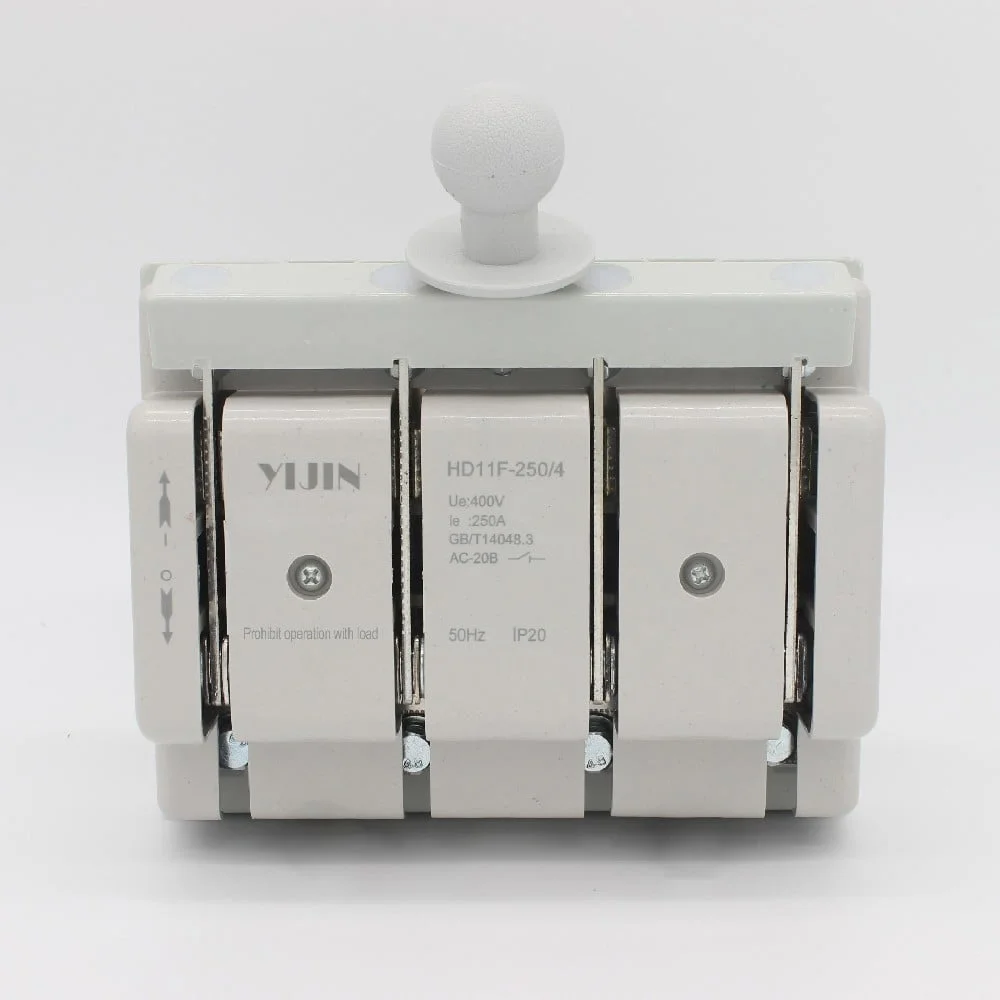
The product photo above is the Path① HD11F recommendation image for isolation-only fit.
Choose the HD11F-250 protective opening knife switch when the decision is protected-location isolation at higher ampere bands with the protective-opening construction language on the product page. Browse the isolating switch hub when you need adjacent isolator formats.
| Model | Poles (page) | Voltage / impulse | Current band | Utilization | Fused? | Environment note |
|---|---|---|---|---|---|---|
| HD11F-250 | 3P / 4P | Ue 400 V; Uimp 8 kV | Ith 250 A; working 160–250 A | AC-20B | No — isolation only | No rain/snow invasion |
| HK18-125 | 2P / 3P / 4P | ≤400 V; Uimp 6 kV | 63 / 80 / 100 / 125 A | AC-20B | No — isolation only | No rain/snow invasion; rail or base-plate mount |
Choose the HK18-125 type knife switch for photovoltaic applications when you need 63–125 A, multi-pole formats, and DIN-rail or base-plate mounting in a protected bay.
Do not order either SKU when the specification requires a fused isolator, a fusible safety switch, or a UL 98 fusible disconnect. Those are different product classes.
Common Fused-Isolator Label Mistakes
Do not buy a knife as a fused isolator, and do not change fuse curves casually on true fused hardware.
Searching “fused isolator” and then selecting the first knife switch photo is the expensive mistake. Knife sheets without fuse carriers cannot satisfy a fused-class bill of materials, no matter how carefully you padlock the handle.
The opposite mistake also happens: adding fused disconnects everywhere when upstream OCPD already matches the load. Extra fuses add spare-part burden without solving an isolation gap.
On genuine fused isolators, fuse replacement is not a casual ampere upgrade. Matching the original fuse rating and time-current curve matters unless a protection engineer redesigns the scheme — a recurring concern when technicians swap bottle fuses during a 3-pole fused isolator changeout.
Finally, do not equate “safety switch” wording with GFCI residual-current devices. In US catalog practice for this topic, safety switch usually means an enclosed fused or non-fused disconnect, not a personnel-protection RCD.
FAQ
What is a 3 phase fused isolator switch?
It is a three-phase isolator that also carries integral fuses, so one assembly provides isolation and local overcurrent protection.
What is a switch fuse isolator?
Switch fuse isolator is a common catalog name for the same fused-isolation family, especially in UK/IEC merchandising for TP&N fused switches.
What is the difference between a fuse switch and an isolator?
A fuse switch includes fuse protection with the switch. An isolator-only device opens the circuit for service and depends on upstream OCPD for overcurrent protection.
When does a three-phase disconnect need to be fused?
When local fuse OCPD is required at that point — for example equipment that calls for fuse protection, local fuse sizing needs, or a listed fusible disconnect class. It is not automatic for every three-phase disconnect.
Can a knife isolator replace a fused isolator?
Only when the design needs isolation-only duty and upstream OCPD already covers the load. A knife sheet without integral fuses cannot replace a fused-class specification.
Does Yijin sell a fused isolator?
No verified fused isolator SKU appears on the HD11F-250 or HK18-125 product pages cited here, and those pages do not claim UL Listed fusible disconnect compliance.
What HD11F-250 isolation limits matter for buyers?
AC 50 Hz, Ue 400 V, Uimp 8 kV, Ith 250 A, working currents 160–250 A, 3P/4P, Utilization category AC-20B, no rain/snow invasion, infrequent no-load isolation.
How should fuses be replaced on a fused isolator?
Replace with the same rating and curve unless a protection engineer redesigns the scheme. Do not treat fuse swapping as a convenience ampere change.
References
- Disconnector (Wikipedia) — isolator class and off-load isolation duty framing for three-phase fused vs isolation-only choices.
- Fused vs. Non-Fused Disconnects (ExpertCE) — fused isolation + local OCPD versus isolation-only upstream dependency.
- NEC / NFPA 70 Code Development — US model code family for electrical installation education.
- OSHA Control of Hazardous Energy (Lockout/Tagout) — LOTO / hazardous energy control context for isolation work.
- Fused and non-fused disconnects (Mike Holt’s Forum) — field discussion on when a three-phase local disconnect needs fuses.