 Yueqing Yijin Electronics Co., Ltd.



Non Fusible Safety Disconnect Switch — Class Fit for Isolation Buyers
A non fusible safety disconnect switch isolates equipment for maintenance without integral fuses, so it only fits when an upstream breaker or fuse already protects the circuit. This article maps that device class against fusible safety switches, listed outdoor disconnects, and honest fit for Yijin AC-20B knife isolators — including safety switch vs disconnect switch terminology and the fusible vs non-fusible disconnect choice.
What a Non-Fusible Safety Disconnect Switch Actually Does
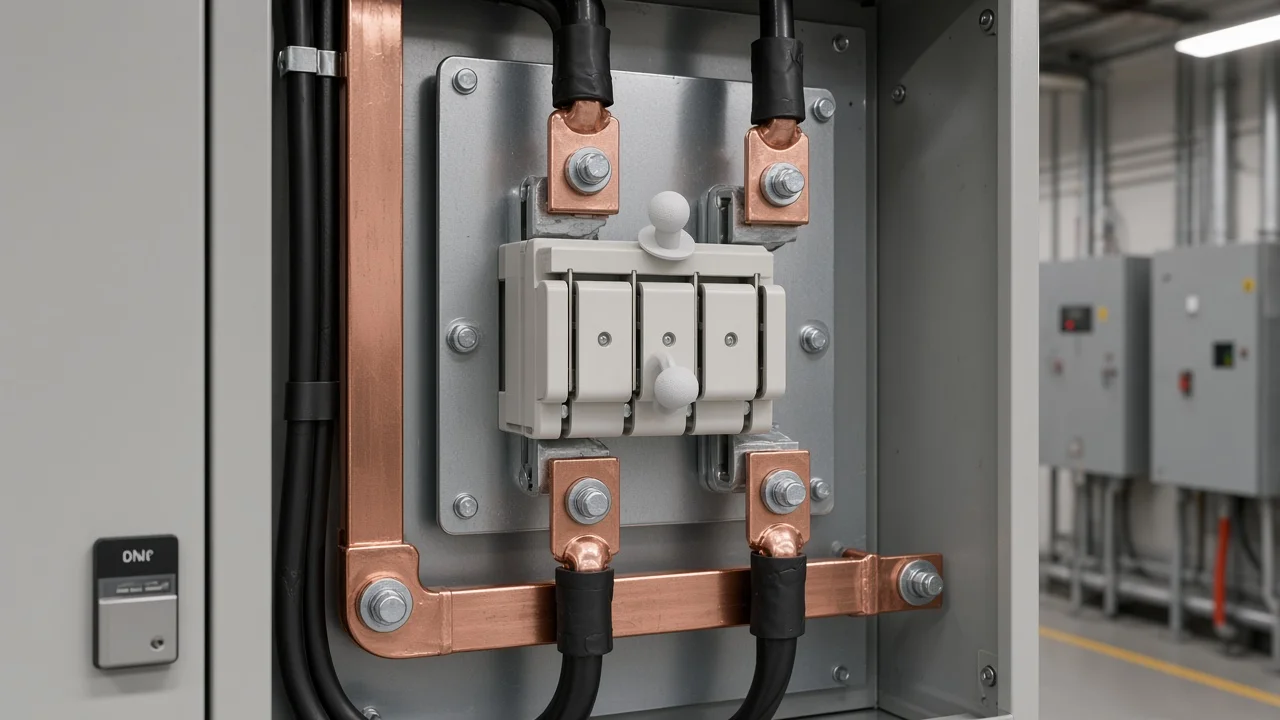
It isolates the circuit for service without integral fuses and usually supports a lockable OFF position.
In US catalog language, “non-fusible” (or non-fused) means the enclosure contains the switching mechanism only. There are no fuse clips and no local fuse overcurrent protective device (OCPD) inside that disconnect.
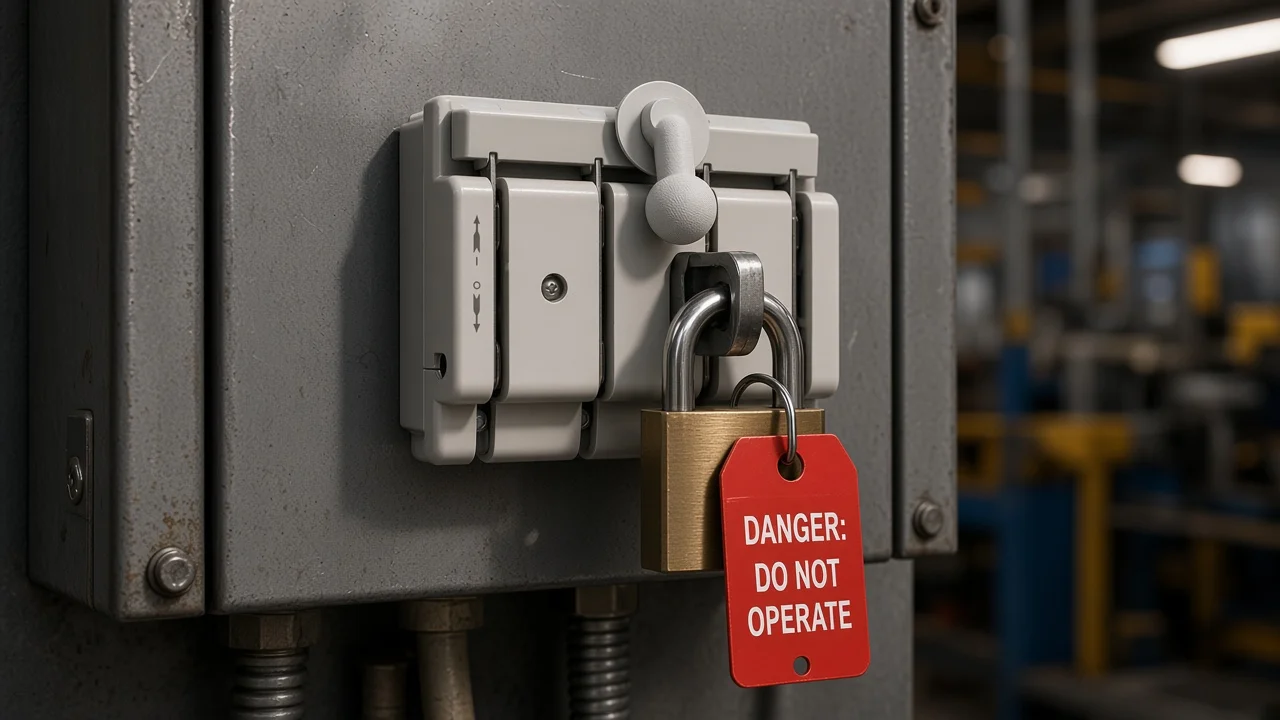
Procurement teams often treat the handle as a visible break for maintenance. Many designs allow padlocking the handle OFF so technicians can support lockout/tagout (LOTO) work practices while the upstream panel still owns short-circuit and overload protection.
That isolation job sits in the same family as the Disconnect / isolator / disconnector group used to de-energize equipment for service. The non-fusible label answers one narrow question: does this disconnect also carry fuses?
Fusible vs Non-Fusible: The Upstream Protection Decision
Choose non-fusible when upstream OCPD already protects the load; choose fusible when local fuse protection is required at the disconnect.
| Decision point | Non-fusible safety disconnect | Fusible safety disconnect |
|---|---|---|
| What is inside the enclosure | Switch / isolation mechanism only | Switch plus fuse clips and fuses |
| Overcurrent protection | Must already exist upstream (breaker or separate fuses) | Local fuse OCPD in the same enclosure |
| Typical fit | Dedicated branch already correctly protected; local LOTO handle needed | Upstream device too large for the single load, or local fuse characteristics required |
| Field expectation | Common on HVAC service disconnects with a correctly sized panel breaker | Used when the installation needs fuse protection at the equipment |
From the field: HVAC and service techs often ask whether an outdoor disconnect must be fusible when the condenser already sits on a dedicated breaker — source: r/hvacadvice fusible vs non-fusible thread. Experienced replies usually land here: if that breaker is sized to the equipment nameplate and applicable motor/HVAC rules, a non-fusible disconnect is often enough for local isolation.
A fusible safety switch still provides the same on/off isolation path, but it adds local fuse protection. That helps when the feeder breaker is sized for a combination of loads and the machine itself needs smaller fuses, or when the specification calls for fuse characteristics at the disconnect.
Non-fusible is not “less safe” by default. It simply moves the OCPD responsibility upstream. If that upstream device is missing, oversized for the single load, or otherwise inadequate, non-fusible is the wrong class.
When a Listed Safety Disconnect Is the Right Class
Outdoor equipment, motor/HVAC service disconnects, and projects specifying NEMA enclosed safety switches need that listed class — not an open indoor knife by default.
US retail and distributor search results for this keyword are dominated by enclosed general-duty and heavy-duty safety switches, often outdoor-rated, plus HVAC pullout disconnects. Those products are sold as weather-capable, dead-front enclosed disconnects with horsepower or ampere ratings suited to equipment service disconnect practice.
When a drawing or AHJ expectation calls for a listed outdoor non-fusible safety disconnect next to equipment, buy that class. Enclosure type, listing marks, and local disconnect rules under the National Electrical Code (NEC / NFPA 70) family belong to the project design — not to an indoor knife isolator that was never published as a NEMA enclosure / outdoor safety switch.
Three-phase motor and machinery layouts follow the same logic. A “safety disconnect switch 3 phase” request usually means an enclosed multi-pole safety switch sized for the motor branch, not a generic open knife assumed to survive outdoor exposure.
Isolation Duty vs Load Breaking
Many isolators are intended for off-load isolation after another device has interrupted current.
A disconnector’s classic job is to ensure a circuit is de-energized for service. Unlike a circuit breaker, a basic isolator does not carry an arc-extinguishing mechanism sized for routine load breaking. Safety practice is to open the load with a suitable control or protective device first, then open the isolator.
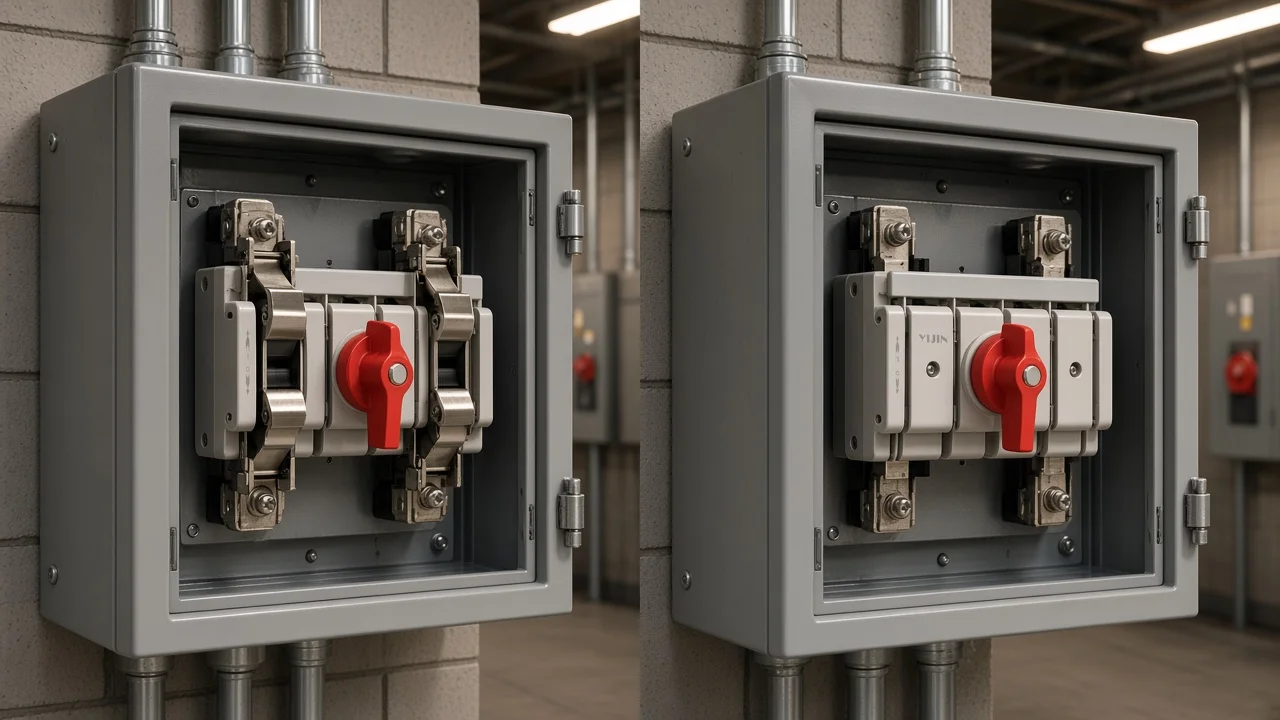
That duty note matters for knife isolators and for non-fusible safety switches alike. Always follow the utilization category and switching duty printed for the specific hardware. Do not treat “it opens conductors” as permission to break locked-rotor or continuous load current unless the product is rated for that duty.
Knife Isolator Fit: Where HD11F and HK18 Belong
They fit protected-bay AC-20B no-load isolation on the voltage and environment limits published for these knife isolators — not as UL outdoor non-fusible safety disconnect substitutes.
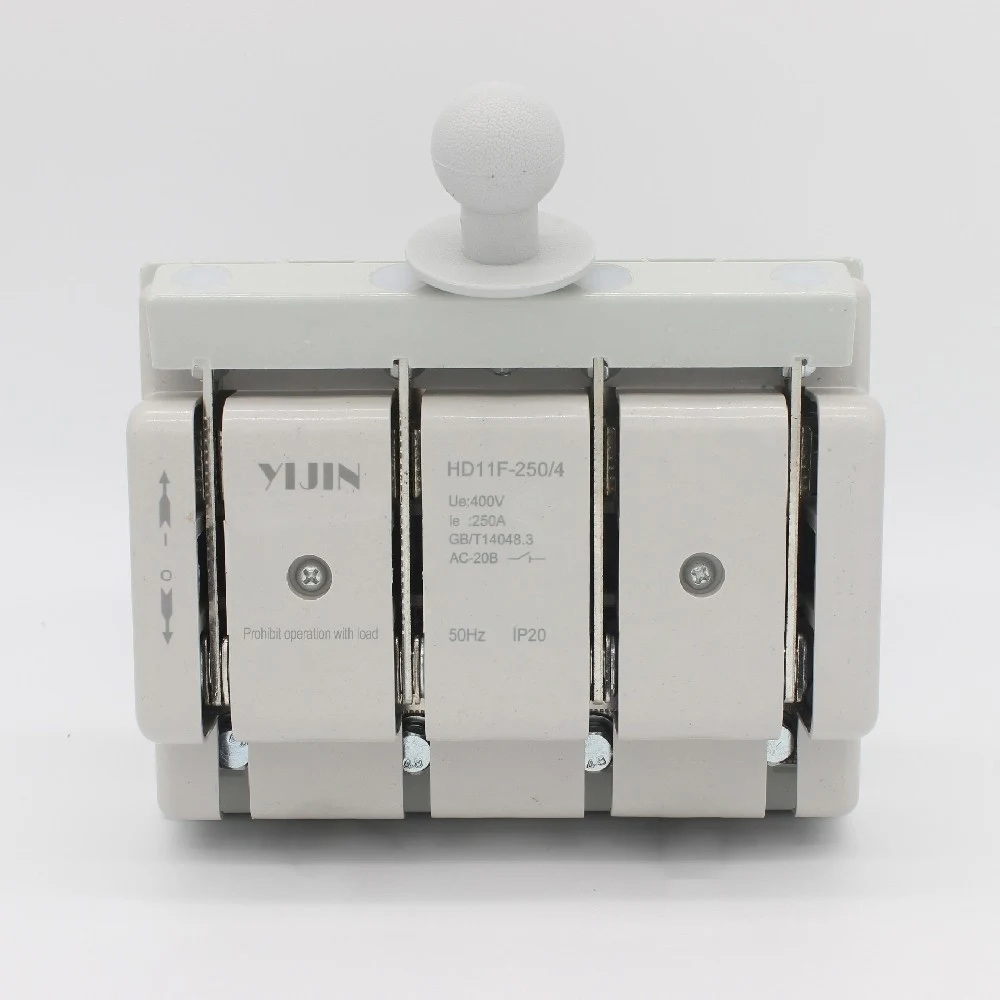
Yijin’s HD11F-250 protective opening knife switch and HK18-125 knife switch for photovoltaic applications publish Utilization category AC-20B, compliance with IEC 60947-3 / GB/T14048.3, and installation language that excludes rain or snow invasion. They are infrequent manual isolation devices for AC circuits up to 400 V on the product pages — not documented as UL Listed NEMA outdoor safety disconnects.
See the live HD11F-250 protective opening knife switch and HK18-125 knife switch for photovoltaic applications pages for the full tables.
HD11F-250 is listed at Ue 400 V, Uimp 8 kV, Ith 250 A, working currents 160–250 A, and Utilization category AC-20B with no rain/snow invasion.
HK18-125 is listed at up to 400 V, Uimp 6 kV, currents 63 / 80 / 100 / 125 A across 2P / 3P / 4P, and Utilization category AC-20B with no rain/snow invasion.
| Model | Poles (page) | Voltage / impulse | Current band | Utilization | Environment note |
|---|---|---|---|---|---|
| HD11F-250 | 3P / 4P | Ue 400 V; Uimp 8 kV | Ith 250 A; working 160–250 A | AC-20B | No rain/snow invasion; protected location |
| HK18-125 | 2P / 3P / 4P | ≤400 V; Uimp 6 kV | 63 / 80 / 100 / 125 A | AC-20B | No rain/snow invasion; rail or base-plate mount |
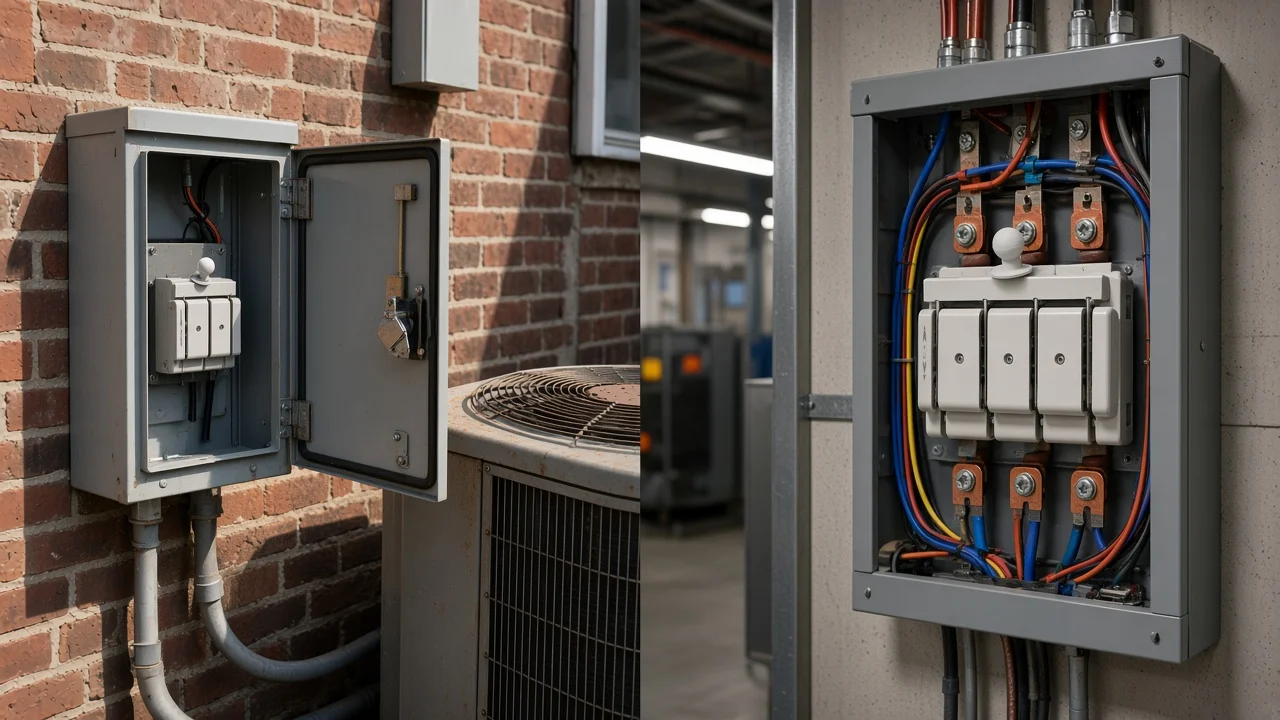
Important: If the job specification says “non-fusible safety disconnect, outdoor, listed,” keep shopping in that US enclosed safety-switch class — source: HD11F/HK18 product pages (AC-20B, no rain/snow). Use HD11F or HK18 when the real need is protected-bay AC-20B knife isolation under no-load, with upstream protection already designed elsewhere.
Browse the isolating switch hub when you are comparing isolation hardware families rather than hunting an outdoor HVAC pullout.
Recommended Starting Point: HD11F-250 Knife Isolator
Start with HD11F-250 when you need a higher-current AC-20B protective-opening knife isolator indoors; use HK18-125 when the mid-amp protected-bay formats on that product page fit better.
Choose the HD11F-250 protective opening knife switch when the decision is protected-location isolation at higher ampere bands (page currents 160–250 A) with anti-misoperation / protective-opening construction language on the product page. It fits the non-fusible isolation idea — open the circuit for service — without pretending to be a NEMA outdoor safety switch.
Choose the HK18-125 type knife switch for photovoltaic applications when you need 63–125 A, 2/3/4 pole formats, and DIN-rail or base-plate mounting in a protected bay. The “photovoltaic” series name on the page does not convert it into a UL outdoor PV DC disconnect listing.
Do not use either SKU when the project requires a listed outdoor non-fusible safety disconnect, rain/snow exposure, or on-load switching beyond the published AC-20B duty.
Common Non-Fusible Fit Mistakes
Do not add unnecessary fuses when the breaker already fits, and do not substitute an indoor knife for a specified outdoor safety disconnect.
- Ordering a fusible disconnect “just in case” on a dedicated, correctly sized breaker often adds fuse-clip maintenance without solving a protection gap.
- Treating any knife switch as an outdoor NEMA safety disconnect ignores enclosure and listing expectations on US equipment disconnects.
- Confusing “safety switch” with a residual-current / GFCI device mixes catalog disconnect language with shock-protection hardware used under other names in some regions.
- Using an AC-20B isolator as a routine load-break switch fights the published utilization category.
- Shopping only by “30 amp non-fusible” ampere cards without checking enclosure, poles, and upstream OCPD still leaves the class decision unfinished.
FAQ
What is a non-fusible disconnect switch?
It is a disconnect that isolates a circuit without integral fuses. Overcurrent protection must come from an upstream breaker or separate fuse arrangement.
What is the difference between a fusible and non-fusible disconnect switch?
A fusible unit combines isolation and local fuse protection in one enclosure. A non-fusible unit provides isolation only and relies on upstream OCPD.
When is a non-fusible safety disconnect enough?
When the branch already has correctly sized overcurrent protection and you mainly need a local, often lockable, isolation point for service.
Do I still need fuses if the breaker is correctly sized?
Often no for that single dedicated load. Field discussions around HVAC service disconnects commonly accept non-fusible hardware when the panel breaker already matches equipment and code sizing rules. Confirm the nameplate and design documents for your job.
Can a knife isolator replace an outdoor non-fusible safety switch?
Not as a drop-in substitute when the specification calls for a listed outdoor enclosed safety disconnect. Yijin HD11F and HK18 pages describe AC-20B knife isolation without rain/snow invasion — a different class and environment.
Do they make a 30 amp non-fusible disconnect?
Yes — US retail channels widely sell 30 A and 60 A non-fusible enclosed disconnects and pullouts. Ampere availability is separate from whether your project needs that listed enclosure class or a protected-bay knife isolator.
How do you wire a non-fused disconnect?
At a high level: land line and load conductors on the marked terminals, bond grounding as required, verify upstream OCPD, and leave the handle operable and lockable as designed. Follow the product wiring diagram and local code — this article is a class/fit guide, not a substitute for job drawings.
Is a safety switch the same as a disconnect switch?
In US catalog practice, “safety switch” usually means an enclosed fused or non-fused disconnect. In some other regions, the GFCI / RCD “safety switch” (AU/wiki sense) names a residual-current device instead. Read the product type, not only the marketing name.
References
- Disconnector (Wikipedia) — isolator/disconnect duty and off-load isolation context.
- Fused vs. Non-Fused Disconnects (ExpertCE) — independent technical education on isolation-only vs local fuse OCPD.
- NFPA 70 / National Electrical Code standards page — US model code family for disconnecting-means rules.
- OSHA Control of Hazardous Energy (Lockout/Tagout) — energy-control / LOTO context for lockable isolation.
- Fusible vs non-fusible service disconnect for condenser (r/hvacadvice) — community discussion on whether fusible is needed when a dedicated breaker exists.
Humanizer audit: PASS
Second self-pass: No new facts, numbers, quotes, or citations were added beyond approved research/brief. Rewrote parallel checklist cadence in mistakes section; kept one Important boundary beside product fit and one From the field callout. Removed source-first / meta-process phrasing from reader prose.