 Yueqing Yijin Electronics Co., Ltd.




Choose a timer switch for whole house fan runtime, not a bath countdown
A timer switch for whole house fan runtime is a control that starts the fan after the windows are open and stops it when the night cool-down is over.
That job is not a bath exhaust countdown, and it is not the thermostat on a roof attic fan. A rail time switch can be the clock for the run only when the fan circuit matches the voltage and motor load printed on the timer sheet.
Separate the attic exhaust fan from the whole-house fan
An attic fan pulls hot air out of the attic. A whole-house fan pulls outdoor air through the living space and sends house air into the attic.
The attic-fan page describes a thermostat, or sometimes a manual switch, for that roof or gable exhaust. It sends readers who want to cool the rooms to a different topic.
Mixing the two names is how a buyer orders a temperature switch for a fan that should follow the evening, not the attic temperature.
A manufacturer FAQ states the same split in plain language. Whole-house fans draw air in through the windows and blow hot house air out through the attic.
The attic unit, on that page, is a roof fan with its own thermostat. An attic fan thermostat does not become a whole-house fan runtime just because both devices sit near the roof.
Owners writing about an existing whole-house fan often ask for a repair, not a new control brand. One note describes a call that ended in a belt replacement rather than a full fan swap. The control question still matters, but it starts from the fan you already have.
If the grille is in the ceiling and the plan is to flush the rooms, you are in the whole-house job. If the fan only stirs the attic and the rooms stay closed, you are in the attic-fan job. Buy the control for the job you actually run.
Decide whether the runtime is a countdown or a clock program
A countdown ends after one interval. A clock program starts and stops at times you store, then repeats the next day or the next week.
Building guides list an on/off switch, a multi-speed control, or a timer as ways to run a whole-house fan. They do not say every timer is a wall countdown.
Fan sellers also bundle a two-speed wall control whose timer is a short hour countdown, sold so the installer can skip a separate line-voltage timer. That accessory is a wall device for that fan family.
A bath exhaust countdown is a third habit. It keeps a small bathroom fan on for a few minutes after the light goes off.
The airflow, the hour of day, and the reason for stopping are different. Using that countdown as the model for a whole house fan runtime leaves the house fan without an evening start and an early-morning stop.
A din-rail weekly timer stores on and off pairs and can repeat them. That is the clock-program class.
It fits a household that wants the same night window on selected days. It does not fit a person who only wants a press-to-start interval, unless the sheet’s minimum interval and manual control can do that without a fake countdown claim.
Read the control you are about to buy and name it: wall countdown, attic thermostat, or rail clock. Then match the name to the evening you actually want.
| Control you are holding | What ends the run | Fits a whole-house night flush |
|---|---|---|
| Short wall countdown bundled with some fans | One preset interval | Only if you start it yourself each night |
| Attic fan thermostat | Attic temperature | No, that fan is a different device |
| Bath exhaust countdown | A few minutes of run-on | No, that is a bathroom fan job |
| Rail weekly time switch | Stored clock times | Yes, when voltage and motor load also match |
Keep the windows open before the fan starts
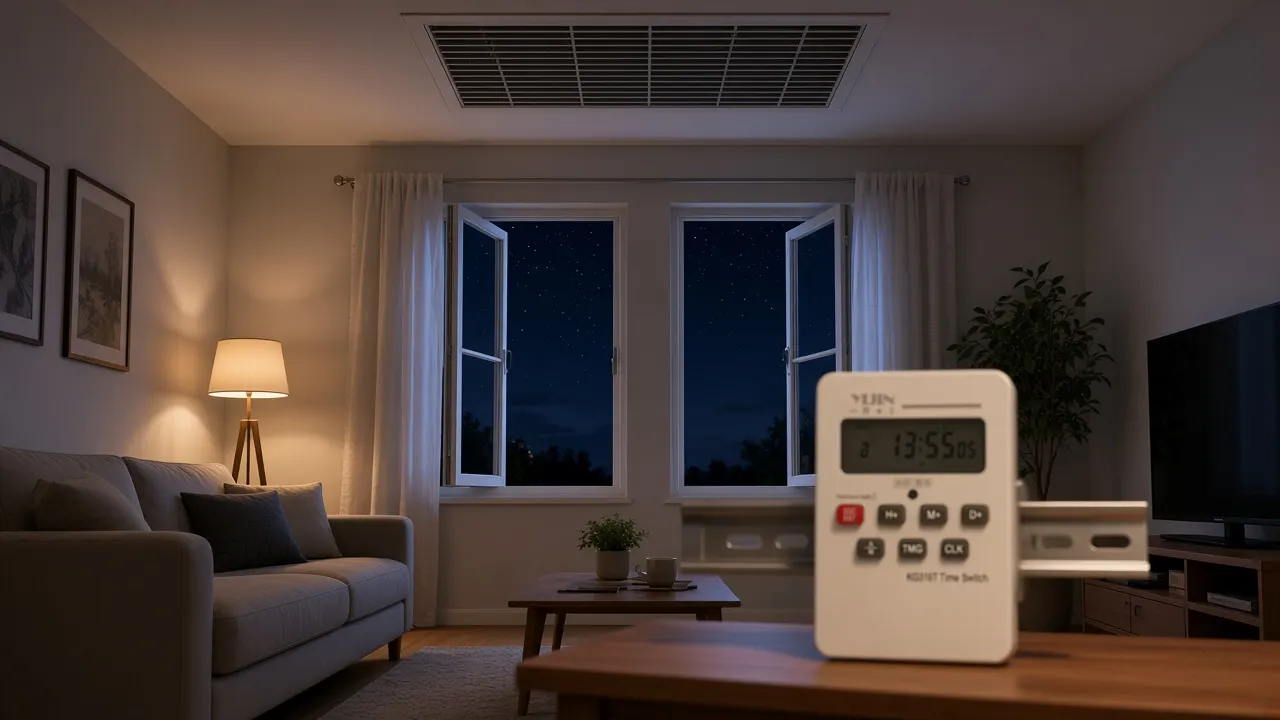
The fan is an exhaust machine for the whole living space. If the windows stay shut, it pulls on the ceiling, the fireplace, and any other opening it can find.
The building guide is direct about the order. Whatever starts the fan, the occupant opens windows first.
A timer that closes at a set hour does not open those windows for you. If the program starts while the house is still shut, the fan runs against a closed shell.
Put the open-window check in the same evening routine as the timer. Walk the rooms you want flushed.
Open those sashes before the start time. Close interior doors only where you mean to keep air out of a room.
From the field: The Building America whole-house fan guide says the occupant has to have the windows open before the fan runs, whichever control starts it.
A remote or a wall control does not change that order. The timer only decides the clock. The person in the house decides the windows.
Leave the air conditioner off during that run
The same guide says the fan and the air conditioner should not run together.
The fan is bringing outdoor air through the rooms. The air conditioner is trying to keep those rooms closed and cool. One undoes the other.
The manufacturer FAQ uses the same limit. It says a whole-house fan would not be used at the same time as an air conditioner, and it also flags hot, humid, or dusty outdoor air. A timer that overlaps the cooling schedule creates that overlap every night until someone edits the program.
Set the fan window for the hours when you are willing to open the house. End it before the cooling equipment is supposed to recover the rooms.
If the evening never gets cooler than the house, skip the fan night. A clock will not invent a temperature drop.
This is an operating choice, not a claim that one timer brand saves a measured share of the cooling bill. No savings figure is printed on the rail timer page, so none is repeated here.
Match the timer output to the fan motor load
The KG316T time control switch is a DIN-rail timer control, not a decorator wall switch for a US fan circuit.
The KG316T page rates the control supply at AC 50/60 Hz, 220 V and 380 V, and it limits those control circuits to 380 V and below.
Printed load power on that page is resistive 6 kW, inductive 1.8 kW, motor 1.2 kW, and lamp 0.9 kW.
A whole-house fan motor has to sit inside the motor line, and the circuit voltage has to sit inside that control supply.
Many US fans are discussed as 120 V appliances. This sheet does not print a 120 V fan rating.
Do not treat the timer as that switch. If the fan nameplate is outside the printed control supply, pick a control that is actually rated for that nameplate.
The page also prints a relay output, an LCD, and a replaceable battery. A time switch can work through a relay.
That supports the device class. It does not add a horsepower the page never printed.
No fan horsepower and no UL mark appear on the KG316T page, so this article does not add either one.
Use the timer category only as the family index: timer switch. The decision still happens on the product sheet and on the fan nameplate, side by side.
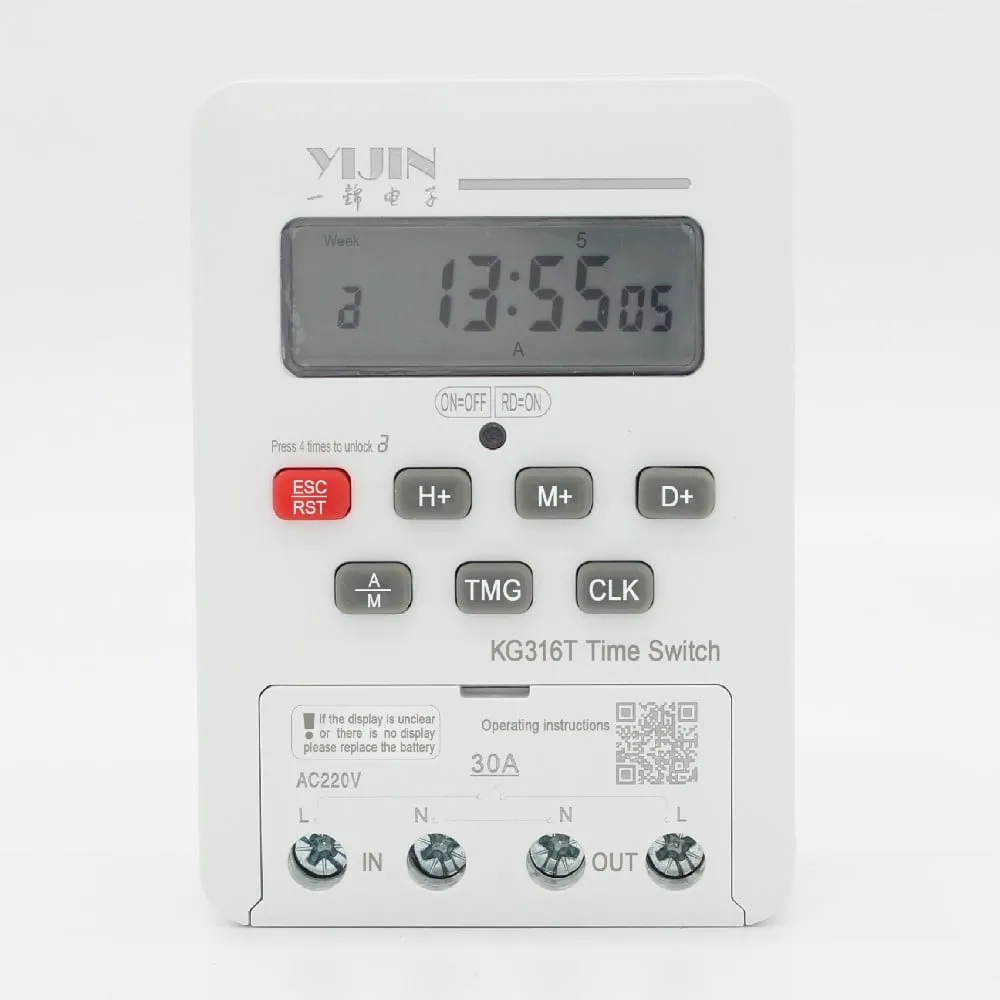
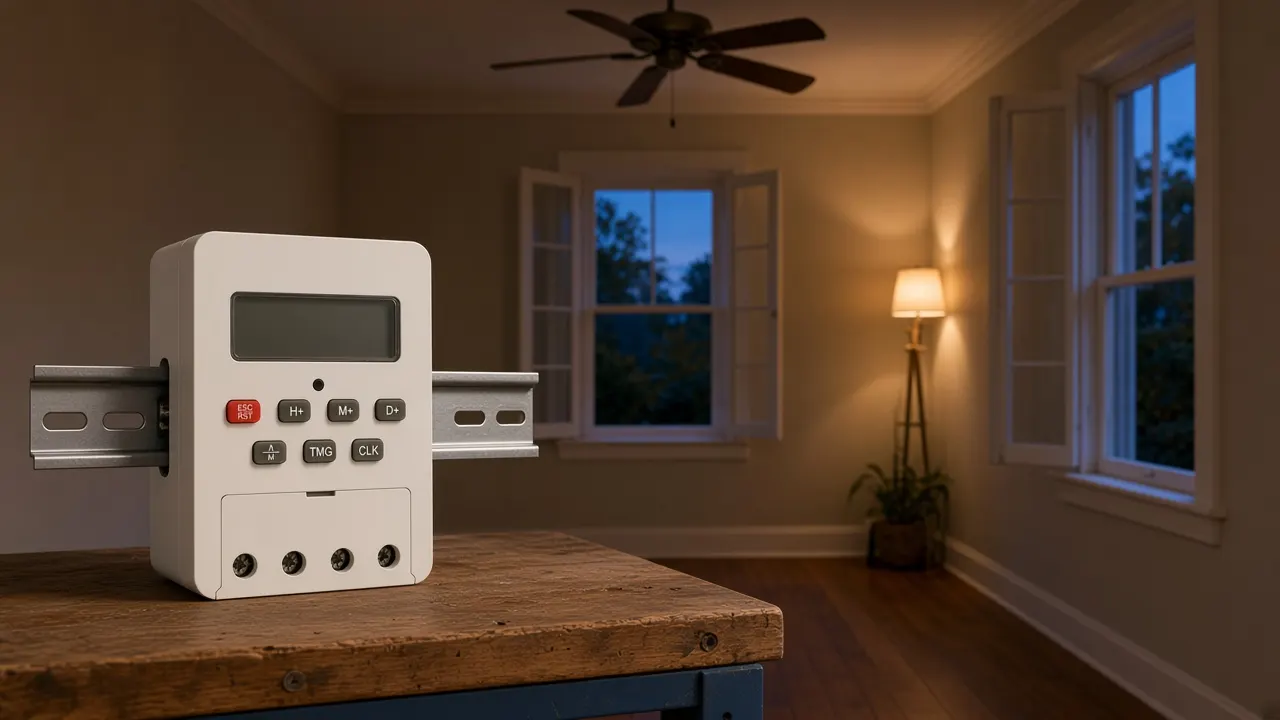
The photo shows the rail timer named in this section.
| Printed KG316T line | How to use it for this fan question |
|---|---|
| Control supply 220 V and 380 V | Eligible only if the fan circuit is in that range |
| Motor load line | Compare the fan motor with this line, not with the lamp line |
| No 120 V fan rating on the page | Do not assign a US wall-fan job to this timer |
| No horsepower and no UL mark | Do not invent either figure |
Clear unused on and off slots before the first night
A weekly clock repeats whatever is still stored. A leftover on time from a street-light setup will start the fan on a hot afternoon.
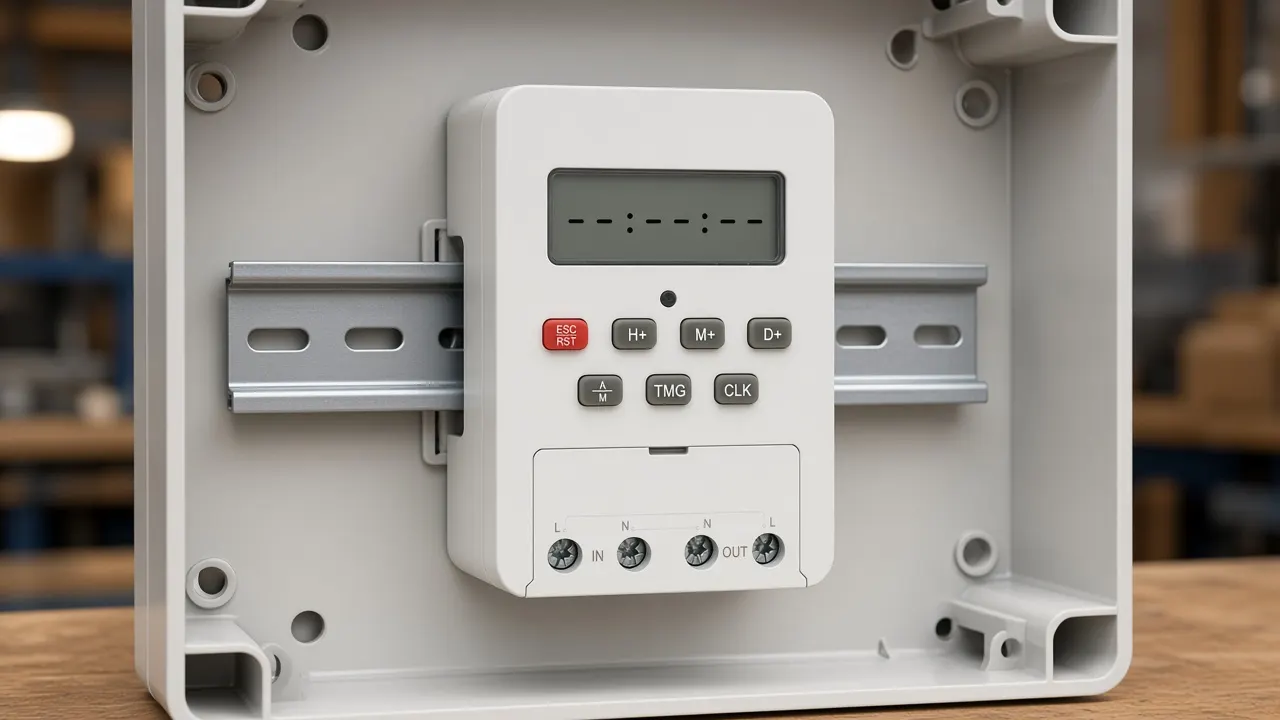
The KG316T key sequence opens an on slot, sets the day group, sets the hour and minute, then opens the matching off slot.
Slots you do not want should be left blank. The page tells you to make an unused slot display a dash pair so a leftover event cannot fire.
After the slots are clean, the clock key returns to clock mode, and Auto/Manual has to sit in automatic or the program never runs.
The same sheet allows up to 16 on/off actions per day, a daily or weekly repeat, a maximum setting of 168 hours, and a minimum setting of 1 minute.
That capacity is the reason leftovers are easy to miss. You will not use every slot for one night flush.
Walk the unused ones anyway. A blank display after a long outage is a battery job on this sheet, which uses a small replaceable cell. Replace the cell before you blame the program.
Do not install or remove the timer with the circuit live. The page says to tighten terminals so the contacts do not heat, and to disconnect power before the unit comes off the rail.
OSHA’s equipment rule is the workplace version of the same caution: electrical equipment has to be examined and kept free of recognized hazards. This page is not a wiring diagram and it is not a permit.
FAQ
Does a whole-house fan need the windows open before a timer starts it?
Yes. The building guide puts the open windows ahead of every control, including a timer. The clock cannot open the sashes.
Can an attic-fan thermostat replace a whole-house fan runtime control?
No. The attic fan exhausts attic heat and follows attic temperature. The whole-house fan flushes the rooms and follows the evening you choose.
Why avoid running the whole-house fan and the air conditioner together?
The fan is pulling outdoor air through the rooms while the air conditioner is trying to hold those rooms closed. Both the building guide and the fan FAQ tell you not to run them together.
What load line should a panel timer show before it switches a fan motor?
Use the motor load line and the control supply voltage. On KG316T those figures are printed. A lamp line or a resistive line is the wrong comparison for a fan motor.
Is a short wall countdown the same device as a weekly rail timer?
A countdown ends one interval after you start it. A weekly rail timer repeats stored clock times. A bath countdown is a third device for a different fan.
What should an unused daily program slot show before the first night run?
On KG316T, an unused slot should show the blank dash display from the product page, and the run mode should be automatic. A leftover on time will otherwise repeat.
References
- Building America Solution Center, whole-house fans: https://basc.pnnl.gov/resource-guides/whole-house-fans
- Attic fan, device class: https://en.wikipedia.org/wiki/Attic_fan
- Time switch, relay or contactor output: https://en.wikipedia.org/wiki/Time_switch
- OSHA 1910.303, examination of electric equipment: https://www.osha.gov/laws-regs/regulations/standardnumber/1910/1910.303