 Yueqing Yijin Electronics Co., Ltd.




What Drives the Cost to Replace an AC Contactor
The cost to replace ac contactor depends on which device the bill is for. A US HVAC publisher can print a visit range for a condenser unit, while the YJC1-63 4P page prints ratings and a quote button instead of a street price.
A condenser-unit visit and a DIN-rail household part are different purchases. The sections below separate those bills, then list the figures a modular quote needs.
Why the search does not produce one replacement price
One search phrase covers two purchases, so it cannot land on one tag. HVAC publishers price a technician’s visit to an outdoor unit, and the YJC1-63 4P page does not print a US retail price at all.
People who type ac contactor replacement cost usually mean that outdoor-unit job. A buyer who needs a modular contactor needs the ratings on the product page, then a quote for that part.
The contactor category holds this modular family. Failure signs and pole count are separate articles, so this one stays with the bill.
Which AC contactor the US cost pages are pricing
Those pages are pricing a definite-purpose contactor in a condenser unit. An AC contactor, in the general sense, is an electrically operated switch whose current rating and voltage rating decide the load it can carry.
That outdoor device takes a low-voltage signal from the thermostat and closes the line to the compressor and fan. A modular contactor on a household rail is a panel device for low-inductance loads and household motors, which is a different object.
Wikipedia describes a contactor as a relay with a high current rating and a high voltage rating, used for motors, lighting, heating, and similar loads. That definition names the device class. It does not set a brand price.
Homeowners arguing on forums are usually staring at a condensing-unit quote and a small parts guess. The gap they feel is the visit itself.
What moves a condenser-unit replacement bill
HomeGuide’s HVAC guide puts the total visit at $200 to $450, with the part at $20 to $100+ and labor at $180 to $350. That band is HomeGuide’s condenser-unit estimate for an outdoor-unit job.
The same guide lists a service call of $75 to $200, a regular hourly rate of $75 to $150, and an emergency hourly rate of $160 to $250+. It also says a professional swap takes about 30 minutes to an hour, and it states a 10 to 15 year life for that HVAC part.
Read the pieces in one place before you borrow any of them.
| Visit piece | HomeGuide published range |
|---|---|
| Part | $20 to $100+ |
| Labor | $180 to $350 |
| Service call | $75 to $200 |
| Regular hourly rate | $75 to $150 |
| Emergency hourly rate | $160 to $250+ |
| Total visit | $200 to $450 |
Season, access, and a second failed part can push the same visit around. HomeGuide also notes that a warranty may cover the part while labor stays on the invoice.
From the field: A Charlotte homeowner wrote that maintenance led to a capacitor and contactor recommendation, the parts were described as under warranty, and the labor was near $1,000 before a discount to around $800, with the company calling the work high voltage. — r/hvacadvice archive
Important: OSHA says live parts an employee may be exposed to shall be deenergized before the employee works on or near them, unless de-energizing adds hazards or is infeasible, and it notes a separate case for parts under 50 volts to ground. — OSHA 1910.333
That rule is why a cabinet visit is priced as electrical work. OSHA 1910.333 and the training rule in 1910.332 speak to the worker, not to a modular catalog tag. The Charlotte note is preserved in a readable archive of the thread.
People also ask how much does it cost to replace ac contactor, and the hvac contactor replacement cost pages answer with this same visit structure.
What the YJC1-63 4P page states instead of a price
The 4P page prints duty, voltage, current, and the standard names it uses, and it leaves the retail tag off. It describes a household AC contactor for AC 50 Hz or 60 Hz systems, with a rated working voltage of 230 V and a rated working current of 63 A under AC-7a.
The duty is low-inductance loads and household motor loads, and the page says the product complies with GB17885 and IEC1095. Those standard names are the wording printed on the page. They do not establish a UL listing or a retail tag.
Conventional products leave the contacts normally open, and a normally closed build is a custom order. Surrounding air temperature on the coil sentence runs from about -5 °C to +40 °C, the 24-hour average is not to exceed +35 °C, and the altitude is not to exceed 2000 m.
Mounting is a TH35-7.5 rail, with pollution level 2 and installation category III. The model diagram lists rated working current choices of 20 A, 25 A, and 63 A at AC-7a and 230 V, and that diagram has no pole cell.
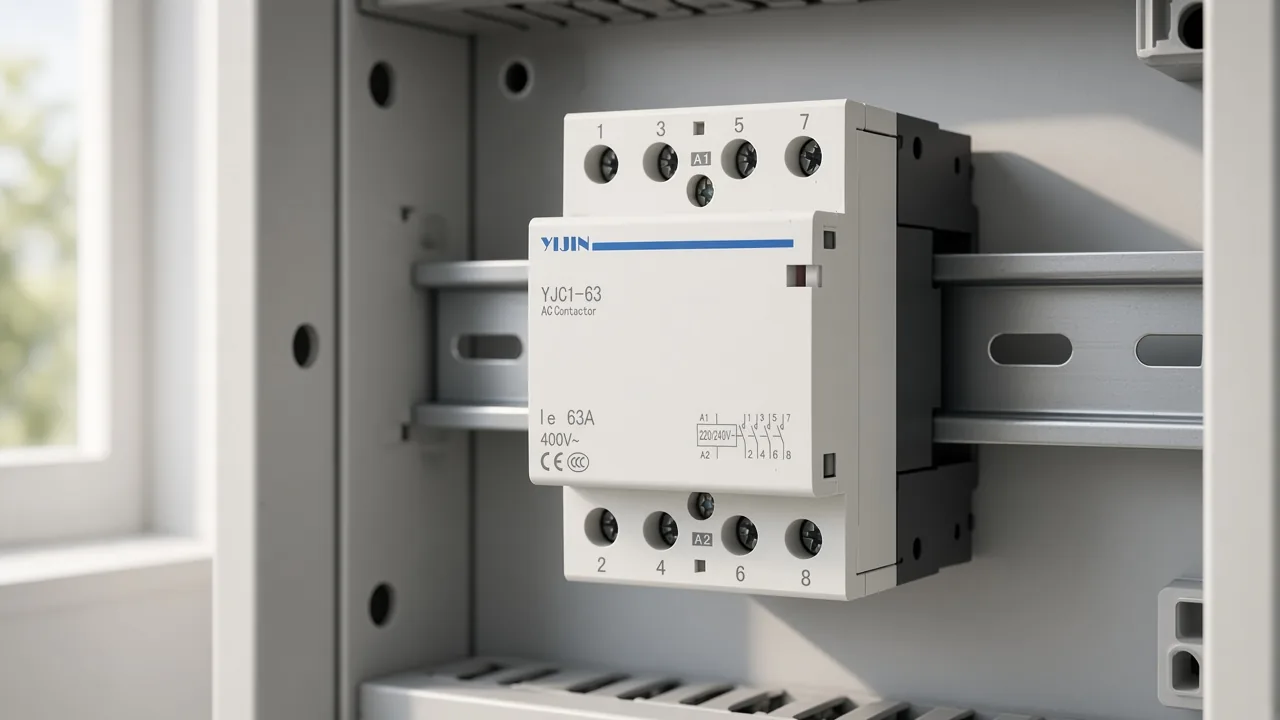
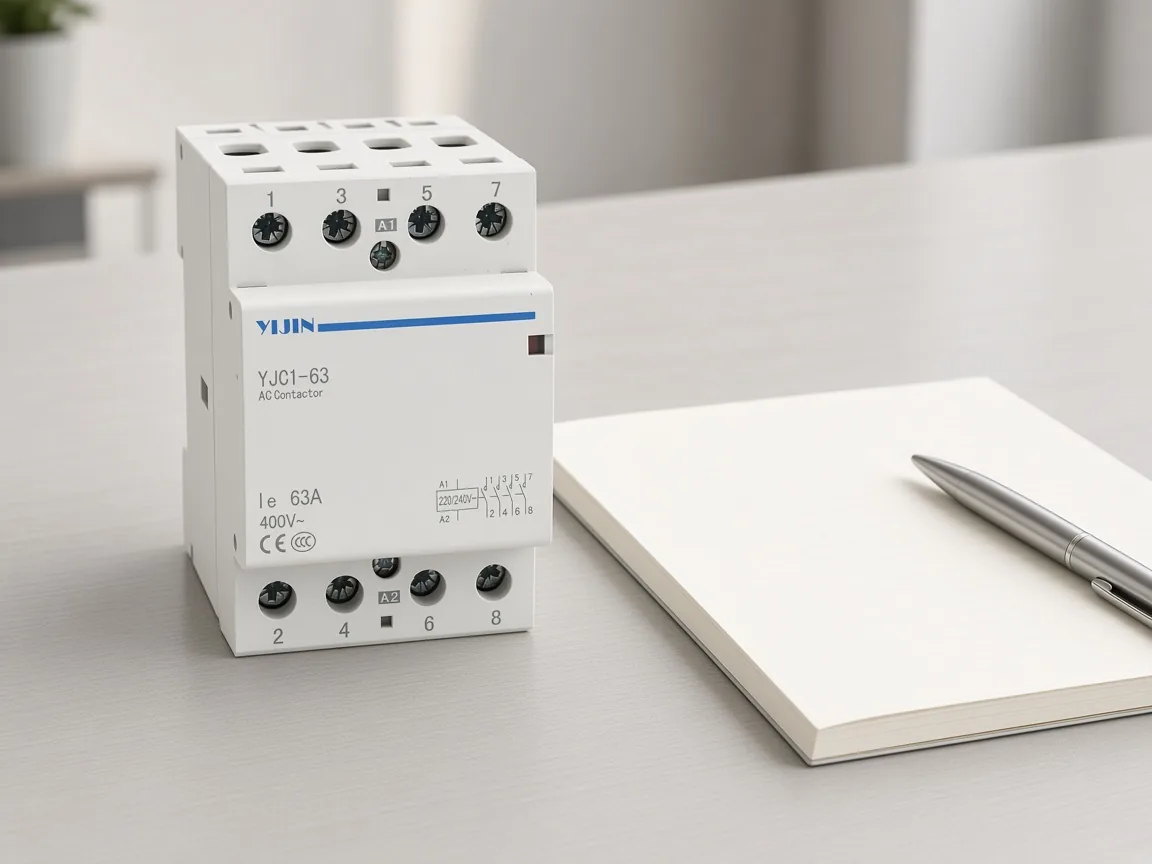
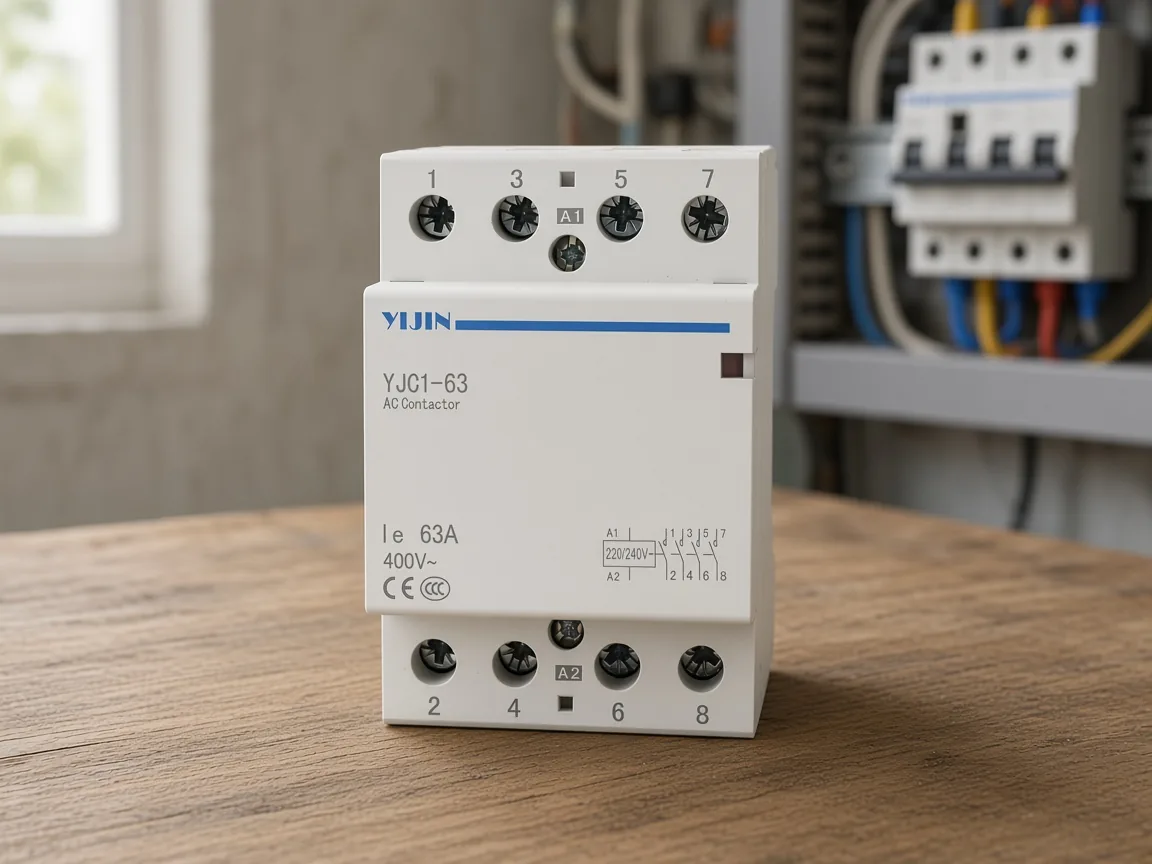
The photograph shows four power circuits on terminals 1 through 8, with the coil marked 220/240V~ and the face marked Ie 63A and 400V~. Table 1’s first row prints an insulation cell written as five hundred volts, a working voltage of 230 V, an agreed heating current written as sixty-three amps, a working-current cell of 63/25, and control power of 13/3.8 kW.
The header on that current column says volts even though the cells are current figures. After the coil heats to a stable state, the contactor is specified to close from 80% to 110% of Us, and the release is neither higher than 75% of Us nor lower than 20% of Us.
Mechanical life is not less than 1 million cycles, and electrical life is not less than 100000 operations. None of those lines is a dollar tag.
| Quote input | What the 4P page prints |
|---|---|
| Duty | AC-7a, low-inductance and household motor loads |
| Supply | AC 50 Hz or 60 Hz, working voltage 230 V |
| Current | Up to 63 A, with diagram choices 20 A, 25 A, and 63 A |
| Coil | Close 80% to 110% of Us, face mark 220/240V~ |
| Poles | Four power circuits, terminals 1 through 8, no pole cell on the model diagram |
| Contact state | normally open as the conventional build |
| Site limits | About -5 °C to +40 °C, altitude 2000 m, TH35-7.5 rail |
| Standards named | GB17885 and IEC1095, as the page words them |
Which ratings change a modular contactor quote
A modular quote moves when the current, the coil voltage, the pole count, or the contact state changes. The diagram’s 20 A, 25 A, and 63 A choices are not interchangeable labels on one hidden price.
The photograph’s four power circuits are the 4P layout, and the coil mark is 220/240V~. A normally open conventional unit and a normally closed custom unit are different orders.
Family-table rows also show lower agreed heating currents than the 63 A model. Quoting the 63 A build with a 25 A row, or the reverse, mixes two lines from the same table.
Coil tolerance matters because the close band is 80% to 110% of Us and the release band is 20% to 75% of Us. A buyer who only sends the word “contactor” has not given the factory those inputs.
Where the YJC1-63 4P fits a household contactor budget
Choose the YJC1-63 when the job is a DIN-rail household contactor for low-inductance or household motor loads, rather than a condenser-unit swap. The page still has no street price, so the purchase step is a quote that carries the ratings above.
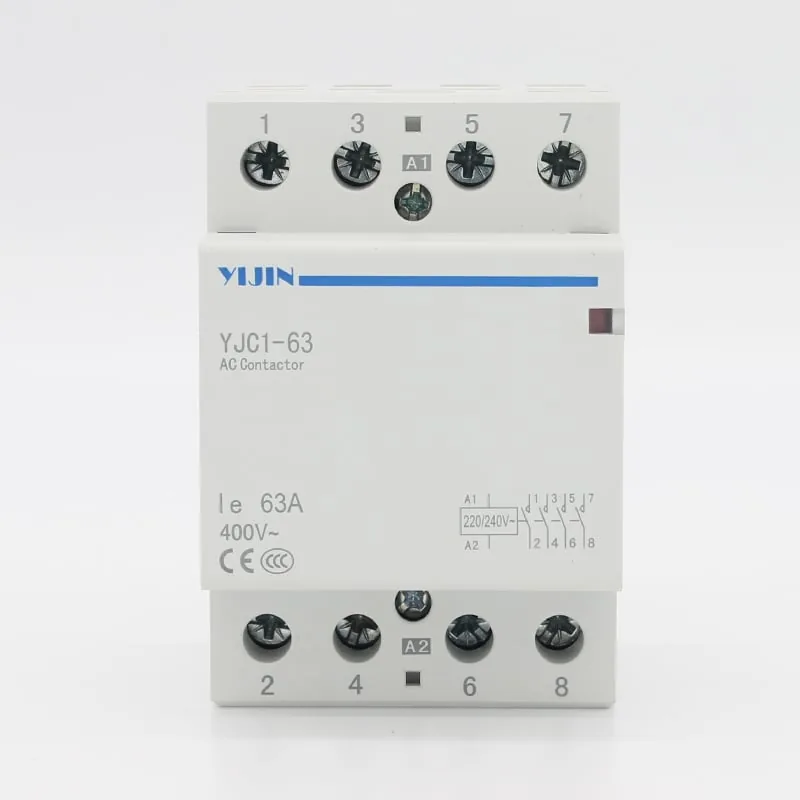
The YJC1-63 4P modular AC contactor is the SKU for this replacement question. Send working current, coil voltage, four power circuits, and normally open or normally closed with the request.
A condenser-unit labor band does not become this part’s price when you paste it onto the quote. Keep the visit invoice and the modular part quote in separate columns.
How to separate a service quote from a modular part quote
Ask whether the number is a technician’s visit or a modular part. If it is a visit, ask whether the diagnostic fee sits inside the total, whether the time is a regular call or an emergency call, and which amp rating and pole count are on the part.
A modular part quote should name AC-7a, the working voltage, the working current, the coil, and the contact state. Putting a condenser-unit labor band next to the YJC1-63 model name still does not create a Yijin tag.
Write the two numbers on separate lines before you accept either one. The visit line can cite the publisher who printed it. The part line should cite the quote you received for this SKU.
FAQ
How much does it cost to replace an AC contactor?
HomeGuide publishes an HVAC visit of $200 to $450 including part and labor. The YJC1-63 4P page does not publish a US retail price, so that visit band is not this modular contactor’s tag.
Why is there no single street price for an AC contactor replacement?
The search mixes a condenser-unit service job with a DIN-rail household part. Those are different invoices, and only the service job has a widely printed range.
Does a condenser-unit service quote apply to a DIN-rail modular contactor?
No. A definite-purpose contactor in an outdoor cabinet is the device those service quotes describe. A modular contactor on a TH35-7.5 rail is quoted from its own ratings.
What ratings should a modular contactor quote include?
Include the working current, the coil voltage, the number of power circuits, and whether the build is normally open or normally closed. On this family, also name AC-7a and the 230 V working voltage.
Does the YJC1-63 4P page list a US retail price?
It does not. The page offers a quote and prints electrical and installation limits instead of a tag.
What does a service visit add beyond the part?
HomeGuide’s HVAC account includes labor, a service call, and about 30 minutes to an hour of professional time. OSHA’s de-energizing rule is one reason that time is real work, not a box fee.
Can normally closed contacts be ordered on this modular contactor?
Yes. The 4P page says conventional products are normally open, and normally closed products can be customized.