 Yueqing Yijin Electronics Co., Ltd.




Class II Module Sitting on a Distribution Board
A type 2 surge protective device is the module a board builder clips on after the service overcurrent device, not the hardware that sits at the meter. On the Yijin page that module is a DIN-rail pressure-limiting unit in experimental category Class II. The sections below read its table, separate the US location name from the page category, and say when YJ1-C40 belongs on a shortlist.
A Class II Module on the Board, Not at the Meter
Open a distribution board and the surge hardware is usually a small cartridge on the DIN rail, wired in parallel with the feeders. People shorten the name to type 2 spd on quotes and panel schedules. Readers also search the longer name class ii surge protective device when the drawing says Class II.
A distribution board spd is the usual seat for this hardware. The cartridge stays quiet at normal voltage.
When a short transient lifts the voltage, a metal oxide varistor conducts and pulls the spike down. The feeder keeps supplying the loads while that path is active.
That picture is a board job. The meter, the outdoor disconnect, and the cord at a machine are different seats, and this page does not walk those installs.
Important: IEC 61643-11 replaces IEC 61643-1, and the older number on the product page does not certify this module — see the surge protector standards list.
The product page says its design basis complies with IEC61643-1. Treat that sentence as the page’s own design note. An inspector cannot treat that sentence as a file number.
Load-Side Seat Versus the Service-Entrance Job
UL 1449 places that name on the load side of the service equipment overcurrent device, including the branch panel. In US market context the words Type 2 point at that seat. They do not, by themselves, describe the Yijin cartridge.
The service-entrance job sits ahead of that overcurrent device, or in the span the standard assigns to a Type 1 device. Yijin already explains that install on the Type 1 SPD installation post. Use that post when the drawing shows the device on the line side of the main.
A point-of-use device lives at the equipment, and the Type 3 surge protective device post covers it. A homeowner thread about an outdoor disconnect and a garage panel is the same confusion in plainer words: the name follows the seat, and the indoor board is the load-side seat.
Listed whole-house units from other makers sometimes advertise a code sentence or a UL mark for their own SKU. Those sentences stay with those SKUs. The YJ1-C40 page does not show an NEC 230.67 sentence, an SCCR, or a UL product mark.
| Job name on the drawing | Where people look | What this page does with it |
|---|---|---|
| Board module | Distribution board, after the service overcurrent device | Reads the Class II table |
| Service-entrance device | Ahead of the main overcurrent device | Leaves the install story to the Type 1 post |
| Point-of-use device | At the equipment cord or receptacle | Leaves that story to the Type 3 post |
On a Mike Holt thread, a Wisconsin technician with a 100 amp recessed panelboard, concrete on all four sides and no spare breaker space, asked whether a Type 2 device could be mounted inside the enclosure. A later comment noted that some listed units plug onto a bus, and that hiding the device means nobody can see the status lights.
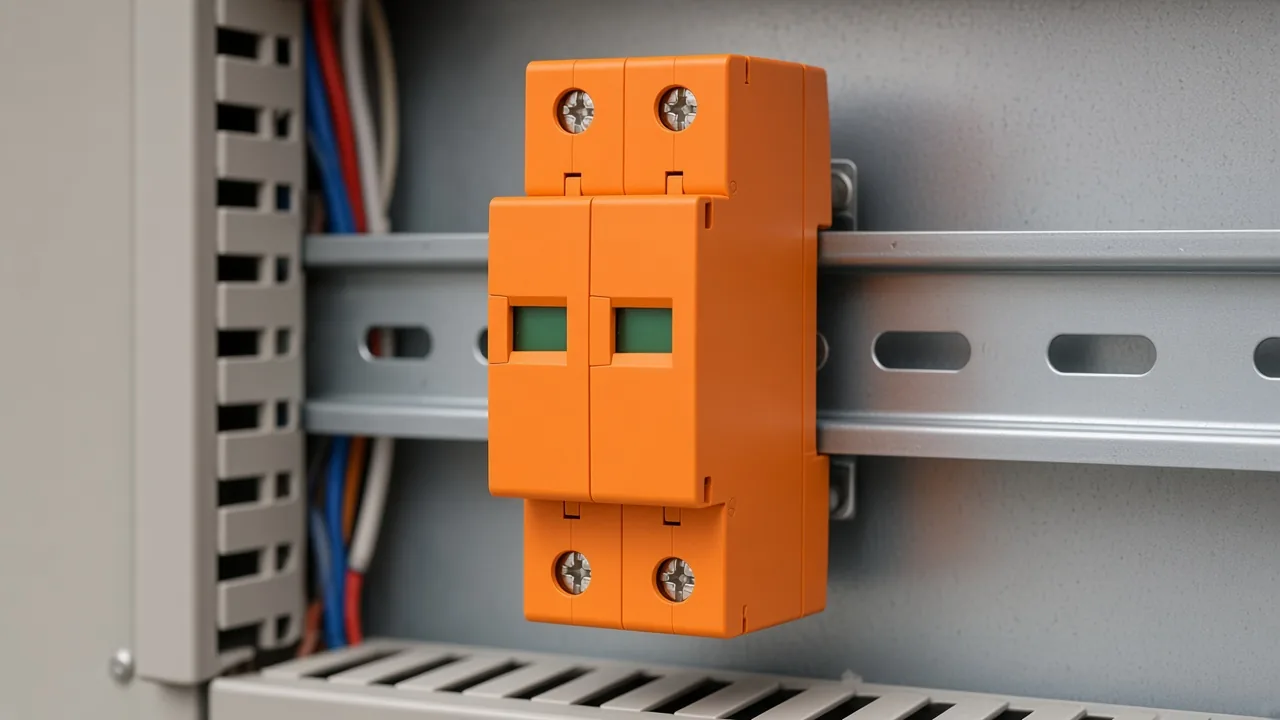
YJ1-C40 is a rail module with a window that turns from green to red. The cartridge mounts on a rail rather than plugging onto a bus like some listed breakers.
If the board has no rail space, or the window would face a dead cover, the mechanical fit fails before the surge numbers matter. The thread is about a different Eaton unit. It only supplies the objection.
Read the 8/20 Table Before the Feature Bullet
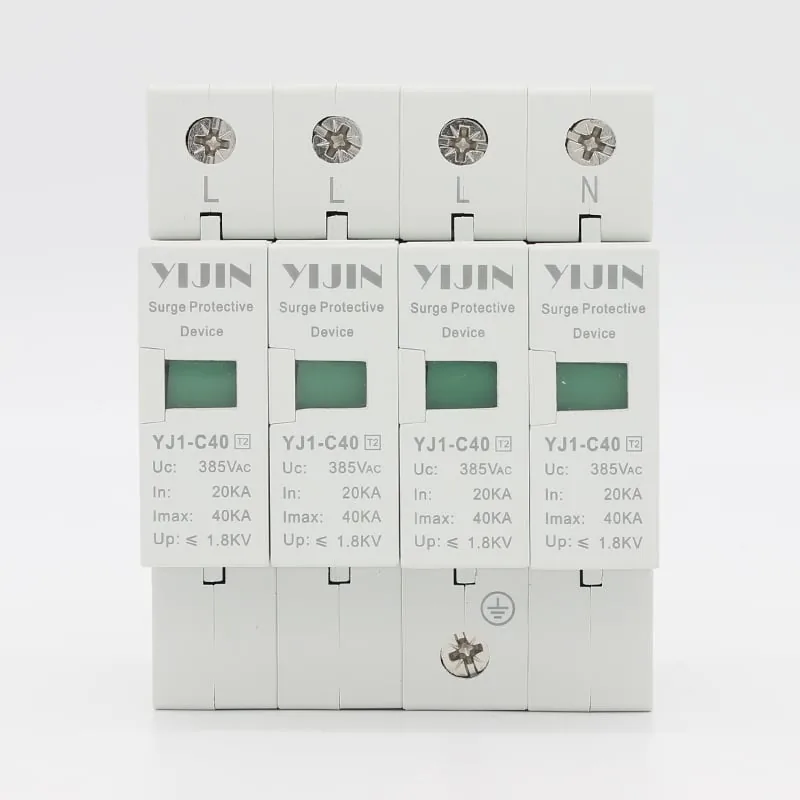
Quote the parameter table when you write the surge currents. The parameter table lists nominal discharge current In at 20 kA and maximum discharge current Imax at 40 kA, both on an 8/20 microsecond wave.
Nominal discharge current is the figure the page associates with repeated duty. Imax is the larger figure on the same wave. They are two columns with two jobs.
A feature bullet writes 8/21 microseconds beside the same 40 kA figure the table assigns to 8/20.
Leave the bullet unused. Averaging 8/20 and 8/21 would invent a wave the page never printed.
The sizing article already explains how In and Imax play different roles. This page only fixes which wave to copy from YJ1-C40.
Voltage protection level Up is 1.8 kV from L to N and 1.8 kV from N to PE on that 8/20 column. Up is the let-through the table declares at the stated current.
Lead length can still add voltage beyond the terminals, so the figure stops at the module.
| Item | Table value |
|---|---|
| Experimental category | Class II |
| In (8/20 µs) | 20 kA |
| Imax (8/20 µs) | 40 kA |
| Up L-N and N-PE | 1.8 kV |
| Uc L-N | 385 V AC |
| Uc N-PE | 255 V AC |
| Un | 220 V AC, 50 Hz |
| Response | 25 ns or faster |
| Rail | 35 mm |
| Wire | 4-25 mm2 |
| Housing plastic | UL94 V-0 |
| Poles | 1P, 2P, 3P, 4P |
| Enclosure | IP20 |
If a datasheet from another brand shows In 20 kA and Imax 40 kA, that is their test sheet. Copying it onto this module would be a guess. Only the rows above come from the YJ1-C40 table.
Uc, Up, and Pole Count on One DIN Module
Continuous voltage Uc is 385 V AC from L to N and 255 V AC from N to PE, while Un is 220 V AC at 50 Hz. Uc has to sit above the voltage the board actually runs, including the swing the utility allows.
Under that ceiling the table keeps the nominal line it printed. A 277-volt or 480-volt American panel needs a different Uc.
Pole options on the table are 1P, 2P, 3P, and 4P. Phase count alone does not pick the pole kit.
TT, IT, TN-S, and TN-C-S systems, which the page lists for supplies at or below 380 volts and 50 hertz, change how N and PE are bonded. Match the kit to that bonding before you count cartridges.
Terminals accept 4-25 mm2 and the module clips to a 35 mm rail. The same block lists response at or below 25 ns, IP20, and an air range from minus 40 to plus 70 C.
Wikipedia notes that ranking MOV parts by response time is a weak buying trick, because the usual test waves last microseconds. Keep the 25 ns line as a page figure. Skip response time when scoring this cartridge against a neighbor.
The housing line says the plastic meets UL94 V-0. That is a flammability note about the plastic.
A product listing would be a different sentence, and this line does not create an SCCR. Remote signaling is optional on the page, with a green window for normal and a red window for a tripped release.
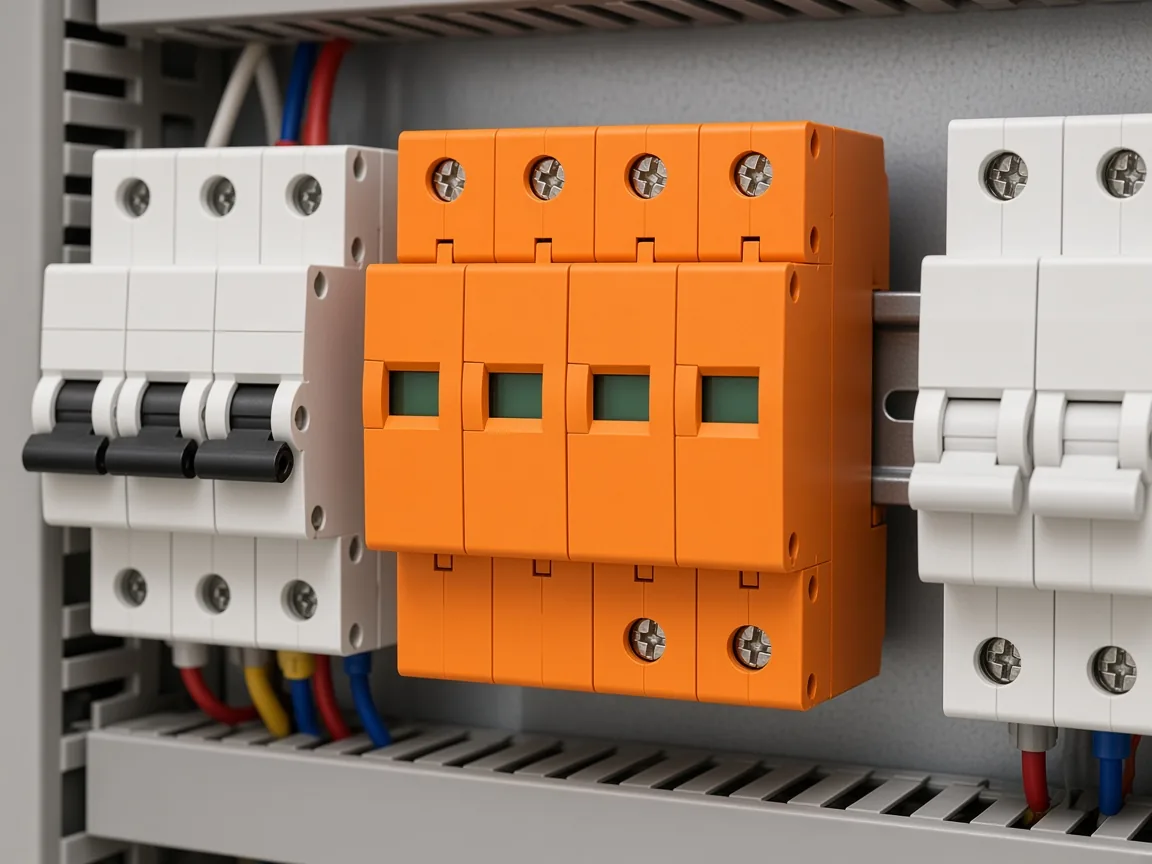
The hub for the rest of the family is the surge protection device category. Stay here for the Type 2 name and the one table.
What the Page Says About Zone Interfaces
The introduction says the series can sit at the interface of LPZ1, LP22, and LP23. The application block names LPZOB, LPZ1, and LPZ2 instead.
Those strings do not agree. LP22 should stay out of a risk file.
Say what the page actually does. It places the series at zone interfaces. The project still has to match the zone.
A floor board, a telecom room, an elevator controller, or a villa panel may all appear in the application list. None of those room names replaces a zone study.
If the specification demands a lightning-current device at the structure entrance, this Class II table is the wrong sheet. Go back to the service-entrance post rather than stretching LPZ typos into a design.
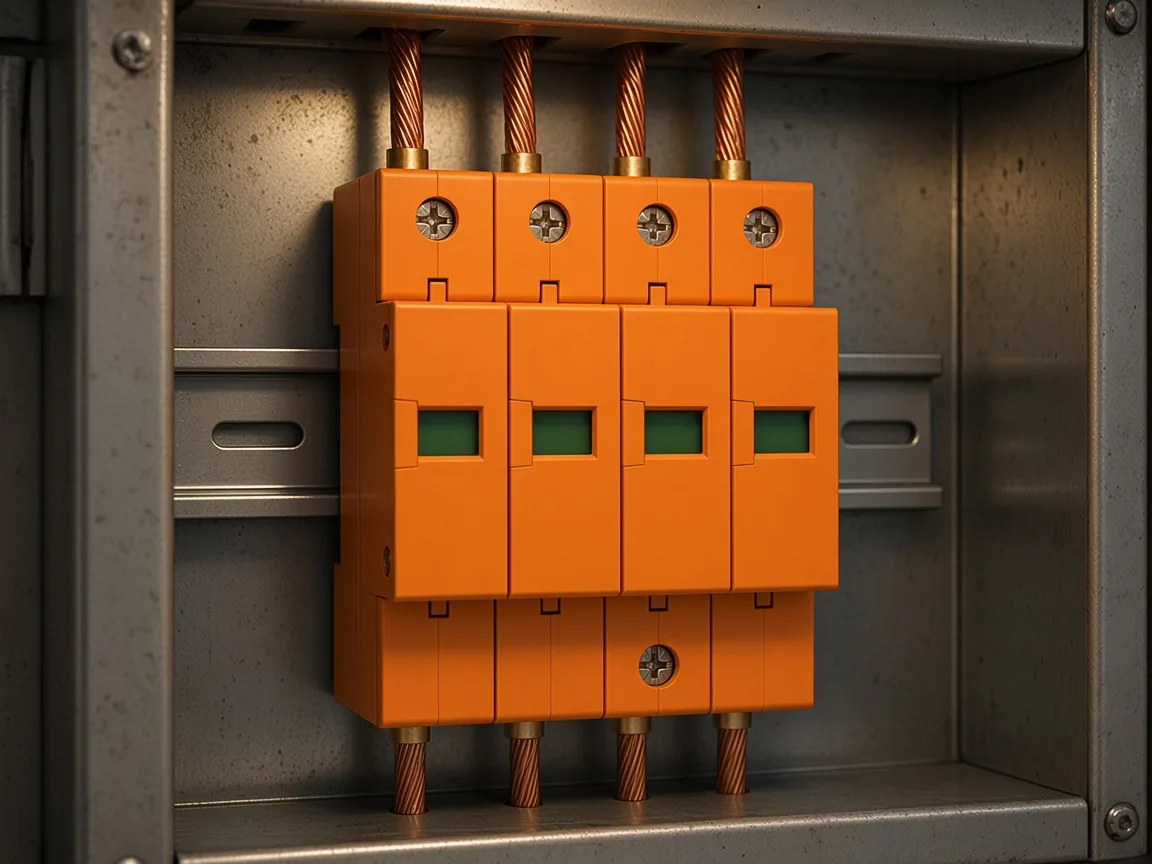
The cabinet view shows the wire tails entering the module.
Where YJ1-C40 Fits a Distribution-Board Shortlist
Put YJ1-C40 on the shortlist when the drawing asks for a pressure-limiting Class II module on a DIN rail and the earthing type is one the page names.
The voltages need to line up with Uc at 385 V AC from L to N and 255 V AC from N to PE. The YJ1-C40 surge protector page is the record for those figures.
Leave it off the shortlist when the device must sit ahead of the service overcurrent device, when the load is a cord-connected point of use, or when the inspector expects a UL mark this page does not print. A backup overcurrent device, lead length, and the earthing bond still belong to the project. The table does not settle them.
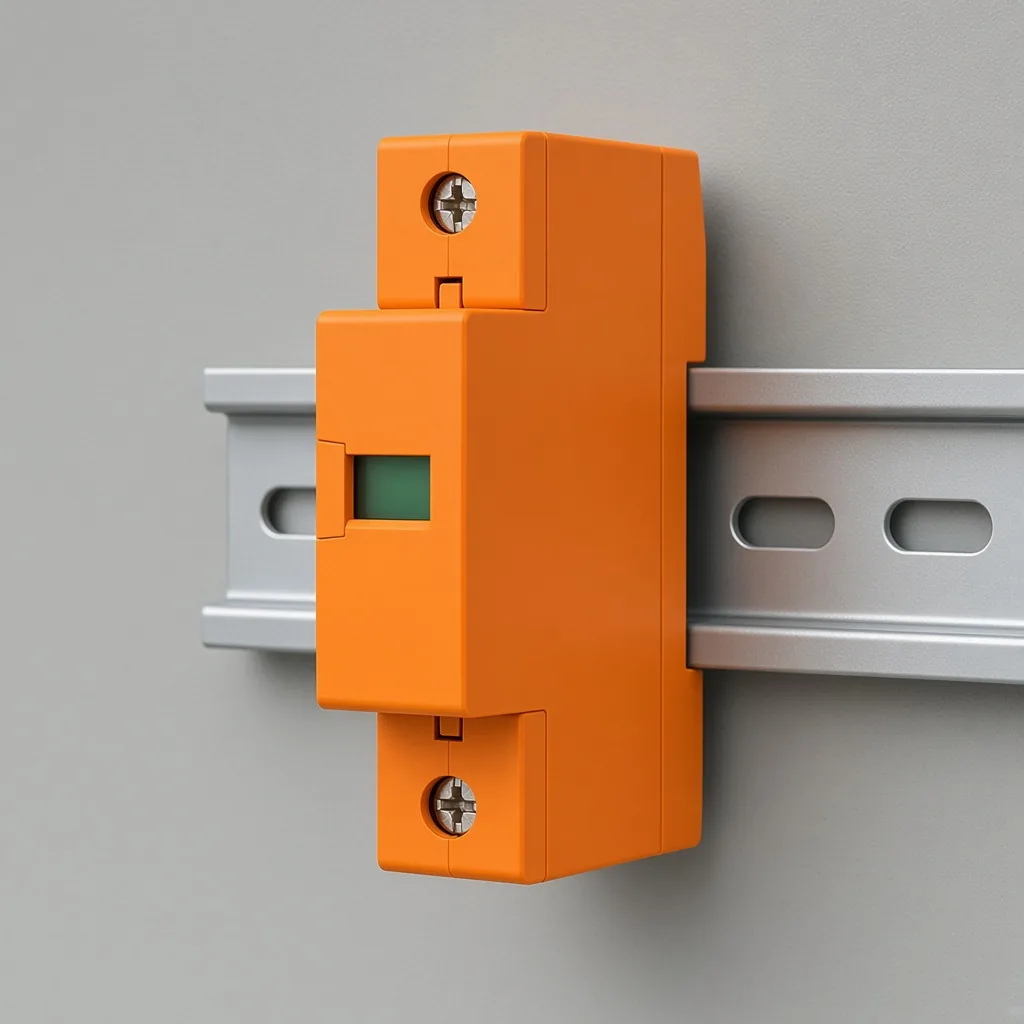
The window and the release are maintenance clues beside a failed-cartridge plan. Green means the page’s normal state.
Red means the release has opened. Stock a replacement cartridge before the board is the only source of that signal.
FAQ
Is a Class II label the same job as a UL Type 2 listing?
No. Class II on this page is the experimental category tied to the 8/20 table. A UL Type 2 listing is a certification result for a specific model, and this product URL does not show one.
Can YJ1-C40 take the service-entrance seat?
The table is a board-level limiting module. The service-entrance seat is the other post. Using this cartridge there because both are called surge devices mixes two jobs.
Why quote 8/20 when a feature line says 8/21?
The parameter table prints 8/20. The feature bullet prints 8/21. Quoting the table keeps one wave in the file, which is the wave the current columns use.
Does a UL94 V-0 housing note mean the module is UL listed?
It means the housing plastic is described to a flammability class. A product listing would name a file and a type. This page has the plastic sentence only.
What do panel electricians argue about when a Type 2 device will not fit a knockout?
They argue about spare space, whether the unit is allowed inside the can, and whether anyone can still see the lights. For this rail module the same argument is rail space and a visible window.
Which live pages cover the service-entrance and point-of-use jobs?
The Type 1 installation post covers the service-entrance seat. The Type 3 post covers the point-of-use seat. The sizing post covers how In, Imax, Uc, and Up are read before a number is copied.
References
Read these three pages for the standards name and the panel-space objection.