 Yueqing Yijin Electronics Co., Ltd.



How to Size a Surge Protection Device Without Guessing the kA Label
Knowing how to size a surge protection device means matching continuous voltage, discharge ratings, and let-through level to the board you actually run — not the panel’s ampere label. This SPD sizing walkthrough covers Uc, In, Imax, and Up, then maps live Yijin Class II cards without inventing a calculator.
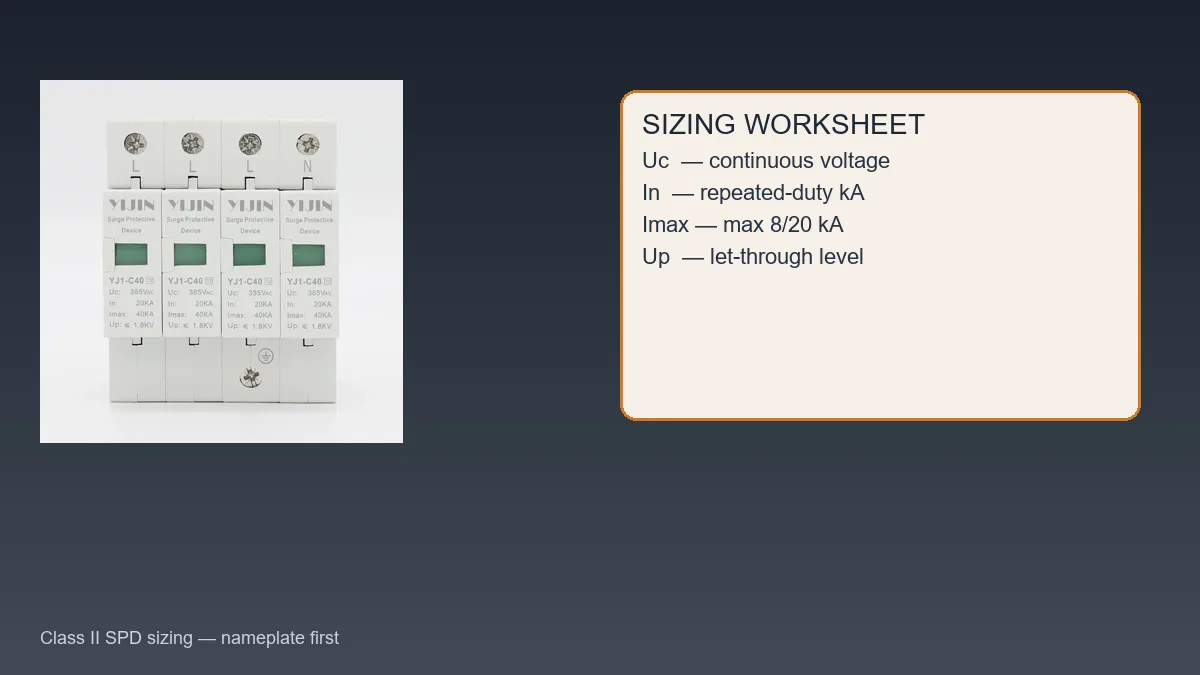
The worksheet below stays on nameplate numbers, not service ampacity myths.
What Sizing an SPD Actually Means
Sizing means matching the SPD’s continuous voltage, discharge ratings, and let-through level to the board’s real voltage and exposure — not treating surge kA like breaker ampacity.
A surge protection device (SPD) sits in parallel and clamps short spikes. The usual procurement mistake is treating “size” like breaker ampacity.
Community threads still ask whether 65 kA is “too much” for a 200 A panel. Electricians on trade forums note there is no code formula that turns panel amperes into surge kA. For a Class II / 8/20 μs board module, the useful talk is a worksheet: maximum continuous operating voltage Uc first, then surge protector In Imax figures, then Up.
Pole count and lead length still matter on install jobs, but they do not replace those four numbers here. Browse the surge protection device hub when you want the family shelf after the worksheet is filled.
Start With Uc Before You Shop kA
Uc — also written as Uc / MCOV in many catalogs — must sit above the continuous voltage the board actually runs, including the earthing arrangement’s continuous stress.
In professional language, maximum continuous operating voltage Uc is the highest continuous voltage a protection mode can endure without entering clamp. In plain language, it is the everyday voltage the device must survive all day.
Educational guides put this gate before any kA shopping. If Uc is too low for the system, the module is the wrong size no matter how loud the Imax banner looks.
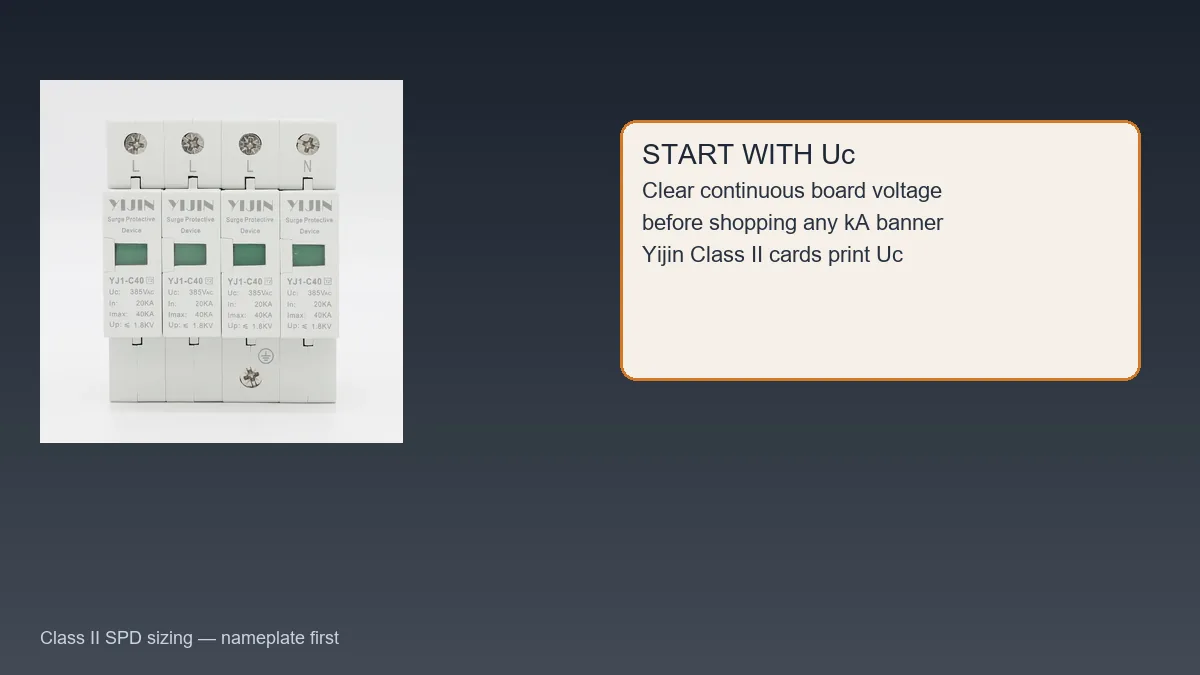
Use maximum continuous operating voltage Uc before any kA banner.
Live Yijin Class II cards for the AC family in this article print Uc (L-N) 385 V on the parameter tables, with Uc (N-PE) 255 V on the cards that list that row.
Product introductions state suitability for TT, IT, TN-S, N-C-S and related systems at AC 50 Hz or 50–60 Hz, 380 V and below. That is the continuous-voltage envelope you are matching.
If your board continuous voltage sits outside that printed envelope, re-scope the product class. Raising Imax will not repair a Uc mismatch.
In Versus Imax: Two Different kA Jobs
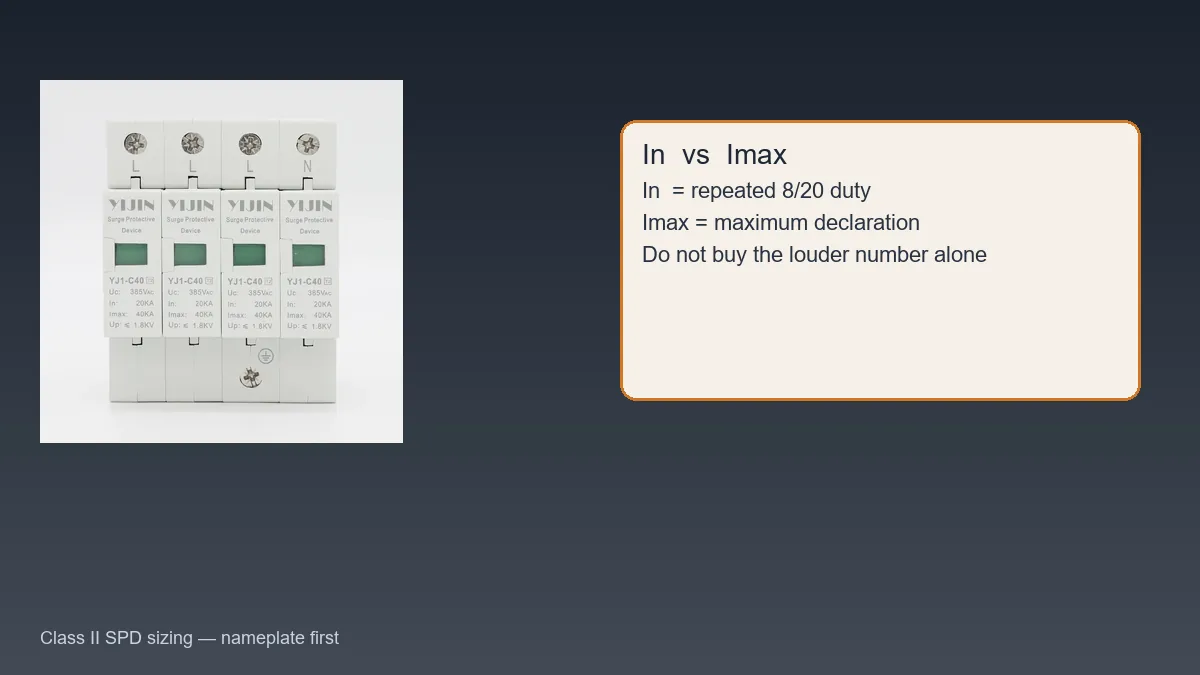
In is the nominal 8/20 μs discharge current for repeated duty; Imax is the maximum 8/20 μs declaration on the same Class II card — they are not one marketing number.
Class II education uses the 8/20 μs waveform for In. Imax is the higher single-event declaration manufacturers print for Class II style cards. Class I conversations bring Iimp on a 10/350 μs wave — a different seat than the Class II tables below.
From the field: Forum answers warn that datasheets show several “kA” figures — In, a short-circuit rating, and a single-shot surge figure — and that marketers often highlight the largest single-shot number. Buyers who only compare that loud figure skip the survivable repeated-duty In.
Use both surge protector In Imax numbers on the worksheet. Treat In as the endurance language. Treat Imax as the maximum 8/20 declaration.
| Rating | What it answers | How to use it on a Class II worksheet |
|---|---|---|
| In | Repeated 8/20 μs discharge duty | Primary endurance figure to compare across cards |
| Imax | Maximum declared 8/20 μs discharge | Headroom declaration beside In — not a substitute for In |
| Up | Let-through under defined tests | Check after voltage and discharge, not instead of them |
Read Up as the Let-Through You Still Have to Live With
Up is the voltage protection level under defined tests — the let-through the equipment still has to live with after the SPD operates.
Professionally, Up is the manufacturer’s stated protection level for a defined impulse. In plain language, it is how high the remaining spike sits at the SPD terminals under that test.
Independent installation education compares Up to equipment impulse withstand categories. Installed leads add margin on top of the datasheet Up.
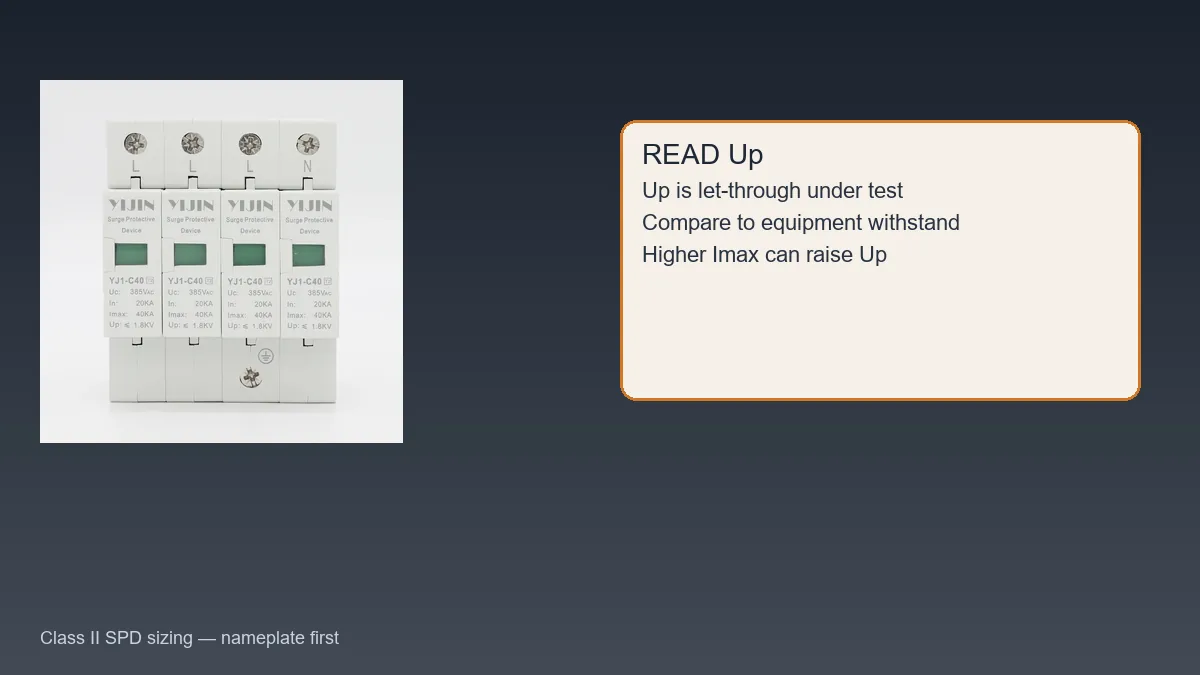
Up is the let-through figure on the same card as In and Imax.
On live Yijin Class II tables in this family, Up rises as you step up the discharge cards: 1.5 kV on YJ1-D20, 1.8 kV on YJ1-C40, 2.0 kV on YJ1-B60, 2.4 kV on YJ-B80.
That pattern matters for buyers who assume bigger Imax automatically means gentler clamping. Inside this verified set, the higher Imax siblings print higher Up values on the same family tables.
A Practical SPD Sizing Worksheet
Fill system voltage and earthing context, Uc target, In/Imax need, Up target, Class seat, and the printed series recommendation — then stop. This SPD sizing checklist is not a calculator.
- System voltage and earthing context — note nominal voltage and arrangement on the drawing. Yijin AC Class II intros in this set speak to TT/IT/TN-S/N-C-S style systems at 380 V and below.
- Uc target — require printed Uc above continuous mode voltage. Confirm the 385 V L-N figure still clears your continuous stress.
- Class seat — for these modules, the tables print Class II experiment. That is board-module 8/20 language.
- In / Imax need — pick the repeated-duty In you need, then read Imax on the same card.
- Up target — compare printed Up to the equipment withstand conversation for that board.
- Printed series recommendation — copy the series row from the chosen card, such as 32A/10kA on YJ1-C40. Pair it with a backup conversation when the project uses YJSCB-40.
- Pole count — confirm 1P/2P/3P/4P against the conductors you must protect.
If a field is blank on the product table, leave it blank on your worksheet.
Map Live Yijin Class II Cards Onto That Worksheet
The live AC Class II set maps onto one scan table: YJ1-D20 / B60 / B80 siblings sit beside YJ1-C40 with the same four-number spine.
| Model | Uc (L-N) | In (8/20) | Imax (8/20) | Up | Recommended series | Poles |
|---|---|---|---|---|---|---|
| YJ1-D20 | 385 V | 10 kA | 20 kA | 1.5 kV | 16A/6kA | 1P/2P/3P/4P |
| YJ1-C40 | 385 V | 20 kA | 40 kA | 1.8 kV | 32A/10kA | 1P/2P/3P/4P |
| YJ1-B60 | 385 V | 30 kA | 60 kA | 2.0 kV | 63A/35kA | 1P/2P/3P/4P |
| YJ-B80 (table model YJ1-B80) | 385 V | 40 kA | 80 kA | 2.4 kV | 63A/35kA | 1P/2P/3P/4P |
All four tables print Class II experiment. Prefer the parameter block when application copy conflicts.
YJ1-D20 prints In 10 kA, Imax 20 kA, and Up 1.5 kV on its Class II table. YJ1-B60 prints In 30kA and Imax 60kA with a series recommendation of 63A/35kA.
On the YJ-B80 card, the table model YJ1-B80 shows In 40 kA and Imax 80 kA with Up 2.4 kV. Housing rows that mention UL94 V-0 describe plastic flammability, not an SPD listing.
YJSCB-40 is not a fifth In/Imax step on that map. It is a backup protector that prints cooperation with Class I (T1) / Class II (T2) SPD language and ≤60kA (8/20) cooperation on its table.
Class II testing tracks nominal discharge current with an 8/20 μs impulse. Consumer and training pages place Type 1 devices at the origin while Type 2 devices sit at sub-distribution boards.
Choose YJ1-C40 When the Worksheet Lands Mid Class II
Start with the mid Class II card when your worksheet lands in the middle of the live family map.
When the worksheet needs a mid Class II board card with Uc 385 V L-N, In 20 kA, Imax 40 kA, and Up 1.8 kV, start with the YJ1-C40 surge protector.
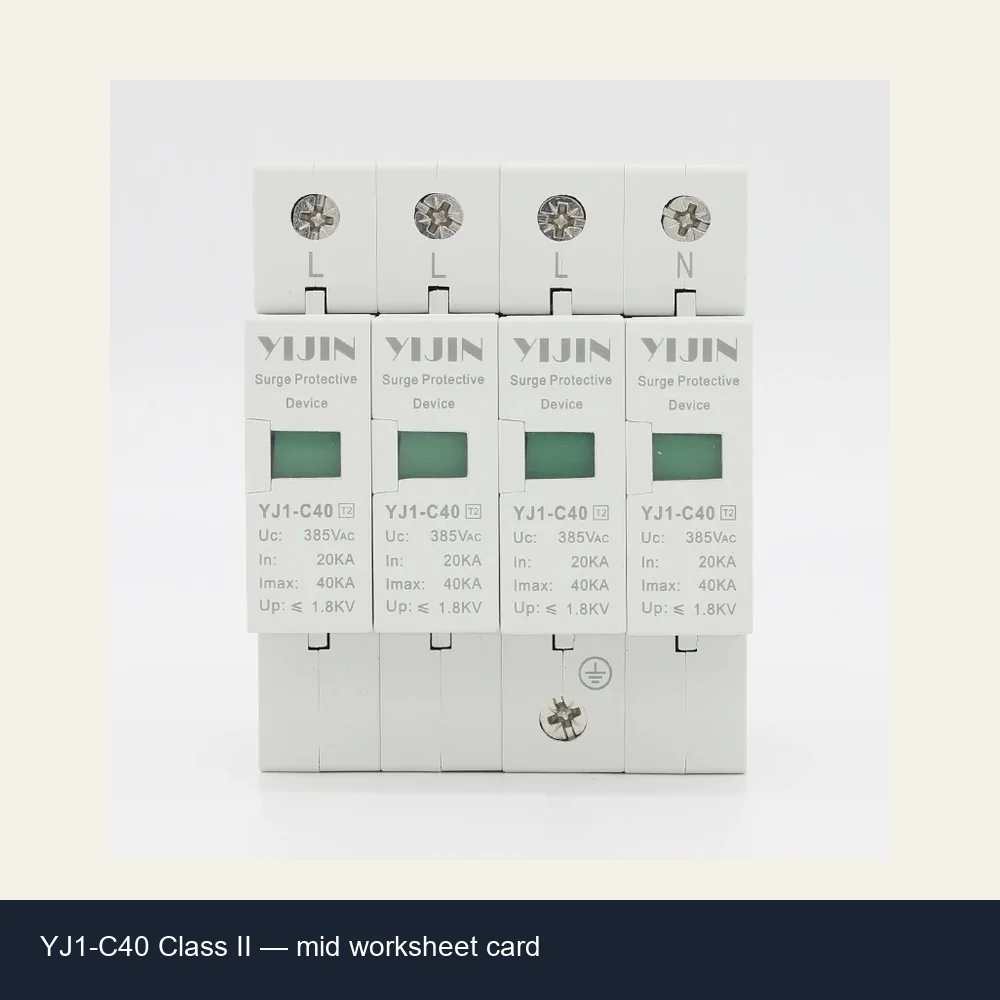
YJ1-C40 sits between the lower-discharge YJ1-D20 card and the higher In/Imax B60/B80 siblings.
For YJ1-C40, that printed recommendation is 32A/10kA. Carry it into the backup conversation without inventing ampere laws.
Step to YJ1-D20 when the worksheet asks for In 10 kA / Imax 20 kA and Up 1.5 kV. Step to YJ1-B60 or YJ-B80 when the worksheet asks for the higher printed discharge cards and you accept the higher printed Up values.
Return to the surge protection device category once the four numbers are locked.
FAQ
How do you size a surge protection device?
Match Uc to continuous board voltage, then read In and Imax as separate 8/20 kA jobs, then check Up against equipment withstand, and copy the printed series recommendation. Do not size surge kA from the panel ampere rating alone.
What is Uc on an SPD nameplate?
Uc is the maximum continuous operating voltage a protection mode can endure. On the live Yijin Class II cards in this article, Uc (L-N) prints as 385 V, with Uc (N-PE) 255 V where that row appears.
What is the difference between In and Imax?
In is the nominal discharge current for repeated 8/20 μs duty. Imax is the maximum declared 8/20 μs discharge on Class II-style cards. They answer different questions; do not treat the larger marketing figure as the only size.
Does a higher Imax always mean better protection?
No. Inside the verified Yijin set, higher Imax siblings also print higher Up values — for example 2.0 kV on B60 and 2.4 kV on B80 versus 1.8 kV on C40. Read discharge and let-through together.
Does SPD kA follow the panel amp rating?
No. Community and field discussion treat panel ampere rating and surge discharge ratings as different worksheets. Service size does not set In or Imax.
Are Yijin Class II modules the same as UL Type 2 listed SPDs?
The live tables print Class II experiment. That is not the same sentence as a UL 1449 Type 2 listing. Housing UL94 V-0 marks are plastic flammability, not SPD listing.
Which Yijin card starts a mid Class II worksheet?
YJ1-C40, with In 20 kA, Imax 40 kA, Up 1.8 kV, and recommended series 32A/10kA on the live table.
When pick D20 or B60/B80 instead of C40?
Choose YJ1-D20 when the worksheet wants In 10 kA / Imax 20 kA and Up 1.5 kV. Choose YJ1-B60 or YJ-B80 when the worksheet wants the higher printed In/Imax cards and accepts their higher printed Up values.
References
- IET — Surge protective devices (consumer guidance) — Type seat education for origin, sub-distribution, and point-of-use roles.
- IET Wiring Matters — Do SPDs require an overcurrent protective device? — Backup / series OCPD literacy beside the printed series row.
- NICEIC / Professional Electrician — Types of surge protective devices — Class I 10/350 vs Class II 8/20 selection factors.
- Electrician Talk — Surge protection at panel ratings — Community discussion that panel ampere rating does not set surge kA.