 Yueqing Yijin Electronics Co., Ltd.




What a DC Circuit Breaker Sizing Calculator Computes, and Why the Nameplate Still Rules
A dc circuit breaker sizing calculator turns load current, voltage, and a few derating fields into one suggested ampere rating. The sections below name those fields, then set them beside the voltage class, pole count, and interrupting limit a buyer still has to read on a live page in the DC circuit breaker range.
What a DC Circuit Breaker Sizing Calculator Actually Computes
The form computes a suggested ampere. It starts from a load current, or from watts divided by DC volts, then multiplies or divides by the factors the author built in.
Coding Ace’s public form is a clear example of that shape. You enter amps or watts, system voltage, a yes-or-no continuous-load flag, ambient derating, grouping derating, a growth margin, and a nuisance-trip margin. Optional boxes ask for conductor ampacity, breaker voltage rating, and interrupt rating.
MEPBase asks a similar set and adds a DC path that turns kilowatts into amps, plus optional fault current and altitude. SolarMathLab’s worked example is a 120-volt household load, which shows how easily a “breaker calculator” drifts into AC math.
None of those forms print a Yijin frame, a pole arrangement, or a utilisation category. The ampere they return is an estimate of the current rating you might shop for. It is the start of a check, and the nameplate is the rest.
| Form input | What the single ampere still leaves open |
|---|---|
| Load current or watts and volts | Whether that current is the device rated current |
| Continuous-duty flag | The factor lives in the form, separate from any Yijin table |
| Ambient derating and grouping | Hot air and bundled conductors before rounding |
| Optional fault or altitude box | Interrupting capacity, poles, and enclosure |
Continuous Current Is an Input, Not the Breaker You Buy
Continuous current is the load you type in. Rated current is the maximum current a breaker is designed to carry continuously, which is a property of the device.
Wikipedia defines rated current as the maximum current that a breaker is designed to carry continuously. Wikipedia’s preferred rated-current list includes 63 A and 125 A among other steps.
Electrical4U notes that miniature circuit breakers are typically rated up to a current up to 125 A. The same explanation splits the job: a bimetal bends when continuous overcurrent heats it, and an electromagnet snaps on a short circuit.
Coding Ace’s DC breaker size calculator says continuous duty commonly uses a 125% design factor. That sentence belongs to Coding Ace. It is absent from the YJB1Z-63, YJB1Z-125, and YJM1Z tables, so the factor must stay outside those nameplates.
A procurement reader can still use the idea. If the load runs for hours, the form inflates the current before it rounds to a standard step. The device you buy is the step that is printed, after voltage class and fault duty are checked.
Voltage Class Sits Beside the Ampere Result
Voltage class is a separate limit. A calculator can suggest 32 amperes and still be silent on whether the circuit is 125 volts DC or several hundred.
Direct current keeps an arc alive, because the current lacks the zero crossing that helps an AC arc die. That is why a DC voltage class is printed as its own column, next to the current list.
On the YJB1Z-63 table the voltage cells read DC125V/220V for the single-pole row and DC250V/440V for the two-pole row. Those same two voltage pairs repeat on the 125 frame.
The same table prints voltage classes DC125V/220V and DC250V/440V. A note on the YJB1Z-63 page says 1P DC220V and 2P DC440V need to be customized.
YJM1Z prints a higher set: DC250, DC440, DC550, and DC750, and the page says DC750V needs to be customized. If your circuit voltage sits above the printed pair, a larger calculator ampere does not fix it.
Ambient and Grouping Change the Number Before You Round
Ambient derating is the form’s way of saying the air around the breaker is hotter or cooler than the air used to calibrate it. Grouping derating says several conductors share the same route and heat one another.
Coding Ace divides the design current by those two factors before it picks the next standard rating. MEPBase treats altitude as a device issue: thinner air cools the breaker less and weakens arc quenching, which is different from the cable’s ambient correction.
YJM1Z is the only live DC page here that prints an environment band. The same page limits altitude to 2000m and below. The surrounding-medium line says the temperature should stay not lower than -5 and not higher than +40, and above that upper bound the breaker can be used with reduced capacity.
No percent is printed for that reduction. A calculator that asks you to type “82” or “90” is using its own curve. You cannot copy that percent onto YJM1Z, and the two DIN pages do not print an ambient band at all.
Round only after you know which document owns the factor. The form owns its percent.
The molded-case page owns the altitude line and the temperature band. The DIN pages own the current list and the voltage pair.
Pole Count and Utilisation Category Stay Off the One-Number Result
Pole count is how many poles open. Utilisation category is the duty class that says how the breaker is meant to switch or protect. The reviewed calculators ask for neither.
YJB1Z-63 and YJB1Z-125 print one-pole and two-pole rows, and the pole cells are written as “one” and “two”. YJM1Z’s dimension table is clearer: it labels 2-pole, 3 poles, and 4-pole.
Curve letters are also a nameplate fact, not a calculator output. Instantaneous letters on the 63 frame are B and C. The 125 frame shows C.
An EEVblog thread puts the buyer warning in plain speech: look at what the rating and the curve letters mean before you order, and use a DC-rated breaker.
A 32-ampere result does not tell you to buy one pole or two, and it does not assign a utilisation category. If the circuit must open both positive and negative, the pole row on the page is the document that says whether that frame is offered.
A Single Ampere Output Is Not a Specification
Interrupting capacity is the current the device can stop without being destroyed or holding an arc too long. Wikipedia notes that a device may have different interrupting ratings for alternating and direct current, and that prospective short-circuit current should stay within the rated breaking capacity.
Coding Ace says the same thing from the form side. After the ampere appears, final choice still has to cover conductor protection, device voltage rating, interrupt rating, enclosure rules, and the manufacturer’s DC limits. Electrical4U’s rating note adds the stress point: a short circuit loads the breaker thermally and mechanically, which is a different question from continuous current.
From the field: A SolarDIY buyer sizing a battery DC breaker said the inverter manual called for a 200 A breaker while 1.25 times a 50 A charge current pointed near 70 A, and a reply said circuit breakers protect the wires. Source: Reddit r/SolarDIY.
That exchange is someone else’s project, not a Yijin calculation. It shows why two ampere numbers can both look official and still fight. The wire’s limit and the device’s interrupting cell have to agree with the load, and a web form that prints one number has not checked either document.
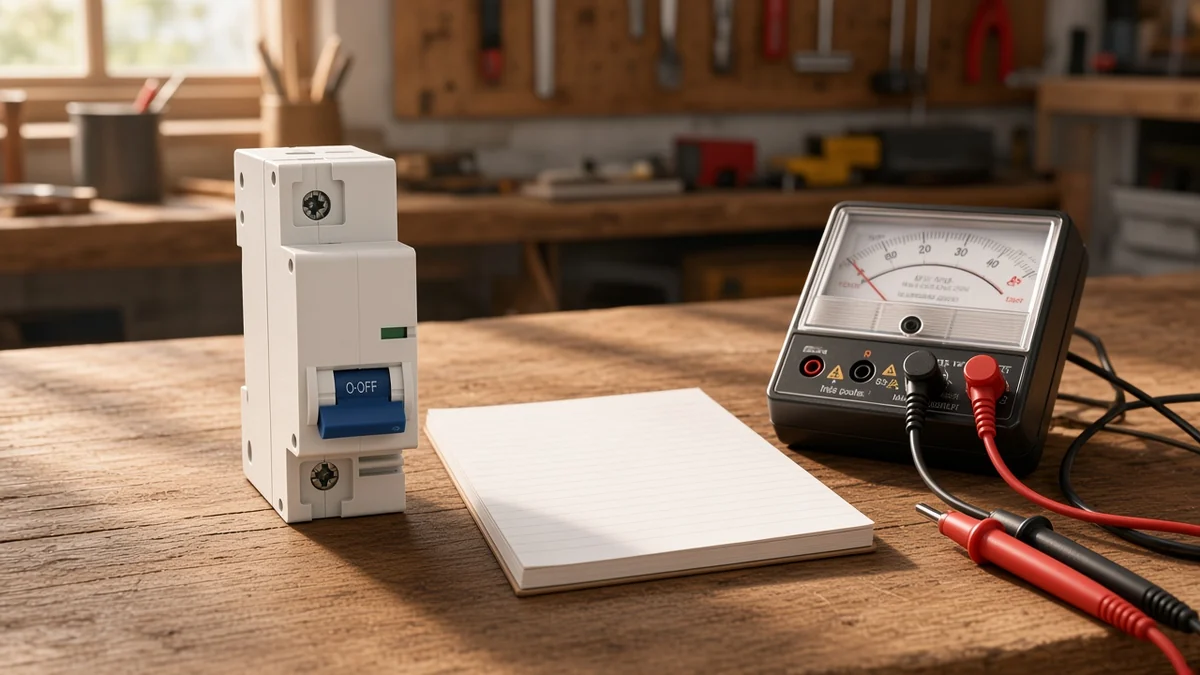
On the DIN pages the interrupting cell is words, not a kiloampere you can drop into a fault box. On the 63 frame the cell reads “ten thousand” and “six thousand”.
On the 125 frame the cell reads “ten thousand”. The time-constant cell reads “ten”. Leave those words as words.
Which Yijin DC Breaker Product Fits the Printed List
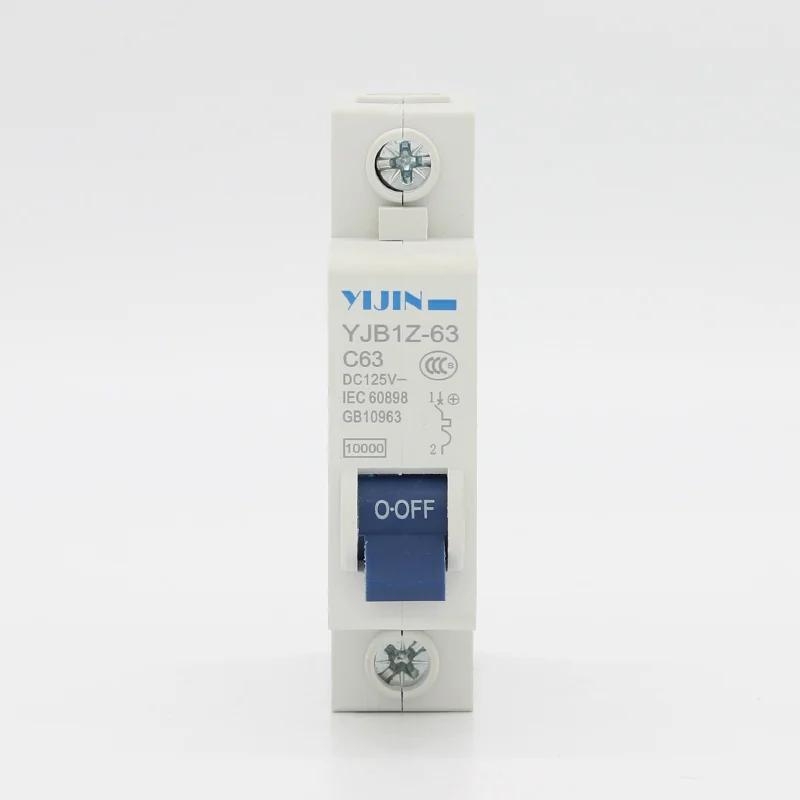
For a small distribution current, start with the YJB1Z-63 small DC circuit breaker. The YJB1Z-63 page says this product complies with the requirements of GB10963.2 and IEC60898-2 standards.
Its rated-current list is printed as 1, 2, 3, 4, 5, 6, 10, 15, 16, 20, 25, 32, 40, 50, 63A. If the form rounds to a step that is missing from that list, this frame is the wrong place to force a match. The shell-level cell reads “sixty-three”, which is a word, so this article does not translate it into a second rating.
A higher DIN list sits on the YJB1Z-125 small DC circuit breaker. The YJB1Z-125 page says it complies with the requirements of IEC60947-2 and GB14048.2 standards.
That page’s rated-current list is printed as 63, 80, 100, 125A. Its shell-level cell also reads “sixty-three”, so the model name and the shell cell are not the same string.
The YJM1Z plastic-shell DC circuit breaker is the molded-case family when the current list has to climb past the DIN steps. YJM1Z prints IEC60947-1 beside GB14048.1 and IEC60947-4-2 beside GB14048.6. A further standards line on that page begins “EC60947-2”, with the leading I missing in the live text, beside GB14048.2.
The molded-case table prints a breaking capacity of 10KA/20KA.
Frame rows cover YJM1Z-100, YJM1Z-225, YJM1Z-400, YJM1Z-630, and YJM1Z-800, with digit current lists under each row. That breaking-capacity cell is the clean interrupting figure among the three pages. It is still a page fact, not a calculator output.
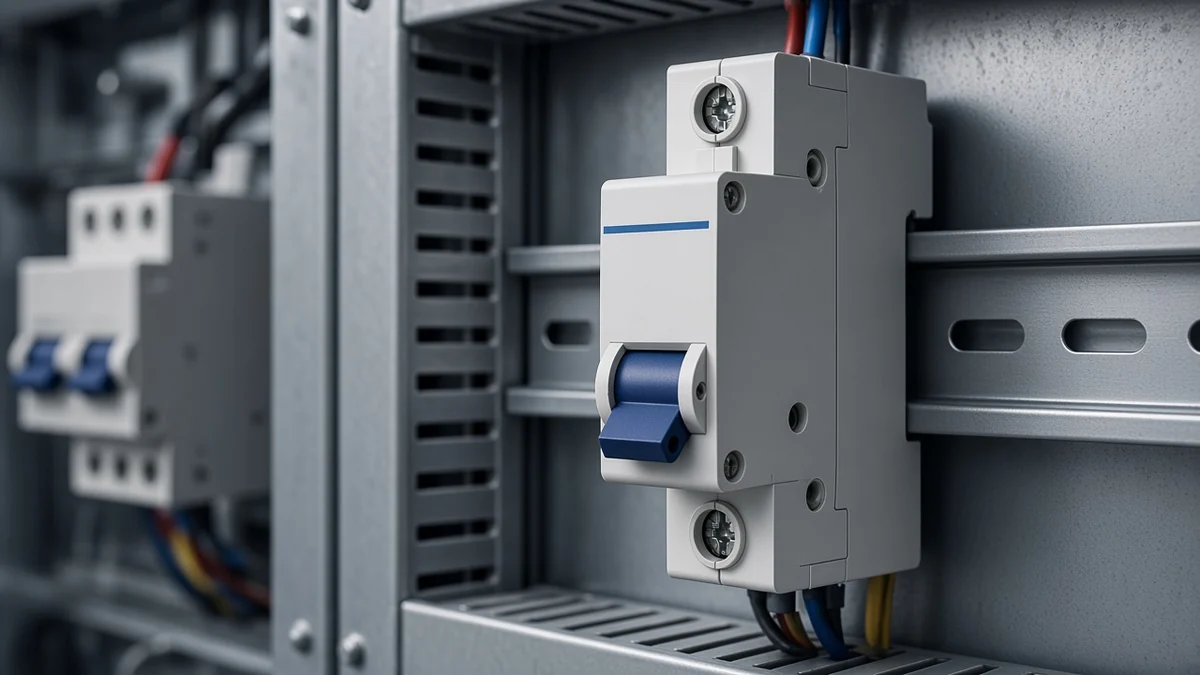
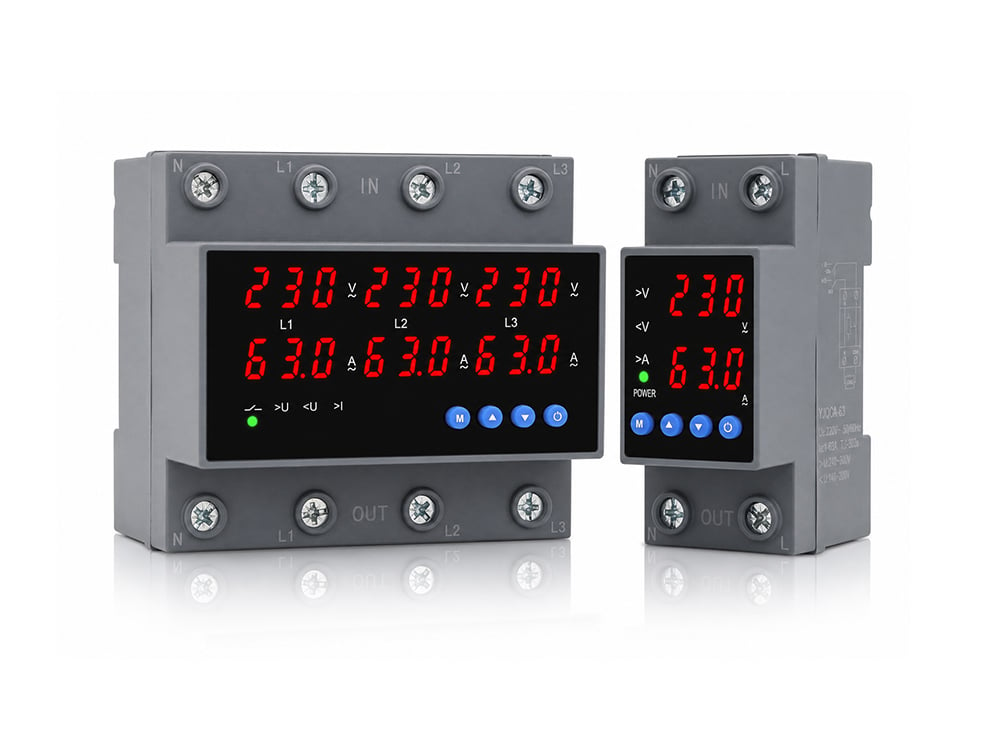
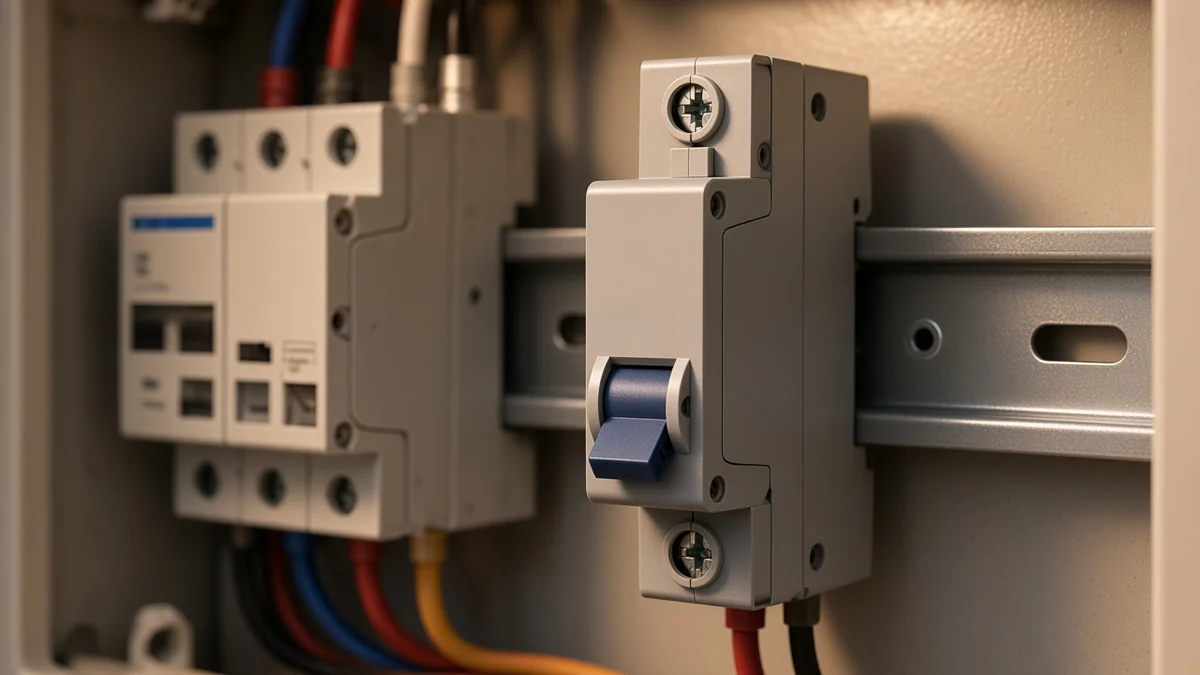
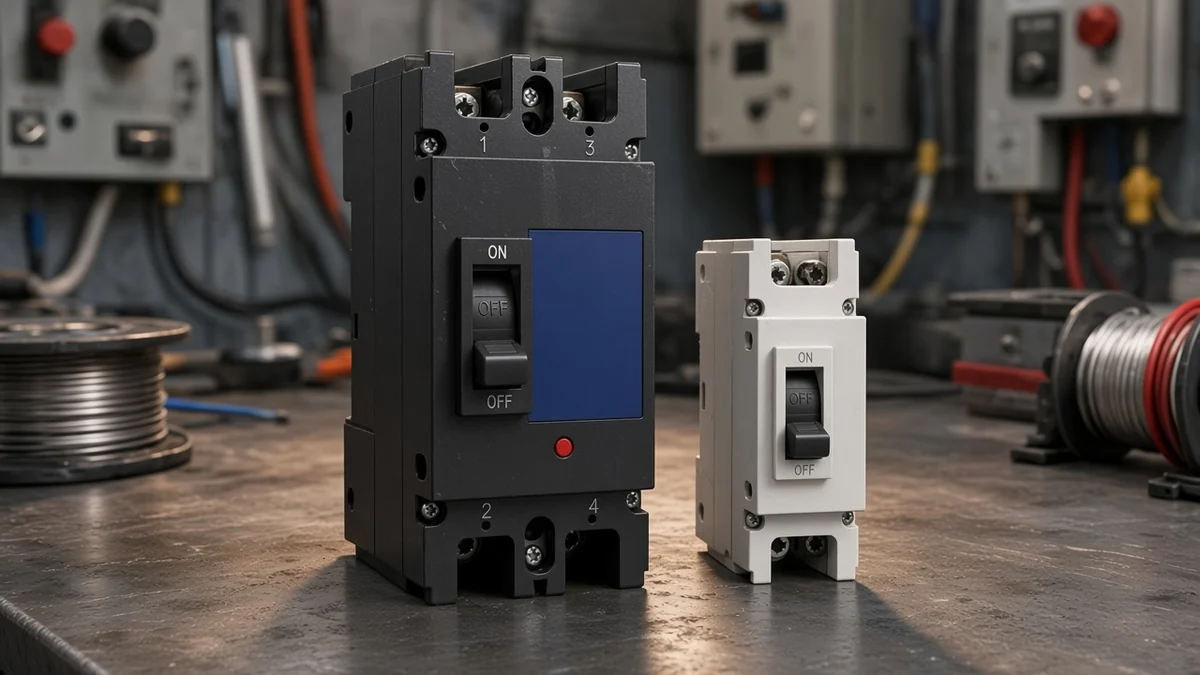
The panel shot is the voltage-class view. The bench shot below is the frame-size view.
WiFi frames and RS485 communication breakers show up on related-product lists. They are other products. They are outside this DC nameplate check.
| Live page | Printed and usable in a check | Left off the page |
|---|---|---|
| YJB1Z-63 | IEC60898-2 sentence, current list through 63A, voltage pair, B and C | Clean Icu digit, utilisation category, ambient band, continuous-duty factor |
| YJB1Z-125 | IEC60947-2 sentence, current list through 125A, voltage pair, curve C | Clean Icu digit, utilisation category, ambient band |
| YJM1Z | breaking-capacity cell, altitude line, temperature band, 2/3/4 pole labels | Utilisation category, a numeric reduced-capacity factor |
For selection criteria once those fields are in hand, the companion article on what “best” means for a solar DC breaker walks voltage, current duty, and poles as a buying frame. This page stays with the calculator inputs. Wiring diagrams are a different reading job and stay outside this explanation.
Where the Calculator Stops and the Nameplate Starts
Stop when the next fact is a voltage class, a pole count, or an interrupting cell. The form has already done the part it knows: inflate or adjust continuous current, then round.
Use YJB1Z-63 when the rounded step appears in its printed list and the circuit voltage sits in the printed pair. Move to YJB1Z-125 when you need the higher DIN current steps that page prints. Move to YJM1Z when the job needs the molded-case lists and the printed breaking-capacity cell, still inside the voltage line that page prints.
If the DIN interrupting cell is only the words “ten thousand” or “six thousand”, leave the fault box blank rather than inventing a kiloampere. If the page omits utilisation category, the calculator’s silence and the page’s silence are the same message: that class is still an open question for the specifier.
A buyer who wants a single ampere to paste into a purchase order will be disappointed, and that disappointment is the useful result. The calculator asked a narrow question. The nameplate answers a wider one, and only where the ink is actually there.
FAQ
What does a DC circuit breaker sizing calculator usually ask you to enter?
Load current or watts, system voltage, a continuous-duty flag, and often ambient derating plus grouping. Some forms add fault current, altitude, or a conductor-ampacity check. Pole count and utilisation category are not in the forms reviewed here.
Why is a single calculated ampere not enough to order a breaker?
The ampere estimates the current step. Voltage class, interrupting duty, pole count, and the wire limit are separate documents. Ordering from the ampere alone skips those documents.
How does continuous duty change the current you type into the form?
The form treats a long-running load as harder on the thermal path, so it applies its own factor before rounding. That factor is the form author’s rule. It is not printed on the Yijin DC tables.
Where does voltage class fit when the result is only an ampere number?
Beside the result. The DIN pages print voltage pairs for one-pole and two-pole rows, and the molded-case page prints a higher DC voltage line. The ampere does not choose those cells.
What should you do if the interrupting figure on the page is not a clean number?
Keep the cell as printed words and leave it out of any fault-current box. The molded-case page is the one that prints a digit breaking-capacity cell you can read without translation.
Which Yijin DC breaker page prints a current list you can check a calculator against?
YJB1Z-63 prints the widest small-frame list. YJB1Z-125 prints the higher DIN steps. YJM1Z prints molded-case lists under each frame row.
Are the WiFi and RS485 frames on the site the same job as these DC breakers?
No. They appear as other products on related lists. This check uses the three DC pages only.
When should you read the solar selection guide instead of trusting the calculator alone?
Read it when you already have the nameplate fields and you need the buying frame: voltage class against the circuit, current duty, and pole choice. The calculator does not replace that frame, and this article does not repeat it.
References
- Circuit breaker on Wikipedia, for rated current and why a DC arc stays continuous.
- Breaking capacity on Wikipedia, for interrupting ratings that can differ on AC and DC.
- Miniature Circuit Breaker or MCB on Electrical4U, for thermal and magnetic trip paths.
- Rating of Circuit Breaker on Electrical4U, for short-circuit breaking current.
- AC circuit breaker on DC circuit? on the EEVblog forum, for the curve-letter warning.
- Sizing a battery DC circuit breaker on Reddit r/SolarDIY, for the manual-versus-wire argument.
Humanizer audit: PASS
Humanizer second-pass owner: YJ-DCSIZE-DRF-20260919-C
Patterns rewritten: removed a repeated omission chorus, kept the continuous-duty factor in one attributed sentence, split nameplate facts into a table, and varied openings across definition, form, and page-fact paragraphs.