 Yueqing Yijin Electronics Co., Ltd.




Read a DC Breaker Wiring Diagram Before You Land Wires
A dc breaker wiring diagram is a sheet of marks and conductor paths, and the instruction ends at the last line that sheet actually prints. The pages that rank for this query rush toward landing steps. The useful first pass is quieter: name the drawing type, read its legend, count the conductors, find the supply and downstream labels, and notice the blank edge.
That pass is a pre-check. It sits in front of any landing sequence, and it is separate from the polarity-myth article already on this site. If the symbol in front of you is a knife isolator rather than a breaker, the solar disconnect wiring diagram is the sheet to open instead.
What the sheet is allowed to show
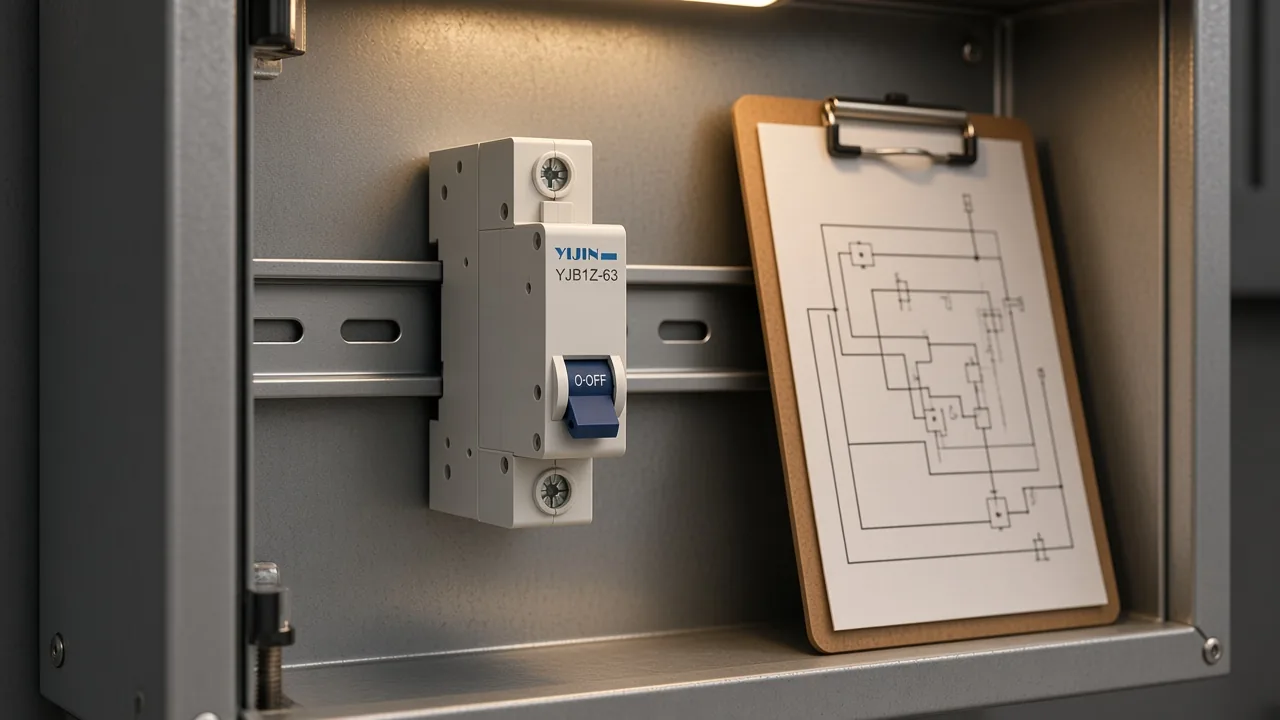
A wiring diagram shows devices as simple shapes and tries to place terminals where they sit on the hardware. A schematic diagram can be electrically true while the symbols float in an order that never matches the panel.
Hold the two sheets apart before you trace a wire. On a wiring diagram, the relative position of a breaker, a bus, and a load is part of the message. On a schematic diagram, that same breaker may sit in a corner because the draftsperson wanted a clean symbol, not a map of the enclosure.
A DC breaker wiring diagram still has to name a DC device. Direct current does not give the arc a current zero every half cycle, which is why a circuit breaker built for DC is a different object from a household AC frame that happens to look similar.
The drawing can show that object. It cannot invent the interrupting job by the thickness of a line.
Three things belong on this kind of sheet, and three things usually do not.
- Belong: device identity, terminal arrangement, and the path of each conductor the author chose to draw.
- Usually absent: a torque figure, a code article, and a promise that any breaker with the same pole count will accept the picture.
- Easy to confuse: a single-line sketch, where one stroke stands for a whole circuit, versus a multi-line sketch, where each conductor has its own stroke.
When a colleague sends “the dc circuit breaker wiring diagram” as a PDF with no title block, ask which of those three drawings you received. The file name is not the document type.
Read the legend before the lines
Read the legend on that sheet before you follow a line. A dashed stroke between poles is a mechanical tie on the handle, not a copper path, unless the legend says otherwise.
Most generic sheets reuse a small set of marks. The trouble starts when a reader imports the meaning from a different manufacturer’s PDF. The legend on the page in your hand wins, even when a blog diagram uses the same squiggle for something else.
| Mark on the sheet | What you can read | What you still need from the device |
|---|---|---|
| Legend key | How this drawing defines its own symbols | Whether the breaker face uses the same marks |
| 1P or 2P tag | How many poles the author claims | Whether each pole is a switched conductor or a series gap |
| Dashed link between poles | Poles that move together | Nothing about current direction |
| Arrow or the words line and load | The supply side and the downstream side as this sheet labels them | The marks actually printed on the breaker |
| Plus or minus | A polarity mark the author chose to print | The + and − sentence on the product page, if it has one |
| Color note | Conductor color only when the legend defines it | Do not import a color habit from another job |
The symbol-shape guides that rank beside this query make the same split. Pole count, the device tag, and the ratings note finish the identification. A rectangle with a toggle is not, by itself, a DC breaker.
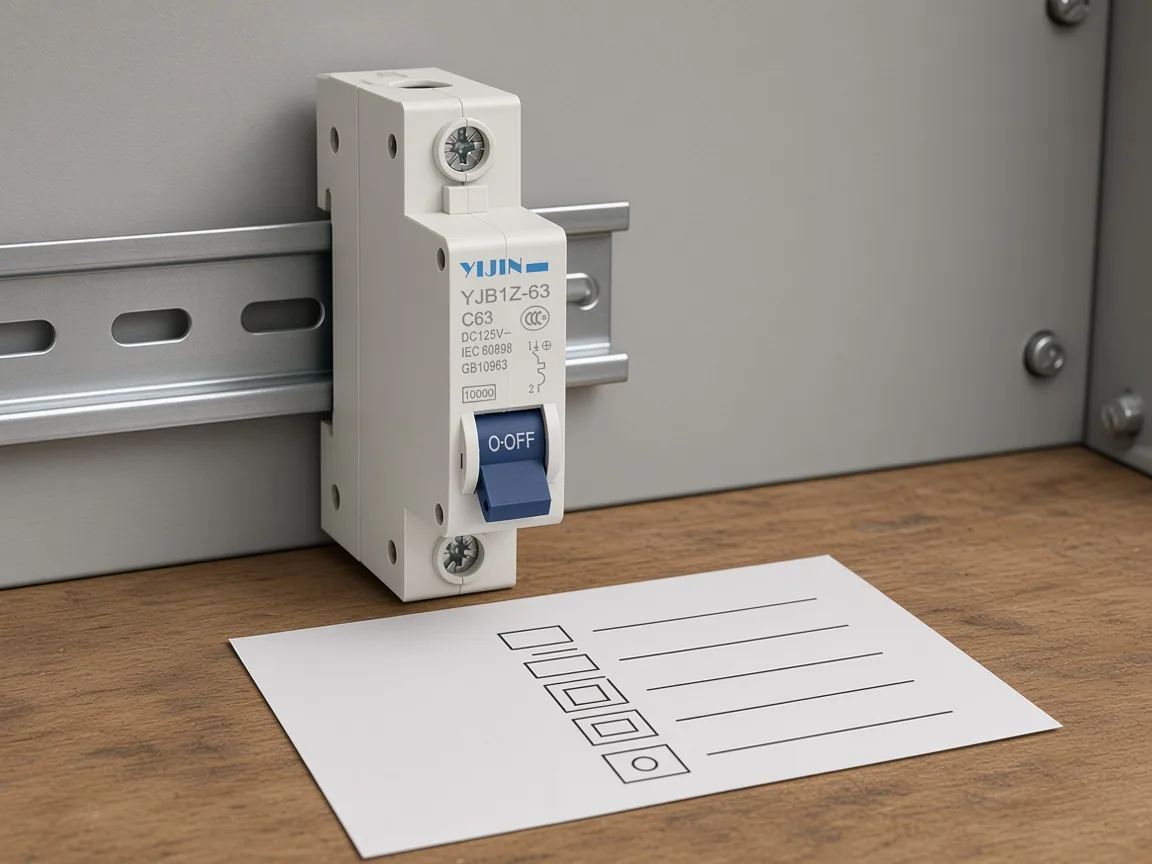
If the legend is missing, you do not have a finished reading. You have a picture. Park the landing work until someone produces the key, or until the breaker face itself carries the only marks you are willing to trust.
Count conductors on the drawing
Count the conductors the drawing routes. A title that says 2 pole dc circuit breaker wiring diagram can mean two wires, positive and negative, or two poles stacked on one conductor, and only that sheet can say which.
Start with the strokes, not the pole badge.
- Mark every conductor that enters the breaker symbol and every conductor that leaves it.
- See whether a jumper on the drawing ties one pole’s outgoing side to the next pole’s incoming side. That jumper is a series path, not a second circuit.
- See whether the two poles each carry their own incoming and outgoing conductor, with no jumper between them. That is a two-wire path.
- On a single-line sheet, the pole tag is doing the counting for you, and you should say so out loud before you order hardware.
A one-pole symbol with a single in and a single out is a one-conductor interruption on the drawing. It does not tell you that the negative is grounded, bonded, or left solid. Those facts live in the system sketch around the breaker, or they are missing.
Series poles show up on higher-voltage DC sketches because each contact gap shares the voltage. Parallel conductors on one pole are a different drawing: two wires into one terminal, which a miniature breaker page may not allow.
When either arrangement is drawn, the note next to the jumper or the double wire is the instruction. The pole digit alone is not.
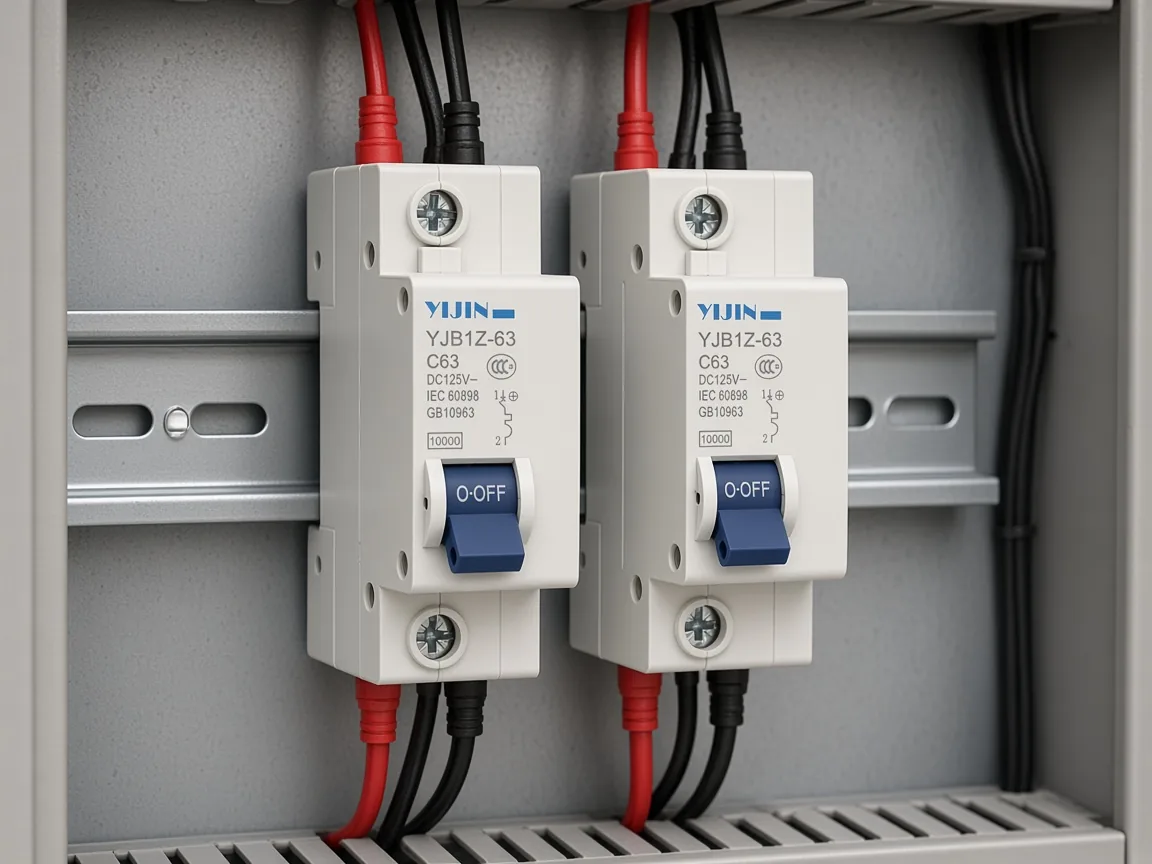
People searching a 2 pole dc circuit breaker wiring diagram often want the two-wire picture, because an ungrounded battery or PV pair needs both conductors opened together. Write that desire down, then check whether the PDF in the email is actually the series picture. They share a pole count and almost nothing else.
Find source marks and load marks
Find the words or arrows this sheet uses for the supply side and for the downstream side. Those labels are properties of the drawing. A remembered habit that “the top is always the source” is a different document, and it is not the one in your hand.
On protective-device commentary, supply and load are distinguished by arrows toward the device and arrows away from it, or by the words line and load placed at the terminals. A marking article aimed at electricians also notes that the wiring diagram may sit on the side of the device, or inside a cover you remove before the wires go on.
If your sheet has no arrow and no line/load words, it has not named a source terminal or a load terminal. Say that plainly and stop guessing from screw position.
A polarity mark is a second label, not a synonym. Plus and minus tell you which conductor the author called positive.
Line and load tell you which side the author called the supply. Some drawings print both. Some print one.
A sheet that prints only plus and minus has not identified the source terminal, and a sheet that prints only line and load has not identified polarity.
The sibling article on DC MCB wiring diagram marks walks through the mix-ups that follow when those two label families get swapped. This page stays on the prior step: can you point at the label, and is it on this sheet?
Battery circuits make the labels feel slippery because current reverses when the battery charges. The drawing either shows one direction, shows two, or stays silent.
A silent drawing does not become a bidirectional rating. If the author drew a single arrow, that arrow is the only direction the sheet claims.
Stop where the drawing stops
Stop at the last printed line. That line ends the instruction. Anything past that line — a torque habit, a code citation, a terminal index from another brand — is a story you added.
Yijin’s small DC breaker pages show a named block that does not finish the job.
YJB1Z-63 is specified for circuits at 63A and below, and the scope sentence names a DC rated voltage of 250V and 440V.
The YJB1Z-63 pole table prints one pole at DC125V/220V and two poles at DC250V/440V.
Those two statements sit on the same page. The drawing, if you expected one, does not explain how they fit together, because the wiring-diagram heading is followed by empty space until the dimensions heading. There is no conductor path to trace and no screw index to copy.
From the field: “No. AC breakers are not designed to handle the sustained arc created by DC. Use a properly rated DC breaker.” — EEVblog discussion of an AC breaker on a DC circuit
That forum line is the right kind of stop. A symbol that could be any miniature breaker has not earned a DC identity. The sheet has to say DC, or the device face has to say DC, before the picture becomes a landing document.
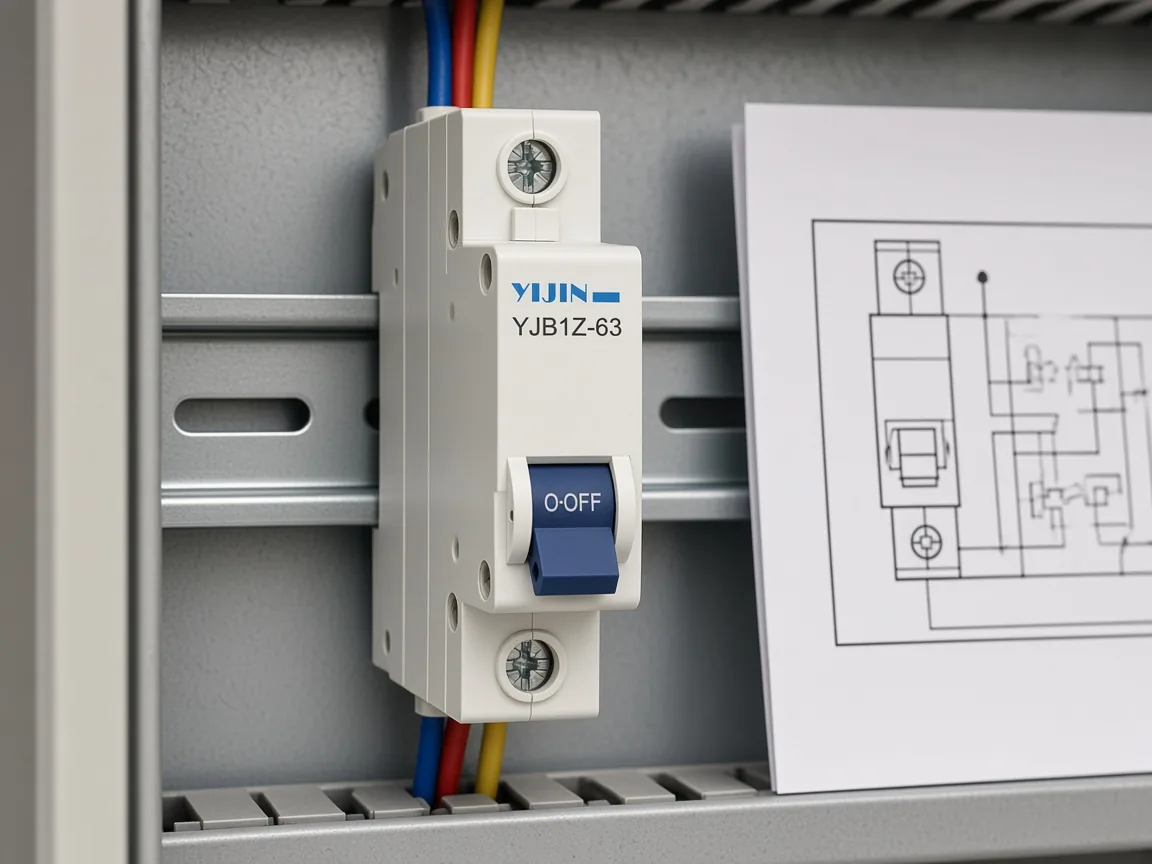
Use the margin as a checklist, not as a place to invent the missing rows.
- A missing current figure means you do not yet know which frame to hold up against it.
- A missing voltage figure means the pole table on a product page cannot be matched to a system voltage you have not been given.
- Without a polarity mark and without line/load words, the only marks you can compare are the ones printed on the breaker you are about to buy.
- Landing order, screw torque, and cable lugs belong to the install article that follows this one. They are not hiding in a blank diagram block.
The rendered search overview for this query includes a torque step. No Yijin DC page fetched for this article prints a torque value, so this pre-check does not supply one.
Which Yijin DC breaker product matches the sheet
Compare the sheet with the YJB1Z-63 small DC circuit breaker when the drawing is a small DIN-rail DC breaker and you need a page that actually prints a polarity mark.
That page tells you to watch the polarity of “+” and “−” when wiring, and it says the supply enters and leaves in line with that warning. That is a mark you can hold next to the sheet. It is not a schematic, and the page does not pretend to be one.
That page states a short circuit capacity of 10kA and names IEC60898-2.
The rail it names is TH35-7.5, and the mechanical life line says more than 20000 times. Use those lines as page facts beside the sheet. They still do not choose a cable size.
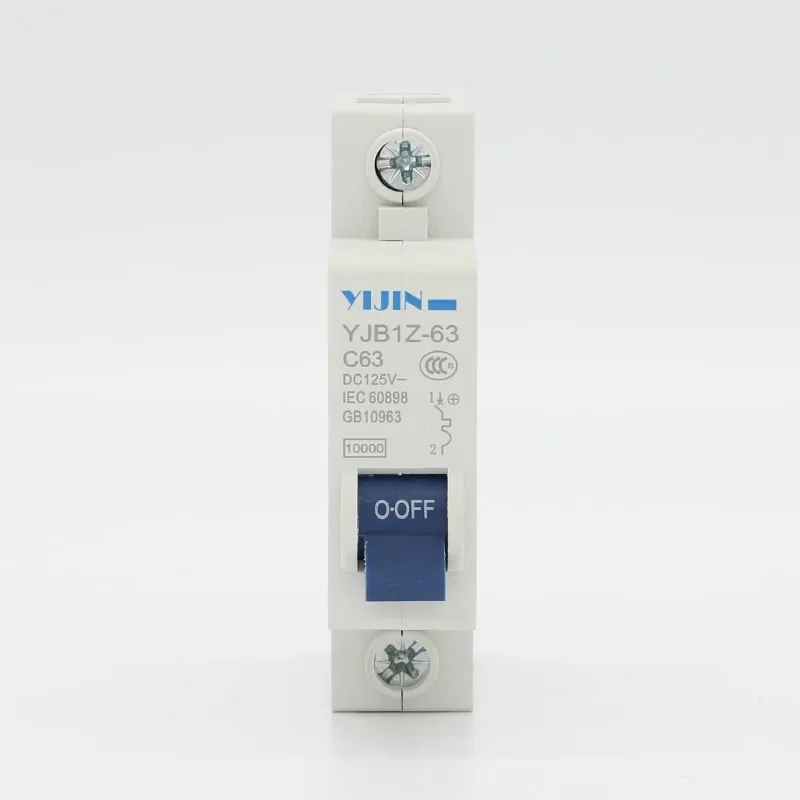
Move along the family when the sheet’s own figures no longer sit inside that first page.
| What the sheet is showing | Page to open | What that page gives you | What it still withholds |
|---|---|---|---|
| Small DIN-rail symbol, current inside the 63A scope sentence | YJB1Z-63 | + and − wiring warning, IEC60898-2, 10kA prose, empty diagram heading | No printed conductor path |
| Current above that 63A sentence, still a DIN-rail outline | YJB1Z-125 | + and − warning, IEC60947-2, its own pole table | Diagram heading likewise empty |
| Molded-case outline, or a voltage row in the 750V class | YJM1Z | Higher current and voltage rows, including a customization note | No polarity sentence and no diagram heading |
| WiFi, GQ, or RS485 frame from the same category | None of the three | Those listings are communication frames | They are outside this DC sheet |
YJB1Z-125 is specified for 125A and below, with a scope sentence of 220V and 440V, and it names IEC60947-2.
The YJB1Z-125 pole table prints one pole at DC125V/220V and two poles at DC250V/440V, and the features line states 10kA.
Open the YJB1Z-125 small DC circuit breaker when the sheet’s current has already left the first scope sentence and the symbol is still a DIN-rail miniature breaker. The polarity warning is there. The schematic is not.
YJM1Z is specified for a rated working voltage of 750V and below and a rated working current up to 800A.
The YJM1Z-100 row lists 250V, 440V, 550V, and 750V, with breaking figures printed as 10kA/20kA.
The YJM1Z plastic-shell DC circuit breaker is the page for that outline. Fetched text on that page does not include a + and − wiring sentence, so you cannot borrow the miniature-breaker warning and paste it onto the molded-case symbol.
The circuit breaker category also lists WiFi, GQ, and RS485 frames. Those pages are not substitutes when the sheet says DC. Leave them out of the comparison even though they share the category URL.
After the sheet and the page agree on device type, pole story, and the marks you can actually see, the landing sequence is a different article. This one ends when you can say what the drawing showed, what it refused to show, and which Yijin page you are holding up beside it.
FAQ
How do I connect a DC circuit breaker?
Connection order is the next article, not this one. Finish the sheet read first: document type, legend, conductor count, source and load labels, and the blank edge. Only then does a landing sequence have a drawing to follow.
Do DC circuit breakers work both ways?
YJB1Z-63 and YJB1Z-125 tell you to watch + and − polarity when wiring. They do not print a line that says current may reverse. If your battery both charges and discharges through the breaker, the sheet has to show that, or you are past what these two pages state.
What are the color codes for DC power circuit wiring?
Use a color only when the legend on your sheet defines it. A red stroke on someone else’s PDF is not a terminal identity. If the legend is silent, color is decoration and the polarity mark or the line/load words are the labels that count.
Is there a DC circuit breaker?
Yes. A DC breaker is built to open a current that does not pass through zero on its own. An AC miniature breaker, including the WiFi and RS485 frames listed beside Yijin’s DC models, is a different device even when the outline looks familiar.
Where does the load go on this DC circuit breaker?
On the terminal your sheet marks as load, outgoing, or with an arrow pointing away. Screw position on a photo is not a substitute label when those marks are missing.
Does an empty wiring-diagram block still tell me the terminals?
It tells you the page author reserved a heading. On YJB1Z-63 and YJB1Z-125 that heading has no schematic under it. You still have the + and − sentence, and you still need the sheet in your hand for conductor count and source or load labels.
References
- Wiring diagram, Wikipedia, on how a wiring diagram differs from a schematic.
- Circuit breaker, Wikipedia, on why a DC arc is continuous.
- Selecting protective devices when power can flow both ways, Professional Electrician, on line, load, and arrows.
- AC circuit breaker on a DC circuit, EEVblog forum, on the sustained-arc objection.