 Yueqing Yijin Electronics Co., Ltd.




A DC MCB Wiring Diagram Is a Read, Not a Landing Order
A dc mcb wiring diagram is a reading job first: the marks tell you polarity and direction, and a cable color does not.
Read the marks before you trust the jacket color. Plus and minus name the conductors. Line and load name which side is the source and which side is downstream.
A printed sheet can show both, one, or neither. Treating a catalog photo, a red jacket, or “top is always the source” as the sheet is how good breakers get landed wrong.
Next comes that miss, split into three different faults, then a look at which published Yijin DC page even belongs next to the sheet.
A diagram misread starts at the terminal marks
The first miss is treating a face number, a cable color, or a last-job habit as the diagram itself.
A circuit breaker interrupts excess current and can be reset, unlike a fuse that opens once and has to be replaced. That job is real. It still does not tell you which screw is the source.
Commercial pages that rank for this query say the sheet travels with the device, on the housing or in the pack, and that the last cabinet’s terminal layout is a poor teacher. Conventions move between families.
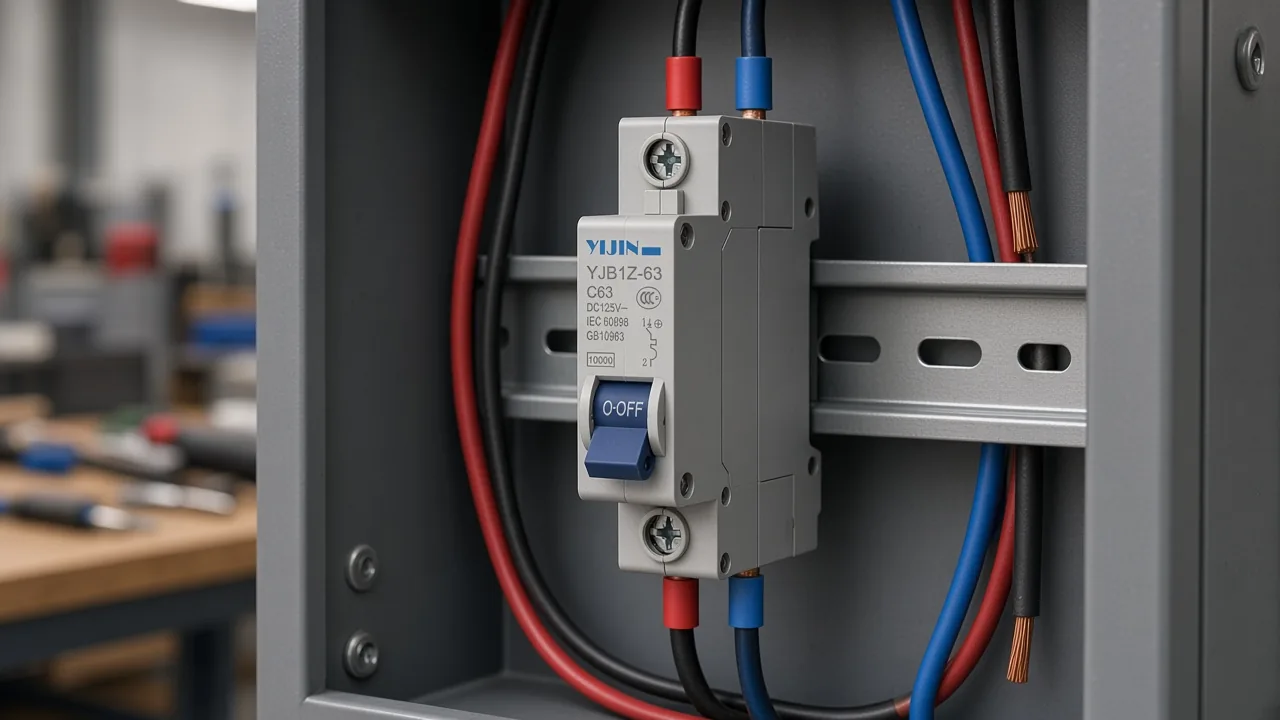
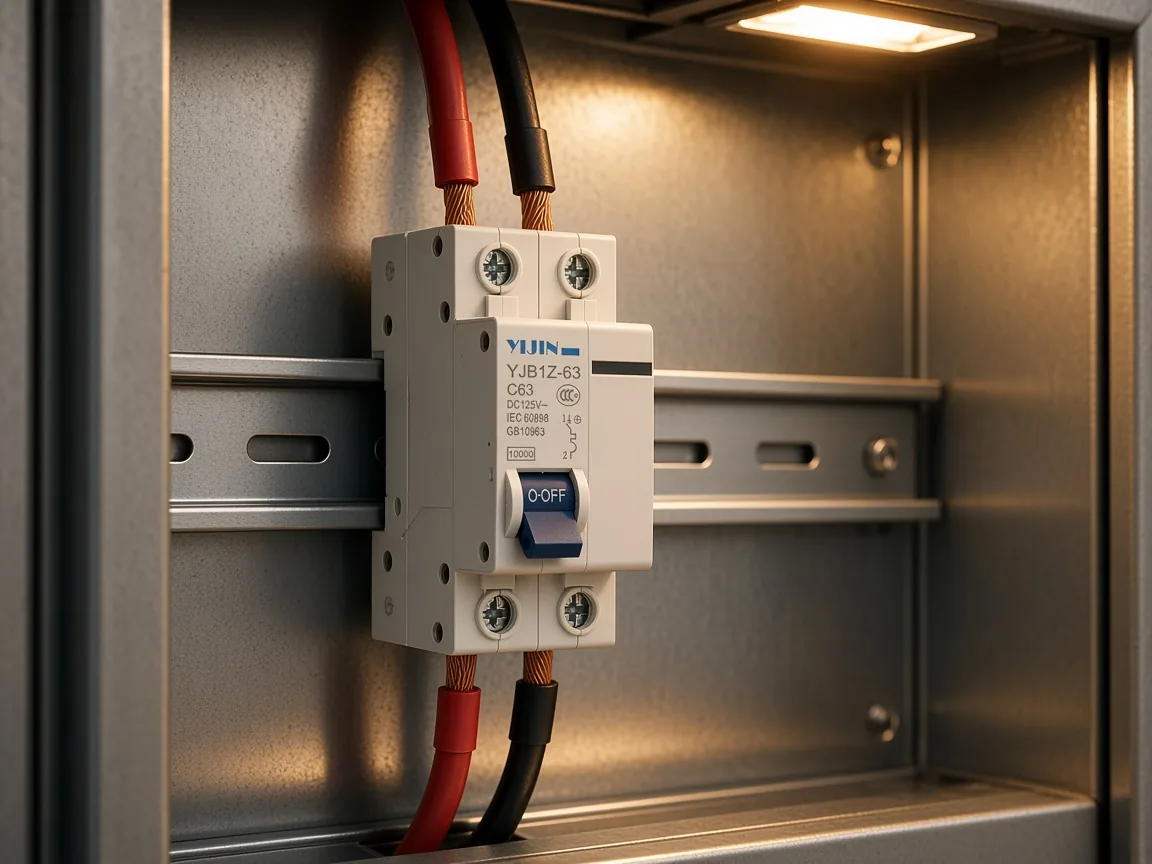
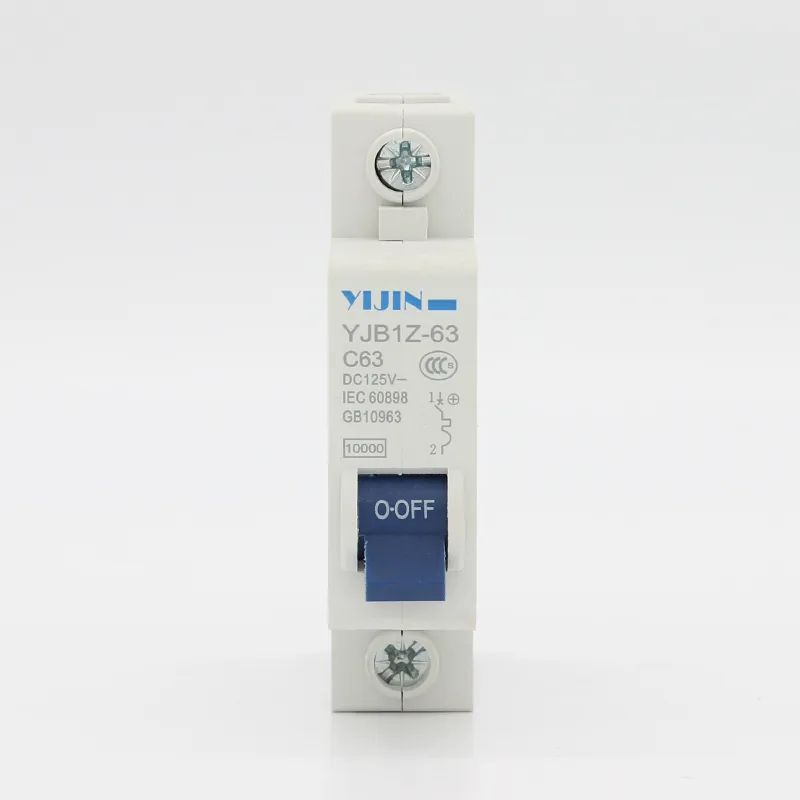
On the published YJB1Z-63 photo, the face is a single pole with screws marked 1 and 2. The published YJB1Z-63 photo shows a 1P face marked DC125V and C63, with terminals numbered 1 and 2. Those numbers are a view of one device.
They are not a series code that says “1 is the array and 2 is the inverter.” The product page beside that photo talks about plus and minus, and about the supply entering and leaving. A buyer who lands wires from the photo alone has skipped the sentence the page actually printed.
From the field: On a color-code thread, one electrician wrote that white has been landed on positive and black on negative, and a reply said colors confuse people — Electrician Talk.
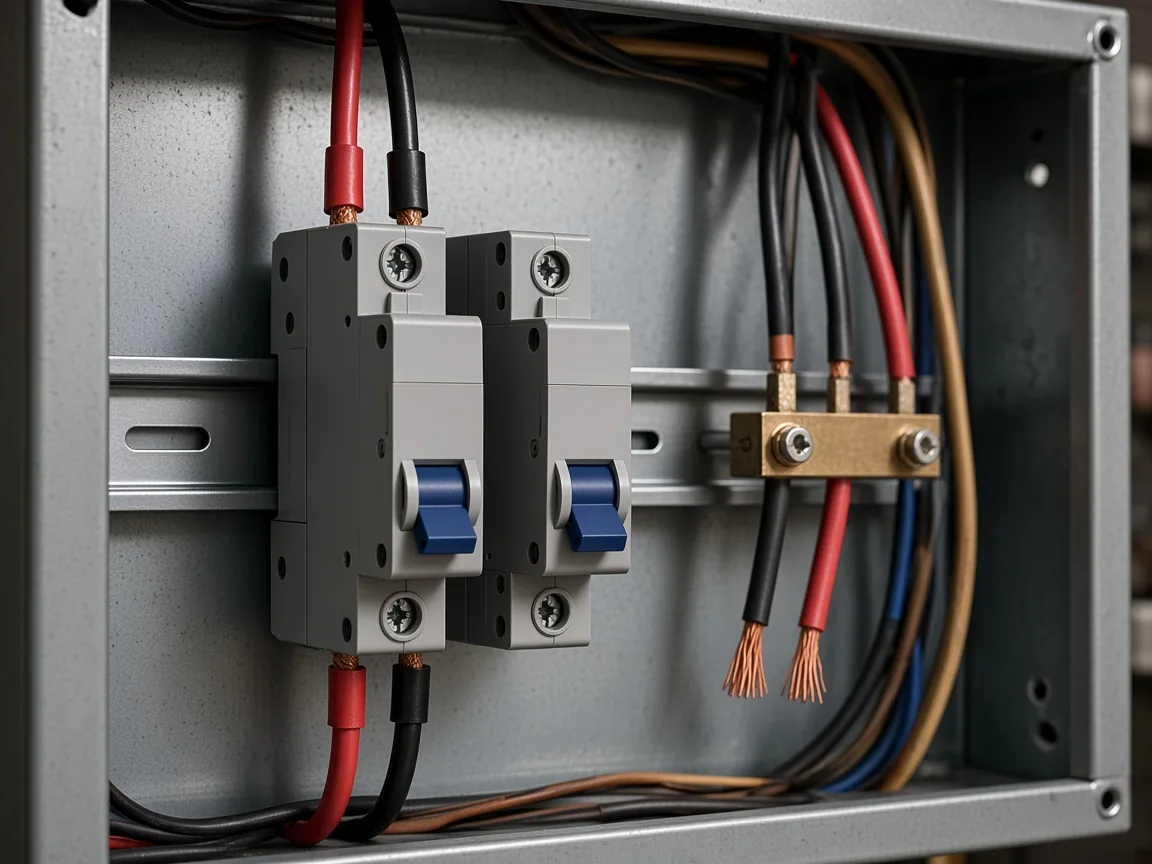
A 2-pole sheet makes the same miss bigger. Forum readers often expect one side to be positive in and out, and the other side to be negative in and out, then guess that the bottom is incoming because the drawing looks crowded there. Sometimes the sheet really is drawn that way.
Sometimes the two top terminals are a pair and the two bottom terminals are the other pair, with direction printed beside the toggle. The miss is deciding before the marks are read.
| What you are looking at | What it can mean | What it does not settle |
|---|---|---|
| Terminal numbers on a face | Which screw the factory numbered | Which conductor is the source |
| A red or black jacket | A shop or vehicle habit | Which terminal is positive |
| Top versus bottom | A common cabinet habit | Direction on this device |
| Plus and minus marks | Conductor polarity on this device | Whether the source must sit on top |
Plus and minus are not line and load
Plus names the conductor. A line terminal names the source side, and a load terminal names the downstream side. They can share a screw, or they can name two different facts on the same sheet.
Vendor explainers that rank for a dc circuit breaker wiring diagram often fold those marks together. One page says AC devices are labeled LINE and LOAD, while many DC miniature breakers are labeled only plus and minus. Another page treats LINE as the conductor from the source and LOAD as the conductor toward the inverter or the next device, and treats plus and minus as a separate notation.
Both pages are describing their own families. Neither page is a Yijin terminal map.
That split matters on a 2 pole dc circuit breaker wiring diagram. A 2-pole device can switch both conductors. It can also be drawn so that two poles sit in series on one conductor.
The sheet has to say which. Pole count on the face is not the drawing. If the only marks are plus and minus, you still have not been told which end is the source.
If the only marks are line and load, you still have not been told which conductor is positive.
Electricians already argue this on AC disconnects. One thread starts with a person who cut the load wires too short and landed the source on the bottom. A reply said that if the device itself is not marked line and load, it can be fed either way, and that line does not have to sit on top.
Useful as a warning against habit. Useless as a DC polarity rule. A polarized DC face can care about both the conductor and the direction even when an unmarked AC disconnect does not.
The Yijin small DC pages say the same practical thing in their own words: pay attention to plus and minus when wiring, and the supply enters and leaves. They do not say “top is always line” and they do not say “plus is always the upper screw.” Read the sheet that shipped with the unit you are holding. If that sheet is missing, stop.
A lookalike drawing from another brand is how the marks get swapped.
Reversed polarity is not a source and load swap
Swapping the positive and negative conductors is a different miss from feeding the load end from the source.
Call the first one a polarity reversal. The plus conductor sits on the minus terminal, or the other way around. Call the second one a source and load swap.
Current is asked to enter the end the sheet marked for the downstream side. You can make both mistakes on one landing, or only one. A person who “fixed” the colors and left the source on the load end has fixed one miss and kept the other.
Commercial DC MCB pages warn that a reversed connection can leave the device unable to cut the fault and quench the arc. That is their warning, about their magnetic blow-out. Yijin’s pages do not publish a bench story.
They do print the polarity sentence, and they describe a permanent-magnet arc system on the small DC breakers. Treat the sentence as required reading. Do not invent a failure video the pages do not have.
Direction also answers the battery question that keeps showing up under this query. A string that only feeds an inverter is one-way in normal operation. A battery that both charges and discharges is not.
Pages that discuss bidirectional current say a polarized device, aimed for one direction, is the wrong read when the sheet shows current that can come back. Yijin’s published DC pages do not say the breaker is bidirectional. If your sheet is a charge-and-discharge path, the page’s polarity sentence is not a silent yes.
The dc breaker input and output question is this section in shorter clothes. Input is the source end if the sheet uses that word. Output is the downstream end.
Some sheets say IN and OUT. Some say LINE and LOAD. Some only print arrows.
Match the word on the sheet to the end of the device the sheet points at. A synonym from the last job is how input and output get swapped while the colors still look tidy.
A series string diagram is not a parallel combiner
A series sheet adds voltage on one current. A combiner sheet adds current at one voltage. Landing one as if it were the other changes what the breaker is being asked to sit in.
A series circuit keeps the same current through each piece and adds the voltages. A parallel circuit keeps the same voltage across each branch and adds the currents. That is network language, not a Yijin jumper chart.
It is still the right test for a drawing labeled “string” or “combiner.”
A photovoltaic system is the wider job: panels, cabling, an inverter that turns the DC output into alternating current, and the other electrical accessories that make the system work. The array is the panels. It is not the breaker, the combiner bus, or the inverter input.
A drawing that only shows modules in a line is a voltage stack. A drawing that brings several of those lines onto a bus is a current sum. The breaker symbol may look similar in both.
The topology does not.
Vendor sheets get specific here in ways a general article should not copy onto Yijin. Some families raise the voltage rating by wiring poles in series with a jumper, and the label’s higher voltage applies only in that arrangement. Some mark a default entry and an optional entry.
Yijin’s small DC pages say the supply enters and leaves, and they note that certain pole-and-voltage combinations are customized. They do not print an external jumper map in the text this package reviewed. If your sheet shows a jumper between poles, that instruction lives on the sheet and the unit’s own diagram, not on a neighboring brand’s catalog.
The drawing does not pick the breaker for you
A drawing shows a connection idea. It does not change the current, the DC voltage, or the pole count printed for the device you buy.
That limit is easy to skip because a tidy diagram feels like a specification. It is a picture of an idea of a landing. The device still has to match the circuit the picture is pretending to protect.
A sheet that shows a high-current bus and a high string voltage is not a license to offer the smallest miniature page. A sheet that shows a WiFi-looking icon is not a reason to grab a communication breaker from the same category and call it the DC MCB. The live category now lists more than the three DC-rated pages.
Those extra listings are a different product conversation.
The sibling question — whether a DC-rated face can be dropped onto an AC circuit — lives on its own page. Nameplate DC marks are the short version here. If the drawing never shows a DC voltage, you are in the wrong article.
Which Yijin DC breaker fits after the diagram read
Match the sheet’s current and DC voltage to a published page, then still obey that page’s plus-and-minus sentence.
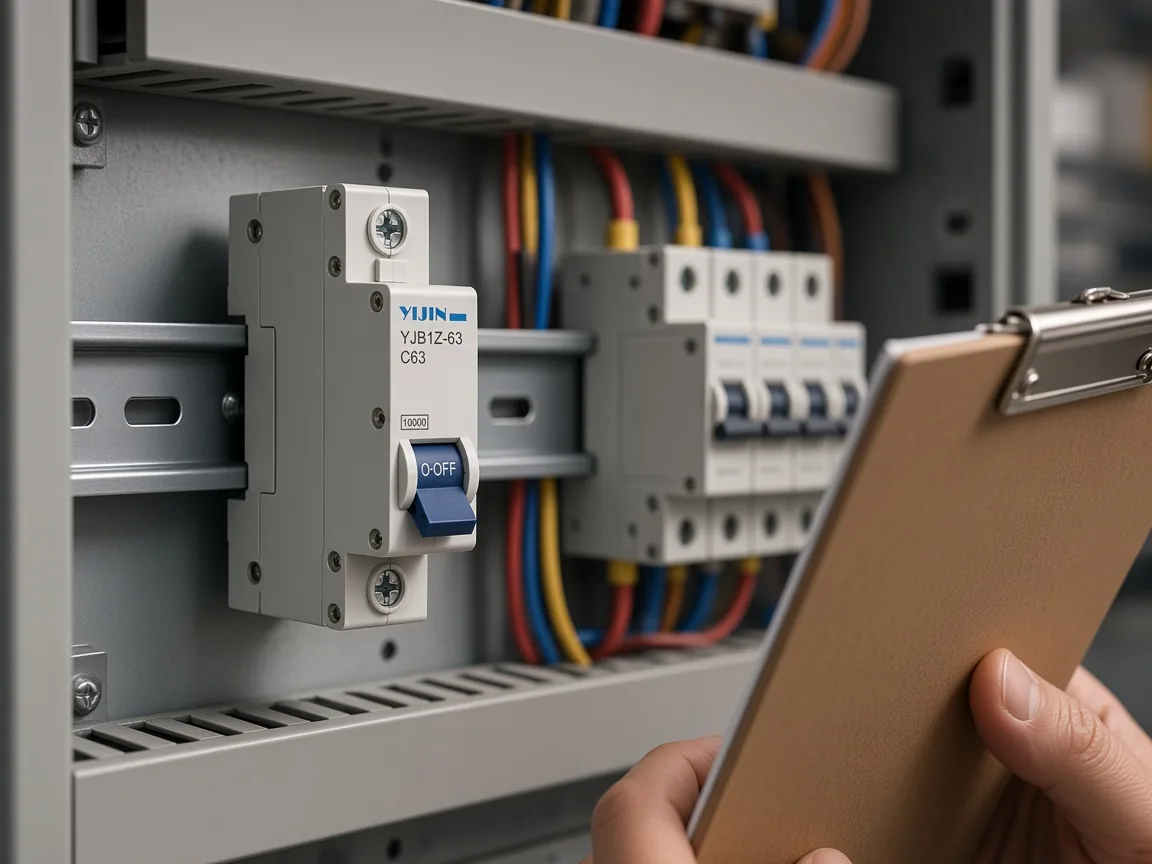
The YJB1Z-63 page states a rated current of 63A and below, with DC rated voltage of 250V and 440V. That page cites GB10963.2 and IEC60898-2, a short-circuit capacity of 10KA, and a mechanical life of more than 20000 times. The YJB1Z-63 page notes that 1P DC220V and 2P DC440V need to be customized.
For a sheet inside those current and voltage statements, the YJB1Z-63 small DC circuit breaker is the page to read next. Rail is the TH35-7.5 form the page names. Handle on the front, overload and short-circuit interruption, supply in and supply out.
The YJB1Z-125 page states a rated current of 125A and below and a DC rated voltage of 220V and 440V. The 125A page cites IEC60947-2 and GB14048.2 and states a short-circuit capacity of 10KA. Currents named on that page are 63A, 80A, 100A, and 125A.
If the sheet is already above 63A and still inside that 125A statement, move to the YJB1Z-125 small DC circuit breaker instead of squeezing the smaller page. The polarity sentence is the same idea: plus and minus, supply in, supply out.
The YJM1Z page states a rated working voltage of DC750V and below and a rated working current up to 800A. The YJM1Z environment note is an altitude of 2000m and below, with surrounding air not lower than -5°C and not higher than +40°C. Above that temperature the page says to use the breaker at reduced capacity.
The page also notes that DC750V needs to be customized. That is the molded-case conversation, not a miniature-face conversation. The YJM1Z plastic-shell DC circuit breaker is the page for those frames.
| Published page | Current the page states | DC voltage the page states | Wiring sentence on the page |
|---|---|---|---|
| YJB1Z-63 | 63A and below | 250V and 440V | Plus and minus; supply enters and leaves |
| YJB1Z-125 | 125A and below | 220V and 440V | Plus and minus; supply enters and leaves |
| YJM1Z | up to 800A | DC750V and below | Molded-case frames; DC750V needs customization |
None of those pages is a substitute for the diagram that shipped with the unit. If the sheet’s current sits above the page, or the voltage is a customized combination the page flags, pick the other page or stop. A pretty landing sketch does not widen the nameplate.
The rest of the circuit breaker range is the hub for these DC pages. If the real argument is whether a DC face can be used on an AC circuit, that is a different question on the AC and DC rating page. Panel jobs that sit in a solar or storage layout can sit next to the new-energy application page, still with the diagram in hand.
When the sheet is a DC circuit at or below 63A, inside the 250V and 440V statement, the YJB1Z-63 page is the honest next read.
Leave that page alone when the current is higher or the frame is a molded case.
In every case the last check is the same: the plus mark, the minus mark, and the end the sheet calls the source.
FAQ
Can an ordinary MCB be used on a DC circuit?
Only if that device’s own marks say so. A drawing of a DC string does not turn an unmarked AC face into a DC breaker. The rating question is covered on the sibling page; this one stays on the marks.
What does a 2-pole DC MCB actually switch?
It depends on the sheet. Two poles can each carry one conductor, or the drawing can put poles in series on one conductor. Count the poles, then read which arrangement the diagram actually draws.
Do wire colors tell you which terminal is positive?
No. Workshop habits disagree, including cases where white was used as positive and black as negative. The terminal mark and the sheet win over the jacket color.
How can you tell an AC MCB from a DC MCB on a drawing?
Look for a DC voltage and polarity or direction marks on the symbol or the device it points at. An AC-style line drawing with no DC voltage is not a DC MCB diagram just because someone added a solar icon.
Does it matter which conductor lands on a 2-pole breaker?
Yes, when the sheet marks polarity or direction. A 2-pole body has more screws, which makes a swapped pair easier to hide. The extra pole is not permission to pick a convenient side.
Do DC circuit breakers work in both directions?
Some families are described as bidirectional. The Yijin DC pages reviewed here do not say that. A sheet with current that can return needs a device whose own diagram allows that return.
Why does the published YJB1Z-63 photo show terminals 1 and 2?
Because that photo is one 1P face. The numbers locate the screws. The page text is where plus, minus, and supply-in and supply-out are stated.
Use both, and do not promote the photo into a string layout.
References
- Circuit breaker — what a breaker does, and how that differs from a fuse.
- Series and parallel circuits — why a voltage stack and a current sum are different drawings.
- Photovoltaic system — panels, cabling, and the inverter as separate parts of the system.
- Reversing line and load on a breaker disconnect — why a top-feed habit is not a mark.
- White wire used as DC positive — why jacket color is a poor stand-in for polarity.