 Yueqing Yijin Electronics Co., Ltd.



Arc Fault Circuit Interrupter vs Ground Fault Circuit Interrupter: Which Hazard Each Stops
An arc fault circuit interrupter vs ground fault circuit interrupter decision is really a hazard decision: AFCI protection watches for dangerous arcing that can start fires, while GFCI protection watches for leakage that can shock people. They are not interchangeable, and modern dwelling practice often requires both on the same circuit. This guide maps the contrast, dual function AFCI GFCI options, combination AFCI vs GFCI mix-ups, and how an AFDD DIN rail path from Yijin relates without inventing US panel listings.
What Each Interrupter Stops: Arc Fault vs Ground Fault
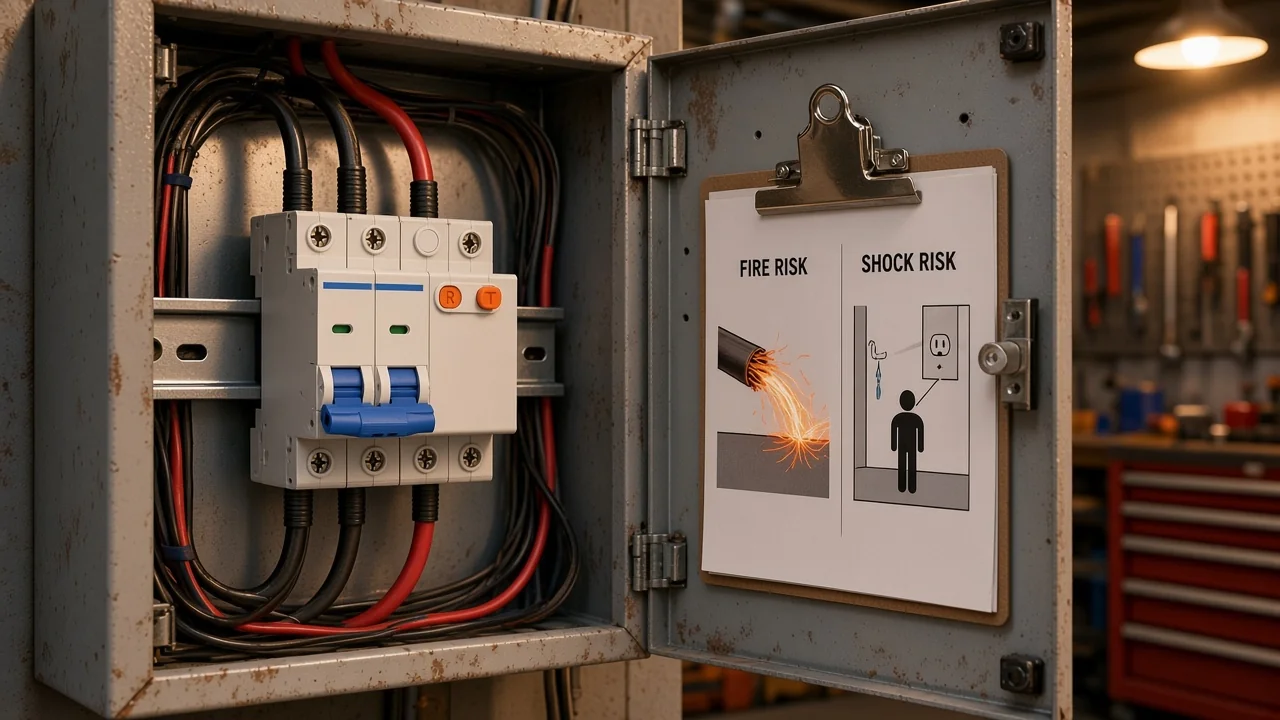
AFCI targets dangerous arcing; GFCI targets leakage that can shock people.
An arc-fault circuit interrupter (AFCI)—also called an arc-fault detection device (AFDD) in some regions—opens the circuit when it sees electrical arcs that look like loose connections, damaged cords, or aging insulation rather than normal switching sparks. Ordinary overcurrent breakers are built for overloads and short circuits. Many damaging arcs stay below those trip thresholds, so the fire risk can grow while the standard breaker stays closed.
A ground-fault circuit interrupter (GFCI) is the North American name for a residual current / earth-leakage interrupter. It compares current leaving on the line conductor with current returning on the neutral. If those currents are unequal, some current is taking an unintended path—often through a person, water, or grounded metal—and the device opens quickly to reduce shock injury.
AFCI designs watch both series and parallel arc patterns. That arc-family coverage is why “combination AFCI” language appears in product catalogs.
| Protection | Watches for | Primary risk it reduces | Common US form factors |
|---|---|---|---|
| AFCI | Dangerous series/parallel arc signatures | Electrical fire from arcing faults | Branch-panel breaker; AFCI receptacle |
| GFCI | Line/neutral imbalance (residual current) | Electric shock in wet or damp use | GFCI receptacle; GFCI breaker |
| Dual-function | Both arc and Class A ground-fault jobs | Fire + shock on one circuit | Dual-function breaker or receptacle |
That is why “AFCI or GFCI?” is usually the wrong first question. Ask which hazard the circuit presents, then decide whether one device or two protections are required.
Where US Practice Usually Requires AFCI vs GFCI
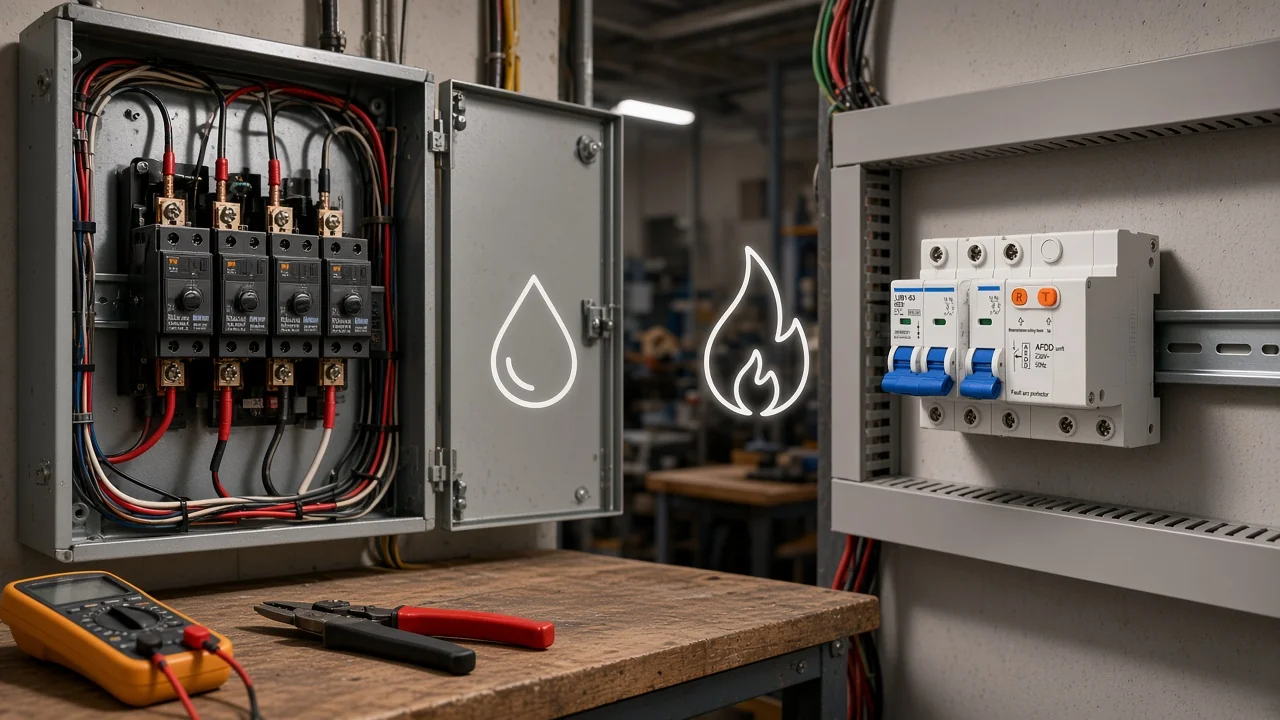
Living-space arc-fault rules and wet-area shock rules often point to different devices—and sometimes both.
In US practice, AFCI protection expanded from early bedroom outlet requirements into many dwelling living spaces such as bedrooms, living rooms, hallways, and similar areas, with later cycles adding more locations. GFCI protection is the familiar answer near water and damp work: bathrooms, kitchens, garages, outdoors, unfinished basements, and similar wet-adjacent places.
Exact lists belong to the National Electrical Code edition your local authority having jurisdiction (AHJ) adopts. That code framework lives under NFPA 70, so treat education summaries as orientation, not a substitute for the local code book.
| Reader decision | Typical AFCI emphasis | Typical GFCI emphasis | Often need both? |
|---|---|---|---|
| Bedroom receptacle circuit | Yes | Usually no, unless a wet bar / outdoor tap is added | Sometimes |
| Bathroom receptacle | Usually no (unless your adopted cycle says otherwise) | Yes | Rarely both on the bathroom circuit alone |
| Kitchen counter / laundry | Often yes under modern cycles | Yes | Frequently |
| Outdoor receptacle fed from a living-space branch | Parent branch may already be AFCI | Yes at the outdoor point | Yes in practice |
Procurement readers should also keep form factor separate from hazard. A US load-center AFCI/GFCI breaker and a DIN-rail AFDD-style module can both talk about “arc fault,” but they are different purchase and install classes.
When You Need Both—and How Dual-Function Devices Fit
One does not cancel the other; dual-function or stacked devices cover circuits that need both jobs.
Inspection and trade education are consistent on this point: AFCI and GFCI serve different purposes, so installing one does not cancel the need for the other where both hazards exist. Kitchens and laundry rooms are the everyday examples. A wet-bar receptacle in a family room, or an outdoor receptacle jumped from a bedroom circuit, creates the same overlap in the field.
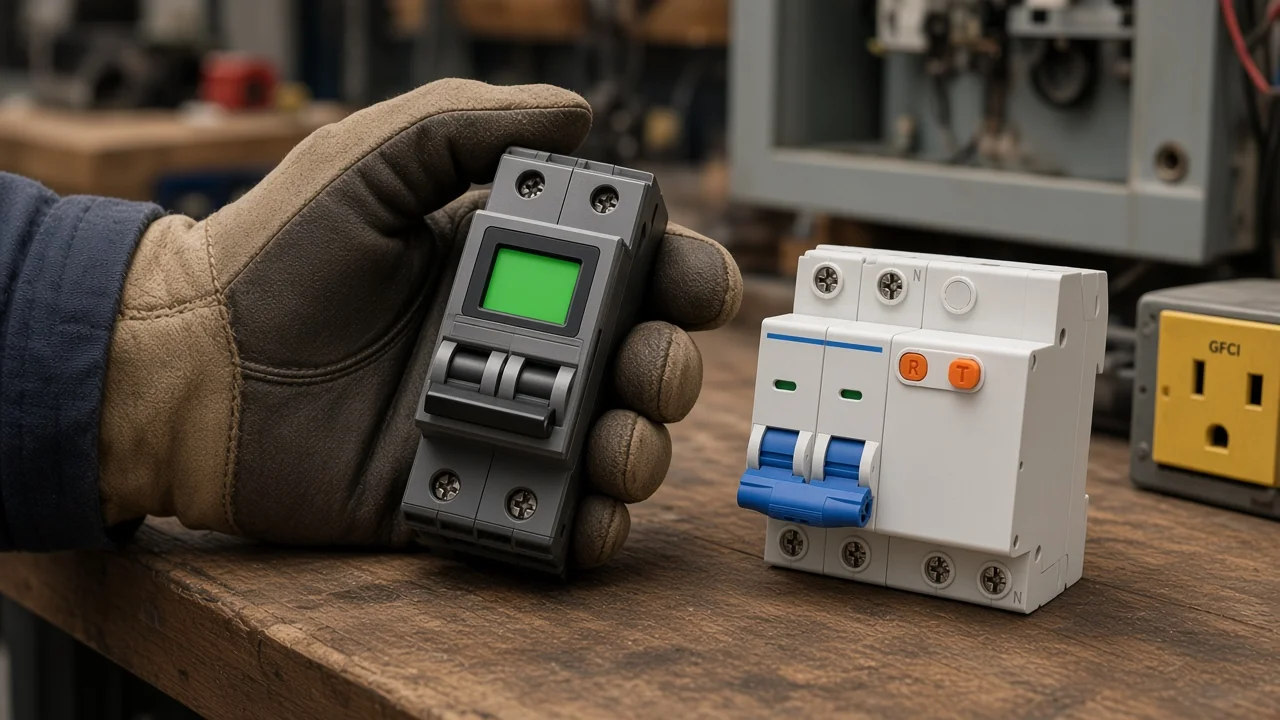
There are two common ways to finish that job on a US branch circuit:
- Dual-function AFCI/GFCI breaker or receptacle — one listed device that packages both protections for circuits that need both.
- Stacked devices — for example an AFCI breaker at the panel plus a GFCI receptacle at the wet location. Trade-forum consensus is that this arrangement can function; order and accessibility still have to satisfy the adopted code and the inspector.
Dual-function is often the tidy panel solution, but it is a packaging choice, not a mystical third hazard class. If only one hazard applies, buying dual-function “just in case” is a cost decision, not a substitute for reading the circuit’s actual requirements.
Why Combination AFCI Is Not Class A GFCI
Combination AFCI describes arc-detection coverage, not automatic bathroom-grade shock protection.
This is the mix-up that wastes the most money. In AFCI product language, “combination” usually means the device covers more than one arc-fault family (series and parallel detection), not “this breaker already finished your GFCI job”.
Field electricians routinely warn that many AFCI designs include a coarser ground-fault equipment protection element—often discussed around roughly 30 mA—while Class A GFCI personnel protection is discussed around roughly 5 mA. Those are different thresholds for different jobs.
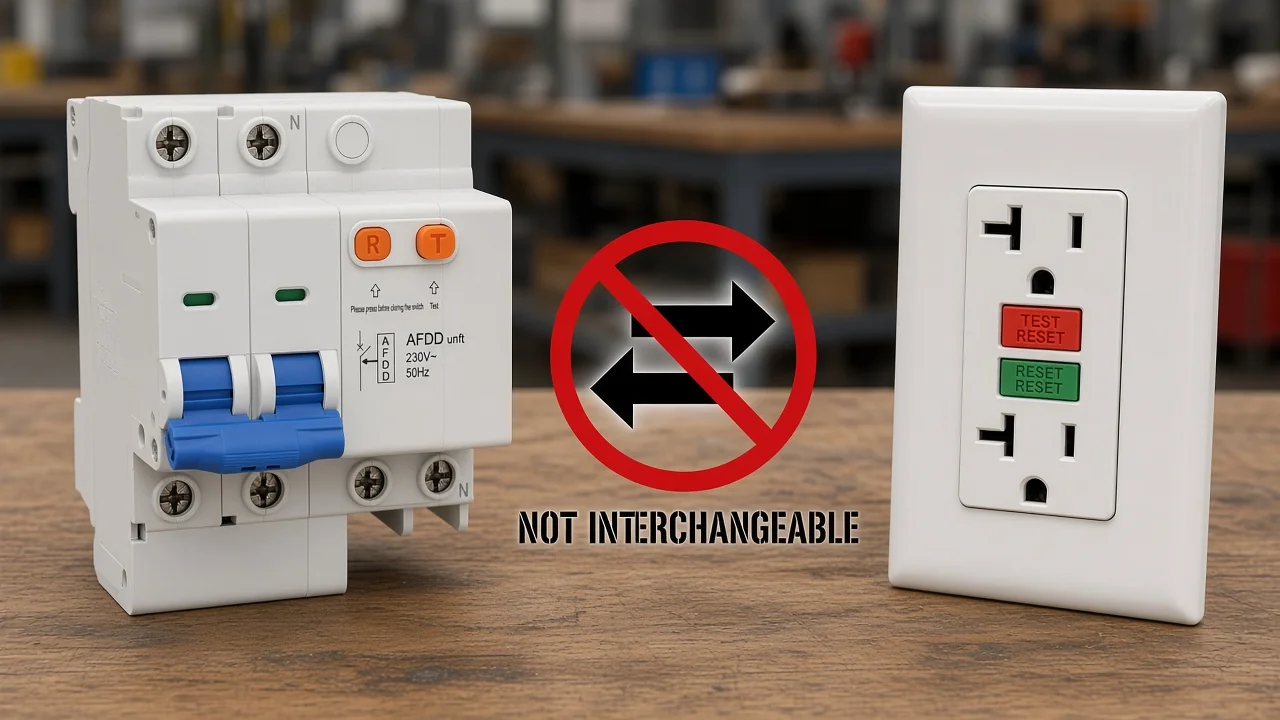
Important: Do not skip a required bathroom or kitchen GFCI because the panel already has a combination AFCI. If the circuit needs shock protection at Class A levels, specify a GFCI device or a dual-function AFCI/GFCI listed for that job. — source: https://forums.mikeholt.com/threads/putting-a-gfi-rec-on-an-arc-fault-circuit.88620/
The same logic blocks the PAA shortcut “Can I use AFCI instead of GFCI in the bathroom?” AFCI does not finish the wet-location shock job. Conversely, a GFCI does not finish the arc-fault fire job in spaces that require AFCI.
How Yijin DIN-Rail AFD Products Map to This Comparison
YJB1-63/AFD (and the leakage variant) are rail AFDD-style products per page facts—not evidenced as UL panel AFCI/GFCI.
After the US SERP comparison, buyers land on Yijin’s site and meet a different hardware class. The AFCI/AFD cluster maps to the Others category. Live product pages describe DIN-rail AFDD-style devices and a separate detector—not US branch-panel AFCI/GFCI breakers with UL 1699 or UL 943 listing language.
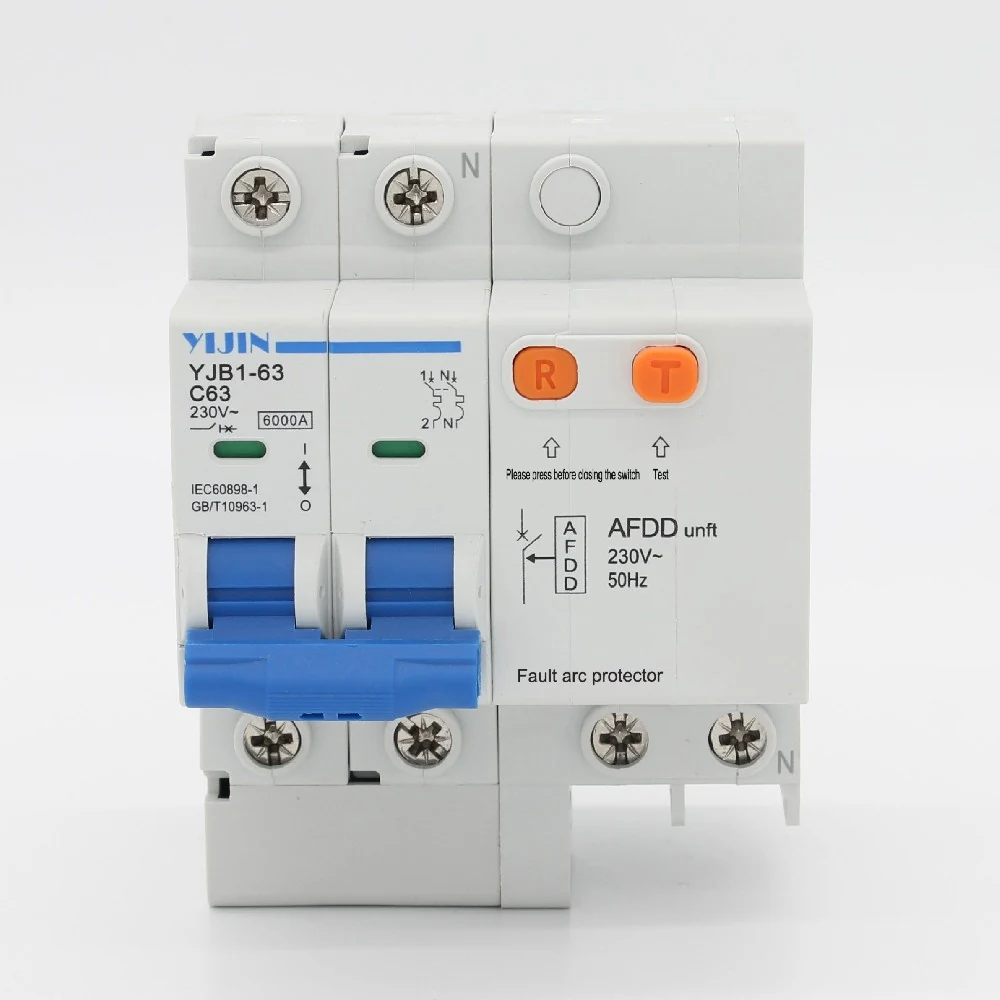
For a DIN-rail arc-fault specification that matches the published page, start with the YJB1-63/AFD arc fault circuit breaker. The page describes an AFDD assembled from a small circuit breaker and an arc-fault module, with overload, short-circuit, and arc-fault protection for AC 50 Hz, 230 V circuits with rated current up to 63 A, series and parallel arc protection, standard rail installation, and GB/T31143 as the cited standard.
If the rail job also needs leakage monitoring, the sibling YJB1-63/AFD Circuit Breaker with Leakage Arc Fault adds leakage monitoring / leakage protection language and a leakage test window on the same AFDD-style platform. That is still a first-party page description—not a claim that the SKU is a UL Listed Class A GFCI for US dwelling bathrooms.
If the job is monitoring and alarm rather than a rail interrupter, the YJ-AFD-SMG Fault Arc Detector is an independent fault-arc fire detector citing GB14287.4-2014, with audible/visual alarm and monitoring communication. It is not a US panel AFCI or GFCI breaker.
Tip: Keep the purchase paths separate. — source: https://yijinele-group.com/product/yjb1-63-afd-arc-fault-circuit-breaker/
Listed US AFCI/GFCI devices answer US branch-panel code language. Yijin’s published AFD pages answer DIN-rail AFDD-style and detector specifications. Do not invent UL 1699 or UL 943 listings that the product pages do not state.
Specifier Checklist: US Panel Path vs DIN-Rail AFD Path
Choose listed US AFCI/GFCI when that is the job; choose DIN-rail AFD when the specification is rail AFDD-style hardware.
Use this short checklist before you treat any SKU as the answer to an AFCI-vs-GFCI search:
- Name the hazard. Fire-oriented arcing, shock-oriented leakage, or both?
- Name the adopted code path. Which National Electrical Code cycle does the AHJ enforce, and which rooms/outlets are in scope?
- Name the form factor. US load-center breaker/receptacle, or DIN-rail distribution hardware?
- Reject false equivalents. Combination AFCI ≠ automatic Class A GFCI; GFCI ≠ AFCI.
- If both hazards apply on a US branch, plan dual-function or stacked listed devices—not a single-hazard compromise.
- If the specification is DIN-rail AFDD-style, evaluate YJB1-63/AFD (or the leakage sibling) against published ratings, and keep the Others hub as the category entry—without claiming US panel AFCI/GFCI listing.
That checklist is the whole comparison in practice: match the hazard, then match the hardware class.
FAQ
Do I need both AFCI and GFCI protection?
Sometimes yes. When a circuit presents both arc-fault fire risk and ground-fault shock risk—common in kitchens, laundry, and some living-space circuits with wet taps—you need both protections. One device type does not cancel the other.
Are ground fault and arc fault the same?
No. An arc fault is unintended arcing that can ignite nearby materials.
A ground fault is current leaving the intended conductors, often through a person or grounded path. Different physics, different interrupters.
Can I use AFCI instead of GFCI in a bathroom?
No. Bathroom receptacles need shock protection. A combination AFCI in the panel does not automatically provide Class A GFCI protection for that wet-location job.
Can I put a GFCI on an arc-fault breaker?
Yes, stacking is a common field approach when both protections are required—for example an AFCI breaker feeding a GFCI receptacle at a wet location. Follow the adopted code, manufacturer instructions, and inspector expectations.
What is a dual-function AFCI/GFCI breaker?
It is a single listed device that provides both arc-fault and Class A ground-fault protection. It is useful when a circuit needs both jobs and you want one panel device instead of separate AFCI and GFCI hardware.
Does “combination AFCI” mean I already have GFCI?
Usually no. “Combination” refers to arc-detection coverage (series and parallel families). Many AFCI designs include coarser ground-fault equipment protection that is not the same as required Class A GFCI.
How does a DIN-rail AFD product relate to US AFCI/GFCI language?
AFCI and AFDD name related arc-fault jobs under different market languages. Yijin’s live AFD pages describe DIN-rail AFDD-style hardware (and a separate detector) with published voltage, current, and GB standards. That is a different purchase path from listed US branch-panel AFCI/GFCI devices.
Is YJ-AFD-SMG an AFCI breaker?
No. The page presents YJ-AFD-SMG as an independent fault-arc fire detector with alarm and monitoring functions, not as a US panel AFCI or GFCI breaker.
References
- Wikipedia: Arc-fault circuit interrupter overview
- Residual-current device (GFCI naming) — Wikipedia
- NEC / NFPA electrical code development home
- AFCI vs GFCI Protection — New York Electrical Inspection Agency
- Putting a GFI receptacle on an arc-fault circuit — Mike Holt’s Forum
- Dual Function Breaker Requirements — Mike Holt’s Forum