 Yueqing Yijin Electronics Co., Ltd.



How Do AFCI Breakers Work Inside the Arc-Fault Family
how do afci breakers work? They watch the circuit for electrical signatures of unwanted arcing—patterns ordinary overcurrent breakers often miss—then open the circuit when a dangerous arc signature is recognized. This article walks the arc-fault product family from sensing electronics, through series and parallel arcs, to trip versus detector-alarm paths, then clears up AFCI vs GFCI and AFCI vs AFDD naming before pointing to live DIN-rail examples.
Why Ordinary Breakers Miss Dangerous Arcs
Picture a glowing connection that never looks like a bolted short. Ordinary overcurrent devices can miss low-current arcs that still create fire heat.
A typical miniature or molded-case breaker watches overload and short-circuit current. That job covers many faults. It still leaves a gap when arcing heat stays under the trip curve.
Loose lugs, damaged cords, and pinched conductors can arc while current stays “normal looking.” The heat at the arc root can still char insulation and ignite nearby material.
That gap is why the arc-fault product family exists. An arc fault circuit interrupter (AFCI) and related arc-fault detection devices (AFDDs) add electronics that look for arcing behavior, not only current size.
For buyers and newcomers, keep one mental model: amperage protection and arc-signature protection are different layers. One does not automatically do the other’s job.
How AFCI Electronics Sense Arc Signatures
Inside the product class, the useful picture is waveform watching—not a bigger amp rating. AFCI-class devices watch waveform signatures and high-frequency patterns, not amperage alone.
Inside an AFCI-style breaker, the device is typically tied into the circuit conductors it protects—commonly both the hot and neutral paths on a branch-style unit. Its electronics can then observe the current waveform continuously.
Teaching material and encyclopedia summaries describe arcing-associated high-frequency content often discussed around 100 kHz. They also describe irregular, sustained patterns that do not match normal switching.
Normal life creates sparks too. Flipping a light switch, unplugging a cord under load, or running a brushed motor can all produce brief arcs.
The product family earns its keep by separating those expected events from ragged, persistent signatures tied to damaged wiring or loose connections. When the algorithm decides the pattern looks like a fault arc, it commands a trip.
From the field: Electricians on Mike Holt’s Forum often describe fault arcs as more asynchronous—or differently symmetrical—than the arcs that come from intentional loads. That “signature on a scope” language is a useful reader picture even though it is not a laboratory certificate for any one brand.
Series vs Parallel Arcs the Family Watches
Before buying language, separate the two geometries the family watches. Series arcs sit in one conductor path; parallel arcs jump between paths or to ground.
Two arc geometries matter for this family, including every discussion of a series and parallel arc on the same product class.
| Arc type | What is happening | Why a standard breaker may stay closed | What the family is trying to catch |
|---|---|---|---|
| Series arc | Current still follows the intended circuit, but jumps a gap in one conductor (loose terminal, broken strand, high-resistance joint) | Fault current is near load current | Persistent series arcing signature |
| Parallel arc | Current jumps between hot and neutral, or to ground, through damaged insulation or a foreign object | Current may rise, yet still sit under a fast short-circuit trip | Parallel / line-to-ground arcing signature |
US combination-type AFCI education via UL 1699 summaries often cites about 5 A for series arcing detection. The same education cites about 75 A for certain branch or parallel arcing tests.
Treat those figures as standards-education context for how a combination AFCI is discussed. Do not read them as measured results for any Yijin SKU on this site.
Field language mirrors the same split: “combination” is commonly explained as covering both series and parallel arc-fault detection. That is why the label shows up so often in dwelling panels.
From Detection to Trip — and Detector Alarm Paths
Breaker-style units open the circuit; independent detectors may alarm and communicate instead.
Once electronics flag a dangerous signature, a breaker-style AFCI/AFDD path is meant to open the protected circuit quickly. That interrupt action is the consumer-facing “it tripped” moment.
The sensing story and the interrupting story are linked, but they are not identical hardware jobs. One watches; one clears.
The product family also includes devices that detect fault arcs without being a US panel branch AFCI. On Yijin’s live pages, the YJ-AFD-SMG Fault Arc Detector is described as an independent fault-arc fire detector.
That page states it can identify series and parallel fault arcs and raise audible/visual alarms with communication options. The page also references GB14287.4-2014.
That is still arc-fault family logic—signature recognition for fire risk—but the output may be alarm and linkage. It is not framed as a drop-in listed AFCI breaker in a North American loadcenter.
For procurement, ask a practical question: do we need interruption at the breaker, leakage-capable protection, or detection/alarm architecture? Those are different SKUs even when they share arc-fault vocabulary.
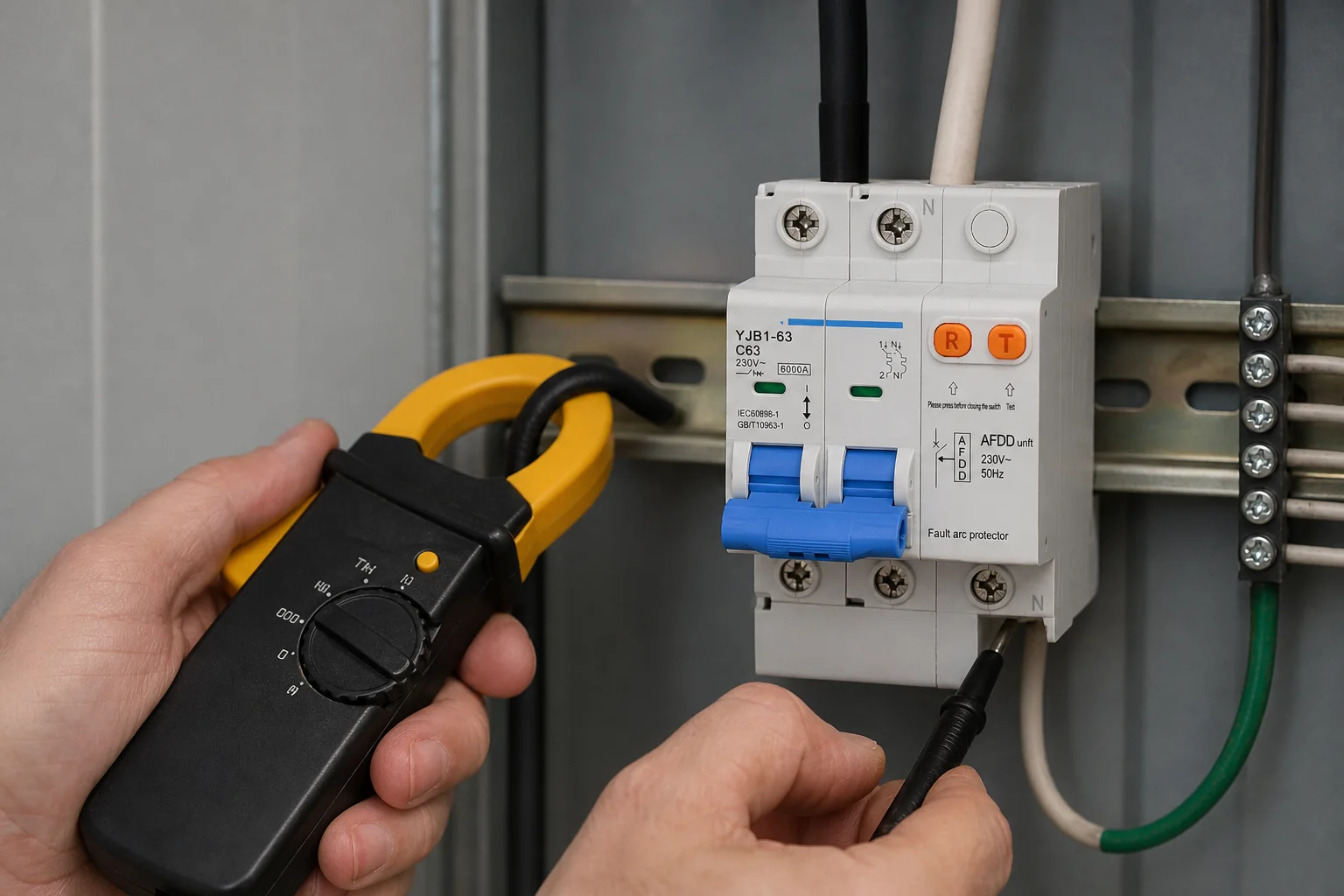
AFCI vs GFCI: Different Jobs in the Same Panel Story
AFCI targets fire/arc signatures; GFCI targets shock/ground-fault current—and GFP is not GFCI.
AFCI vs GFCI confusion is common because both are “special” breakers with test buttons. Both also show up in modern dwelling discussions. They are not the same hazard class.
- AFCI watches for unwanted arcing patterns associated with fire risk.
- GFCI watches for current imbalance that suggests electricity leaving the intended path—shock protection territory.
- Some AFCI products also include equipment ground-fault protection (GFP).
Trade discussions often stress that GFP trip levels are coarser than Class A GFCI. Field explanations commonly contrast GFP above roughly 30 mA with GFCI near 5 mA to 6 mA.
That is why an AFCI with GFP is not automatically a substitute for a required GFCI device. Dual-function AFCI/GFCI products exist in the broader market as combined hardware, but the naming still matters.
If a trip story starts with “the AFCI acted like a GFCI,” slow down and separate the functions before swapping hardware.
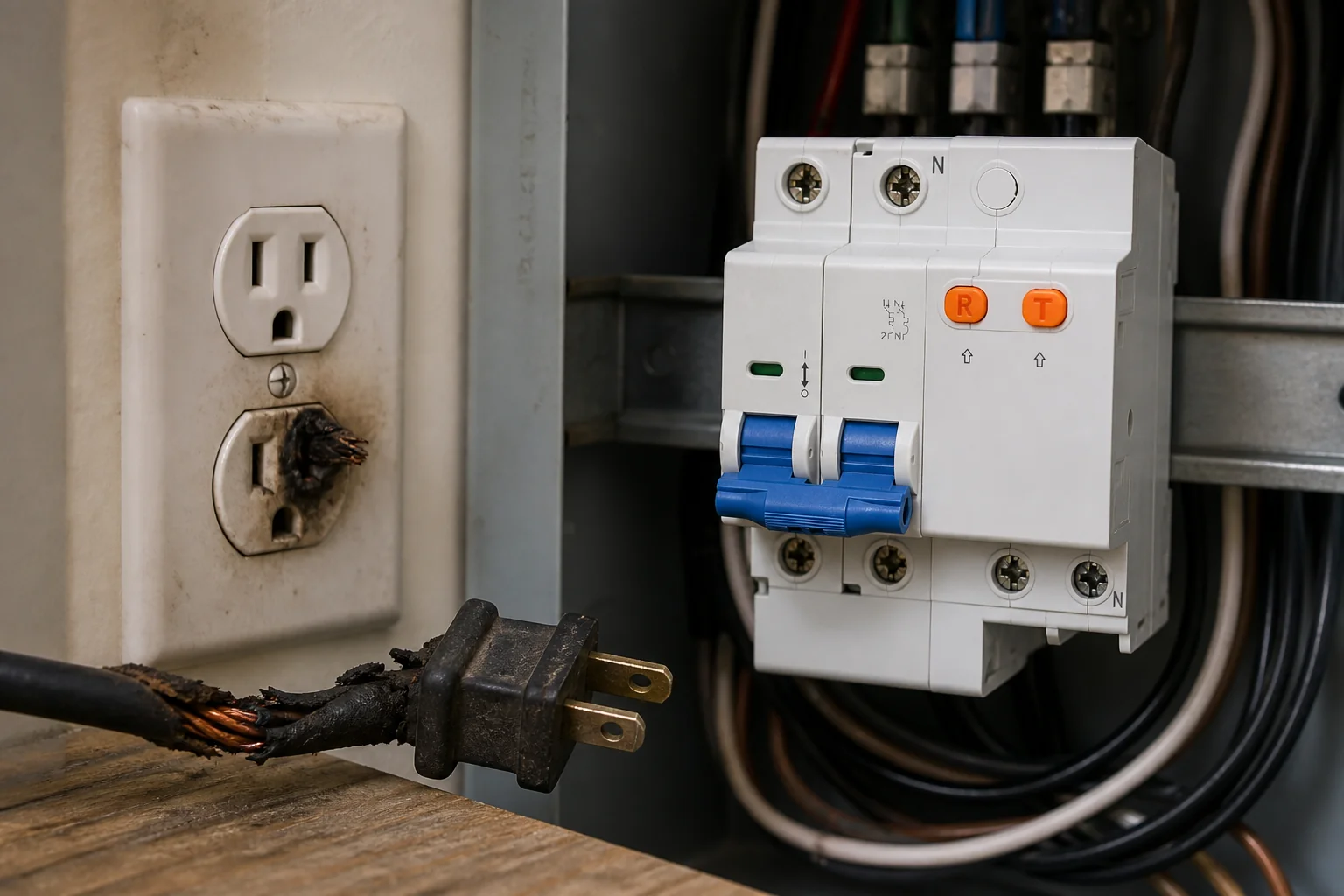
AFCI vs AFDD Naming and the Yijin Product Family
AFCI and AFDD name similar ideas under different standards regions; Yijin pages describe AFDD-style breakers and a separate detector.
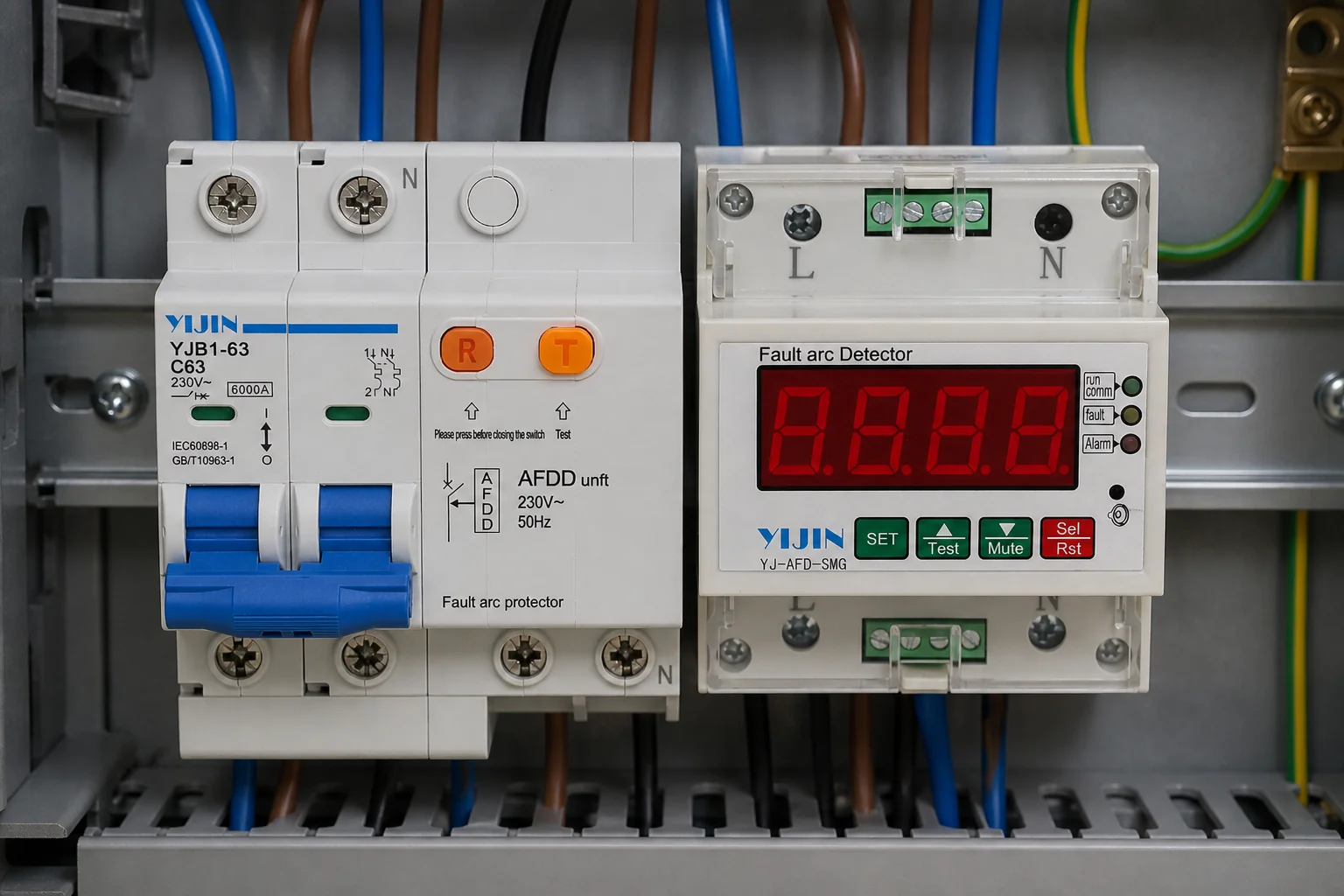
Naming differences show up in both the standards conversation and the form factor buyers usually picture.
| Name / role | Typical standards conversation | Form factor you usually picture | What it is trying to do |
|---|---|---|---|
| AFCI | North American UL / NEC practice language | Panel branch breaker or AFCI receptacle | Detect unwanted arcs and interrupt |
| AFDD | IEC-market conversation for final-circuit arc detection | Often modular DIN-rail | Detect dangerous arcing on final circuits and disconnect |
| GFCI / RCD family | Shock / residual-current protection | Breaker or receptacle | Ground-fault / residual current protection |
| Fault-arc detector | Local detector standards as stated on product pages | Independent module | Detect series/parallel fault arcs and alarm/communicate |
US searchers say “AFCI.” Many DIN-rail catalogs say “AFDD.” Independent technical education treats them as related answers to the same fire problem under different listing and code systems, including IEC 62606 on the AFDD side. They are not identical certificates you can swap without checking the project rules.
On this site, the arc-fault cluster sits under the mixed Others category. Live first-party pages describe three related roles.
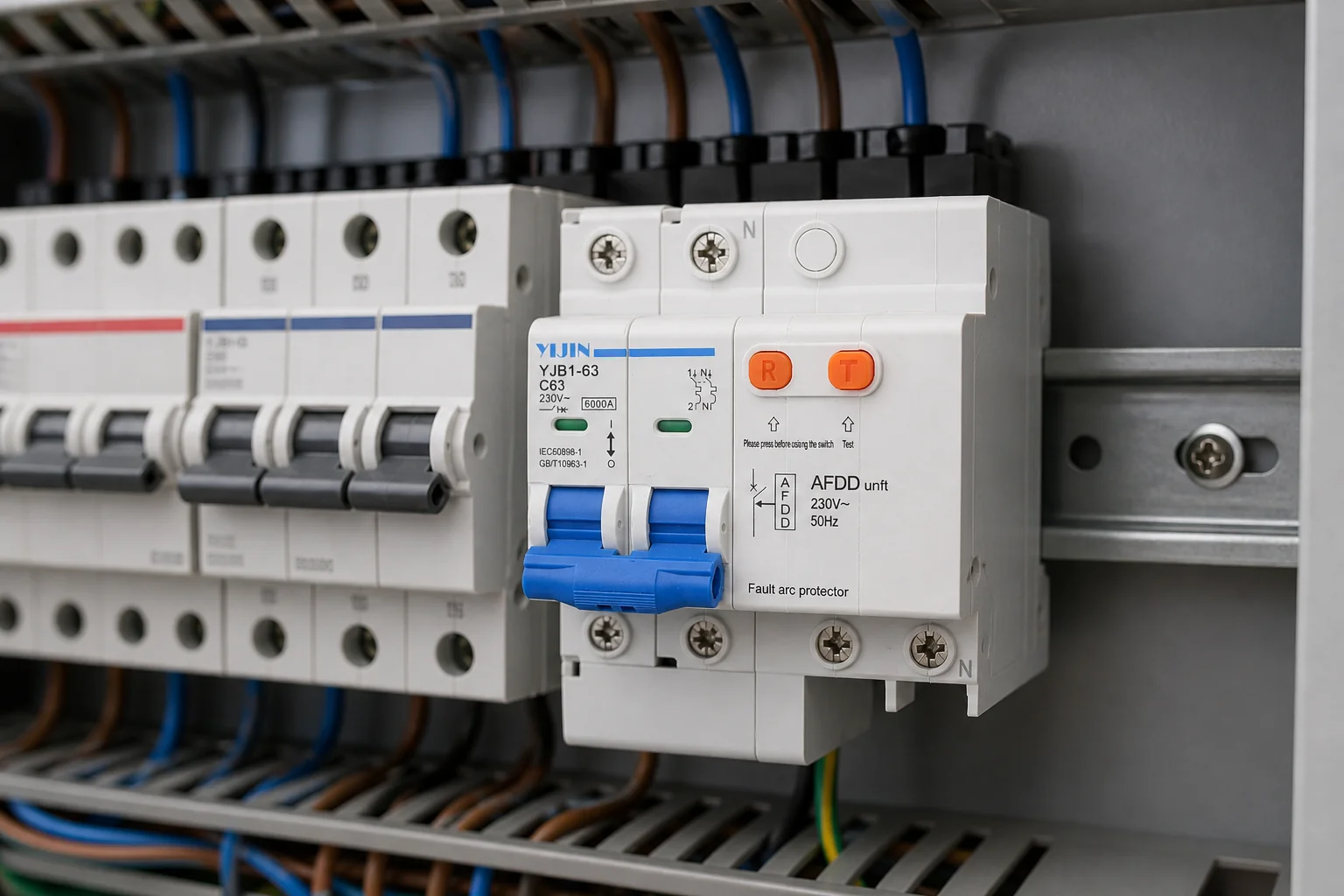
Study the YJB1-63/AFD arc fault circuit breaker first. AFDD assembled from a small circuit breaker plus an arc-fault module; overload, short-circuit, and series/parallel arc-fault protection; AC 50 Hz, 230 V, currents up to 63 A; page table cites GB/T31143 among other parameters.
Next, review the YJB1-63/AFD with leakage page for the same AFDD family framing with leakage monitoring and a leakage test window. Then compare the YJ-AFD-SMG independent fault-arc detector referencing GB14287.4-2014.
Those pages do not establish a UL Listed / NEC AFCI listing for US residential branch-circuit substitution. Keep the mechanism story and the listing story separate.
YJB1-63/AFD Arc-Fault Family Recommendation
Use the live YJB1-63/AFD page as the primary AFDD-style example; do not treat it as a UL-listed US branch AFCI.
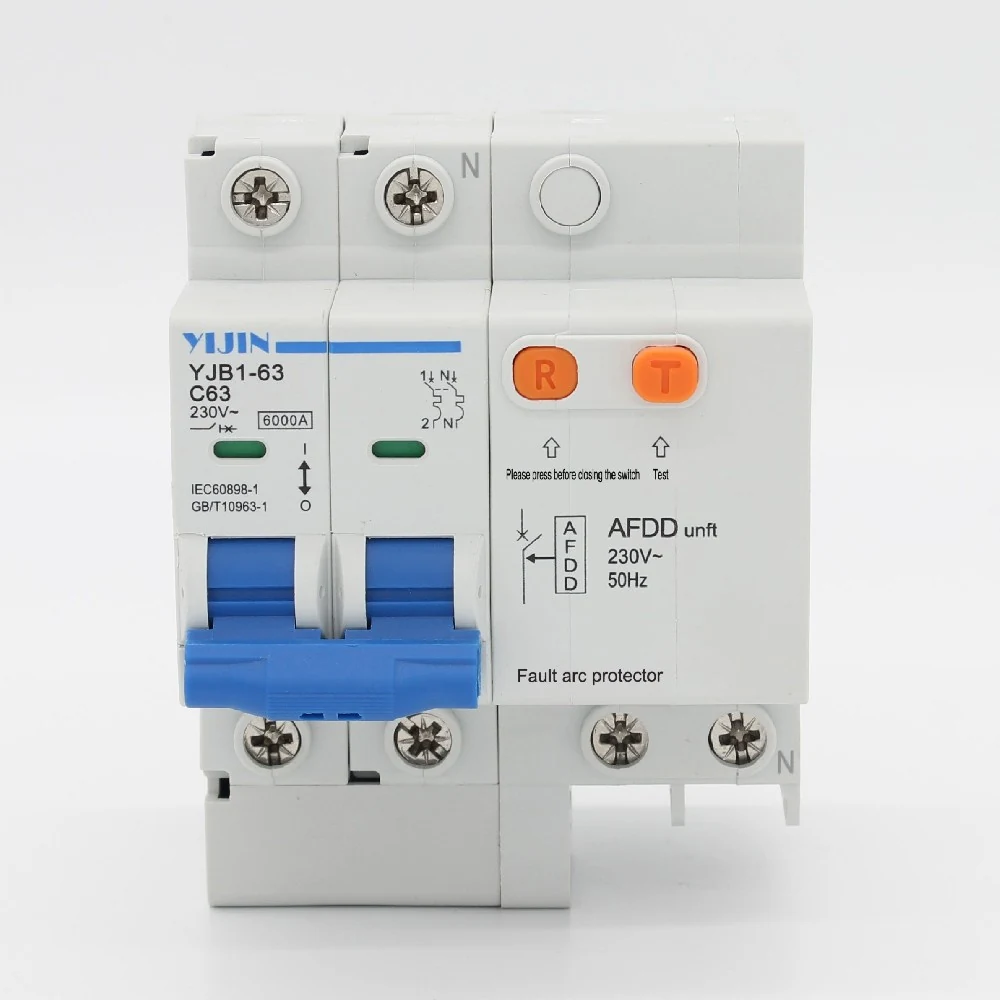
If you arrived here asking how AFCI breakers work and now need a concrete first-party product to study, start with the YJB1-63/AFD arc fault circuit breaker.
The page’s own description matches the family thesis: a small breaker plus an arc-fault module. It watches for series and parallel arc faults while still providing overload and short-circuit protection on the stated AC 50 Hz / 230 V / ≤63 A scope.
The same page calls out DIN-rail installation and GB/T31143 in the parameter table. Choose the leakage sibling when the application discussion explicitly needs leakage monitoring on the same AFDD-style platform.
Choose the YJ-AFD-SMG detector when the job is detection/alarm architecture rather than breaker interruption. Browse related hardware from the Others hub.
Keep project listing requirements honest: similarity of arc-fault function language is not the same thing as a verified UL 1699 / NEC AFCI listing.
FAQ
How does an AFCI breaker actually detect an arc?
It uses onboard electronics to monitor the circuit waveform for arcing signatures—irregular, often high-frequency patterns associated with unwanted arcs—then trips when the pattern is classified as a fault rather than a normal switch or motor spark.
What is the difference between series and parallel arcs?
A series arc is a gap in a single current path (loose screw, broken conductor). A parallel arc jumps between conductors or to ground through damaged insulation or bridging. Both can create fire heat; combination-type education covers both classes.
Are AFCI and GFCI the same device?
No. AFCI focuses on unwanted arcing and fire risk. GFCI focuses on ground-fault current and shock protection.
Some AFCIs include GFP, which is still not the same as a Class A GFCI.
Is AFDD the same as AFCI?
They address a similar fire problem under different naming and standards conversations (UL/NEC language vs IEC-market AFDD language). Do not treat the names as interchangeable listings for a specific panel or country code path.
What does “combination” AFCI mean?
In common field and standards-education language, combination-type AFCI coverage includes both series and parallel arc-fault detection (plus the usual overcurrent functions of the breaker form).
Can Yijin’s AFDD replace a UL-listed AFCI in a US panel?
Not based on the live first-party evidence in this package. Yijin pages describe AFDD-style DIN-rail products and a detector under stated scopes; they do not document a UL Listed / NEC AFCI listing for US branch-circuit substitution.
How is a fault arc detector different from an AFCI breaker?
A breaker-style AFCI/AFDD path interrupts the circuit. An independent fault-arc detector, such as YJ-AFD-SMG on its product page, is framed around detecting series/parallel fault arcs and alarming/communicating rather than acting as a US panel AFCI substitute.
What does the YJB1-63/AFD product page actually cover?
On the live product page, the unit is described as an AFDD built from a small breaker plus an arc module covering overload, short-circuit, and series/parallel arc-fault protection at AC 50 Hz and 230 V with currents up to 63 A, and the parameter table cites GB/T31143. Quote the page—do not invent UL claims.
References
- Arc-fault circuit interrupter overview on Wikipedia
- Arc fault protection tutorial at Industrial Control Academy
- AFCI breaker basics on The Engineering Mindset
- How an AFCI detects arcs — ExpertCE
- AFCI’s – How do they work?? on Mike Holt’s Forum
- AFCI Tripping, Ideas? on Electrician Talk
Humanizer self-audit (Draft Agent)
- Patterns found: reduced parallel stacks; varied paragraph length; opening answers each H2.
- No invented specificity: no fabricated trip times; no UL listing for Yijin; education thresholds kept as education only.
- Source-first / audit language scrubbed from reader prose.
- Second “what still sounds AI?” pass completed by YJ-DRF-AGT-20260908-01 before review handoff.
- Evidence callout present: From the field (signature language).
- Waveform / signature language and electrical fire stakes appear in body sections above.