 Yueqing Yijin Electronics Co., Ltd.



Isolator Switch for Air Conditioner: Buyer Selection Guide
An isolator switch for air conditioner circuits is the local shutoff that isolates the unit so technicians can service it with the supply intentionally off.
The English phrase covers more than one hardware family: a weatherproof outdoor air conditioning disconnect beside a U.S. condenser, and an IEC isolating knife switch used for no-load isolation in low-voltage distribution. This guide separates those jobs, explains why utilisation category matters on compressor circuits, and shows when Yijin’s AC-20B isolator knife switches fit—and when they do not.
What an Isolator Switch for an Air Conditioner Actually Does
It creates a local isolation point so power can be removed for service.
On a split system or packaged outdoor unit, people reach for that switch when they clean coils, replace a contactor, or clear a fault without walking back to a distant panel. The useful job is isolation with a clear OFF state—often padlockable—so the circuit stays dead while work is underway.
That service role is why installers talk about “isolators” in the UK and Australia and about “AC disconnects” in U.S. supply houses. Different catalogs, same maintenance intent.
What the device is not supposed to be is a catch-all safety gadget. It does not size your branch-circuit conductors, does not replace equipment nameplate rules for hermetic compressors, and does not act as a surge protector during storms.
Treat it as a controlled break in the supply path. If you need automatic fault clearing, that is a different device class.
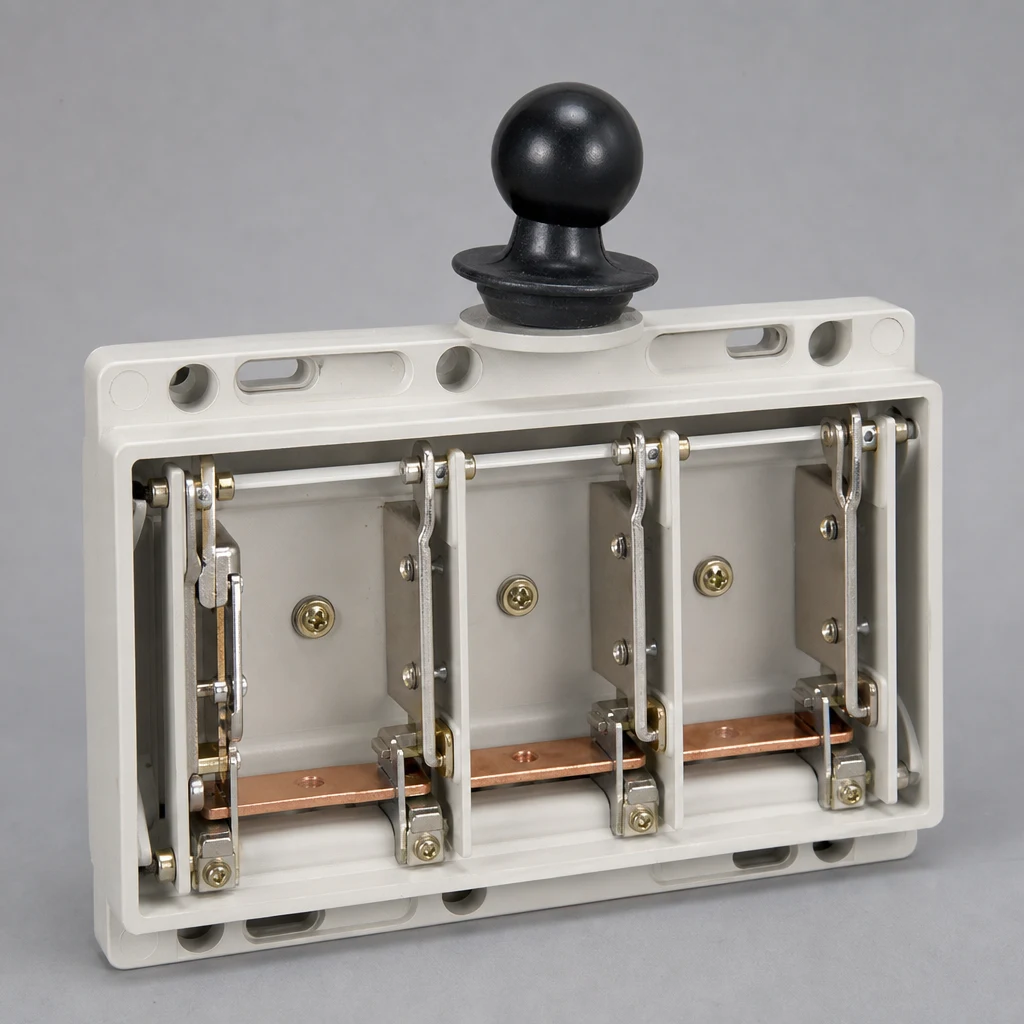
US Outdoor HVAC Disconnect Practice vs “Isolator” Language
In the US, the common outdoor answer is a within-sight air-conditioning disconnect, not every IEC knife isolator.
U.S. electrical education on National Electrical Code Article 440 describes a disconnecting means for air-conditioning or refrigeration equipment that must be located within sight from and readily accessible from the equipment.
“Within sight” is taught as visible and not more than 50 feet away. Later NEC educational summaries also emphasize that the disconnect must meet working-space rules so a person can actually operate it at the unit.
Homeowners and contractors on Electrician Talk ask the same practical question: if the breaker panel is twenty feet away and still visible, does it count, or does the inspector still want a wall-mounted outdoor disconnect? The answer is jurisdiction-sensitive, but the underlying expectation is local, reachable isolation at the outdoor equipment.
Retail form factors follow that outdoor job. Big-box and electrical distributors stock fused and non-fused air-conditioning disconnect enclosures—pullout or switch styles in weather-resistant boxes—because condensers sit outside and service techs need a nearby OFF.
Those products are what most U.S. searches for “AC disconnect” expect.
IEC language travels differently. An enclosed rotary isolator with an IP65 or IP66 rating shows up in many international “aircon isolator” listings. Separately, panel builders specify isolating knife switches inside assemblies for infrequent isolation.
Both can be called isolators in English. Only some of them match the outdoor U.S. condenser disconnect pattern.
If your purchase order says “isolator switch for air conditioner” and the ship-to address is a U.S. rooftop or pad-mount condenser, confirm whether the buyer wants that outdoor disconnecting means—or an in-panel isolation device elsewhere in the system.
| Decision factor | Typical US outdoor HVAC disconnect | IEC isolating knife switch (panel duty) |
|---|---|---|
| Usual location | On or near the outdoor unit, within sight | Inside LV distribution / enclosure |
| Common buyer cue | Fused or non-fused weatherproof ACD | Utilisation category, poles, Ie |
| Primary job | Local disconnecting means for service | Clear isolation under defined duty |
| Overcurrent role | Fused styles add local fuses; non-fused rely on upstream OCPD | Not a substitute for a circuit breaker |
| Weather exposure | Outdoor enclosure ratings expected | Often indoor / enclosed assembly (check product conditions) |
Isolation Is Not Overcurrent Protection
An isolator is operated by hand for isolation; a breaker trips to clear faults.
Mixing the two words creates bad BOMs. A circuit breaker opens automatically when it sees overload or short-circuit conditions it is designed to clear.
An isolator (or disconnect used as an isolator) is operated intentionally so people can work. You still need properly rated overcurrent protection somewhere in the circuit.
Putting a knife switch or rotary isolator in a catalog line does not erase that need.
The same discipline applies to “protection” marketing. Cutting power before a storm may be a reasonable operational habit for some sites, but the isolator is not a surge protective device and should not be sold as one.
Keep the roles separate: isolation for people and equipment access, overcurrent devices for fault energy, and SPDs for transient voltage when the design calls for them.
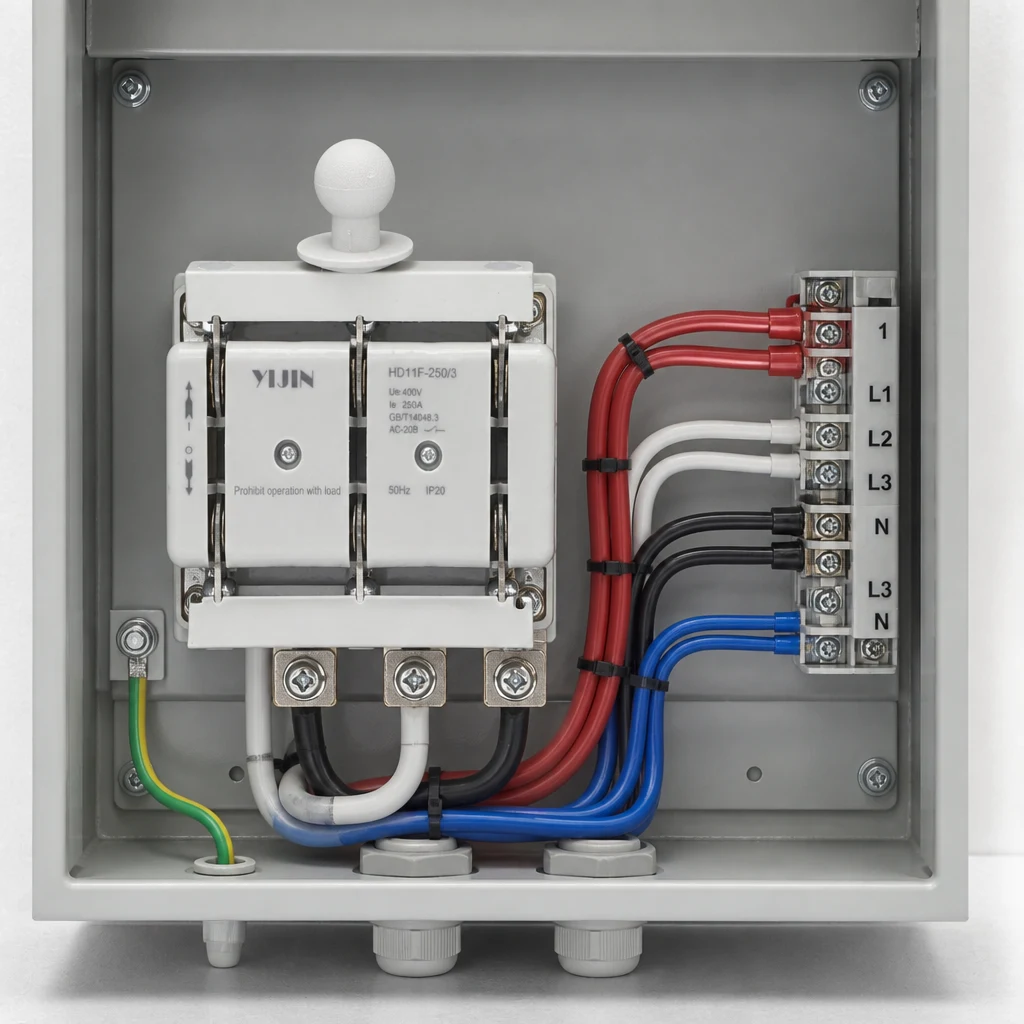
Why Utilisation Category Matters for Air-Conditioner Loads
AC-20B means isolation under no-load—not switching a running compressor.
IEC switchgear utilisation categories describe the electrical duty a switch was tested against. Independent technical guidance on those categories states that AC-20A/AC-20B covers isolation only—making and breaking without load current.
Using an AC-20 device to switch load is treated as the wrong application. Categories such as AC-23 address highly inductive loads and motor switching.
The A/B suffix relates to frequent versus infrequent operation endurance, not a free pass to interrupt compressor current on an isolation-only device.
Air conditioners complicate the picture because the outdoor section often includes a hermetic refrigerant motor-compressor. That load starts hard and is inductive.
If a switch is expected to make or break that circuit under load, an isolation-only category is the wrong tool. In many assemblies the contactor or another switching device handles load duty, while the isolator is reserved for off-load isolation after the load path is already open.
Product pages that state “operation should be carried out under no-load conditions” are describing that discipline, not a suggestion.
Important: Devices rated AC-20 are for isolation without making or breaking load current. Operate them only when the circuit is off-load; do not use an AC-20 knife switch as a daily on-load motor switch. — source: Voltimum / Doepke utilisation categories guide
Source: Voltimum / Doepke utilisation categories guide
Selection Checklist for Buyers and Specifiers
Match current, poles, enclosure, lockout, and jurisdiction before you pick a catalog number.
Work the decision in this order:
- Nameplate first. For U.S. hermetic air-conditioning equipment, disconnect and conductor sizing education starts from the equipment nameplate (rated-load current, MCA, MOCP). Do not reverse-engineer ampacity from a switch brochure alone.
- Jurisdiction and location. If the unit is a U.S. outdoor condenser, plan for a disconnecting means within sight and readily accessible, with workable clearances. Porch crawlspaces and blocked working space are real inspection fights, not edge cases.
- Fused vs non-fused (outdoor ACD). Non-fused outdoor disconnects are common when the panel breaker already covers the MOCP; fused styles add local fuse protection. Pick the style the design and AHJ expect—not the cheapest handle. Forum install discussions also warn that a breaker alone is not treated as the outdoor service disconnect next to the unit; plan a dedicated disconnect for serviceability.
- Poles and switching topology. Confirm single-phase vs three-phase, whether neutral is switched, and whether the device is only an isolator or a switch-disconnector with a higher utilisation category.
- Utilisation category and load path. If the device must interrupt motor load, AC-20 isolation-only ratings are out of scope. Keep isolation devices coordinated with contactors or other load-break means.
- Enclosure and environment. Outdoor U.S. pads need weather-rated disconnect enclosures. Panel knife switches often carry ambient, altitude, pollution-degree, and “no rain/snow invasion” conditions on their product pages—read those before substituting them for an outdoor box.
- Lockout. Prefer a clear OFF position that supports lockout/tagout during service.
- Standards claims. Match the standard family the project actually requires. Do not assume NEC/UL naming and IEC documentation are interchangeable on an approval drawing.
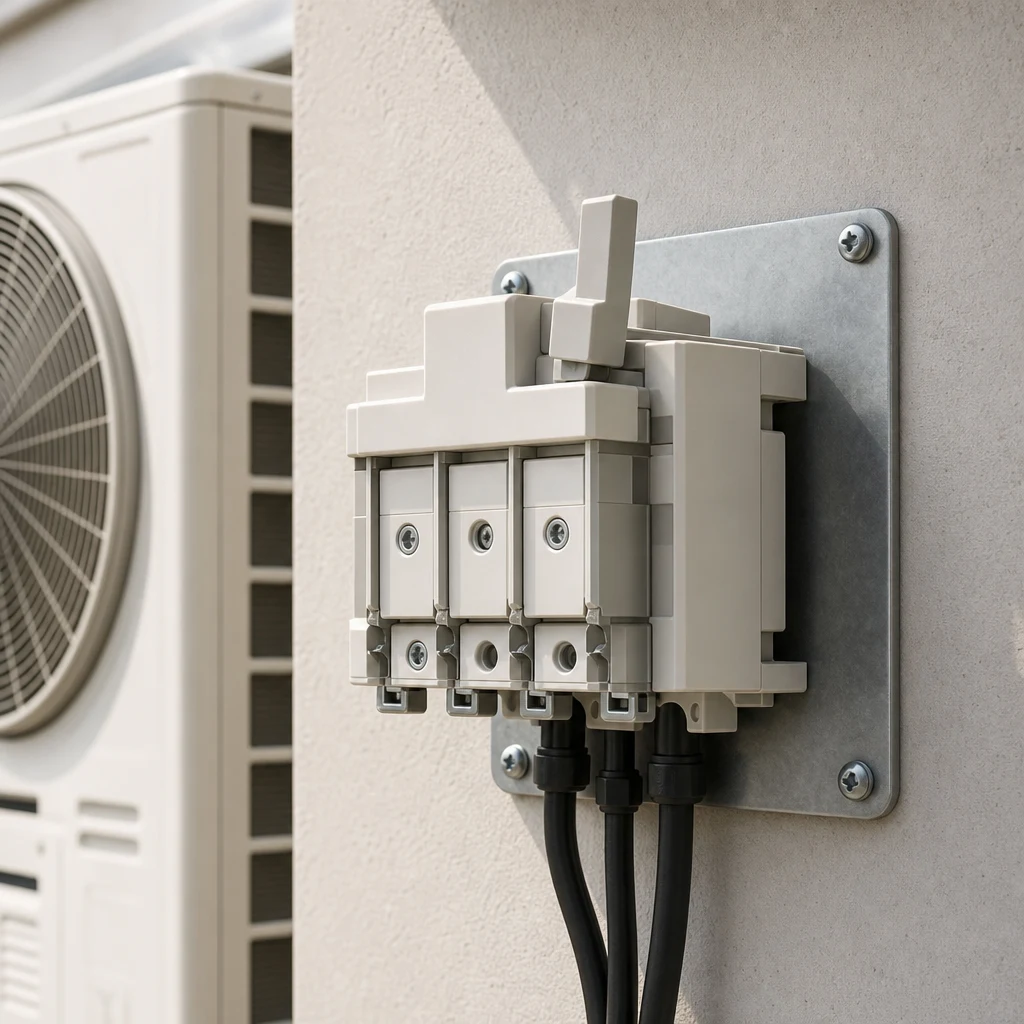
When to Choose Yijin Isolating Knife Switches for AC Isolation Duty
Choose them for AC-20B panel isolation jobs; choose a listed outdoor HVAC disconnect when the condenser needs a US field disconnect.
Browse the Isolating Switch category when the requirement is low-voltage isolation hardware in the IEC sense. For air-conditioner-related BOMs, two knife-switch families are the honest starting points on this site.
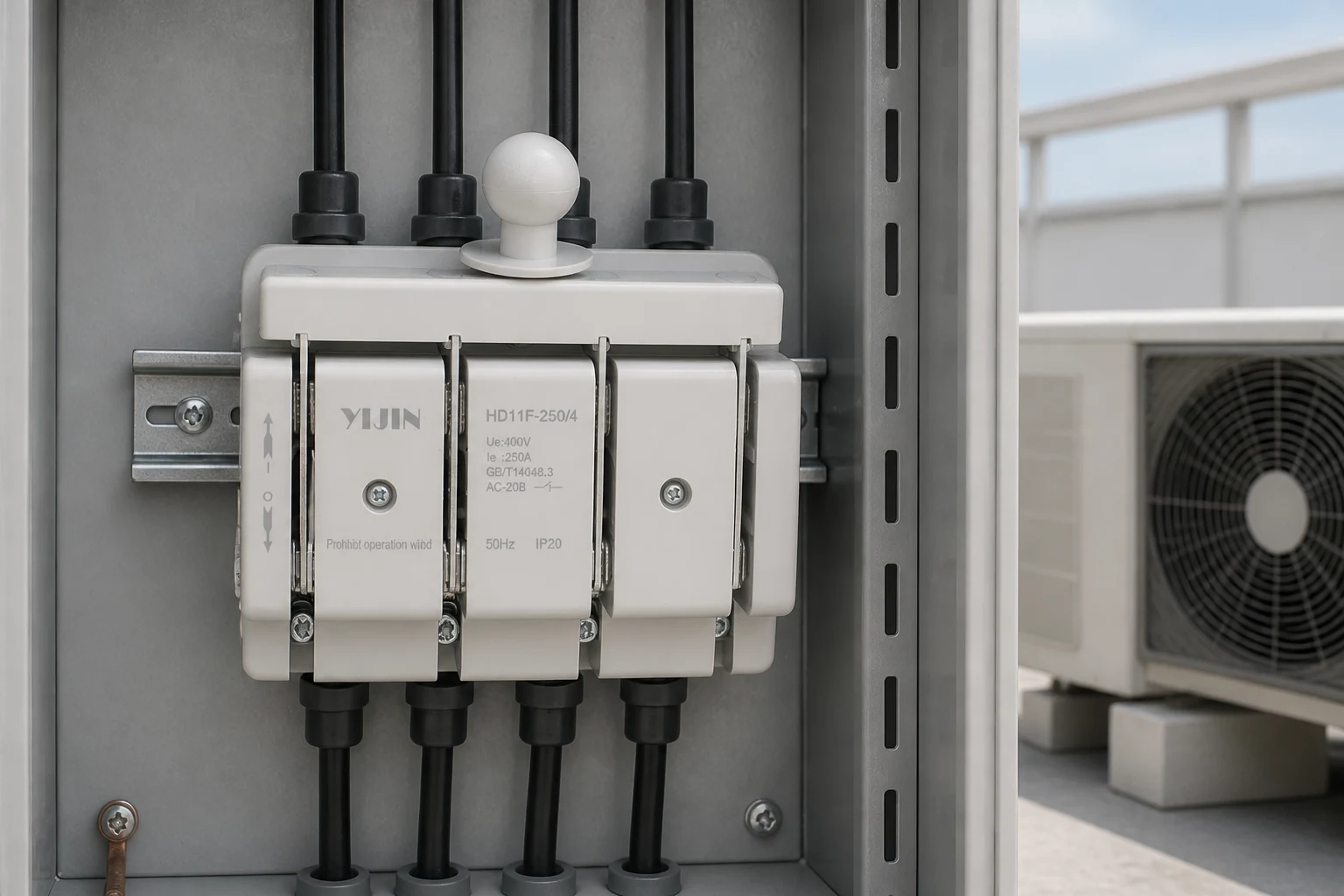
The HD11F-250 protective opening knife switch is specified for AC 50 Hz circuits with rated operational voltage up to 400 V, rated impulse withstand voltage 8 kV, agreed heating current 250 A, and rated working current options from 160 A to 250 A in 3P or 4P.
Its utilisation category is AC-20B. The product page states the series is mainly used in low-voltage distribution for infrequent manual connection, disconnection, and isolation, and that operation should be carried out under no-load conditions.
It references GB/T14048.3 and IEC 60947-3.
Normal working conditions include ambient air from −25 °C to +70 °C (24-hour average not exceeding +35 °C), altitude not exceeding 2000 m, and pollution degree 3, with installation away from rain and snow invasion.
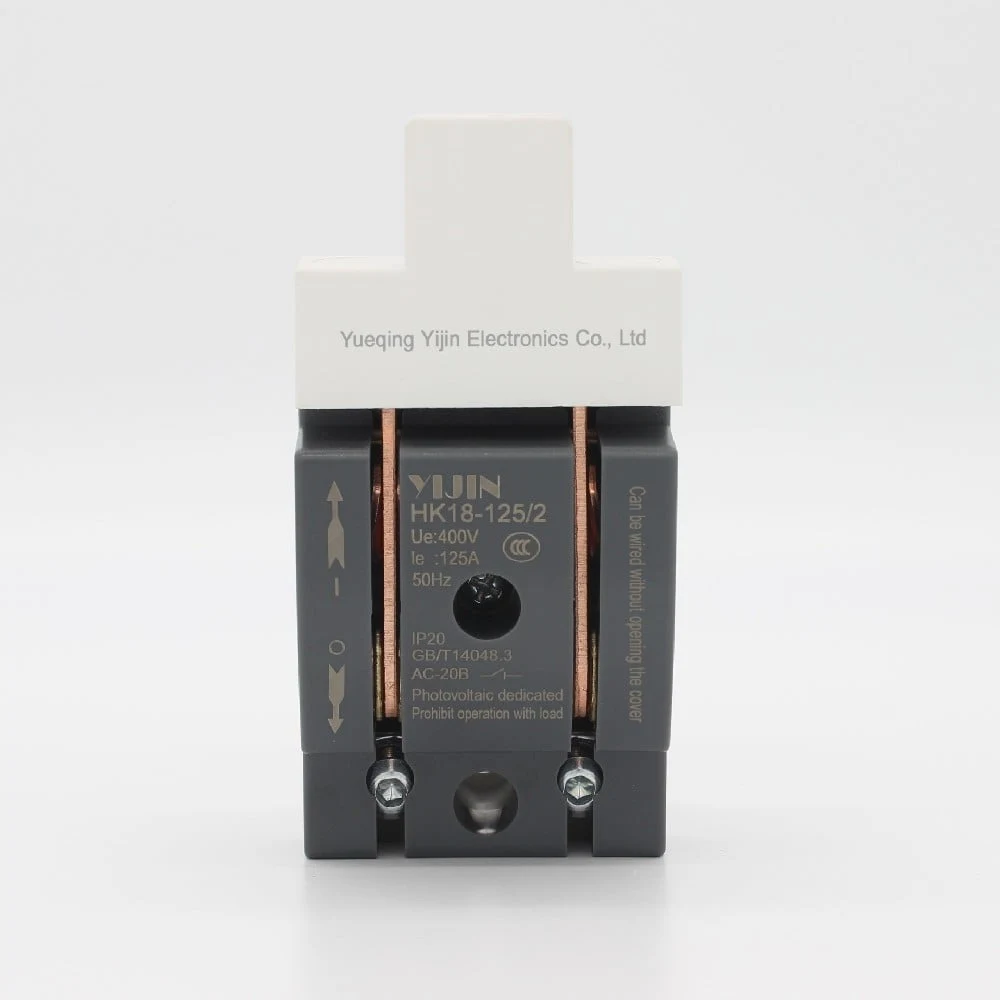
The HK18-125 type knife switch for photovoltaic applications covers 2P/3P/4P versions at 400 V with rated working currents of 63 A, 80 A, 100 A, or 125 A, 50 Hz, 6 kV impulse withstand, and AC-20B utilisation category.
The page highlights DIN-rail or baseplate mounting and wiring without opening the cover. Related HK18 ratings (for example HK18-160) sit in the same isolating-switch family when current needs step up within that platform.
| Parameter | HD11F-250 | HK18-125 |
|---|---|---|
| Poles | 3P, 4P | 2P, 3P, 4P |
| Rated operational voltage | 400 V | 400 V |
| Rated working current | 160–250 A | 63–125 A |
| Frequency (product page) | 50 Hz | 50 Hz |
| Uimp | 8 kV | 6 kV |
| Utilisation category | AC-20B | AC-20B |
| Mounting notes | Protective opening knife switch | DIN-rail or baseplate; cover-closed wiring |
| Standards cited on page | GB/T14048.3, IEC60947-3 | GB/T14048.3, IEC60947-3 |
Choose these knife switches when you need infrequent, off-load isolation in an LV assembly aligned with AC-20B and the published voltage/current ranges.
Do not treat them as a drop-in outdoor U.S. air-conditioning disconnect, a fused ACD, a circuit breaker, or a device verified here as UL Listed for NEC outdoor condenser installations.
If the line item is “disconnect within sight of the outdoor unit,” buy the outdoor disconnecting means that the project documentation and AHJ expect—then use knife isolators only where the panel design actually calls for AC-20B isolation.
Next step: confirm poles and current against the assembly drawing, open the product pages above for wiring diagrams, and contact Yijin with the exact configuration if you need a quote.
FAQ
What is an isolator switch for an air conditioner?
It is a local switch used to isolate the air conditioner’s supply so service or emergency shutdown can happen at a reachable point. In U.S. outdoor practice that usually means an air-conditioning disconnect; in IEC catalogs it may mean a rotary isolator or an isolating knife switch.
Is an isolator the same as a circuit breaker?
No. Breakers provide overcurrent protection and can trip automatically. Isolators are operated manually for isolation and do not replace upstream or local overcurrent devices.
Does a US outdoor AC unit need a disconnect?
U.S. NEC education on Article 440 expects a disconnecting means within sight from and readily accessible from air-conditioning or refrigeration equipment. Whether a visible panel breaker is enough still depends on the installation and the authority having jurisdiction.
What does “within sight” mean for an AC disconnect?
NEC educational summaries define within sight as visible and not more than 50 feet from the equipment. Working space at the disconnect still has to be usable.
Can an AC-20B knife switch switch a running compressor?
No. AC-20 covers isolation without making or breaking load current. Interrupt compressor load with a device rated for that duty, or open the load path before operating an AC-20 isolator.
When should I choose a fused outdoor HVAC disconnect instead of an IEC knife isolator?
Choose the outdoor fused or non-fused HVAC disconnect when the job is a U.S. condenser disconnecting means beside the unit. Choose an IEC knife isolator when the drawing calls for AC-20B isolation inside distribution equipment—not as a substitute outdoor ACD.
Do the HD11F-250 or HK18-125 carry UL listing for NEC outdoor ACD use?
This site’s published product pages document IEC/GB knife-switch ratings (including AC-20B). They do not provide verified UL Listed outdoor HVAC disconnect evidence for NEC condenser installations, so do not specify them that way.
What voltage and frequency do the recommended knife switches state?
Both HD11F-250 and HK18-125 product pages state 400 V rated operational voltage and 50 Hz rated frequency, with AC-20B utilisation category. Confirm any sixty-hertz project requirement against the actual approval path before substituting.