 Yueqing Yijin Electronics Co., Ltd.




How to Install a 3 Phase Surge Protection Device: Board Readiness Before Landing
how to install 3 phase surge protection device work starts before any lug is tightened. Prove the board is ready—pole count versus topology, short lead length, a backup-protector plan, and a Class II / Type 2 seat—then land L1/L2/L3/N/PE. The pages below keep three-phase AC board readiness ahead of torque talk.
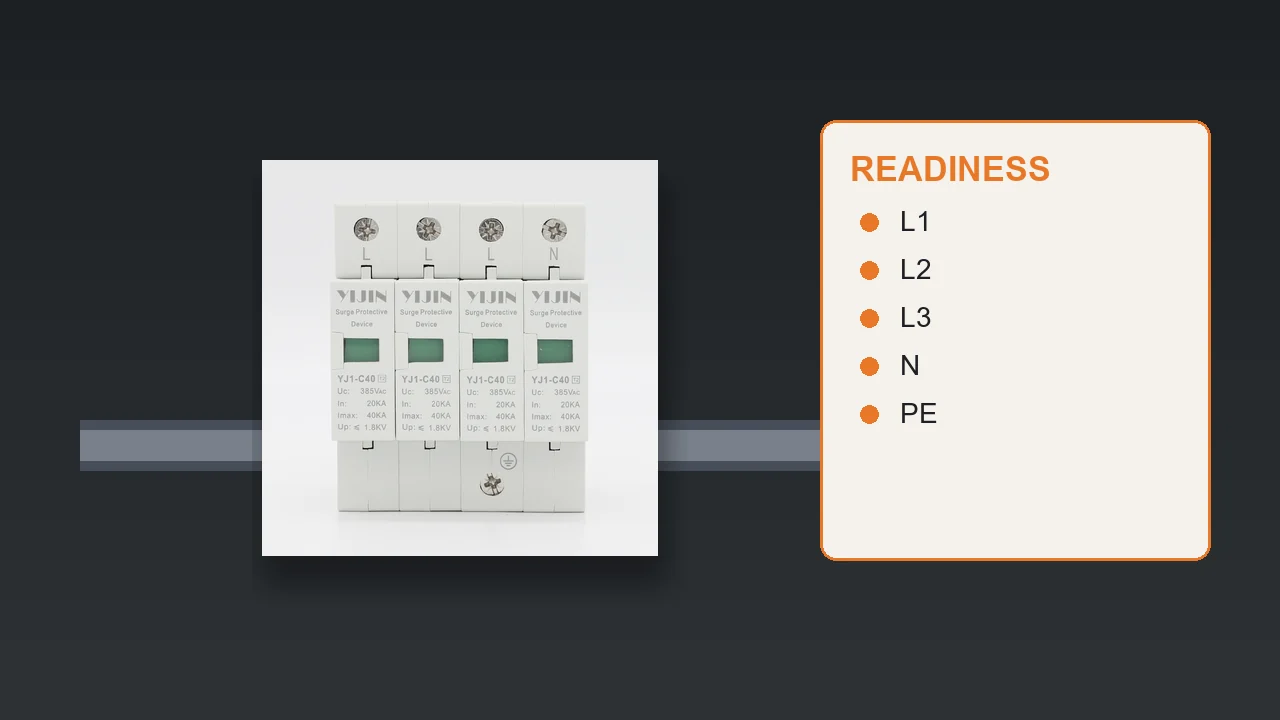
What “Install Ready” Means Before You Land L1/L2/L3/N/PE
Ready means conductors, class seat, lead path, and backup plan are decided before a screwdriver parks on an SPD terminal. A 3-phase surge protection device on a panel is a parallel tap across the supply.
It is not a series filter that cleans power on the way to the meter. Electricians on trade forums keep repeating that parallel idea because crews otherwise invent wiring the board never needed.
3 phase SPD installation tutorials often jump to lockout, land phases, land neutral, land PE, restore power, watch the window. That sequence only helps after the board map is honest.
| Readiness gate | Question you answer before landing | If the answer is fuzzy |
|---|---|---|
| Conductor identity | Which of L1/L2/L3/N/PE actually exist at this board? | Stop and read the drawing |
| Pole match | Does the module set match those conductors? | Hold the stock pull |
| Geometry | Can the SPD sit close enough for short, straight leads? | Relocate the module first |
| Backup | What clears the path if the SPD fails short? | Settle the series device now |
| Class seat | Is this a Class II / Type 2 seat or a Type 1 / origin seat question? | Keep the catalog card honest |
Procurement readers can use the same table as a buying brief. If a quote lists a module but skips poles, leads, or backup, the quote is incomplete even when the kA number looks large.
Hub context for the product family sits under the live surge protection device category.
Pole Count Versus Board Topology: The First Readiness Gate
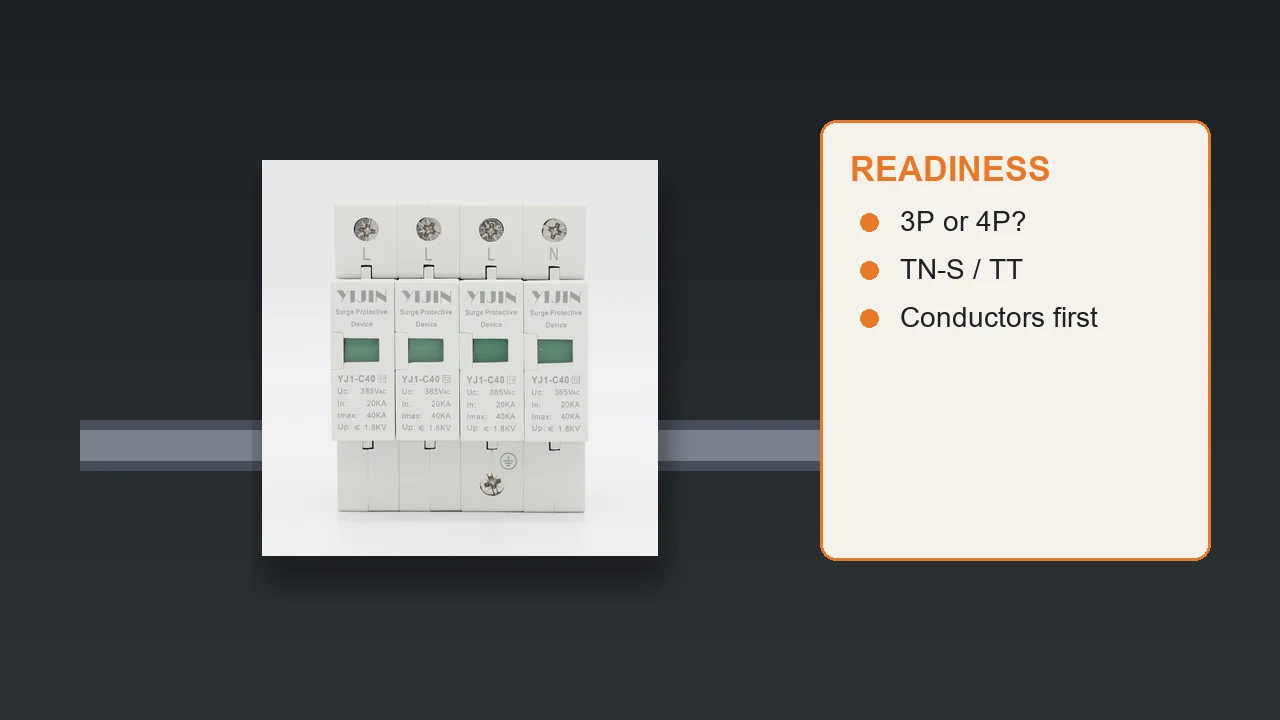
Match the module set to the conductors present at the board. Earthing arrangement is one of the first selection facts in professional SPD education.
TN-S / TT / TN-C naming is not interchangeable when you decide whether neutral and PE are separate or combined as PEN.
Count the live phases at the install point. Decide whether a separate neutral is present and whether it must be protected. Confirm how PE or PEN is referenced at that same point.
Only then choose a 3P, 4P, or other pole set that the live product card actually offers. On Yijin Class II cards such as YJ1-C40, the specification block lists 1P/2P/3P/4P options.
That list is a shopping range. It does not clear a 4P set into a board that has no separate neutral path. Deep 4P versus 3P+N topology belongs elsewhere; here you only refuse a mismatched pull from stock.
US boards and IEC-framed boards use different naming habits. The copper that exists still decides the pole set. If the project drawing still shows a question mark on earthing class, the SPD stays on the shelf.
Short-Lead Geometry: Plan the Path Before the Terminals
Short lead length is a geometry decision. Connecting conductors must be no longer than necessary, and the mount comes before torque talk.
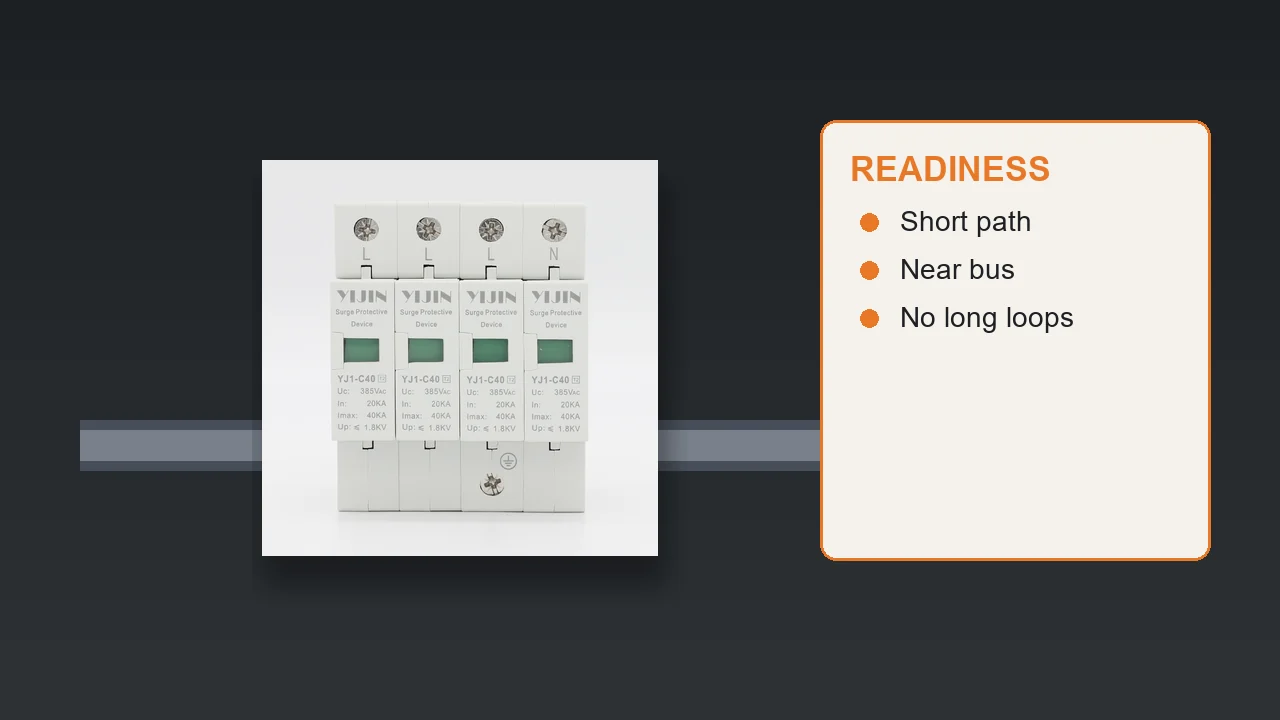
NEC commentary and manufacturer install sheets keep returning to the same buyer-level rule: keep leads short and avoid sharp bends. Excess lead length raises the voltage equipment actually sees during a clamp event.
Commercial blogs love a fixed centimetre slogan. Treat those slogans as marketing shorthand rather than a figure printed on a Yijin table. Place the SPD where phase, neutral, and PE taps can be short and roughly symmetrical.
Prefer a seat near the busbars over a tidy empty slot across the panel. Plan the bend radius before you cut; a U-turn of spare wire is not extra safety. If the only free DIN space forces long loops, change the layout first.
Equal phase lead lengths matter on three-phase boards because unequal impedance makes one phase clamp harder than its neighbors. Cut the three phase leads to the same practical length once the mount is fixed.
The Backup Protector Conversation Before Any Landing
Settle the backup protector / series OCPD conversation before any phase lands. A series overcurrent device in front of an SPD is usually there for end-of-life short failure.
From the field: Upstream backup clears an SPD that failed short; the surge pulse is usually too brief to trip that breaker. — IET SPD overcurrent note
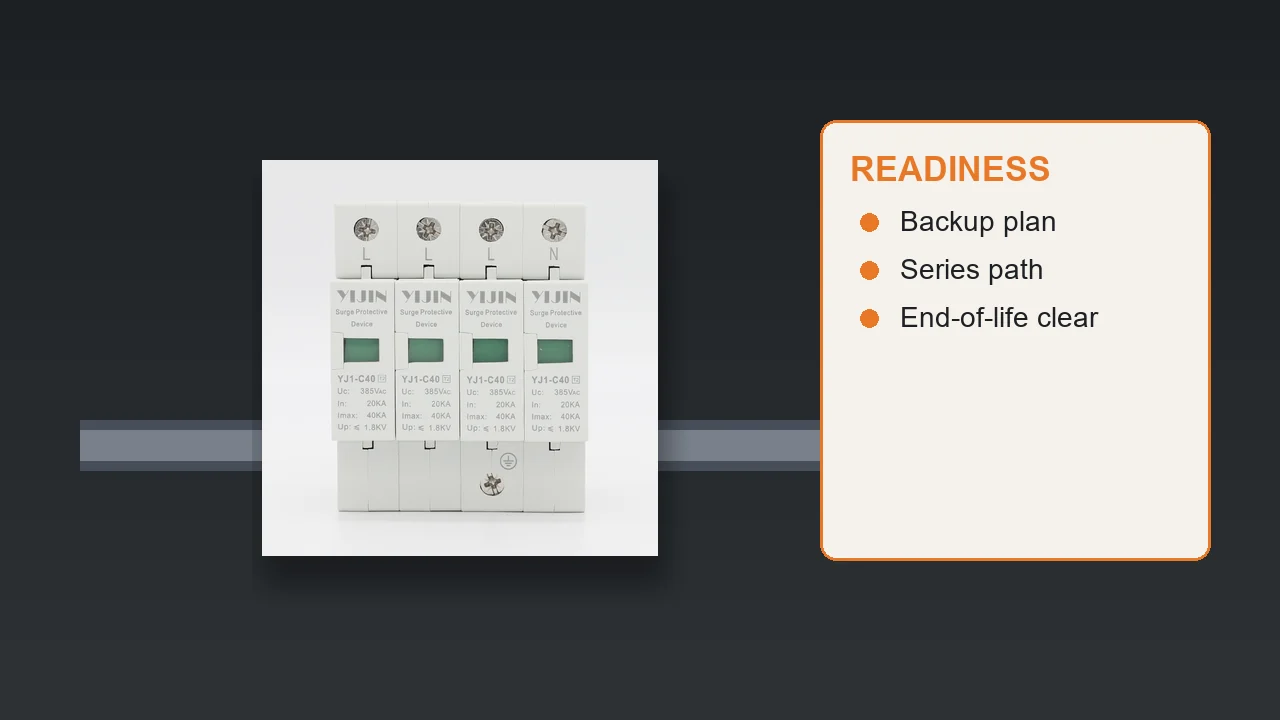
Professional guidance makes the same distinction in calmer language. Whether an external overcurrent protective device is required depends on manufacturer instructions and the SPD’s failure mode.
An external series device also adds impedance, which can raise the effective protection level the equipment sees. That is why backup is planned before copper is cut.
On live Yijin Class II cards, the specification block already prints a recommended series receiving-current protection device. For YJ1-C40, that printed recommendation is 32A/10kA.
A dedicated SPD backup protector on the same site, YJSCB-40, describes itself as cooperating with Class I (T1) / Class II (T2) SPD experiment categories. Use that language as a backup-path talk. It does not turn the Class II board module into a Type 1 / origin seat listing.
Green/red windows on the module tell you the cartridge state. They are not a substitute for the short-circuit backup path.
Class II Board Seat Versus a Type 1 Service Question
A Class II surge module on a DIN rail is a board or sub-distribution seat. A Class II / Type 2 seat is not, by itself, a Type 1 / origin seat listing.
Consumer and training pages place Type 1 devices at the origin—for example the main distribution board—while Type 2 devices sit at sub-distribution boards.
Class I testing tracks a 10/350 μs lightning-current impulse.
Class II testing tracks nominal discharge current with an 8/20 μs impulse. Those are different seats and different test ideas.
Crews land the wrong class when a catalog card shows a large kA number and someone assumes bigger means service entrance. Live Yijin module tables for YJ1-C40, YJ1-B60, and YJ-B80 state Experimental category: Class II experiment.
Application text may talk about floor boxes, equipment rooms, or first-level board language on a specific card. The table class stays Class II.
Housing text that says plastic meets UL94 V-0 is a flammability phrase for the shell.
It is not a UL 1449 SPD listing claim.
If the project truly needs a Type 1 service-class decision, keep that as a separate job. Keep this board ready for a Class II three-phase AC seat, then land.
YJ1-C40 Readiness Fit With YJSCB-40 Backup
For a mid Class II 3P/4P board seat on three-phase AC distribution, start with the live YJ1-C40 surge protector card. Pair the backup conversation with YJSCB-40.
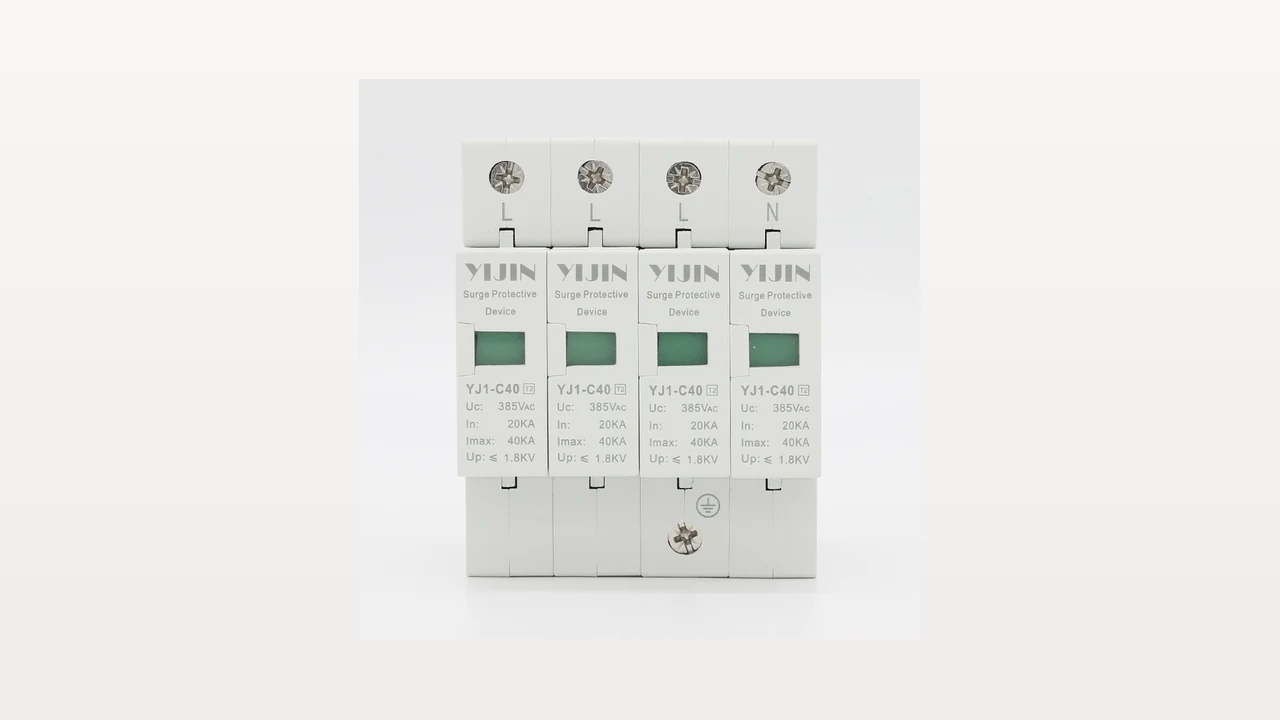
This is the live Class II board module used in the readiness path.
The YJ1-C40 specification block states Class II experiment, poles 1P/2P/3P/4P, rated voltage Un 220V AC 50Hz, maximum continuous operating voltage Uc 385V AC on L-N and 255V AC on N-PE, nominal discharge current 20kA (8/20), maximum discharge current 40kA (8/20), voltage protection level Up 1.8kV, recommended series device 32A/10kA, wire cross-section 4–25 mm², and 35 mm rail mounting.
Uc / In / Imax / Up on that card are the nameplate scan for readiness, not a full sizing chapter.
The product introduction lists suitability for TT, IT, TN-S, N-C-S and other systems at AC 50Hz, 380V and below, with design basis IEC61643-1 and GB18802.1.
Application text points at floor distribution boxes, computer centers, telecom rooms, elevator control rooms, and similar board seats.
| Live Class II card | In (8/20) | Imax (8/20) | Printed series recommendation | Readiness note |
|---|---|---|---|---|
| YJ1-C40 | 20kA | 40kA | 32A/10kA | Mid board seat starting point |
| YJ1-B60 | 30kA | 60kA | 63A/35kA | Higher capacity Class II sibling |
| YJ-B80 (spec model YJ1-B80) | 40kA | 80kA | 63A/35kA | Highest Imax sibling; still Class II |
YJ1-B60 prints In 30kA and Imax 60kA with a series recommendation of 63A/35kA.
On the YJ-B80 card, the spec model YJ1-B80 shows In 40kA and Imax 80kA with a series recommendation of 63A/35kA.
YJ1-B60 / YJ-B80 are the capacity siblings when the board job needs those higher printed ratings. Keep discharge-current choice thin here; a dedicated sizing piece owns that depth.
YJSCB-40’s table names it an SPD backup protector with poles 1P/2P/3P/4P, Ue 230V, cooperation with Class I (T1)/Class II (T2) SPD experiment categories, cooperation with SPD parameters ≤60kA (8/20), power-frequency trip value 3A, and Icn 65kA on a 35 mm rail.
That is the backup conversation device. After the gates pass—conductors, poles, short leads, backup, Class II seat—land L1/L2/L3/N/PE according to the maker’s diagram and the authority having jurisdiction.
FAQ
Do I torque terminals from a generic YouTube list?
No. Finish the readiness gates first, then follow the maker’s terminal instructions and local code. Generic torque clips do not know your rail, lug, or listing.
How do I know 3P vs 4P is ready?
Match the module set to the conductors present at that board. If neutral and PE are separate, evaluate a 4P path. If the point is PEN-based, do not force a neutral pole that has nowhere honest to land.
Why do people put a breaker in front of an SPD?
Usually to clear an SPD that has failed toward a short. The surge event itself is typically too brief to be what trips that breaker. Settle the backup plan from the product card and maker instructions before landing.
How short is short enough for leads?
Keep connecting conductors no longer than necessary and avoid sharp bends. Commercial centimetre slogans are not Yijin table facts. If the only free slot forces long loops, move the module.
Is a Class II DIN module a Type 1 service SPD?
No. Type 1 language belongs at the origin or service class. Class II / Type 2 language belongs at board and sub-distribution seats.
Live Yijin YJ1 cards here are Class II experiment tables.
Which Yijin module starts a mid Class II 3-phase board seat?
YJ1-C40 with its printed 32A/10kA series recommendation, plus a backup conversation that can include YJSCB-40.
When pick B60 or B80 instead?
When the board job needs the higher printed In/Imax values on those Class II cards. Sizing depth belongs elsewhere; readiness only needs you to notice the larger printed ratings and matching series recommendations.
Does the housing flammability mark mean an SPD listing?
No. UL94 V-0 is a plastics flammability phrase on the live module pages. It is not an SPD listing mark.
References
- IET — Surge protective devices (consumer guidance)
- IET Wiring Matters — Do SPDs require an overcurrent protective device?
- NICEIC / Professional Electrician — Types of surge protective devices
- Wikipedia — Surge protector
- Mike Holt — SPD installation commentary
- Electrician Talk — Where do you install your Type 1 surge protectors