 Yueqing Yijin Electronics Co., Ltd.




Photocell Wall Label or Lat/Long Rail Clock for Dusk-to-Dawn Control
A dusk to dawn timer switch is usually sold as a photocell wall or outdoor sensor device that watches ambient light—or, less often, as an astronomic wall clock that follows sunrise and sunset. A modular guide-rail latitude/longitude time switch is a third path: it schedules from geography and seasonal sunshine hours inside a panel, without a light eye on the wall. This page helps you decode that label fork, run a short compatibility check, and shortlist a rail lat/long module only when that path matches the job.
What US buyers mean by a dusk to dawn timer switch
Most US search hits for this phrase are photocell plug-in outlets or light-activated outdoor timers, plus some single-pole astronomic wall switches.
Retail pages lead with light sensing, weather covers, and dusk-to-dawn or “hours after dark” dials. Wall astronomic pages lead with location-based dusk and dawn, daylight-saving adjustment, and switch-box wiring notes.
Neither of those result families is the same object as a modular panel timer that stores latitude and longitude. If you are buying for a control cabinet, treat the phrase as a buyer label first and a SKU family second.
Procurement teams that stop at the first marketplace or big-box hit often bring a photocell outlet into a meeting about rail control. Flip that order: name the mount and the decision method before you compare prices.
Distributors hear the same phrase from landscape contractors and from panel builders. The contractor may want a photocell timer on a receptacle string. The panel builder may want a lat/long module beside contactors.
Same words produce different bills of material. Write the requirement as “ambient-light sensor” or “seasonal lat/long rail clock” in the RFQ so vendors stop guessing from the marketing label alone.
When a photocell dusk-dawn path is the compatible label
Choose a photocell when the job must react to the light the sensor actually sees, and you can place that sensor where the sky is representative.
A photocell timer turns loads on as ambient light falls and off as light returns. It does not need a map coordinate. It does need a clean view: shade from growing plants, snow glare, dirt on the lens, or the fixture’s own spill can fool the eye.
Landscape and site crews still pick photocells for simple “run whenever it is dark” circuits. They also report replacements when sensors age or when LED inrush stresses older eyes.
From the field: Electricians arguing about astronomical clocks still ask whether a timer can replace a photocell for true dusk-to-dawn accuracy; some keep the light eye for odd weather, while others retire photocells after trees and cloudy-day false trips. Source: https://www.electriciantalk.com/threads/astronomical-timer.195553/
Keep the photocell path when the specification literally calls for ambient-light sensing hardware, a twist-lock eye, or a UL Listed wall/outlet timer for a receptacle load.
A photocell also fits temporary seasonal displays where the crew will be on site to re-aim the eye after decor changes. If nobody will revisit the sensor after plant growth, budget for a different control method.
When a lat/long seasonal rail clock fits better
Choose a lat/long seasonal clock when on/off must track geography and the calendar’s sunshine hours without trusting a wall-mounted light eye.
An astronomical timer or latitude/longitude time switch calculates dusk and dawn from place and date. Public solar tools such as NOAA’s solar calculator exist for the same sunrise/sunset planning problem, which is why seasonal clocks can stay consistent even when a sensor is shaded.
That path shines when the panel sits indoors, the facade changes over years, or the site needs a predictable night window. Many outdoor lighting timer jobs want dusk turn-on plus a night curfew schedule rather than a full run until morning.
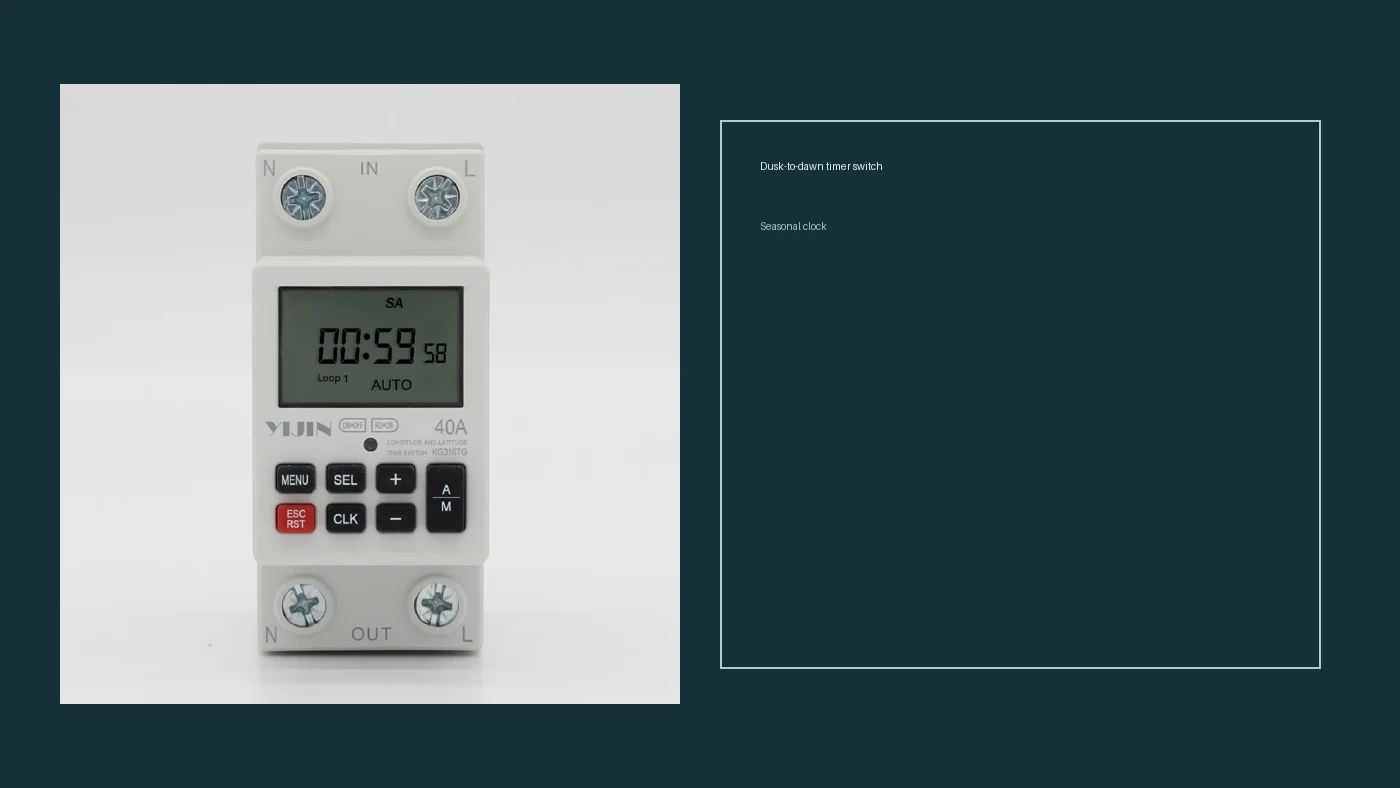
A rail lat/long module belongs here when the control lives on a guide rail mount beside other low-voltage devices. It is a poor substitute for a photocell wall plate if the drawing still shows a sensor on the building skin.
Buying guides that separate automatic seasonal timers from multi-event programmable clocks help procurement language, but they still leave form factor open. Close that gap by stating “guide-rail lat/long” when the cabinet is the install surface.
For street lights, advertising signs, and similar outdoor lighting load classes listed on industrial time-switch sheets, a calculated season schedule often beats a sensor that faces parking-lot glare.
Compatibility checklist: wall sensor label vs rail clock
Match five decisions before you shortlist hardware: form factor, control logic, schedule shape, electrical sheet, and listing expectations.
| Decision | Photocell wall / outdoor sensor path | Lat/long seasonal rail clock path |
|---|---|---|
| Form factor | Wall box, plug-in outlet, or twist-lock eye | Modular guide-rail module in a panel |
| Control logic | Ambient light threshold | Calculated sunrise/sunset from location and season |
| Typical schedule shape | Often full dusk-to-dawn; some add hours-after-dark | Dusk/dawn with optional night curfew schedule |
| Placement risk | Sensor view, shade, stray light | Coordinate / time-zone entry accuracy |
| US listing language | Many retail SKUs market a UL Listed wall/outlet timer | First-party rail sheets may omit UL Listed claims |
Walk the drawing for a sensor head. Confirm whether the panel only has rail space. Decide dusk-only versus dusk-plus-curfew.
Compare the voltage and current on the sheet to the feeder you actually have.
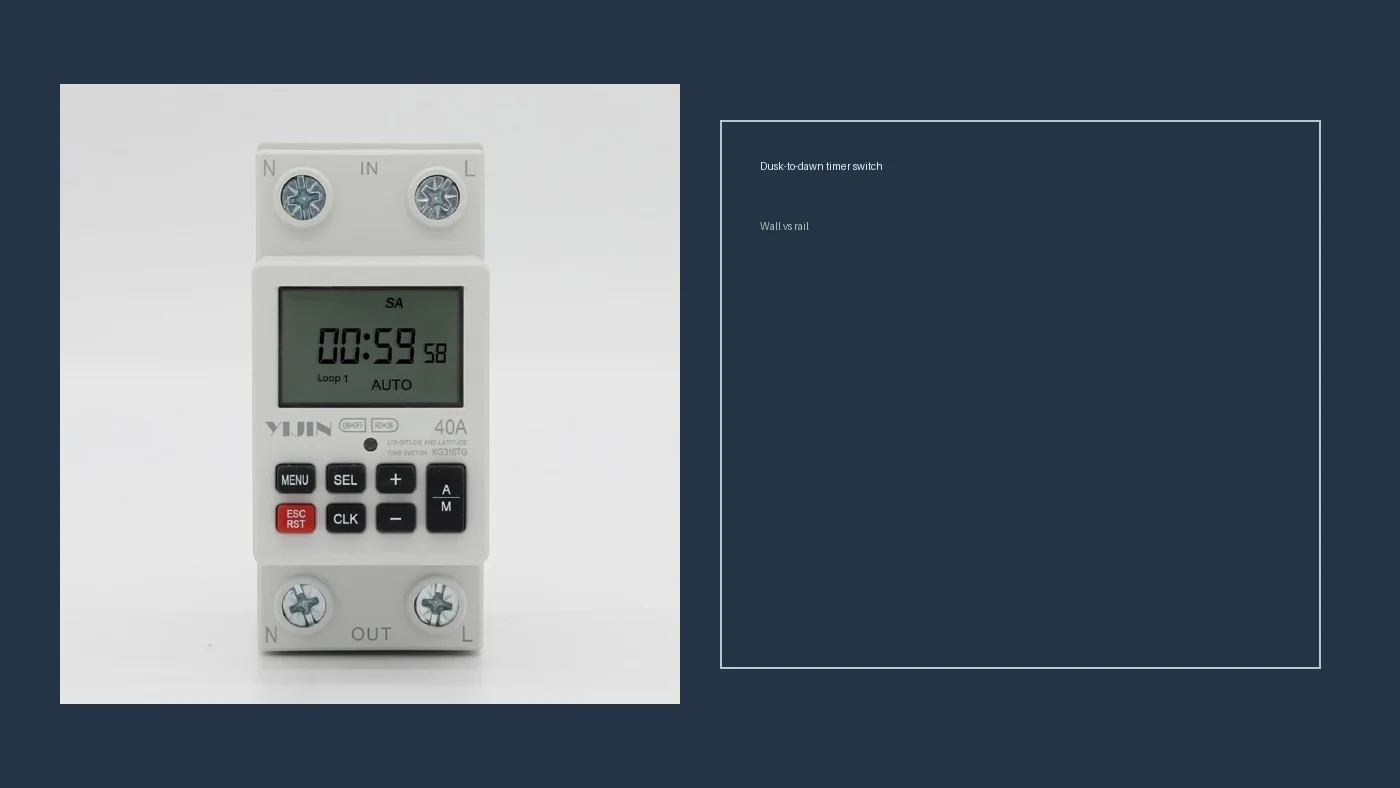
If two answers conflict—for example, “must sense real darkness” and “must live only on an indoor rail”—plan a hybrid with a contactor and a separate eye, or change the specification. Forcing one SKU to pretend it is the other usually shows up as callbacks after the first cloudy week.
Document the chosen path in the submittal so the installer does not swap a photocell timer for a lat/long rail clock on site.
Misfits that break dusk-to-dawn expectations
Dusk-to-dawn jobs fail when the control method and the site disagree, even if the carton says the right phrase.
Photocell misfits include day-burning under overcast skies, night flicker when headlights sweep the eye, and sensors buried behind shrubs. Timers without a light eye will not “see” those events; that is either a benefit or a gap depending on the owner’s tolerance.
Rail clock misfits include leftover program slots that still hold real times, wrong longitude or latitude, and expecting a 120 V wall-box astronomic switch when the sheet is a different voltage class. On lat/long modules, cancelled slots should show as empty markers such as --:-- rather than 00:00 if the manual says so.
Tip: If the switch turns on or off when it should not, cancel unused program rows so they no longer hold live times. Source: https://yijinele-group.com/product/kg316tg36mm-modular-latitude-and-longitude-time-control-switch/
Another hard misfit is treating a non-UL rail datasheet as a drop-in for a project that named a UL Listed wall/outlet timer. Change the submittal language, or change the product family.
Wrong time-zone entry on a lat/long unit can shift dusk by an hour even when latitude looks correct. Recheck zone and DST behavior during commissioning, not after the first complaint call.
Product fit: KG316TG modular lat/long for rail seasonal control
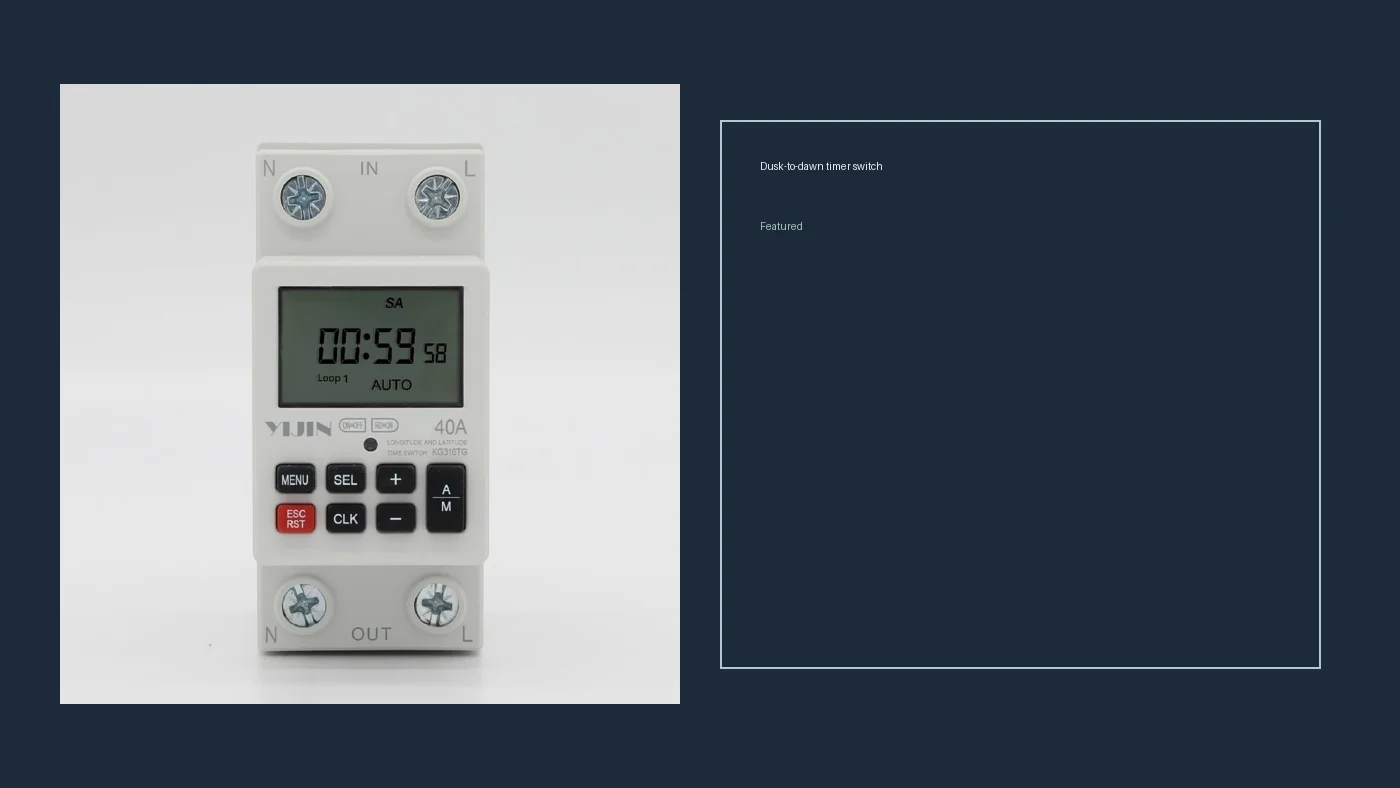
The KG316TG36mm modular latitude and longitude time control switch fits when you need a guide-rail seasonal clock with optional lat/long control—not a photocell wall plate.
Users can enable or disable latitude and longitude control in settings. With lat-long enabled, the switch automatically adjusts on/off times by geography and seasonal sunshine hours. The earth icon on the display marks lat-long mode; without that icon, the unit follows the timed programs you entered.
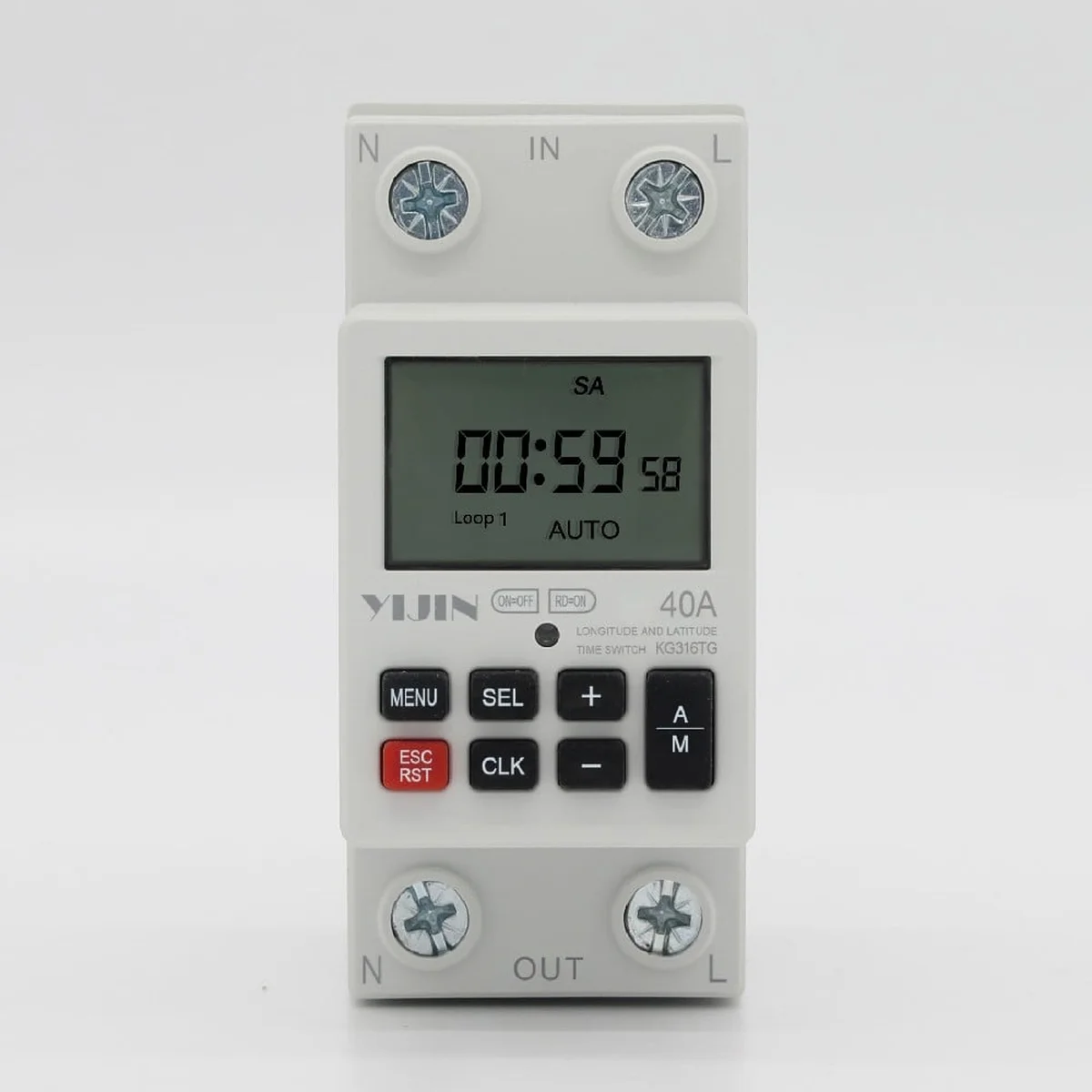
Published performance figures on the live product page include the rows below.
| Parameter | Published value |
|---|---|
| Power supply | AC 187–240 V 50/60 Hz |
| Switch capacity | 40 A resistive; 63 A resistive |
| Time control range | 1 minute to 168 hours |
| Timing error | under ±2 seconds/day |
| Longitude range | 0° E–180° E; 0° W–−180° |
| Latitude range | 0°–80° N |
| Installation | Guide rail |
The live sheet lists AC 187–240 V 50/60 Hz and resistive switch capacity of 40 A and 63 A. Match those figures to your feeder and outdoor lighting load before you order.
Browse the timer switch hub for related rail timing devices when weekly-only clocks or countdown units are a better match than lat/long.
Commissioning still matters after the SKU is chosen. Enter longitude, latitude, and time zone carefully, confirm the earth icon when lat-long should run, and clear unused program rows before the first overnight test.
Owners who need a mixed night window—on at calculated dusk, off at a fixed clock hour—can keep lat-long for the dusk edge and use ordinary timed off events for the curfew. That is still a clock path, not a photocell path.
Skip KG316TG when the package must be a photocell sensor, a UL Listed wall or outlet timer, or a 120 V single-pole astronomic faceplate. Those are different products for different drawings.
For export or OEM projects that standardize on rail timing across sites, one lat/long family can cover multiple latitudes inside the published 0°–80° N range. Recheck each site’s coordinates instead of cloning one city’s program into another city unchanged.
Electrical buyers should also confirm resistive versus inductive load language on the sheet. The published 40 A and 63 A figures are resistive ratings; motor or ballast loads need a separate engineering check and may need a contactor.
Hub navigation on the timer-switch category helps when the job shifts from lat/long seasonal control to a plain weekly digital clock. Keep that cluster split so dusk-to-dawn label articles do not collide with weekly-programming pages.
FAQ
What does “dusk to dawn timer switch” usually mean in US search results?
It usually points to photocell outlets or light-activated outdoor timers, with some astronomic wall switches in the mix. Rail lat/long modules are a separate shortlist once you lock form factor.
Does a dusk-to-dawn label always include a photocell?
No. Some devices use calculated sunrise and sunset instead of a light sensor. Read whether the carton describes ambient sensing or location-based dusk/dawn.
When should I keep a photocell instead of a lat/long clock?
Keep a photocell when the owner wants the circuit to react to real darkness—including odd overcast days—and you can protect the sensor’s view of the sky.
When does a modular lat/long rail timer fit better?
It fits when control must live on a guide rail and schedules must follow geography and season without a facade-mounted eye. Night-curfew outdoor lighting programs are a common reason.
Can KG316TG replace a photocell wall plate?
No. KG316TG is a modular lat/long time control switch for guide-rail mounting. It does not provide a photocell sensor faceplate.
What voltage and load ratings does KG316TG publish?
The live sheet lists AC 187–240 V 50/60 Hz and resistive switch capacity of 40 A and 63 A. Match those figures to your feeder and load type before you order.
How do I know lat-long mode is active on KG316TG?
The earth icon on the display indicates latitude and longitude functions are in use. If the earth icon is absent, the unit runs the timed programs you set.
Why might a programmed rail timer switch at the wrong time?
Extra program rows that were never cancelled can still hold live times. Clear unused slots to the empty marker shown in the product precautions, and re-check longitude, latitude, and time zone.