 Yueqing Yijin Electronics Co., Ltd.



When Code Makes an SPD Mandatory – and When a Rail Module Fits
Are surge protection devices mandatory? Only where your adopted electrical code and the authority having jurisdiction (AHJ) enforce that rule. National headlines about NEC Article 230.67 are not a blank yes for every job. This page separates that mandate path from insurance tips, then shows when an IEC Class II rail SPD sheet still fits a board shortlist after the code path is settled.
When adopted NEC language makes an SPD mandatory
An SPD becomes a hard install rule only when the edition your AHJ enforces includes the service surge section and that section applies to your occupancy and work.
Under the 2020 NEC text that many jurisdictions still use, services supplying dwelling units must be provided with a surge protective device (SPD).
The device must be a Type 1 SPD / Type 2 SPD. It must sit as an integral part of the service equipment or immediately adjacent, unless the code exception places it at the next distribution level toward the load.
Where service equipment is replaced, the same section applies.
The 2023 NEC text expands the occupancy list beyond dwelling units. It adds dormitory units, hotel and motel guest rooms and suites, and patient sleeping rooms in nursing homes and limited-care facilities.
That edition also requires SPDs to have a nominal discharge current (In) of not less than 10 kA.
NFPA’s enforcement map still shows mixed state editions. Treat “the NEC says so” as incomplete until you name the edition your AHJ actually uses.
| Code snapshot | What the reader should verify |
|---|---|
| 2020-style 230.67 | Dwelling-unit services; Type 1 or Type 2; location; replacement |
| 2023-style 230.67 | Broader occupancy list; In not less than 10 kA |
| Earlier editions without 230.67 | No automatic dwelling-service SPD mandate from that article |
| Local amendments | Can add, delay, or remove enforcement |
How AHJ, amendments, and replacement rules change the answer
The AHJ—not a vendor brochure—decides which edition and amendments apply to your permit.
Some jurisdictions amend NEC Article 230.67 so it does not apply. South Carolina’s published regulation states that the article, including (A) through (D), does not apply in that state.
Elsewhere, city memos list concrete triggers: new single-family work, accessory dwellings, panel upgrades, panel change-outs, or PV installs.
AHJ handouts also draw lines around “service equipment.” In one multi-city Iowa metro policy, new dwelling construction and service-equipment replacement require a surge-protection device.
Meter sockets that are not meter-mains are not treated as the SPD trigger for that handout. Multi-panel arrangements may need a case-by-case AHJ call.
From the field: Forum electricians still argue with AHJs over whether a panel change forces an SPD; practitioners say the duty is driven by the NEC and your AHJ, so ask the codes office when bids conflict. Source: https://forums.mikeholt.com/threads/service-spd.2585433/
Replacement language matters. Where 230.67 is in force, replacing service equipment can pull the SPD requirement into an existing building even when older work never had one.
Existing-installation exemptions, if any, are local. Do not invent a national waiver from a forum anecdote.
Insurance tips versus a code install mandate
Homeowners insurance pages usually talk about coverage after a surge, not about a statutory install mandate.
A typical insurer explainer may say lightning-related surge damage can fall under personal property or dwelling coverage, subject to policy limits and exclusions.
The same pages often tip readers to use surge protectors or consider whole-home equipment. That is loss-prevention advice. It is not the same sentence as “your AHJ will fail the inspection without a Type 1 or Type 2 SPD.”
Outside the US NEC path, other wiring guidance can treat transient overvoltage protection as risk-based. An informed customer decision may follow a risk assessment.
Some consumer guidance also notes that a policy may mention SPD expectations for certain claims. Read the policy and ask the agent.
Do not treat an insurance tip as proof that NEC 230.67 surge protection applies at your address.
Voluntary protection and mandatory protection can both be rational. They answer different questions: “Will this claim pay?” versus “Will this permit pass?”
NEC Type 1 or Type 2 wording versus IEC Class II sheet language
NEC Type 1 or Type 2 SPD language is a US code placement system. An IEC Class II SPD mark on a rail datasheet is a different naming system.
Type 1 and Type 2 describe where a listed service-related SPD may connect relative to the service disconnect under the NEC article family that governs SPD installation. Inspectors asking for a Type 1 or Type 2 device for dwelling-service compliance are speaking that language.
Many DIN-rail modules print Class II (and related design-basis standards) instead. That Class II line tells a board designer which test category the sheet claims.
It does not automatically prove the module is the listed Type 1 or Type 2 device your AHJ wants at the service.
Keep the two jobs on two clipboards. Clipboard A: adopted edition, occupancy, location, listing marks the AHJ accepts.
Clipboard B: system voltage, earthing arrangement, rail pitch, and the discharge figures on the module sheet. Crossing the clipboards without translation is how wrong SKUs get ordered.
Where the YJ1-C40 product fits a Class II rail shortlist
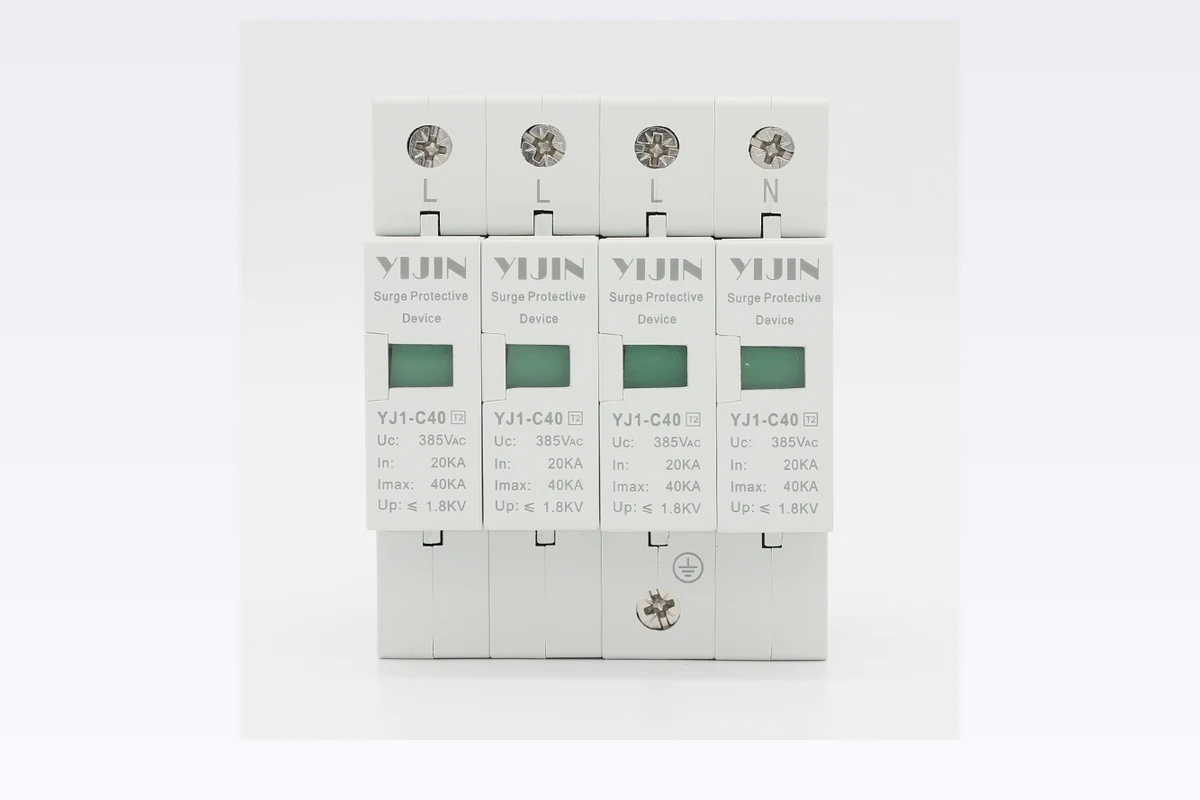
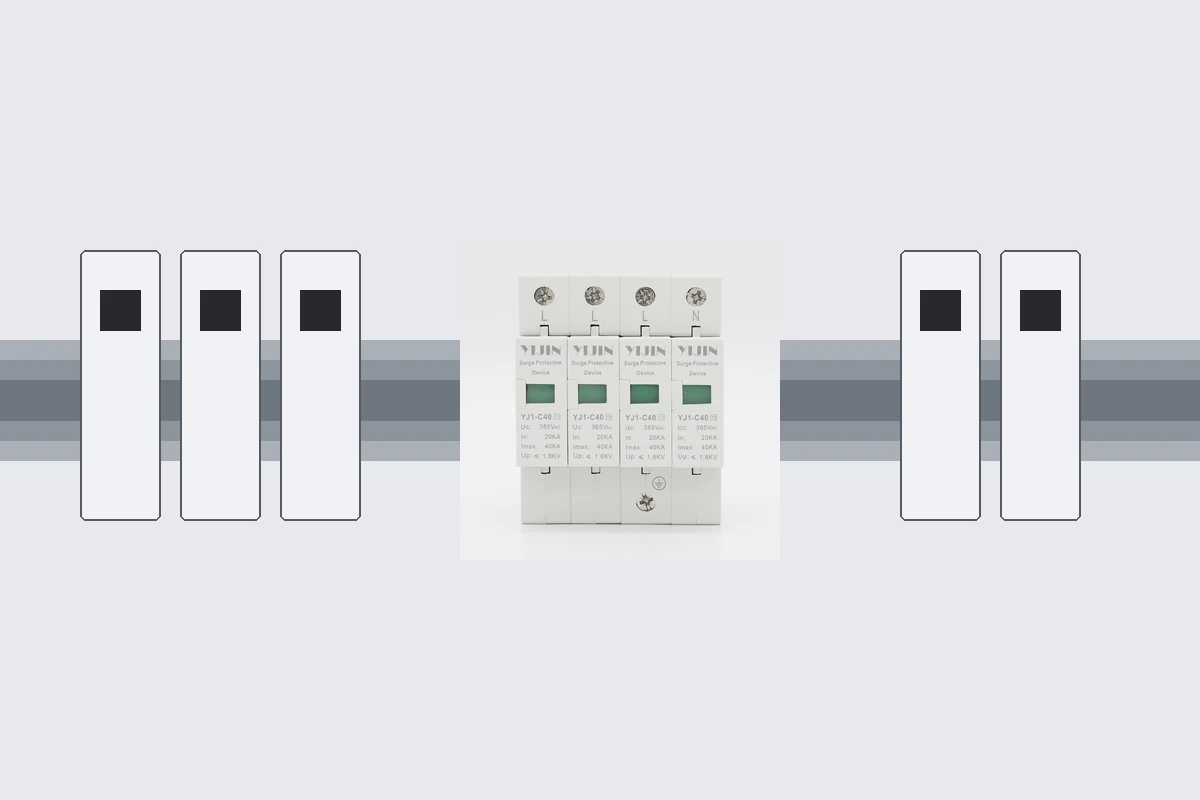
After the AHJ/code path is separate, the YJ1-C40 surge protector fits a Class II rail product shortlist when the printed sheet matches the board—not when you need a claimed NEC Type mark this page does not print.
The live page marks the series as pressure-limiting with a Class II experiment category.
It targets TT, IT, TN-S, and N-C-S systems at AC 50 Hz, 380 V and below. The housing mounts on a DIN rail (35 mm).
Design-basis language on the page cites IEC61643-1 and GB18802.1. That is first-party design-basis wording. It is not a substitute for a US listed Type 1 or Type 2 SPD stamp.
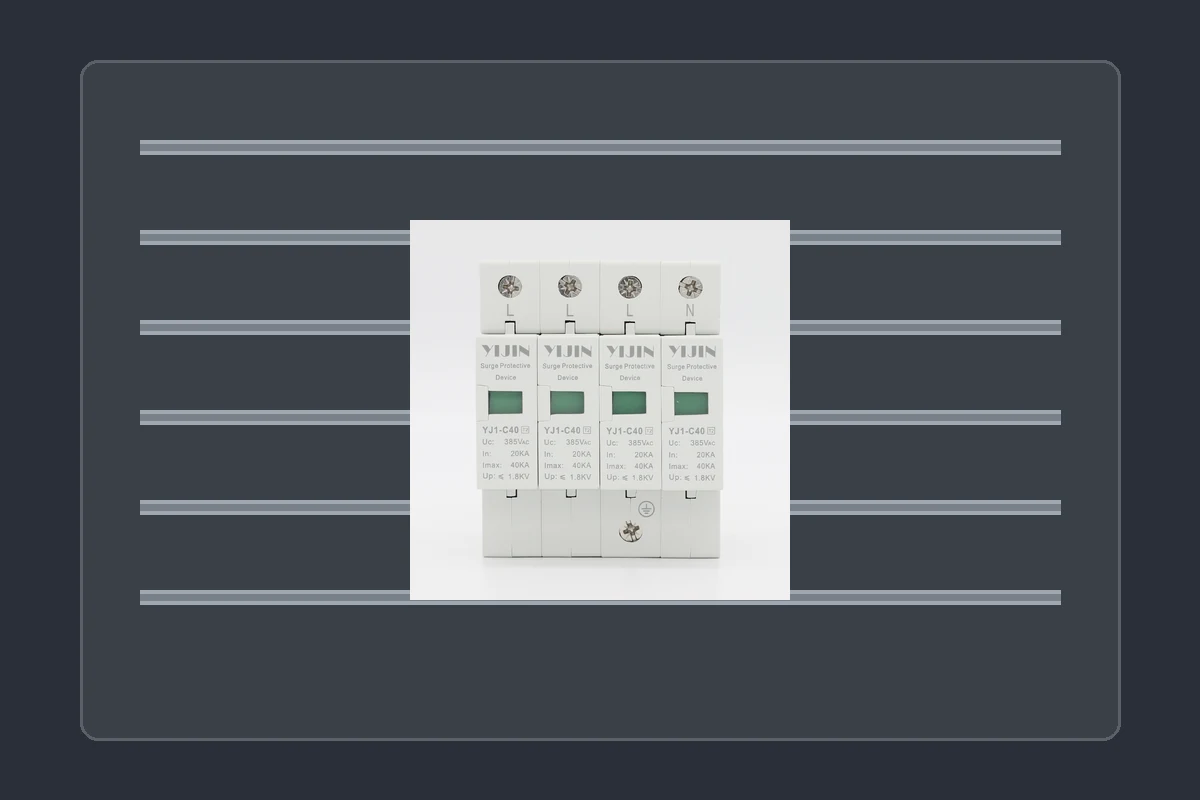
Printed parameters on the sheet include Un 220 V AC 50 Hz; Uc L-N 385 V and Uc N-PE 255 V; nominal discharge current In 20 kA and maximum discharge current Imax 40 kA on an 8/20 µs wave; voltage protection level Up 1.8 kV; response time ≤25 ns; IP20; green/red failure window; optional remote signaling; and 1P–4P pole options.
The page also states housing plastics meet UL94 V-0 standards. That plastics flammability claim is not an SPD listing. Do not rewrite it as a listed surge device or as NEC compliance.
| YJ1-C40 printed line | Honest use |
|---|---|
| Class II / pressure-limiting | Rail module category on this sheet |
| Un / Uc | Match continuous system voltage before buying |
| In 20 kA / Imax 40 kA (8/20) | Sheet discharge figures—not a 2023 code In≥10 kA certificate |
| Up 1.8 kV | Protection level on the printed wave |
| 35 mm rail, 1P–4P, IP20, status window | Board mechanical and indication fit |
| UL94 V-0 plastics claim | Housing material wording only |
| IEC61643-1 / GB18802.1 design basis | First-party design claim—not NEC Type proof |
Recommend this product when the project already knows it needs an IEC Class II rail SPD for a matching AC board—for example a floor distribution box, equipment room board, or similar LPZ interface the page describes—after the permit’s listed service SPD path is handled with whatever device the AHJ accepts.
Do not recommend it as the device that “makes 230.67 go away” for a US dwelling service that still needs a listed Type 1 or Type 2 SPD.
Browse the family index at the surge protection device hub only after the sheet parameters match. The hub is navigation. The decision stays on the model table.
Decision checklist before you shortlist surge hardware
Start with the mandate path. Then open the sheet path. Do not reverse the order.
- Name the NEC edition (or local code) your AHJ enforces, including amendments.
- Confirm whether your occupancy and work type fall under the SPD section that is in force.
- If the job is a service-equipment replacement, ask whether replacement language pulls SPD into scope.
- If bidders disagree, get the answer in writing from the codes office—not from a product brochure.
- Separate insurance policy questions from AHJ install questions.
- If the AHJ requires a Type 1 or Type 2 SPD, shortlist devices that carry the listing language that office accepts.
- If a separate board still needs an IEC Class II rail SPD, match Un, Uc, poles, rail, and discharge figures on the sheet.
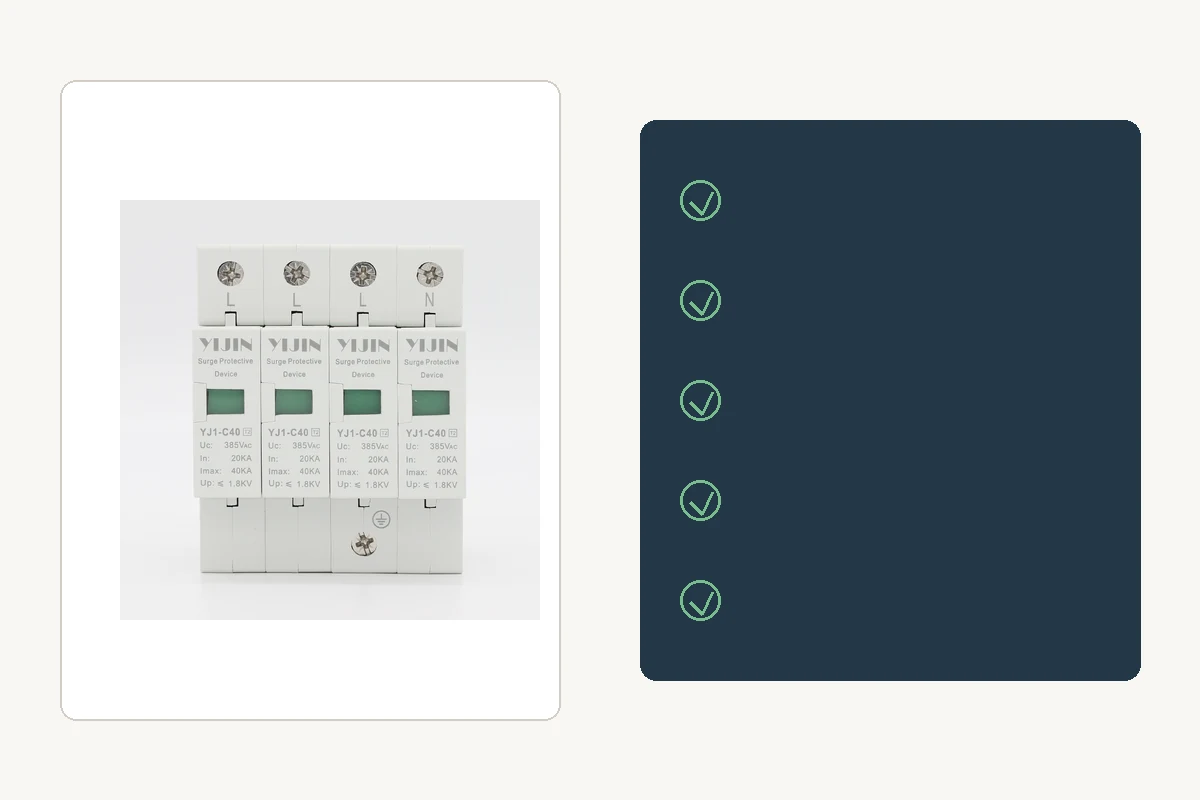
- Only then place a Class II rail candidate such as YJ1-C40 on that second shortlist.
The focus keyword question is not a single global yes. It is a jurisdiction answer first and a datasheet answer second.
FAQ
Are surge protection devices mandatory in every US state?
No. Enforcement depends on the adopted NEC edition and local amendments. Some places enforce 230.67; some still use earlier editions; at least one published state regulation makes 230.67 not apply.
Does replacing a panel always require an SPD?
Not always. Where 230.67 is in force, replacing service equipment can require an SPD.
Local existing-installation rules and what counts as service equipment can change the trigger. Confirm with the AHJ.
What type of SPD does NEC 230.67 call for?
Where that section applies, the SPD shall be a Type 1 or Type 2 SPD. Later edition text also sets a minimum nominal discharge current rating discussed above.
Can a jurisdiction amend the SPD requirement away?
Yes. Amendments and delayed enforcement are real. South Carolina’s published regulation is one public example of 230.67 not applying as written in that state.
Does homeowners insurance require installing an SPD?
Usually not as a universal install statute. Policies may cover some surge losses and may offer tips or claim conditions. Read the policy; do not equate it with NEC Article 230.67.
Is an IEC Class II rail module the same as a NEC Type 1 or Type 2 SPD?
No. Class II is sheet/test-category language common on rail modules. Type 1 and Type 2 are NEC placement/type language for the service-related mandate path.
When does YJ1-C40 fit after the code path is separate?
When the board matches the printed Class II rail table for the systems and voltages on the sheet, including the DIN rail (35 mm) mount and the discharge figures you actually need, without treating the page as NEC Type proof.
Does a plastics flammability line on the sheet mean the module is listed as an SPD?
No. On the YJ1-C40 page that line is a housing plastics claim. It does not authorize a UL Listed SPD or NEC compliance statement for the product.