 Yueqing Yijin Electronics Co., Ltd.




AC Contactor Buzzing With Power Off: Coil Circuit vs Line Power
AC contactor buzzing with power off usually means the coil circuit is still energized—or the meter is showing ghost or induced voltage—not that the outdoor disconnect alone failed to silence the electromagnet. You will separate line isolation from coil supply, contrast residual contactor coil buzzing with true low-voltage chatter, and finish with modular DIN-rail selection using published product facts only.
Why “Power Off” Can Still Leave the Coil Live
Outdoor line isolation does not automatically silence the coil circuit.
On many packaged AC systems, the outdoor disconnect or condenser breaker cuts the high-voltage feed to the compressor and fan. The contactor coil often sits on a separate control circuit fed from the indoor air handler, furnace transformer, or panel control supply.
Pull the outdoor disconnect and the motors stop. The coil can still hum if a cooling call, shorted control wire, or stuck thermostat path keeps control voltage on the coil terminals.
That mismatch explains many searches after “killing power” at the unit. The sound is frequently the electromagnet holding or vibrating, not residual compressor noise.
Treat “power off” as two questions: Is line power open? Is the coil circuit open?
| What you opened | What it usually isolates | What it may leave live |
|---|---|---|
| Outdoor disconnect / condenser breaker | Line feed to compressor and outdoor fan through the power contacts | Indoor-fed coil / control circuit |
| Thermostat set to Off (only) | Intended cooling call | Faults that still feed Y or coil hot; induced voltage on long runs |
| Indoor air-handler / furnace power | Control transformer and board that feed many coils | Nothing useful for outdoor line work if you still need line LOTO |
| Contactor itself | Neither a breaker nor a lockout disconnect | — |
Tip: If the outdoor disconnect is pulled and a faint buzz continues at the contactor, check whether the coil is still receiving control voltage from indoors before replacing parts. Source: r/hvacadvice thread on compressor buzzing with no outdoor power connected.
A contactor is not a circuit breaker and is not a lockout/tagout disconnect. For service work, isolate and prove dead on every energy source that can feed the coil and the line sides, following the authority having jurisdiction and your site’s LOTO program.
Coil-Off Buzz vs Energized Chatter: How to Tell Them Apart
Residual coil energy and low-Us chatter sound similar but branch differently.
Coil-off buzz is noise when the operator believes the unit or control is off: outdoor power removed, thermostat off, or “no call,” yet the coil still hums. Prove whether control voltage is actually present across the coil.
Energized chatter is rapid open/close vibration while a call is supposed to be present. Typical drivers are weak applied coil voltage, high-resistance connections, loose control wiring, or mechanical debris.
HVAC School notes that unintended series resistance can collapse voltage at the coil under load and produce chatter or noise even when a disconnected-wire reading looked fine.
Use one listening cue and one measurement cue:
- If buzz stops when you open the indoor control feed or lift a coil lead (qualified work only), you had residual or commanded coil energy.
- If a call is present, voltage across the coil is soft, and the armature chatters, chase the control supply path as energized chatter.
- If line and coil are both proven dead and noise continues, look for mechanical vibration that is not the coil magnet.
Sibling pages cover broad symptom catalogs and pass/fail how-tos. Here the decision is which energy path is still active when “off” is assumed.
Diagnosis Map: Measure Across the Coil, Then Branch
Measure across the coil under the real control path before condemning the device.
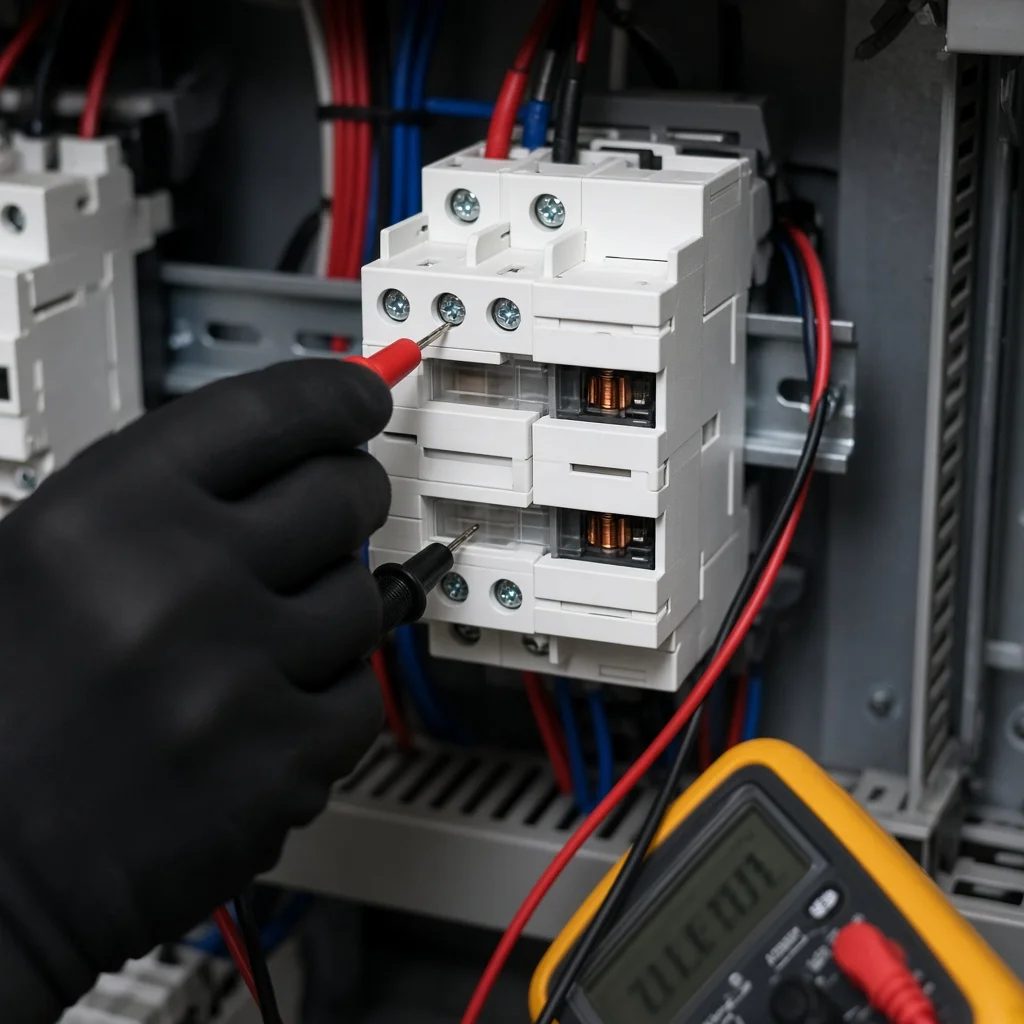
Readers often ask what voltage “should” be at the contactor when AC is off, then mistrust a 24-ish volt reading. Stack Exchange answers show how measuring a floating control leg to an arbitrary reference can display transformer voltage even when the thermostat is not completing the coil circuit.
The useful measurement is across the coil terminals with the wiring in its normal state for the condition you are testing.
Practical branch order (qualified electrical work only):
- State the “off.” Thermostat off? Outdoor disconnect open? Indoor power open? Write it down so you do not mix cases.
- Listen for the coil. Confirm the sound is at the contactor body, not a capacitor can or panel cover.
- Measure across the coil. With the system in the reported “off” state, read coil terminal to coil terminal.
- Read the result. Near-rated control voltage means the coil circuit is still energized—chase thermostat, board, shorted Y, or miswired control. Near zero with a stable open means the coil is not being driven.
- If a call is present and the coil chatters, measure during the attempt to pull in. Soft voltage points upstream. Full voltage with violent chatter points more to mechanical or magnet-face issues after the control path is healthy.
- Confirm suspicious high-Z readings with a low-impedance check before calling the wire “hot.”
Skip invented coil-resistance targets for a modular product that does not publish ohms on its page. Resistance checks belong to the manufacturer’s published data for that coil rating.
Ghost and Phantom Readings That Fake a Live Coil
High-Z ghost voltage can look live until a low-Z check.
Ghost / phantom voltage is the name field techs use when a high-impedance meter shows volts that collapse under a real load. Modern digital multimeters often present input impedance above one megohm.
When an unused or open control conductor runs beside energized line conductors in the same raceway, capacitive coupling can impress a voltage the meter displays as if the conductor were hard-energized. Fluke’s dual-impedance guidance describes this as ghost voltage: the reading can be a large fraction of the adjacent circuit voltage, yet the coupled energy is limited.
A Low-Z / LoZ meter mode—on the order of a few kilohms on common dual-impedance meters—loads the phantom reading down toward near zero, while a hard voltage still displays.
ETC’s technical note on phantom voltage makes the same measurement point for low-voltage control beside line conductors. NEMA’s phantom-voltage bulletin likewise warns that high-impedance instruments can show volts on open conductors with no hard connection, and recommends a listed low-impedance approach when testing open conductors.
How this lands in the buzz case:
- High-Z shows “voltage” on a control lead with the thermostat open → suspect ghost before assuming the coil must hum from that reading alone.
- LoZ collapses the reading → treat as phantom for diagnosis purposes; still prove absence of voltage on circuits that can be hard-energized.
- LoZ still shows substantial voltage → treat the circuit as potentially live and find the real feed.
- A ghost voltage contactor misread wastes parts when the real fault is a shorted control path left unfixed.
Treat ghost language as a measurement discipline, not a substitute for isolation practice before you touch conductors.
Induced Voltage and Residual Control Calls
Parallel control cables next to power often couple enough energy to chatter coils.
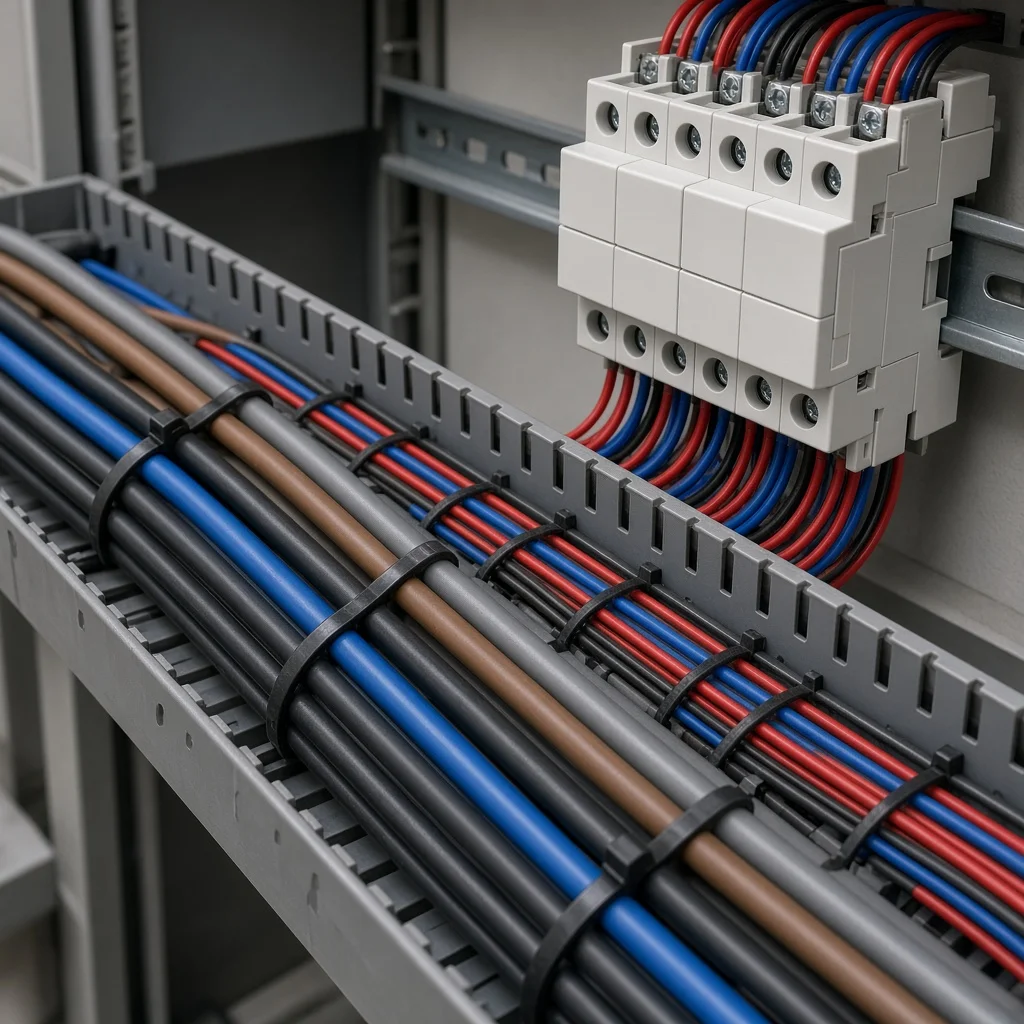
Beyond meter ghost sits energy that actually reaches the coil or solid-state input. Quest’s service note on induced voltage in control wiring describes control conductors run next to other cables—especially long runs and proximity to high voltage—inducing voltage that can keep relays or contactors chattering.
That same note lists equipment that stays running after the intended control opens, and welded contacts as related outcomes. HVAC School also notes induced voltages on long parallel commercial runs as a real phenomenon distinct from simple series voltage drop.
For readers hearing buzz when the thermostat is “off”:
- Confirm the control contact that should open the coil is actually open.
- Check whether long control cables share trays or conduits with power conductors.
- Distinguish a residual commanded call (shorted Y, stuck board relay, failed thermostat path) from induced energy that appears with the intended contact open.
OEM-specific bleed resistors or terminal labels belong to that OEM’s service literature. The transferable lesson is wiring geometry and residual energy.
From the field: Techs who open only the outdoor disconnect while the indoor unit still feeds the coil often blame the contactor first. Source: community reports where buzz continued until the indoor control path was opened.
When the Contactor Itself Is the Noisy Part
Sticky or worn contactors buzz after control faults are cleared.
Once you have proven the coil circuit state, the hardware can still be the noise source. Contractor education pages on “AC buzzing when off” commonly list partially engaged or sticky contactors, debris in the contact gap, and related electrical parts that vibrate.
Independent noise-diagnosis references for electromechanical relays list pitted contacts, dirt, aging coil varnish, and loose connections as chatter drivers when the magnet is trying to seat.
Replace-or-repair logic for this case:
- Control voltage present when it should be absent → fix the control path first; a new contactor will buzz the same way.
- Control correctly open, LoZ shows no hard coil voltage, yet the armature is mechanically stuck or contacts are welded → address the device and any load that welded it.
- Call present, full Us across the coil, chatter continues → inspect for debris, pitting, and mechanical bind; then decide replacement.
- Call present, soft Us → fix supply and connections before condemning a healthy coil.
After the failure mode is clear, selection is a procurement decision. Match the Control voltage / Us, pole count, utilization category, and mounting to the panel.
Product fit: modular AC contactor after the buzz is explained
Match the Us window, DIN-rail form, household utilization-category framing, and published life figures without inventing listings the page does not show.
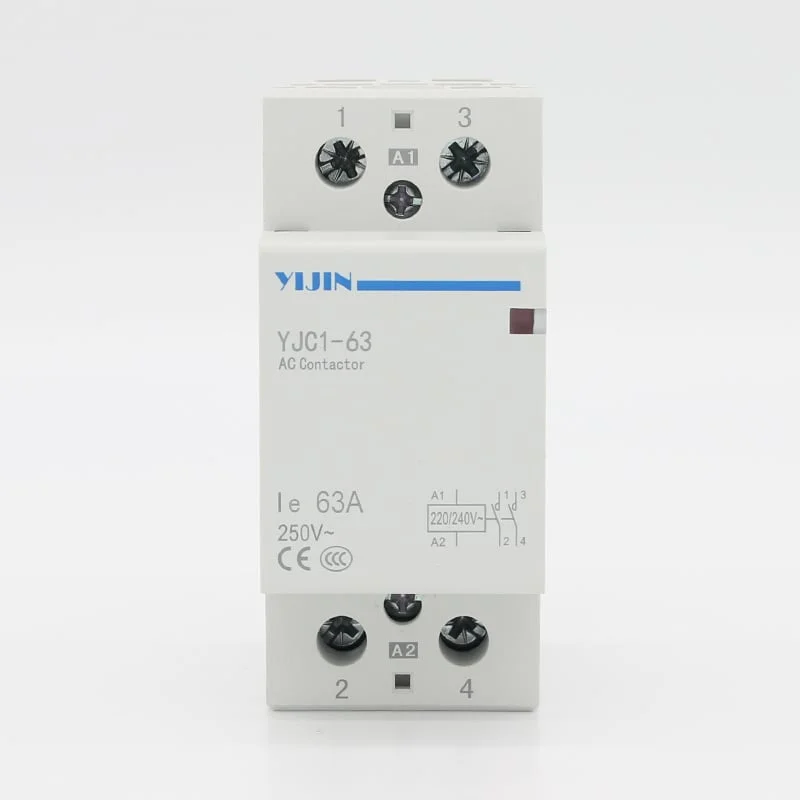
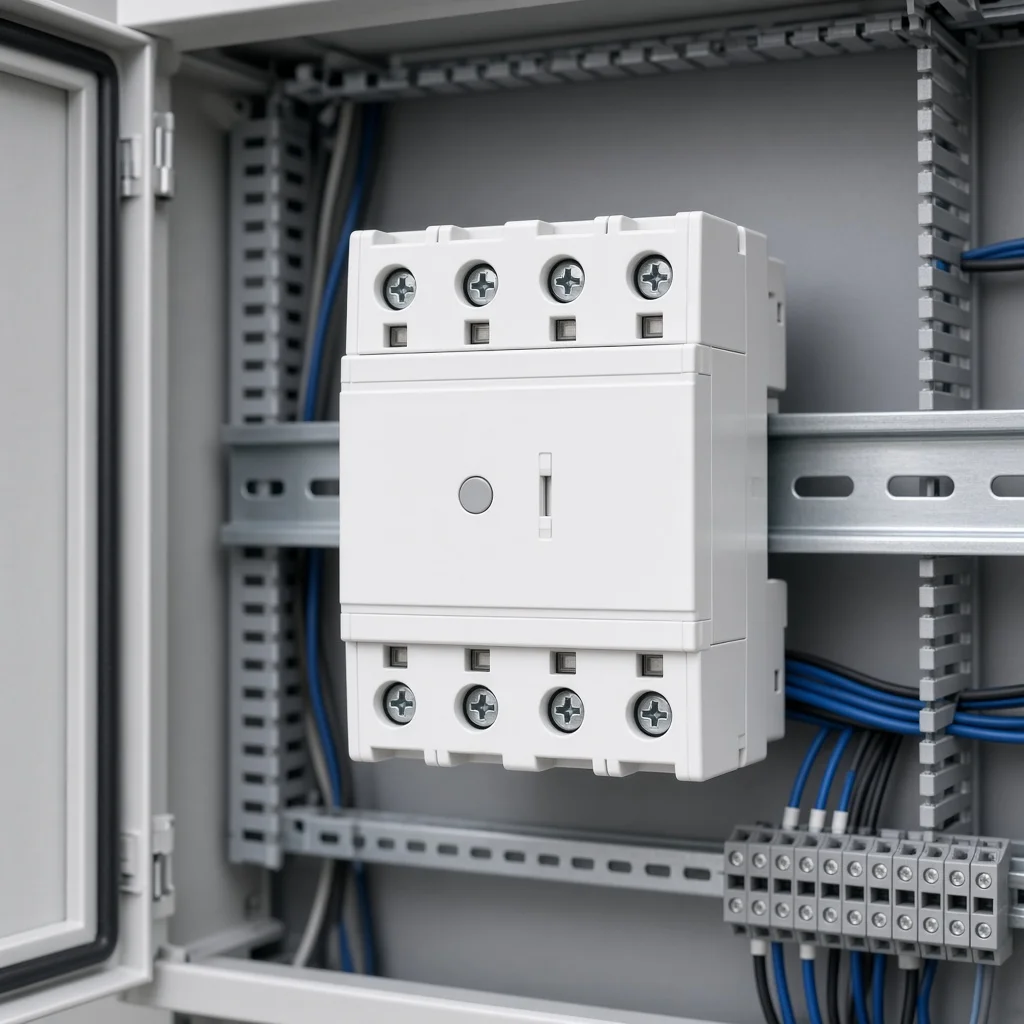
When diagnosis shows a failed modular contactor—or a panel upgrade needs a DIN-rail household AC contactor—the YJC1-63 2P Modular AC Contactor is Yijin’s live fit for this topic. Browse the contactor category for pole and current variants, then confirm parameters on the product page.
Published page facts you can use in RFQs appear below.
| Parameter | Published on YJC1-63 2P page |
|---|---|
| Form / mounting | Modular household AC contactor; DIN rail TH35-7.5 |
| Frequency | AC 50 Hz (or 60 Hz) |
| Rated working voltage context | 230 V |
| Use framing | AC-7a remote switch and main circuit control (page scope) |
| Standards language on page | GB17885 / IEC1095 |
| Us pickup | Reliable close within (80%–110%) Us after thermal stabilization in the stated ambient window |
| Release bounds | Neither higher than 75% Us nor lower than 20% Us |
| Mechanical life | Not less than 1,000,000 cycles |
| Electrical life | Not less than 100,000 operations |
The YJC1-63 2P Modular AC Contactor product page states that the contactor can reliably close at any voltage within (80%–110%) of rated control voltage Us, with release voltage neither higher than 75% Us nor lower than 20% Us, when Us is applied under the page’s ambient note.
The same page places the product in AC 50 Hz (or 60 Hz) systems with a 230 V rated working-voltage context, AC-7a remote/main control framing, GB17885 / IEC1095 language, and DIN rail TH35-7.5 mounting. Mechanical life is not less than 1,000,000 cycles, and electrical life is not less than 100,000 operations.
That Us window is why weak control voltage shows up as noise or failed pull-in: if applied voltage sits outside the published pickup band, quiet seating is unlikely. Match the coil’s rated Us to the available control supply.
Honest limits: the live page does not establish UL Listed or NEC compliance for this SKU. US readers still use NEC/UL language when coordinating site approvals, but those listings are outside what this page proves. The contactor remains a switching device, not a service disconnect.
If Us, poles, and current class match your panel after the buzz path is fixed, the product page and inquiry form are the next step. If the control circuit is still feeding the coil when it should not, quiet the feed before you buy a quieter magnet.
FAQ
Why does an AC contactor buzz after I pull the outdoor disconnect?
Because the outdoor disconnect usually opens line power to the compressor and fan, while the coil may still be powered from the indoor control transformer or board. Confirm voltage across the coil before assuming the contactor is defective.
What voltage should I see across the coil when cooling is off?
With a true open control path and the coil circuit inactive, you should not see hard control voltage across the coil. Floating-leg measurements to an arbitrary reference can display misleading transformer voltage—measure across the coil terminals for the state you are testing.
What is ghost voltage on a contactor circuit?
Ghost or phantom voltage is a high-impedance meter reading caused by capacitive coupling from nearby energized conductors. A low-impedance meter mode typically collapses phantom readings while hard voltage remains. Confirm before treating the reading as coil-driving energy.
Can induced voltage make a contactor chatter with the thermostat off?
Yes. Long control runs routed beside power conductors can induce voltage that chatters relays or contactors even when the intended control contact is open. Separate that case from a shorted or stuck commanded call.
Is contactor buzz the same as energized chatter from low Us?
Buzz with power believed off often means residual coil energy or a measurement mistake. Energized chatter usually means a call is present but applied coil voltage or mechanics cannot hold the armature quietly. Branch the diagnosis before replacing parts.
Is a contactor the same as a breaker or lockout disconnect?
No. A contactor is an electrically operated switch for load control. It is not a circuit breaker and must not be treated as the sole lockout disconnect for service.
Which Yijin modular specs matter after the coil path is fixed?
On the YJC1-63 2P page: AC 50/60 Hz, 230 V working-voltage context, AC-7a framing, TH35-7.5 mounting, Us pickup (80%–110%), release bounds versus Us, GB17885/IEC1095 language, and the published mechanical/electrical life figures. The page does not establish UL Listing.
References
- Fluke — Dual Impedance Digital Multimeters (ghost voltage and LoZ)
- HVAC School — Beware of “Ghost” Voltage
- ETC — Ghost or Phantom voltage and low-Z measurements
- NEMA — Phantom Voltages bulletin (PDF)
- DIY Stack Exchange — Chattering contactor, voltage when AC on/off
Humanizer audit notes (package only)
- Second self-pass completed by Draft Agent YJ-DRF-AGT-20261023-01: shortened long paragraphs, cut meta-process openers, kept Us/life numbers only from the product page, no invented coil ohms/UL.
- No claim IDs, assertion levels, or gate language in reader prose.
- Tip / From the field callouts include Source on the same line.
Evidence callout present
Yes — Tip (disconnect vs coil) and From the field (indoor feed) with same-line Source.