 Yueqing Yijin Electronics Co., Ltd.



Order Label or Class II Rail Sheet for a 2-Pole SPD
A 2 pole surge protection device order usually means a US whole-house Type 2 panel or plug-on unit with two poles for single-phase surge protection—or a Class II surge protector marked 2P on a 1P–4P rail sheet. Those cartons are not interchangeable. This page separates the order label from the rail sheet, shows when Single-phase L-N / L-L framing fits, and shortlists a Class II rail module only after the poles and voltages match.
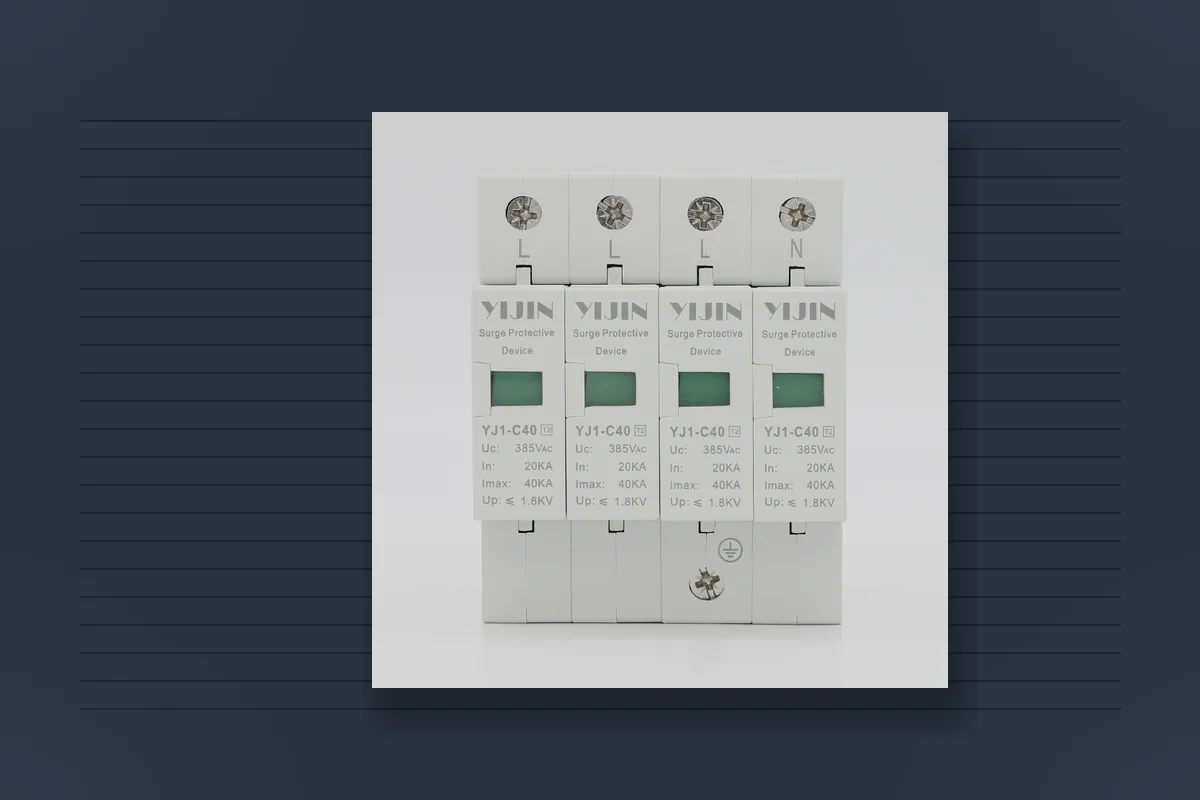
The cover visual frames that order-label versus rail-sheet fork for buyers.
What US buyers mean by a 2 pole surge protection device
Most US hits treat that buyer phrase as whole-house Type 2 hardware, not a DIN-rail Class II shortlist.
Most US search hits for this phrase are whole-house Type 2 SPDs sold as 2-pole, 3-wire, 120/240 V panel-mount or plug-on devices.
Distributor and manufacturer pages lead with poles, single-phase voltage, and panel or breaker form factors. Install sheets for those families often call for a dedicated 2-pole breaker sized to the model.
That shopping path is real. A modular Class II SPD offered as 1P, 2P, 3P, or 4P on one datasheet is a different object.
Procurement teams that stop at the first “2P” carton often bring a plug-on Type 2 into a meeting about DIN-rail Class II boards. Flip that order: name the mount and the listing language before you compare kiloamp figures.
US education from industry associations also separates Type 1, Type 2, and Type 3 roles under NEC / UL 1449 language. Type 2 is commonly described as a permanently connected device for residual and internally generated surges.
That taxonomy helps inspectors and estimators. It still does not tell you whether the SKU is a panel box, a plug-on breaker module, or a Class II SPD on a 35 mm rail.
Distributors hear the same “2 pole” words from residential service crews and from OEM panel builders. The crew may want a whole-house Type 2 on two breaker spaces.
The panel builder may want a 2P Class II rail module beside other modular devices. Same phrase, different bills of material.
Write the RFQ as “US Type 2 panel/plug-on 2P” or “Class II rail 2P” so vendors stop guessing from the marketing label alone. Browse the surge protection device hub when you need the rail family index after the label is decoded.
When a 2-pole order label fits single-phase L-N or L-L framing
Choose 2-pole language when the drawing is single-phase and two poles match the conductors you actually protect.
On many US whole-house Type 2 units, “2P” rides with 120/240 V single-phase, three-wire service talk. Protection modes on plug-on examples may list L-N and L-L paths.
The order label is telling the buyer how many poles land on the breaker or bus. That count is separate from how many IEC Class II test categories the module passed.
On DIN-rail Class II catalogs, a 2P line often means two protected poles for a single-phase network, sometimes with separate notes for TN versus TT topologies. That is still a rail configuration, not a promise that the carton is UL Listed as a Type 2 service SPD.
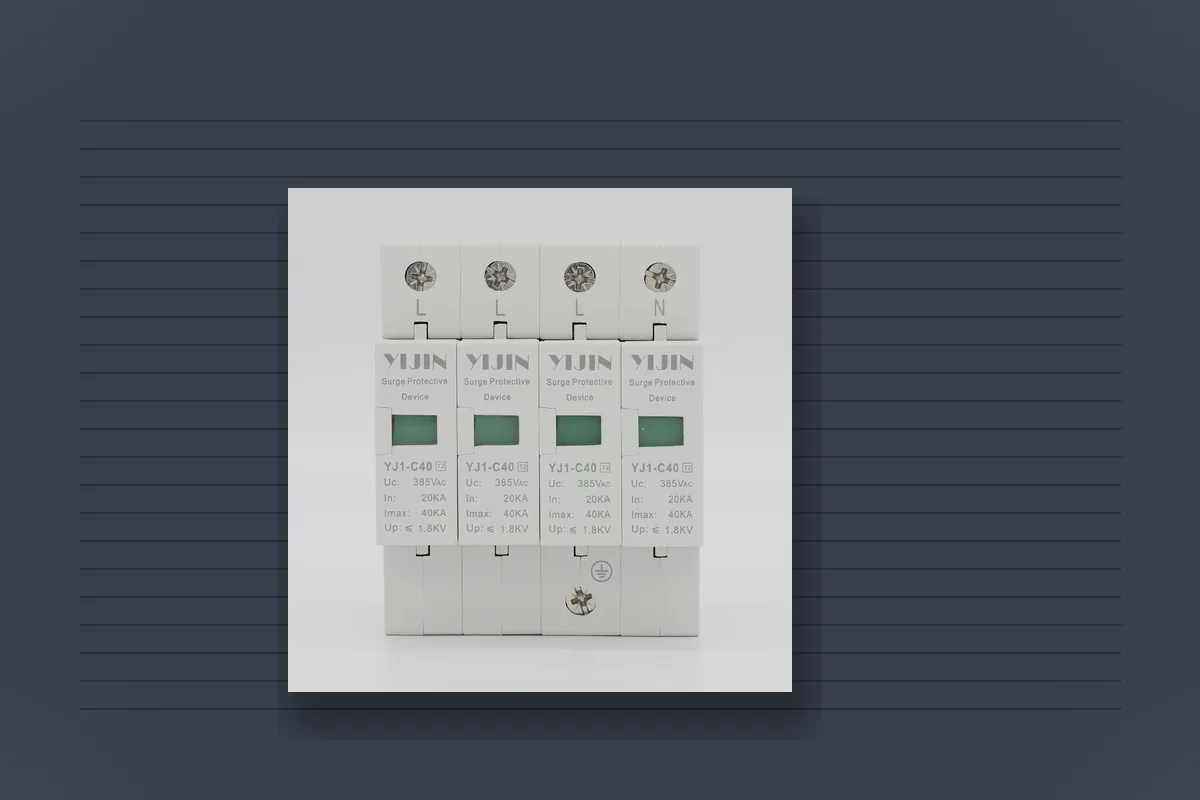
Keep the 2-pole order when the one-line shows two hot paths that need coordinated surge paths and the enclosure has the matching mount. If the drawing is three-phase with a neutral, a 2P label is usually the wrong shorthand.
Move to the 3P/4P discussion on the same family sheet instead of forcing a 2P carton to pretend it is a four-pole board. L-N framing and L-L framing are not decorative synonyms.
Confirm which modes the sheet publishes and which conductors enter the module. Ordering “2P” without that check is how wrong Uc lines get purchased.
How 1P–4P Class II rail sheets map poles to the board
Pole count 1P–4P on a Class II rail sheet is a configuration ladder. Treat that ladder as configuration language, not a US plug-on form-factor code.
Many Class II / Type 2 DIN families publish 1P, 2P, 3P, and 4P options. The number tells you how many poles the manufacturer assembled for the earthing system and conductor set on the drawing.
A 2P row can be the honest pick for a single-phase board. A 4P row is a different shortlist when three phases plus neutral need coordinated paths.
Read the sheet’s system voltage and earthing notes next to the pole count. A first-party Class II rail series may name AC 50 Hz systems at 380 V and below.
It may also list TT, IT, TN-S, and N-C-S among the systems it is written for. Those lines bound the board conversation.
They do not convert the module into a UL Listed NEC Type 2 whole-house device.
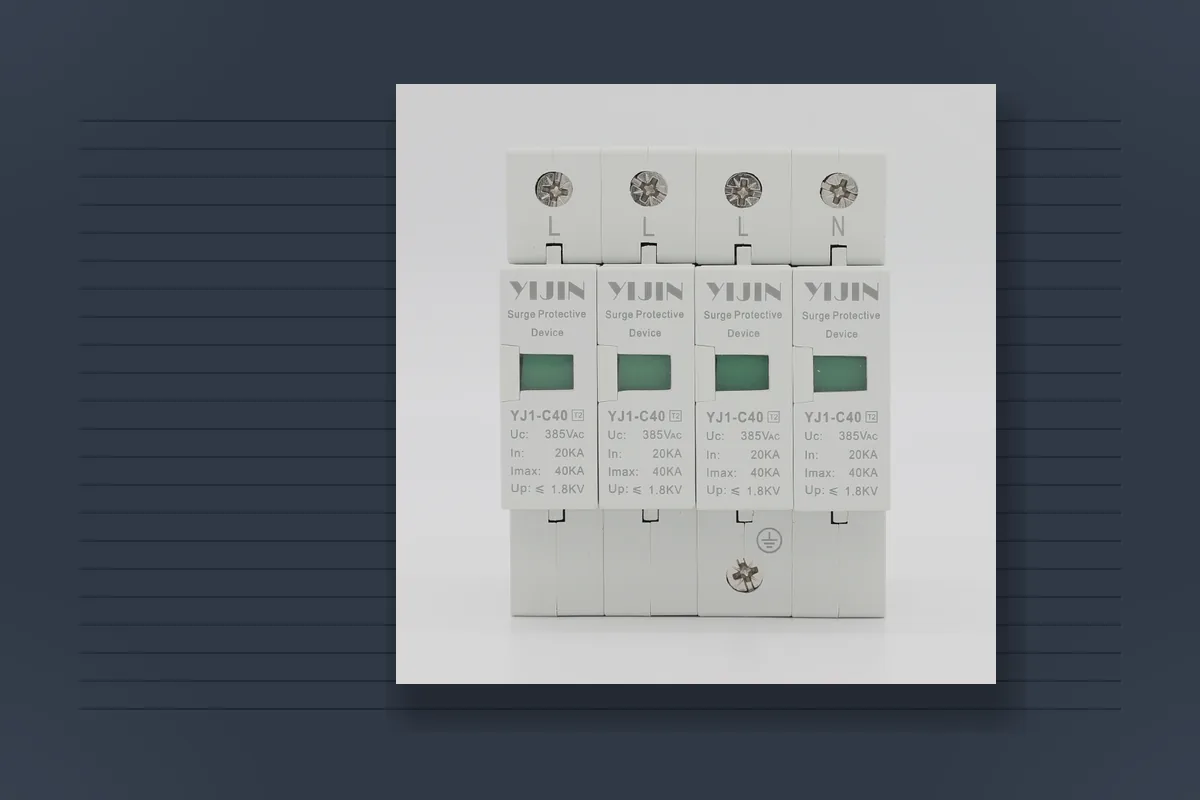
Also separate Class II experiment language from Type 1/2/3 placement talk. Class II on a rail datasheet is a test-category style mark.
US Type 2 talk is a placement and listing conversation. Crossing those clipboards without translation is a common ordering error.
When the sheet also prints design-basis standards such as IEC 61643-1 family language, treat that as design-basis text on the page. Do not treat it as a field certificate taped to the enclosure.
Public standards discussion notes that low-voltage SPD standards evolved toward IEC 61643-11. Writing a standard is still not the same act as listing a product.
Compatibility checklist: 2-pole order label vs Class II rail sheet
Match five decisions before you shortlist hardware: form factor, pole topology, electrical sheet, install habit, and listing expectations.
| Decision | US whole-house / plug-on 2P Type 2 path | Class II rail 1P–4P sheet path |
|---|---|---|
| Form factor | Panel-mount box or plug-on breaker module | Modular DIN rail 35 mm SPD |
| Typical “2P” meaning | Two poles for single-phase 120/240 V service talk | Two poles on a Class II configuration ladder |
| Install habit | Often a dedicated 2-pole breaker sized to the instructions | Rail pitch, wire section, and series OCP notes on the sheet |
| Parameter language | UL 1449 Type labels and kA marketing on US cartons | Uc / In / Imax / Up, Un, and response time on the rail table |
| Listing honesty | Many US SKUs market UL Listed Type 2 | First-party rail sheets may show UL94 V-0 plastics without a UL Listed SPD mark |
Walk the drawing for phase count and neutral. Confirm whether the enclosure only has rail space or needs breaker spaces.
Decide whether the submittal language says “listed Type 2” or “Class II rail module.”
Compare Uc / In / Imax / Up on the sheet to the board you actually have. A rail module that publishes Un 220 V, Uc 385 V L-N / 255 V N-PE, In 20 kA, Imax 40 kA on an 8/20 wave, and Up 1.8 kV is answering a datasheet shortlist.
That shortlist answer does not invent a UL Type 2 listing.
From the field: Electricians pricing whole-house surge work still start from whether two adjacent poles are free for a dedicated double-pole breaker sized to the SPD instructions—panel space, not the word “2P” alone, often decides the install path. Source: https://www.electriciantalk.com/threads/surge-protection.139505/
Document the chosen path in the RFQ so the installer does not swap a plug-on Type 2 for a Class II rail 2P on site.
Misfits that break 2-pole SPD expectations
2-pole jobs fail when the order label and the hardware family disagree, even if both cartons say “2P.”
US Type 2 misfits include assuming any 2P SPD can sit on a random breaker size. They also include ignoring manufacturer max breaker guidance, or treating a plug-on module as a DIN-rail Class II block.
Lead length and slot location habits matter on those installs. Forum crews argue about shared versus dedicated breakers when panels are full.
Rail Class II misfits include ordering 2P for a three-phase one-line that needs 3P or 4P. They also include reading UL94 V-0 housing plastics as a UL Listed SPD mark.
Housing plastics that meet UL94 V-0 speak to material flammability. They do not certify the SPD under UL 1449 Type 2.
Another hard misfit is using a non-listed rail datasheet to satisfy an AHJ that named a listed Type 1 or Type 2 device at the service. Change the submittal language, or change the product family.
Do not invent a listing from a design-basis line.
Wrong earthing assumptions also break expectations. A sheet that names TT, IT, TN-S, and N-C-S still needs the drawing’s neutral and PE arrangement to match the pole kit you buy.
A 2P carton cannot silently become a 4P board kit.
Product fit: YJ1-C40 Class II rail when a 2P module matches
The YJ1-C40 surge protector fits when you need a Class II surge protector on a rail with published 1P/2P/3P/4P configurations—not a UL Listed whole-house Type 2 2P breaker SPD.
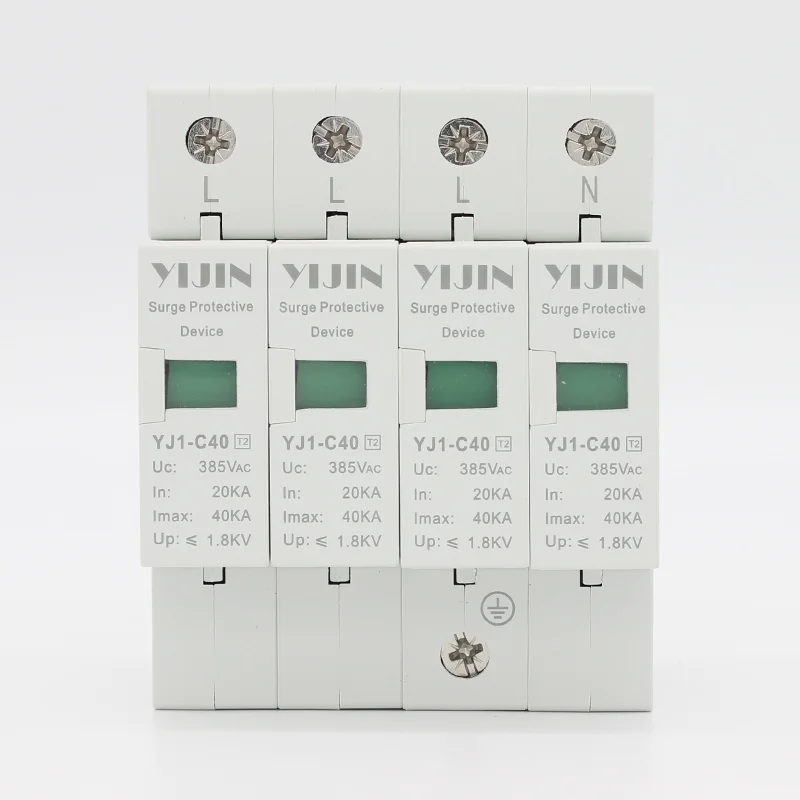
The product photo above is the first-party Class II rail module used for this shortlist.
On the live product page, the series is written for TT, IT, TN-S, and N-C-S power systems with AC 50 Hz at 380 V and below. Design-basis text cites IEC61643-1 and GB18802.1.
The shell mounts on a DIN rail 35 mm electrical rail. The product includes a failure release device and a visual window that changes from green (normal) to red (fault).
Published performance figures on that page include the rows below.
| Parameter | Published value |
|---|---|
| Specifications | 1P / 2P / 3P / 4P |
| SPD category | Pressure-limiting type |
| Experimental category | Class II experiment |
| Rated voltage Un | 220 V AC 50 Hz |
| Uc (L-N) | 385 V AC 50 Hz |
| Uc (N-PE) | 255 V AC 50 Hz |
| In (L-N) 8/20 μs | 20 kA |
| Imax (L-N) 8/20 μs | 40 kA |
| Up (L-N / N-PE) | 1.8 kV |
| Response time tA | ≤25 ns |
| Protection grade | IP20 |
| Installation | 35 mm standard guide rail |
| Housing plastics | Meet UL94 V-0 (material language) |
| Recommended series OCP | 32 A / 10 kA |
Tip: Treat UL94 V-0 on the housing as plastics flammability language only—do not read it as a UL Listed SPD mark for NEC Type 2 submittals. Source: https://yijinele-group.com/product/yj1-c40-surge-protector/
Choose the 2P configuration when the single-phase drawing and earthing arrangement match a two-pole Class II rail kit. Choose 3P or 4P from the same sheet when the board needs those pole counts instead.
Remote signaling contacts are optional on the page. The green/red window is the standard local status cue.
Do not shortlist YJ1-C40 when the project specification hard-requires a UL Listed Type 2 whole-house or plug-on SPD. In that case the honest move is a different product family, not a forced reinterpretation of this sheet.
FAQ
What does “2 pole surge protection device” usually mean in US search results?
It usually means a whole-house Type 2 SPD sold as a 2-pole panel-mount or plug-on device for single-phase service talk. A Class II DIN-rail 2P module is a different form factor that can still appear under the same buyer phrase.
Is a 2-pole SPD only for single-phase boards?
Often that is how the order is framed—L-N or L-L single-phase paths. Confirm the one-line. Three-phase boards usually need a different pole count from the same rail family, not a forced 2P carton.
Do I need a dedicated 2-pole breaker for every 2P SPD?
Many US Type 2 whole-house units are installed with a dedicated 2-pole breaker sized to the instructions. That habit belongs to those products. A rail Class II sheet follows its own series OCP and wiring notes instead of inventing a UL Type 2 breaker rule.
Does 2P on a Class II rail sheet equal a US plug-on Type 2 SPD?
No. Pole count can match while form factor and listing language differ. Read mount, Type vs Class II wording, and listing marks separately.
What do 1P/2P/3P/4P mean on YJ1-C40?
They are the published configuration options on the Class II sheet. Pick the pole count that matches the conductors and earthing arrangement on the drawing.
Is UL94 V-0 the same as UL Listed SPD?
No. UL94 V-0 describes housing plastics flammability on the page. It is not a UL Listed SPD declaration under UL 1449 Type language.
What In, Imax, and Up does the YJ1-C40 page publish?
Nominal discharge current In is 20 kA on an 8/20 wave. Maximum discharge current Imax is 40 kA on an 8/20 wave. Voltage protection level Up is 1.8 kV for the published L-N and N-PE rows.
Can YJ1-C40 satisfy an AHJ that requires a listed Type 2 SPD?
Not from the facts on this sheet. If the AHJ requires a listed Type 1 or Type 2 device, change the submittal or the product family rather than stretching Class II rail language.
References
- NEMA — Low Voltage Surge Protective Devices — Authority education on Type 1 / Type 2 / Type 3 SPD roles for permanently connected and point-of-use devices.
- Type 2 SPD standard summary PDF — Standards-host summary of Type 2 as a permanently connected SPD on the load side of the service equipment overcurrent device.
- Wikipedia — Surge protector — Independent overview of how low-voltage SPD standard lineage is discussed in public technical writing.
- Electrician Talk — Surge protection thread — Field discussion of dedicated double-pole breaker habits for whole-house SPD installs.