 Yueqing Yijin Electronics Co., Ltd.




Combination-Type AFCI Versus Branch, Outlet, Dual-Function, and DIN-Rail AFDD Faces
A combination type arc fault circuit interrupter is the AFCI class that watches both parallel and series arcing on a US dwelling branch circuit. The word “combination” does not mean AFCI plus GFCI. This page separates that class from branch/feeder, outlet, and dual-function faces, then compares it with the printed DIN-rail AFDD face on Yijin’s YJB1-63/AFD.
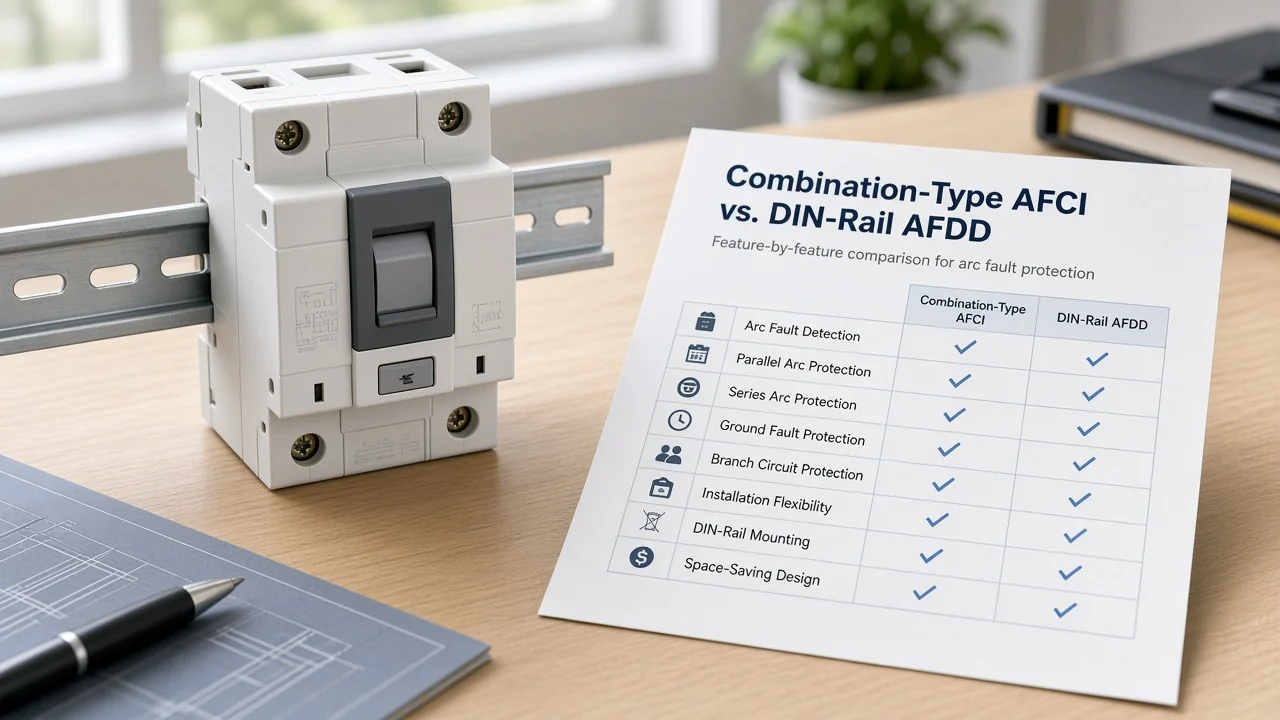
Photo for the class comparison.
What “combination” means on an AFCI
A combination-type AFCI detects both parallel arcing and series arcing; the label does not add Class A GFCI shock protection by itself.
Parallel arcing is the high-energy path between line and neutral or line and ground, such as a nail through a cable. Series arcing is the lower-energy gap along one broken, frayed, or loose conductor. Education sources use “combination” for that pair of arc watches, not for stacking AFCI with GFCI.
From the field: On Electrician Talk, one reply puts the naming bluntly: “combination refers to detecting series and parallel arc faults,” and AFCIs carry GFP behavior that is not the same as GFCI people protection.
If you still need the deeper sensing story after the naming is clear, read the sister note on how AFCI breakers work instead of stretching this page into a waveform tutorial.
Hallway enclosure context.
Combination-type versus branch/feeder AFCI
Combination-type AFCI education adds series-arc detection on top of the parallel-arc watch that branch/feeder AFCI types were built around.
A branch/feeder AFCI is described as handling line-to-neutral and line-to-ground arcing. A combination-type unit is taught as covering those parallel cases plus series arcing in the branch wiring and cord sets. Encyclopedia summaries of UL 1699 type testing often cite a 75 A parallel arcing trip figure for branch-type devices and a 5 A series arcing trip figure once combination-type series detection is included.
| Face | Arc watch taught in US education | Typical use in a decision |
|---|---|---|
| Branch/feeder AFCI | Parallel (line-to-neutral / line-to-ground) | Older panel path; often paired with another device for full means |
| Combination-type AFCI | Parallel plus series | Single breaker protecting the entire branch under NEC 210.12(A)(1) education |
| Outlet branch-circuit AFCI | Outlet-face AFCI used at first outlet or in paired means | Remodel or first-outlet pathways |
| Dual-function AFCI/GFCI | Combination-type AFCI plus Class A GFCI | Circuits that need both arc-fire and shock protection |
For a bedroom or living-room circuit where one listed combination breaker is the plan, combination-type is the face the code-education path usually points to first. Branch/feeder alone is the older, narrower panel type in that comparison.
Combination-type versus outlet branch-circuit AFCI
An outlet branch-circuit AFCI is a different device face used in first-outlet or paired NEC means, not another name for a combination breaker.
NEC 210.12 education lists several means. One common alternative to a single combination-type breaker is a listed branch/feeder AFCI at the panel origin plus a listed outlet branch-circuit AFCI at the first outlet box, with that first box marked. Field threads also ask whether an AFCI receptacle at the first location can help when shared-neutral breaker installs are awkward.
Treat the outlet face as a pathway choice. It can protect downstream wiring and cord sets from the receptacle forward, and in paired means it shares the job with a panel device. It is not proof that every “AFCI” print on an outlet is interchangeable with a combination-type panel breaker.
Combination AFCI versus dual-function AFCI/GFCI
Dual-function AFCI/GFCI stacks Class A GFCI on combination-type AFCI when both arc-fire and shock protection are required on the same circuit.
Kitchen and laundry circuits are the usual teaching example: later NEC cycles ask for both AFCI and GFCI coverage there. A dual-function breaker or receptacle puts combination-type AFCI detection and Class A 5 mA GFCI in one device. A combination-only AFCI still leaves the GFCI job to a separate receptacle or breaker when shock protection is required.
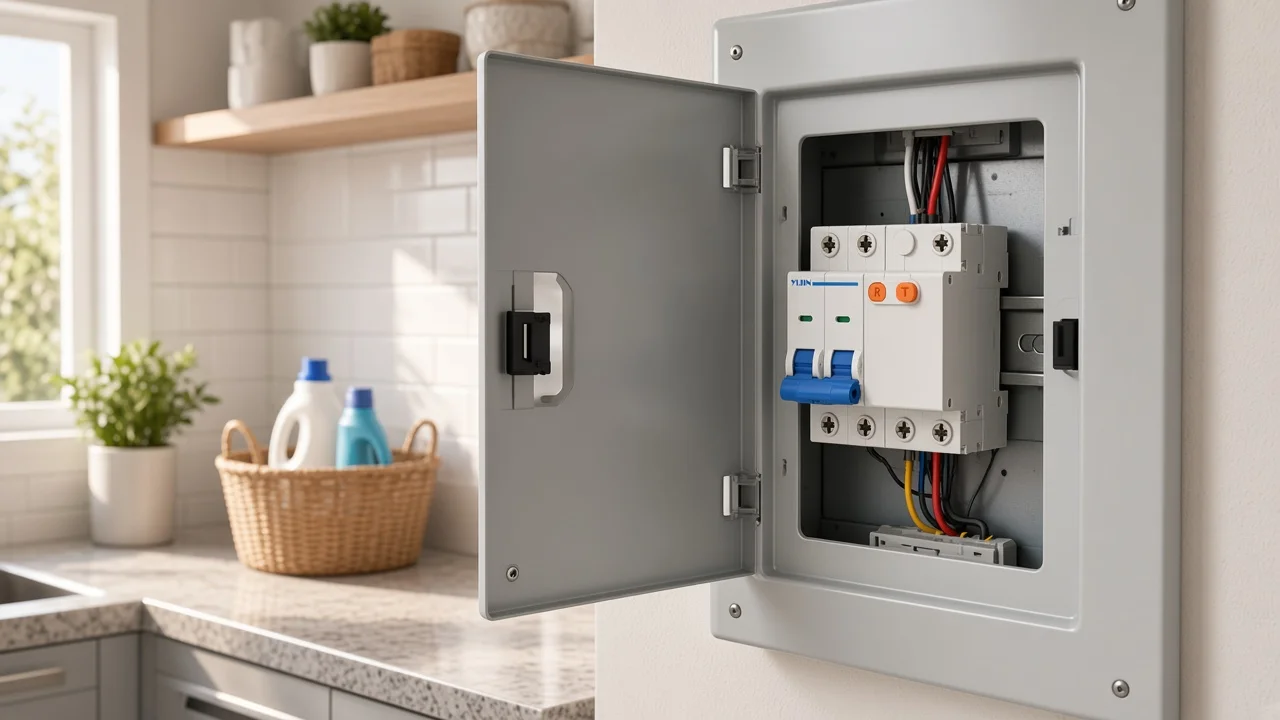
Kitchen and laundry context.
If the primary question is AFCI versus GFCI as protection technologies, use the sister comparison on arc-fault circuit interrupter vs ground-fault circuit interrupter. This page only needs the naming split: combination ≠ dual-function.
How NEC 210.12 and UL 1699 treat combination-type
NEC 210.12 lists a listed combination-type AFCI that protects the entire branch circuit as a primary means, and UL 1699 is the US product-family standard behind those dwelling AFCI types.
For dwelling-unit 120-volt, 15- and 20-ampere branch circuits serving the rooms named in the adopted code edition, education sources walk means (1) through (6). Means (1) is the listed combination-type AFCI installed to protect the entire branch.
Other means pair panel and outlet devices or use special wiring conditions. UL 1699 catalog scope text covers branch/feeder, outlet circuit, portable, and cord AFCIs for dwelling units, with a maximum rating of 20 A for use on 120 V ac, 60 Hz circuits.
That is the US listing and code context for combination-type language. It is not a transfer ticket that turns every overseas AFDD print into a UL 1699 combination-type branch AFCI.
Combination-type AFCI class versus the YJB1-63/AFD DIN-rail AFDD face
The live YJB1-63/AFD face is a DIN-rail AFDD with 230 V / 50 Hz / GB/T ratings, not a UL 1699 combination-type branch-panel AFCI.
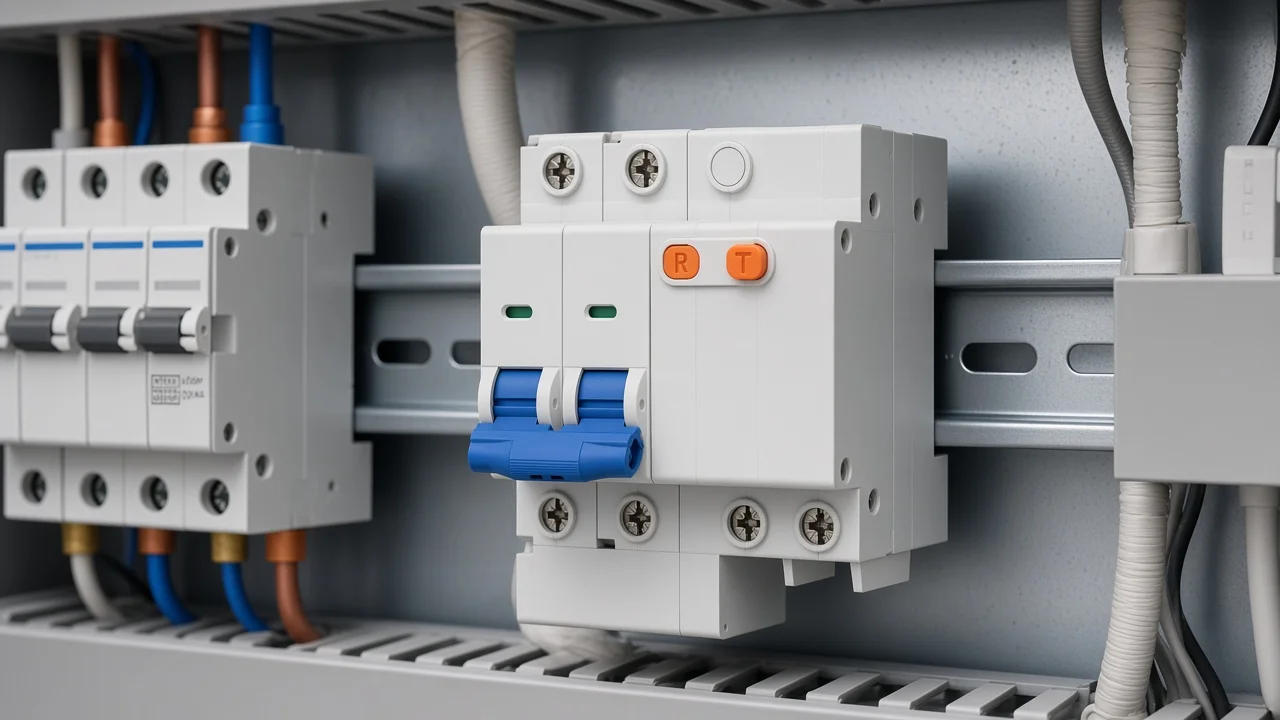
DIN-rail board context.
Independent technical education separates AFCI listing language from AFDD language used with DIN rail practice. Related fire-prevention jobs do not make the listing faces interchangeable.
Yijin’s live product page describes an AFDD arc-fault protection circuit breaker assembled from a small circuit breaker and an arc fault protection module for AC 50 Hz, rated voltage 230 V, and rated current up to 63 A, with overload, short-circuit, and series/parallel arc protection. The parameter table lists standard rail installation and GB/T31143.
| Class cue | US combination-type AFCI education | Live YJB1-63/AFD evidence |
|---|---|---|
| Naming on the face / datasheet | Combination-type AFCI / CAFCI in UL 1699 family | AFDD / YJB1-63/AFD language on the product page |
| Voltage and frequency | 120 V class education; 60 Hz in UL 1699 scope text | 230 V; 50 Hz on the live page |
| Current class taught | 15 A and 20 A dwelling branch education; UL 1699 max 20 A scope text | Currents through 63 A on the live page |
| Mount | US load-center / branch-panel breaker face | Standard rail installation |
| Standard printed | UL 1699 family education | GB/T31143 on the live page |
Do not invent LINE, LOAD, or pigtail marks for this SKU. Those marks belong to US panel AFCI diagram language owned by the wiring-diagram sister article, not to this class comparison.
When YJB1-63/AFD fits a DIN-rail AFDD decision
Choose the YJB1-63/AFD DIN-rail AFDD when the board needs standard-rail AFDD-class protection that matches the printed ratings, not when you need a US load-center combination-type AFCI.
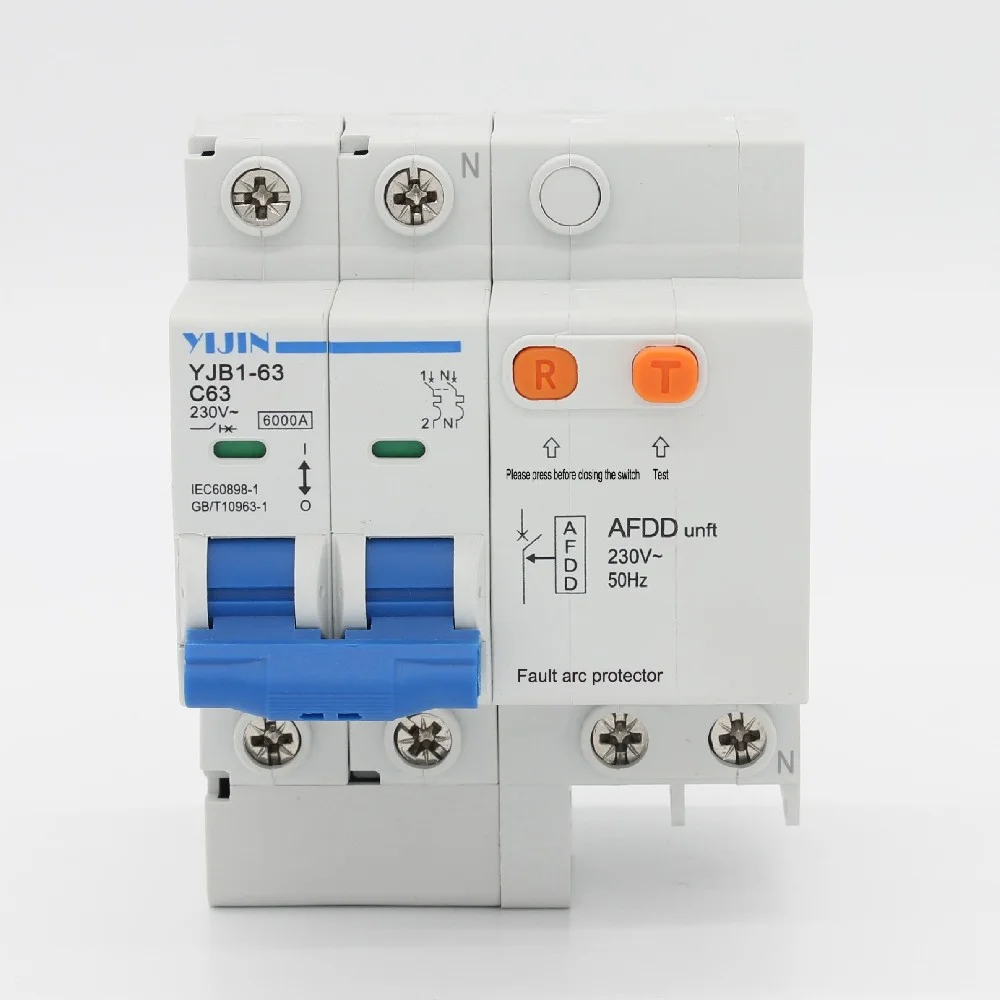
Product face for the rail AFDD decision.
On the live page, the assembly provides overload, short-circuit, and arc-fault protection for building and similar lines at AC 50 Hz and 230 V, with listed currents of 10/16/20/25/32/40/50/63 A in a 2P table, series and parallel arc protection, Serial arc: 5 and Combined arc: 75 in the page wording, IP20, altitude 2000 m, and mechanical life greater than 6000 operations. That package belongs on a DIN-rail AFDD specification.
Skip this SKU when the purchase order is for a UL 1699 combination-type breaker that must drop into a US panel CAFCI slot, or when the only missing protection is Class A GFCI. For the cluster hub of related rail products, start from Others.
FAQ
What does “combination” mean on an AFCI?
It means the device is taught to detect both parallel and series arcing. It does not mean GFCI is built in.
Does a combination AFCI include GFCI protection?
No. Dual-function AFCI/GFCI is the face that adds Class A GFCI on top of combination-type AFCI.
How does combination AFCI differ from branch/feeder AFCI?
Combination-type education adds series-arc detection beyond the parallel-arc watch associated with branch/feeder AFCI types.
What is an outlet branch-circuit AFCI used for?
It is an outlet-face AFCI used at the first outlet or in paired NEC means, not a second name for a combination breaker.
When do I need a dual-function AFCI/GFCI instead?
When the circuit needs both combination-type AFCI and Class A GFCI, such as kitchen or laundry examples in later NEC teaching.
Is a DIN-rail AFDD the same as a combination-type AFCI under UL listing?
No. AFDD/DIN-rail hardware can share the fire-prevention topic, but it is not an automatic UL 1699 combination-type branch AFCI.
Which NEC 210.12 means uses a combination-type AFCI alone?
Education sources point to 210.12(A)(1): a listed combination-type AFCI installed to protect the entire branch circuit.
What ratings does the live YJB1-63/AFD page print?
AC 50 Hz, 230 V, currents through 63 A, standard rail installation, GB/T31143, plus overload, short-circuit, and series/parallel arc protection on the AFDD assembly.
References
- JADE Learning — AFCIs: What You Need to Know
- JADE Learning — Combination Arc-Fault Circuit-Breaker VS. Dual Function
- IAEI Magazine — What’s NEW about AFCIs in the 2014 NEC?
- EC&M — The Apprentice’s Guide to AFCIs and the NEC
- Wikipedia — Arc-fault circuit interrupter
- UL Standards catalog for arc-fault circuit interrupters
- Industrial Control Academy — Arc Fault Protection
- Electrician Talk — AFCI Tripping, Ideas?
- Electrician Talk — Afci shared neutral