 Yueqing Yijin Electronics Co., Ltd.




Under Voltage Relay Testing on DIN OUV Protectors: Windows, Delays, Meter Limits
Field under voltage relay testing on a DIN-rail over/under voltage protector (OUV) is a serviceability read of trip and restore windows plus delays. The walkthrough below covers under-voltage relay / UV element behavior on the rail, how pickup / trip cutoff differs from reset / dropout, what trip delay / restore delay and a multimeter continuity check can show, and when an auto-restore / reclosing protector should be re-set or replaced. United States buyers: treat 50 Hz / 60 Hz and related page labels as labels, not UL or NEC approval.
What Field Under Voltage Relay Testing Can Prove
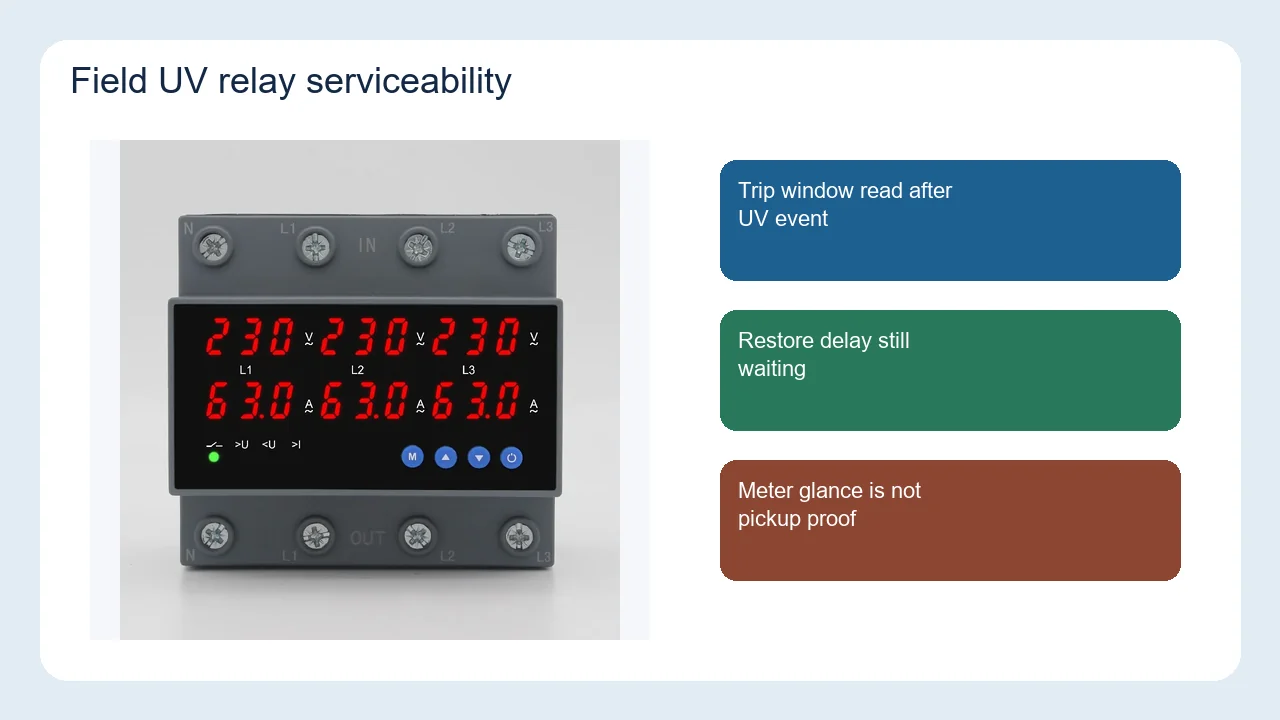
Field under voltage relay testing on a DIN OUV protector proves whether open and restore behavior still lines up with the published trip window and delays.
Commissioning write-ups for classical protection relays start with isolation and a calibrated voltage source or relay test set. They then run a controlled reduce-from-nominal UV ramp so pickup voltage and operate time can be compared to settings.
That method injects voltage at the relay inputs without energizing the primary system. It is the right language for many ANSI 27 jobs. It is a different job from walking a low-voltage DIN auto-restore protector with only a handheld meter.
When a variable source is available and the maker’s procedure allows it, UV pickup is found by lowering voltage until the protector opens, and delay is timed as a separate measurement against the set seconds. Yijin does not sell a portable UV relay tester. Without a controlled source, the honest field path is window literacy, delay literacy, documented supply events, and clear limits on what a beep or a live-voltage glance can show.
| Job | What you control | What a pass can mean |
|---|---|---|
| Secondary injection / relay test set | Injected voltage and timing at the inputs | Pickup and operate time versus settings and maker tolerance |
| Field DIN OUV walkdown | Published cutoffs, resets, delays, and observed board behavior | Serviceability judgment rather than a lab certificate |
Tip: Treat how to test undervoltage relay search results that jump straight to secondary injection as a different scope — useful vocabulary, not a script to invent on a rail module without the kit those pages assume. Source: Forum Electrical OV/UV relay test steps.
Read the Trip Window and Restore Delays
The trip cutoff and the restore point are different voltages. Restore almost never happens the instant the line looks almost fine.
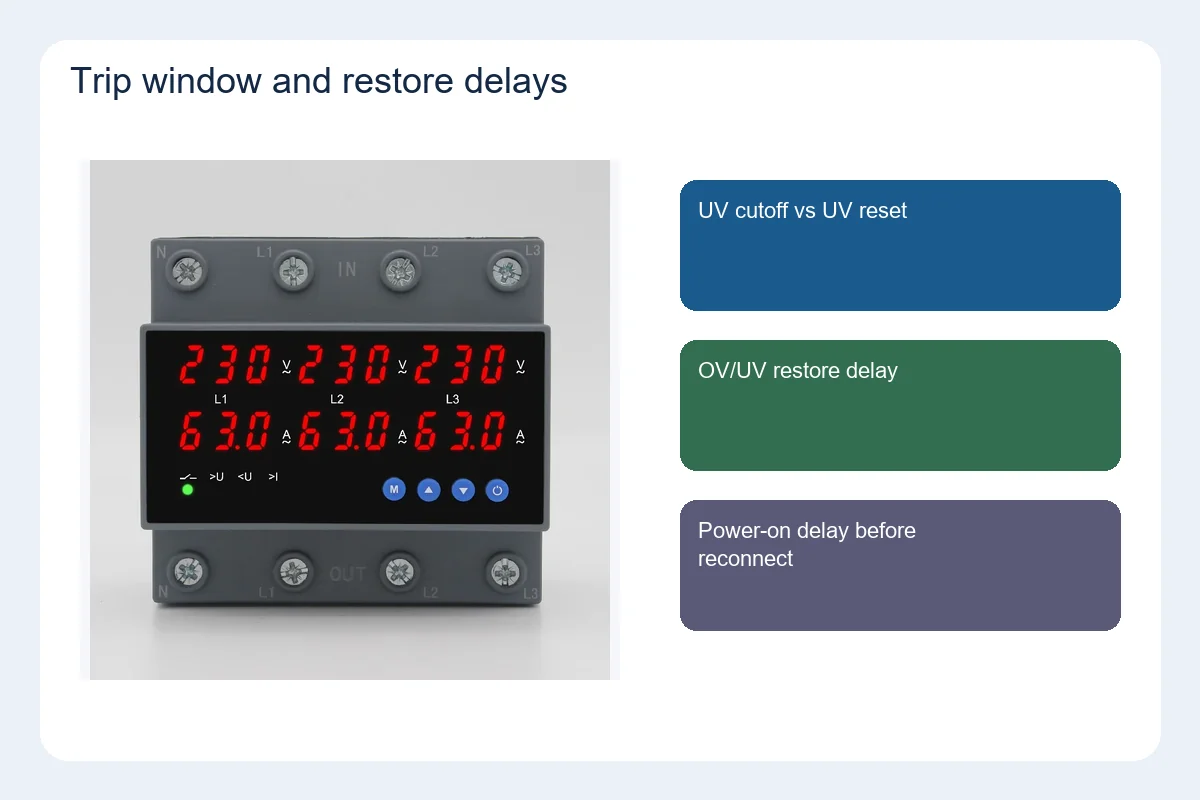
On the live YJQGA-63 3P+N card (AC220 V / 230 V class), Yijin publishes an undervoltage action cutoff adjustable from 140 V to 200 V (default 170 V) and a UV reset from 145 V to 205 VAC that sits 5 V above the UV threshold (default 175 V).
Overvoltage cutoff runs 240 V to 300 V (default 270 V) with an OV reset 5 V below the OV limit (default 265 V).
OV/UV reset delay is adjustable from 5 to 300 s (default 30 s).
Power-on delay is adjustable from 1 to 300 s (default 5 s).
Those numbers belong to that model’s table. They stay specific to the published AC220/230 V card rather than universal UV relay defaults or US 120 V branch defaults.
| Setting | What it decides | What it does not prove alone |
|---|---|---|
| UV / OV cutoff | When the protector should open after its confirm/delay logic | That today’s line event matched that setpoint |
| UV / OV reset | When restore is allowed after a trip | That restore will be immediate |
| OV/UV reset delay / power-on delay | How long the unit waits before reconnecting | That the supply is healthy for the connected load |
Hysteresis between cutoff and reset is intentional. If you treat the trip point and the restore point as identical, you will misread every auto-restore delay as a stuck relay. Undervoltage protection testing that ignores reset and delay literacy is incomplete even when someone brought a nice meter.
What a Multimeter Check Can and Cannot Prove
A multimeter continuity or coil-resistance check can catch an obvious open path. It cannot certify that the UV element still trips at the set volts after the set seconds.
Generic test-a-relay-with-a-DMM guides focus on coil ohms and COM–NC / COM–NO continuity on electromechanical cubes.
An electronic DIN OUV protector is a different device class.
Beeping a path after isolation may show a hard open or short. It does not recreate pickup. It does not stopwatch the OV/UV reset delay.
It does not prove the printed AC220/230 V window is still the window the electronics will use.
A live-voltage glance is equally limited. Reading healthy volts on the terminals proves the line at that moment. It does not prove pickup accuracy, operate delay, or restore timing.
Voltage monitoring relay test language that stops at a live 230 V glance and calls the relay fine skips the element under test.
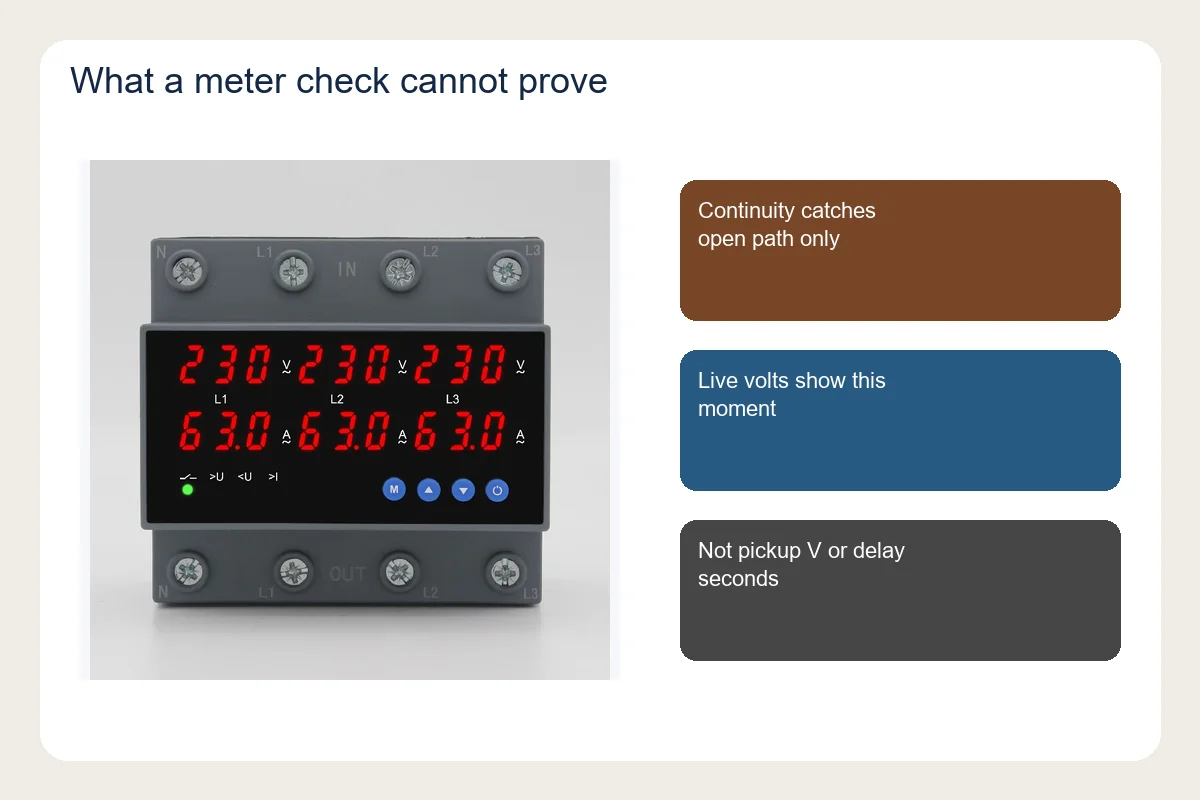
Important: If the only tool on the truck is a DMM, record present voltage, the dialed cutoffs and delays, and whether open/restore events track a documented sag. Then stop short of claiming a certified pickup test. Controlled pickup and timing still need a variable source and the maker’s procedure, as outlined in Wiringuru’s undervoltage protection testing section.
Why a Quiet Board Is Not a Pickup-and-Timing Pass
No recent trip only means the supply stayed inside the window long enough. It does not recertify setpoints.
Crews often chase a failed under-voltage relay when the real story is a tight UV setting during a normal motor-start dip, or a delay that was set too short to ride a brief sag. Forum discussions on voltage monitors and undervoltage releases keep returning to the same point: adjustable under/over thresholds and response delays exist specifically so brief events do not become nuisance outages, and deciding what the contact should do during a disruption is half the job. Source: Electrician Talk — phase monitoring relay.
From the field: Optional delay on undervoltage release hardware is described in field discussions as a way to minimize nuisance tripping when control voltage dips — the delay is part of the protection story, not proof the device is broken. Source: Electrician Talk — undervoltage release thread.
Before you scrap a DIN OUV module, ask whether the trip lined up with a real measured sag, whether UV cutoff sits unrealistically close to normal running voltage for that board, and whether restore delay was long enough for the supply to settle. A quiet week after you loosened an aggressive UV setting is often the load and the window agreeing again.
When to Re-Set, Replace, or Leave the Protector in Service
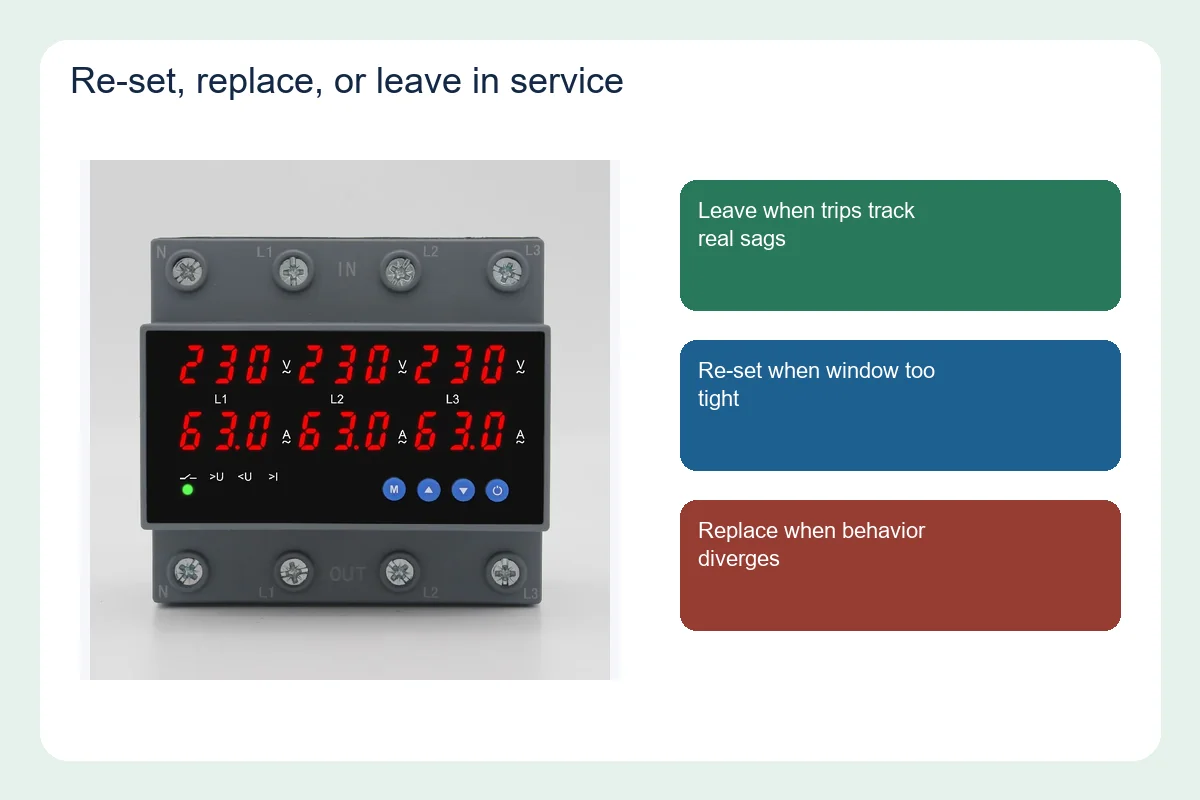
Leave the protector in service when trips and restores track documented sags and match the published cutoffs and delays. Re-set when the window is simply too tight for the real supply and load. Replace when open/restore behavior diverges from the card after a documented event, or when housing and terminals are damaged.
Practical sequence:
- Record the dialed UV/OV cutoffs, resets, and delays against the nameplate or product table.
- Compare that record to measured supply behavior around the trip (independent meter or logger when available).
- If trips are nuisance-only and the supply never left a reasonable band, widen UV or lengthen delay within the maker’s published range.
- If the line clearly went below cutoff for longer than the delay and the protector never opened — or the line returned inside reset for longer than the restore delay and the unit never came back — treat that as a serviceability fail and replace the module.
- After replacement, confirm the new card’s windows before energizing critical loads.
This remains a keep / re-set / replace decision grounded in published windows and observed events.
Choose YJQGA-63 When You Need an Adjustable OUV Protector
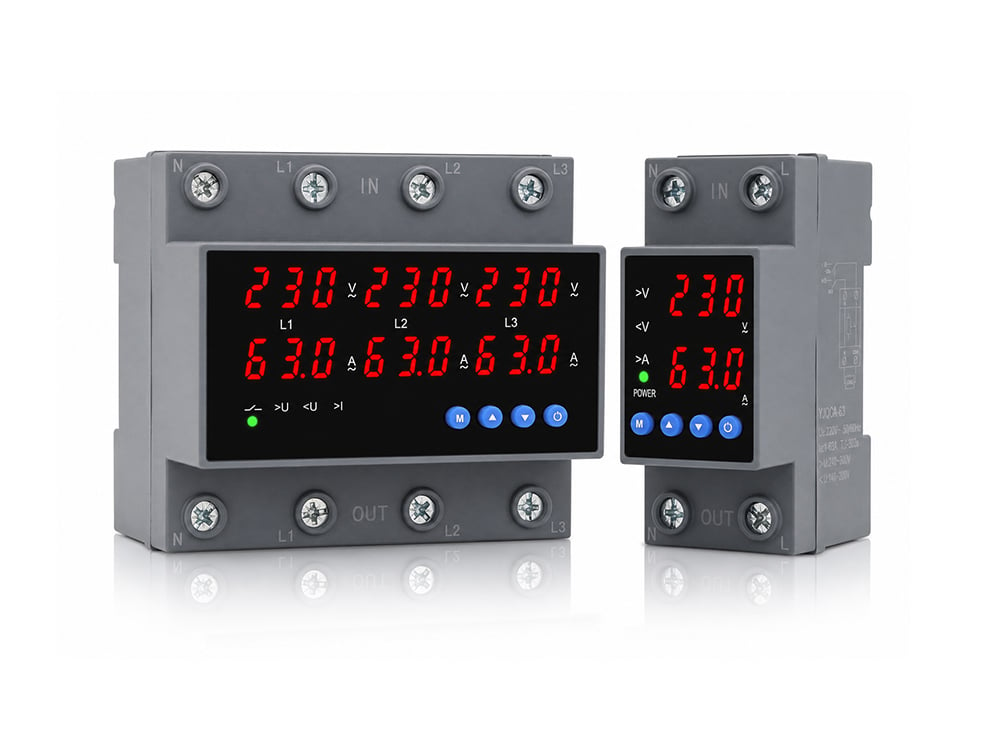
Choose YJQGA-63 3P+N when the board needs a DIN-rail over/under-voltage plus overcurrent protector with adjustable windows and delayed auto-restore — the same parameters this page teaches you to read during under voltage relay testing.
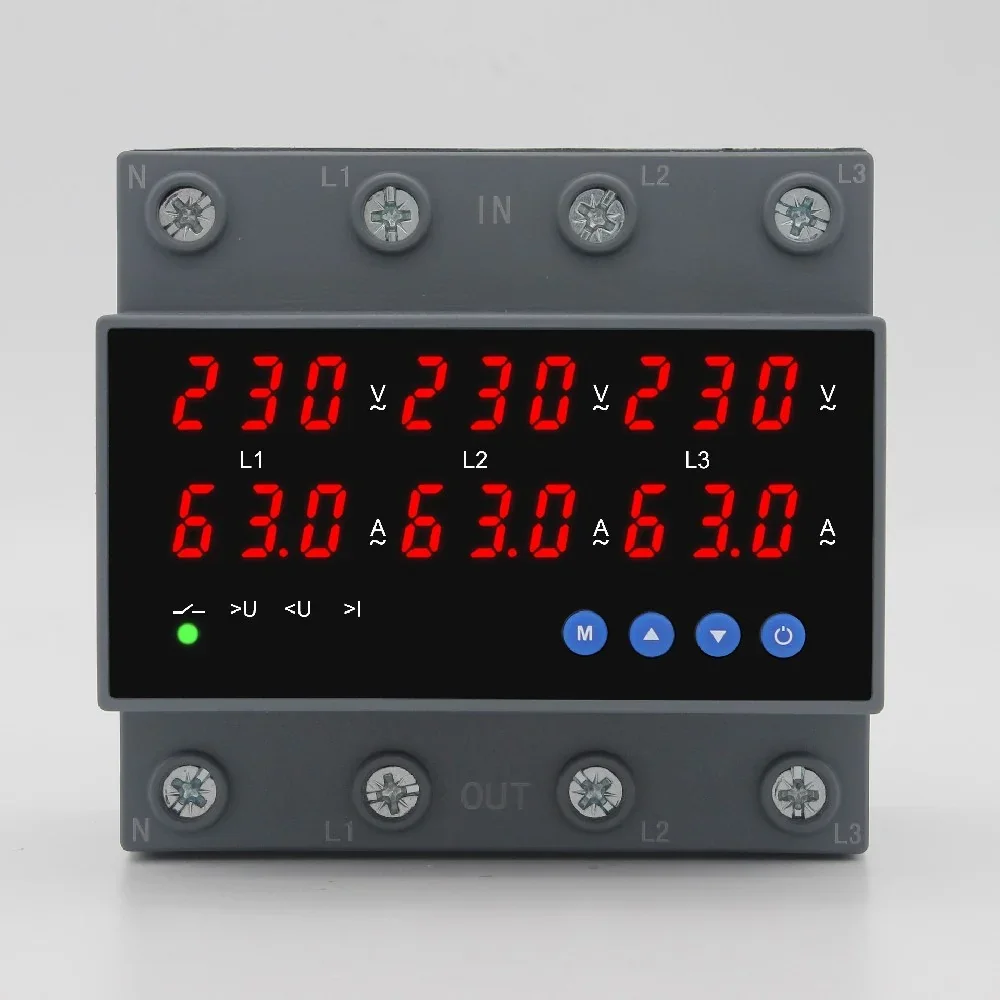
The live product page describes a unit that opens on overvoltage, undervoltage, or overcurrent and can automatically restore after a set delay when the circuit returns to normal, with thresholds and delays independently settable. Prefer the 3P+N SKU when the install needs that pole arrangement; a 1P+N sibling exists in the same family for single-phase boards. Browse the category hub at Over and Under Voltage Protector when you need the wider DIN OUV lineup.
YJQGA-63 is a low-voltage DIN OUV plus overcurrent protector. It is outside the SPD clamp/window-flag job and outside medium-voltage line recloser language.
For US projects, 50 Hz / 60 Hz page labels stay labels — ask for the documentation your AHJ and specification actually require. For specification questions after you lock the windows, use Contact Us.
Definition readers who still need “what is a voltage protector?” should use the separate cluster page — that is a different job from this field testing path: What Is a Voltage Protector?.
FAQ
How do you perform under voltage relay testing in the field?
Read the published UV/OV cutoffs, resets, and delays; compare open/restore behavior to documented supply events; use a controlled voltage source only when the maker’s procedure and a proper test set are available. Do not treat a continuity beep as a pickup certificate.
Can a multimeter alone prove the UV setpoint?
No. Continuity or a live-voltage glance can show an obvious open path or present volts. It cannot prove pickup voltage or operate/restore delay on an electronic DIN OUV protector.
What is the difference between UV cutoff and UV reset on YJQGA-63?
On the live YJQGA-63 table, UV cutoff is the action window (default 170 V within 140–200 V) and UV reset sits 5 V above the UV threshold (default 175 V). Restore waits for the OV/UV reset delay as well.
Why does the protector wait before restoring power?
YJQGA-63 publishes an OV/UV reset delay (default 30 s within 5–300 s) and a power-on delay (default 5 s within 1–300 s) so the unit does not slam loads back onto an unstable supply.
Is every UV trip a failed relay?
No. Tight undervoltage settings and normal motor-start dips create nuisance trips that look like failed relays. Confirm the supply and the window before you condemn the module.
Is YJQGA-63 an SPD or a medium-voltage recloser?
No. It is a low-voltage DIN-rail over/under/overcurrent auto-restore protector. It does not clamp surge energy like an SPD, and it is not a medium-voltage line recloser.
Do frequency page labels mean UL or NEC approval for the US?
No. Frequency and related page labels are not a UL listing or NEC approval claim. Ask for the evidence your US project specification requires.