 Yueqing Yijin Electronics Co., Ltd.




How to Wire a DC Circuit Breaker on a DIN-Rail MCB
How to wire a dc circuit breaker on a DIN-rail MCB starts with landing the printed + and − marks first, then the enter and exit paths the device page actually prints — before any top-versus-bottom habit from the last AC panel. The sections below cover polarity order, terminal assignment, series-string versus parallel feed, where the land stops when marks are missing, and which live Yijin DC breaker page matches. That includes how to connect a dc mcb without guessing top versus bottom, polarized dc circuit breaker wiring marks, and 2 pole dc breaker wiring on a series string feed.
What the field wire job owns on a DC DIN-rail MCB
The wire job owns polarity-first landing on the terminals the breaker prints. It does not own sheet literacy, and it is not a generic install prep list.
Useful search results often jump into a top-is-input checklist or a polarized-versus-non-polarized shopping table. Those pages answer adjacent questions. The job here is narrower: land conductors on a DC-rated DIN-rail miniature circuit breaker so the printed marks still mean what the manufacturer printed.
A DC breaker wiring-diagram read and a DC MCB mark-misread piece already cover sheet literacy and mark myths. This page covers the application land path once metal is ready to go under the screws.
A circuit breaker exists to protect a circuit from overcurrent damage. On DC, the interruption job is harder because the current does not cross zero the way AC does, so the land path has to respect the design direction the housing marks.
Land polarity before top-or-bottom habits
Match + and − — and the current direction they encode — before you argue about top versus bottom.
Many shop guides treat “source on top, load on bottom” as the wiring. That habit is common in AC cabinets. On a polarized DC miniature breaker, the housing marks are not decoration.
Industry white papers on magnet-assisted DC poles describe the failure mode clearly enough for a land decision: if current through the pole runs the wrong way, the arc can be steered away from the chute and into the mechanism when the breaker opens under load.
Yijin’s YJB1Z-63 small DC circuit breaker page states the practical rule in product language: attention must be paid to the polarity of “+” and “-” when wiring, and the power supply enters and exits. The same page names a permanent-magnet arc system behind that caution.
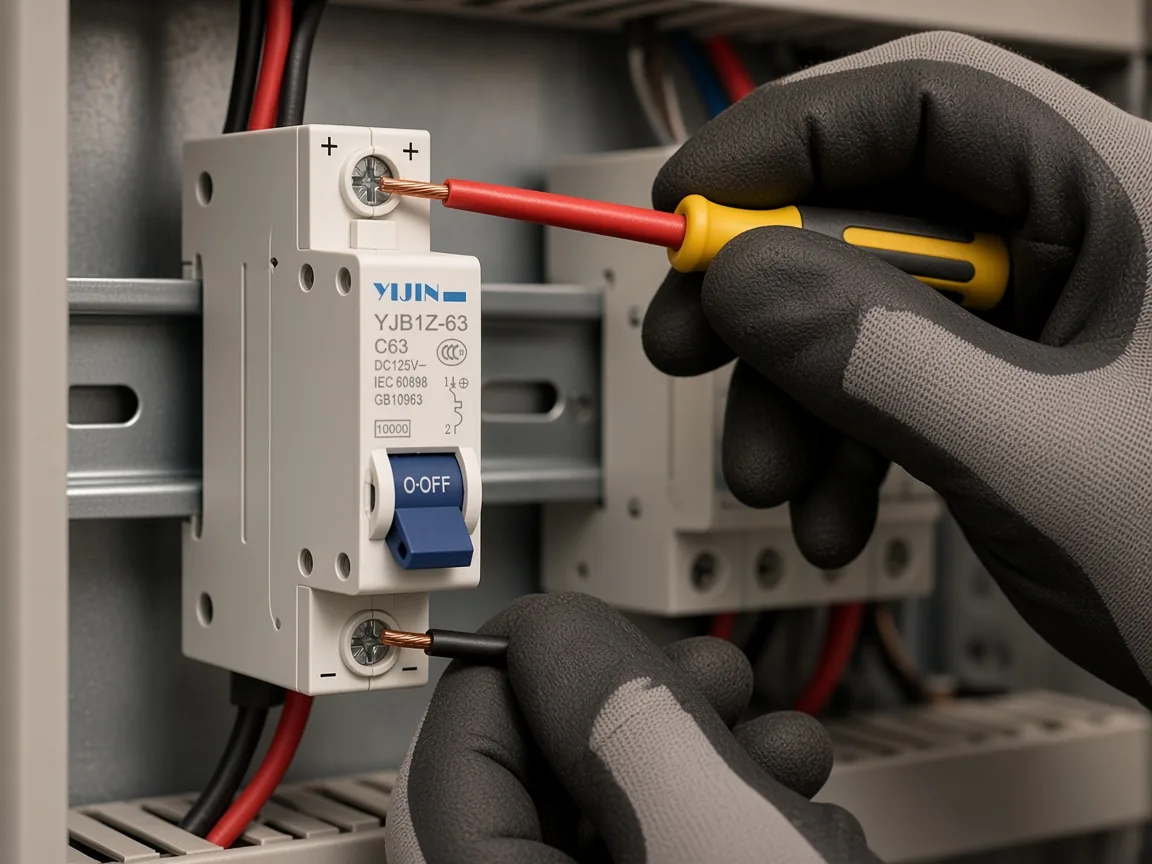
On SolarDIY threads, buyers freeze when they see positive and negative marks on both ends that look “flipped.” The useful reply is not “always top.” Treat the + and − on each channel as the direction current should travel through that pole, then keep the same polarity on the paired exit of that channel.
If the application reverses current as a design case, you leave the fixed-direction land job covered here. The YJB1Z pages do not print a bidirectional battery rating to lean on.
From the field: Electricians on Electrician Talk have seen white used as DC positive on some jobs and black as the common negative on others. Color conventions wander by site. A meter check beats a remembered color story every time you land a polarized DC breaker.
Which conductors land on which terminals
Land supply on the enter path and the downstream run on the exit path the page prints — cable colors are not the map.
After polarity, assign roles. The YJB1Z feature text says the power supply enters and exits. In plain language, the source terminal path is where source conductors arrive, and the load / exit path is where the downstream feed leaves.
Line and load names, when a drawing uses them, mean source versus downstream. They are related to polarity on some products and not identical to + and − on every product. Do not translate “red equals line” from habit.
Keep the land set simple:
- Confirm the housing still shows + and − (or the page’s polarity sentence) for the exact frame in hand.
- Land the positive source conductor on the + mark that belongs to the source end of that channel.
- Land the negative source conductor on the − mark for the same channel.
- Land the downstream pair on the exit end of the same channels without crossing polarity.
- Refuse to invent terminal numbers the page does not print.
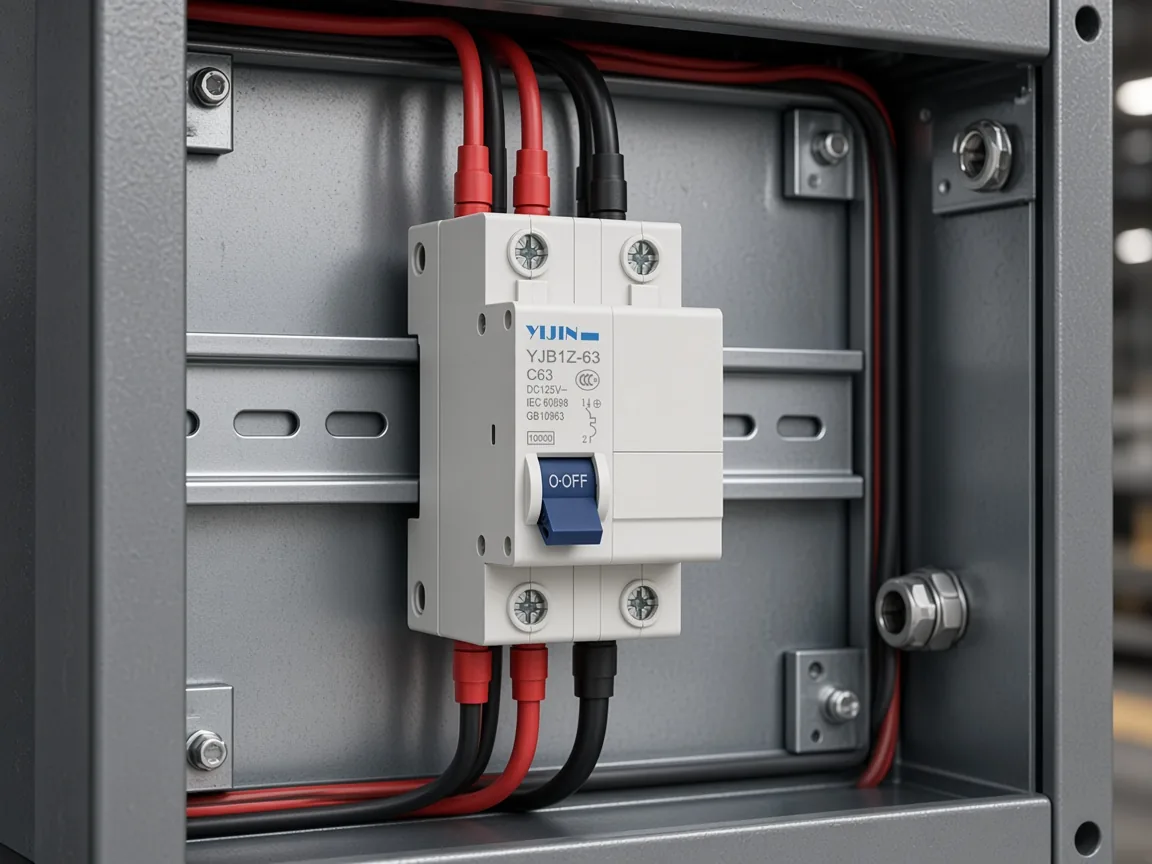
If a drawing uses Line/Load words while the breaker face uses +/−, resolve both against the same datasheet or product page. Do not merge them into one guessed screw.
Series-string feed vs parallel feed on the land path
Series-string feeds stack voltage on one current; parallel feeds add current at one voltage — the land set follows that.
Topology is not a second polarity lesson. It changes which conductors must land together as one set.
In a series circuit, the same current travels one path while voltages add. In a parallel arrangement, branches share voltage while currents add.
A series string feed keeps one pair as a single land set. A parallel feed brings branch pairs that must not be crossed as if they were one series pair.
| Feed type | What the land set looks like | What goes wrong if you mix them |
|---|---|---|
| Series-string feed | One current path; voltage stacks along the string before the breaker | Treating it like a combiner and splitting poles across unrelated branches |
| Parallel feed | Several branches at one voltage; currents add toward the breaker | Landing two branches as if they were one series pair, or crossing polarity between branches |
| 2-pole printed path | Two poles at the page’s higher DC voltage row when that is what the table prints | Assuming every “2P” title means series poles without reading the page table |
YJB1Z-63’s technical parameter table prints one pole at DC125V/220V and two poles at DC250V/440V, with a note that 1P DC220V and 2P DC440V need to be customized. Prefer that table when you decide which conductors the frame is prepared to interrupt.
Stop the wire job where the marks end
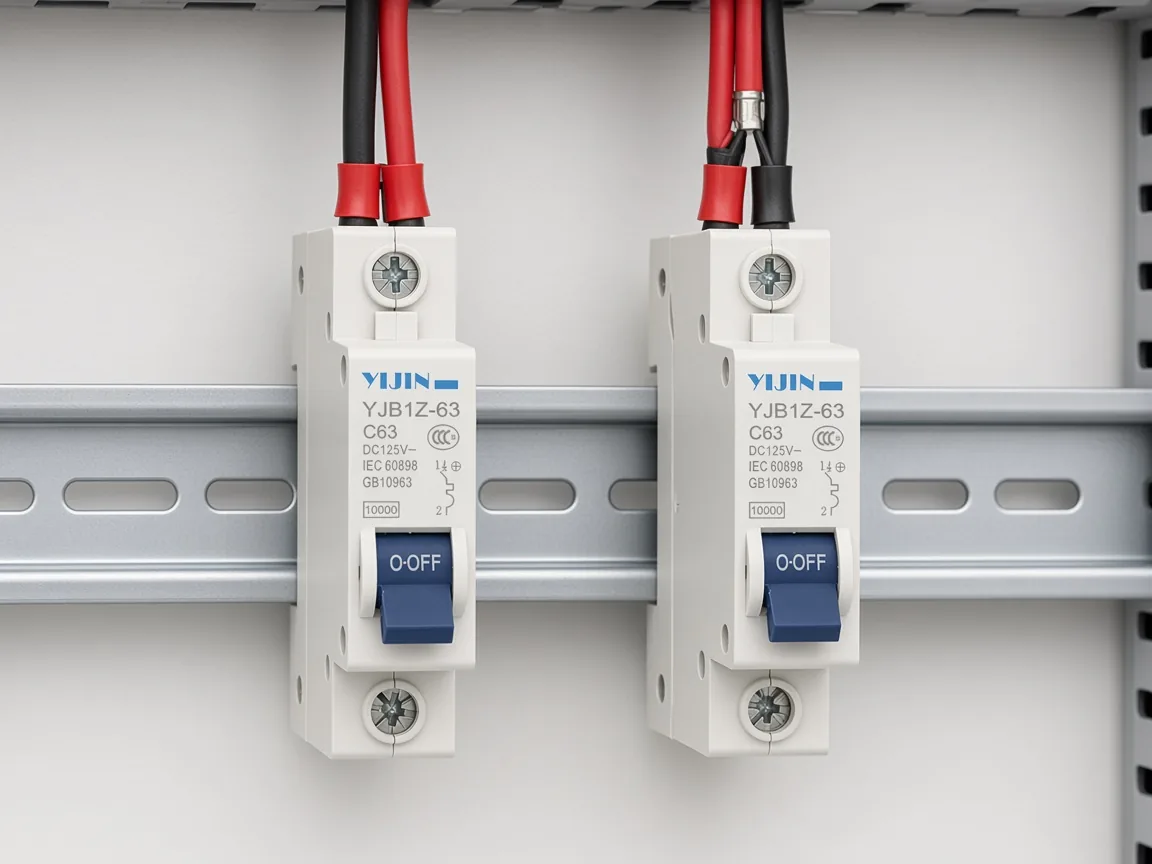
If the page leaves the diagram empty, stop. Do not invent terminal numbers, torque values, or US listing marks.
Both YJB1Z-63 and YJB1Z-125 name a wiring-diagram heading and leave that block without a schematic body in the live HTML. That emptiness ends the authority to invent a picture. It does not erase the polarity sentence or the parameter table.
Stop means no invented Newton-metre torque from a competitor checklist, no NEC ampacity lecture pretending to be a Yijin page fact, and no terminal map built from a generic internet PNG.
No UL Listed claim derived from an IEC60898-2 or IEC60947-2 line on a Chinese manufacturer page aimed at a US English buyer. For US projects, those named standards are first-party references, not a substitute for the listing and inspection path the purchaser requires.
Which Yijin DC breaker product matches this wire job
Match In, Ue, and pole count to the YJB1Z-63 small DC circuit breaker when the land job is a small DIN-rail DC MCB, then still obey that page’s +/− sentence.
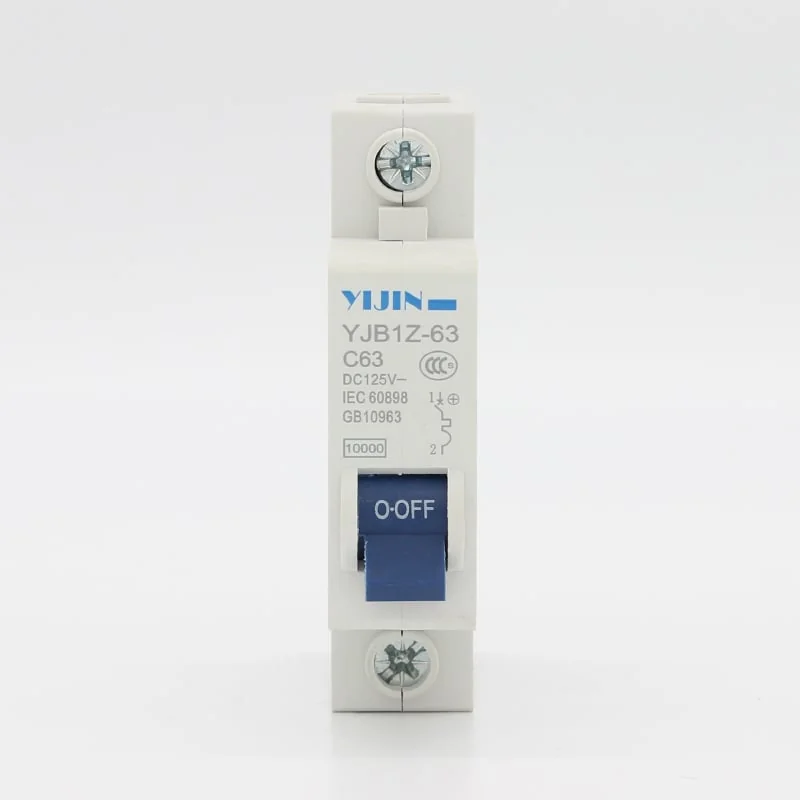
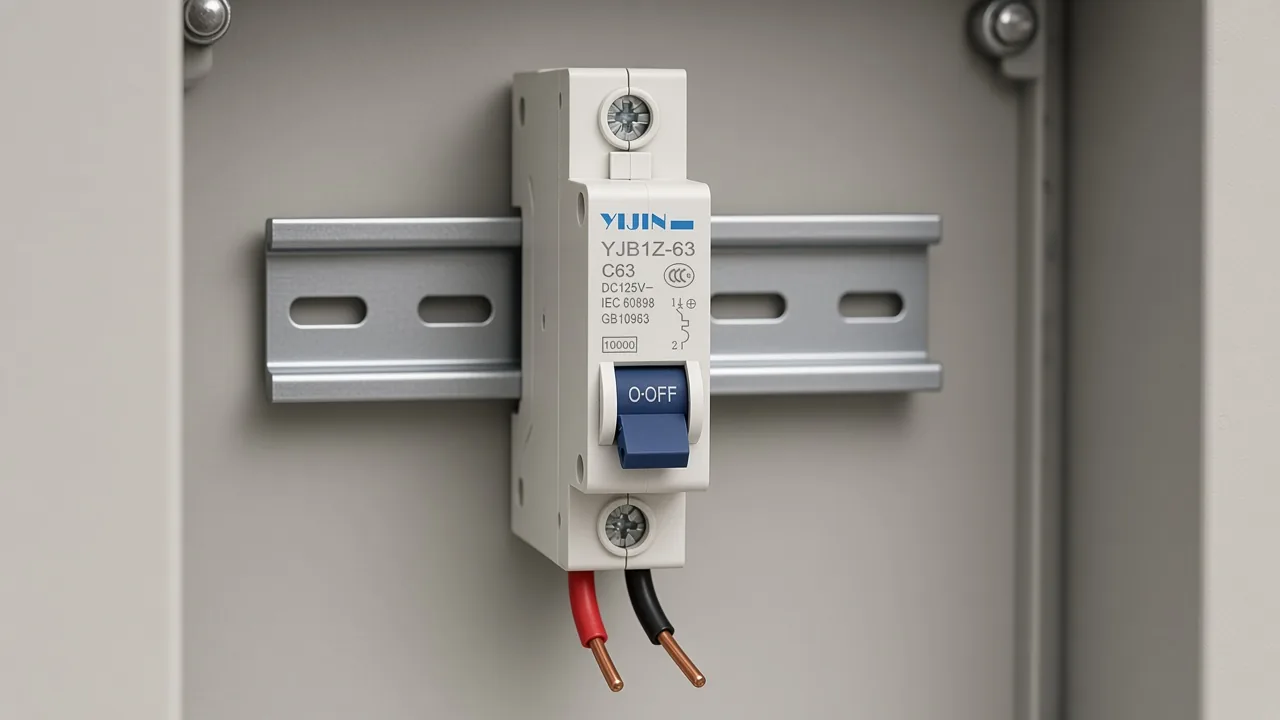
The Path① product photo is the frame to compare with the polarity sentence on the page.
YJB1Z-63 is the primary match for this land path: rated current of 63A and below, DC rated voltage of 250V and 440V in the scope sentence, overload and short-circuit protection for DC distribution, GB10963.2 and IEC60898-2 named on the page, short circuit capacity of 10kA, TH35-7.5 DIN rail, and the polarity enter/exit wiring sentence.
When the printed current sits above that frame, the sibling YJB1Z-125 page carries the same polarity attention with a 125A and below scope, IEC60947-2 / GB14048.2 names, and a 1P/2P voltage table of its own.
| Model | Printed current scope | Printed DC voltage cues | Polarity / enter-exit sentence | Standards named on page |
|---|---|---|---|---|
| YJB1Z-63 | 63A and below | Scope 250V and 440V; table 1P DC125V/220V, 2P DC250V/440V | Yes — +/− attention; power enters and exits | GB10963.2, IEC60898-2 |
| YJB1Z-125 | 125A and below | Scope 220V and 440V; table 1P DC125V/220V, 2P DC250V/440V | Yes — same attention | IEC60947-2, GB14048.2 |
Browse the circuit breaker category only after the land path is clear. WiFi, GQ, and RS485 frames listed nearby are different products. For new-energy adjacency without turning this into a solar shopping guide, see Yijin’s New Energy solution page after the wire job is honest.
FAQ
How do I connect a DC circuit breaker without guessing top vs bottom?
Land the printed +/− and enter/exit path first. Top versus bottom is a cabinet habit, not a substitute for marks.
Do DC circuit breakers work both ways?
Only if the specific product is rated for bidirectional current. YJB1Z pages print a polarity warning and do not print a bidirectional battery duty for this land job.
Do wire colors tell me which terminal is positive?
No. Site conventions vary — white has been used as DC positive on some jobs. Meter the conductors; do not let color pick the screw.
What changes when I wire a 2-pole DC breaker on a series string?
You are landing one current path with stacked voltage, not a parallel combiner. Keep the series set together and read the page’s 1P/2P voltage table before you treat “2P” as a free topology choice.
Can I feed the breaker from the bottom if +/− still match?
Some polarized designs preserve current direction whether the source sits on top or bottom, but only when source +/− still match the marks. Do not flip the breaker upside down as a workaround, and do not assume Yijin printed a bottom-feed diagram if the page left the diagram block empty.
Does an empty wiring-diagram block on the product page still authorize terminal numbers?
No. An empty block ends the authority to invent a schematic. The polarity sentence and the parameter table still apply; invented terminal codes do not.
Which Yijin model fits the YJB1Z-63 current class for this land job?
Start with YJB1Z-63 when the printed current and DIN-rail form match that page. Step to YJB1Z-125 when the published In table for the higher frame is what the project already shows.
References
- Circuit breaker — overcurrent protection role; DC interruption context.
- Series and parallel circuits — topology used for series-string vs parallel feed land consequences.
- Electric arc — sustained DC arc background for polarity-aware interruption.
- White color for Positive DC wiring? (Electrician Talk) — field note that DC color conventions vary; meter rather than assume.
Humanizer self-audit (Draft Agent YJ-DRF-AGT-20260924-01): Shortened long paragraphs; removed repeated “this article” meta phrasing; kept secondary keywords once; no invented torque or UL claim. Second pass cleared audit IDs from reader prose.