 Yueqing Yijin Electronics Co., Ltd.



Matching a 60 Amp Knife Switch Disconnect to the Circuit It Isolates
A 60 amp knife switch disconnect is an isolation label: the circuit current has to sit inside a real nameplate step, and the device still has to be the kind of switch the job is asking for. Buyers use those words for enclosed 60 A disconnects, for a knife-style handle, and for an open blade that only isolates. This piece separates those jobs, then checks the live Yijin frames against a 60 A request.
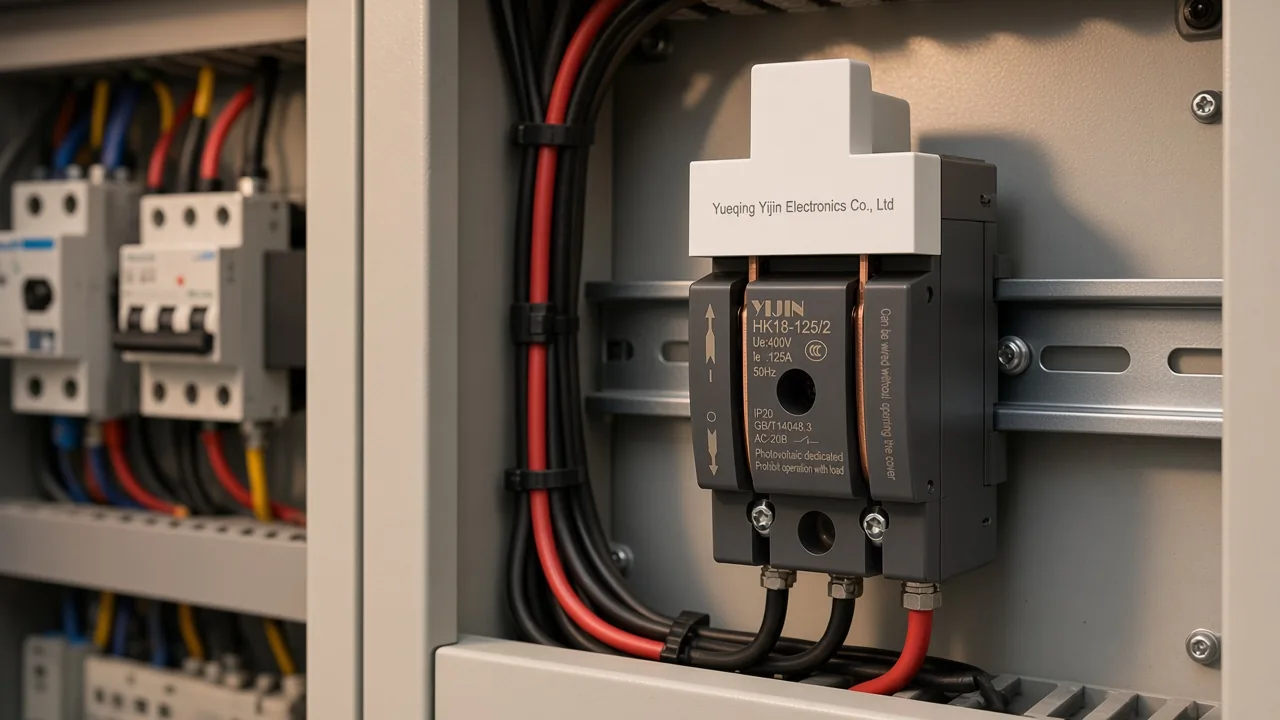
The cabinet is the setting a buyer actually compares with a catalog photo.
The list below follows the decision order.
The 60 Amp Label Is Doing Two Different Jobs
The phrase names a current step and a mechanism at the same time, and catalogs treat those as different parts. A search for the words mostly returns 60 A non-fused disconnect kits and enclosed safety switches. Some of those kits describe a knife-switch-style handle.
That handle language is a way to work a flange disconnect. It does not describe the hinged blade of a knife switch sitting open on a panel.
A knife switch makes and breaks by driving a metal blade into a jaw and lifting it out again. The open is visible. That visibility is the point in isolation work: someone can see that the path is broken.
The same visibility is also why older open blades were a shock and burn hazard when people opened them under load. Enclosed safety switches put the contacts inside a box and brought the handle out, which is a different object even when the handle looks a bit like a knife.
If the purchase order only says “60 A disconnect,” ask whether the spec wants an enclosed listed disconnect or a knife switch isolator for no-load isolation. The ampere figure will not answer that. The isolating switch range on this site mixes several device families, so the model page, not the category name, has to carry the duty.
What a 60 Ampere Isolation Rating Actually Carries
On an isolator, the ampere figure is the current the device is meant to carry while closed, inside the voltage and duty printed with it. That figure does not score how large a fault the blade will clear. A disconnector exists so a circuit can be opened for service and left visibly isolated.
Load switches and circuit breakers are the devices built to interrupt current. A plain isolator is the off-load member of that family.
That split matters on a 60 A request. Sixty amperes can be a fair continuous current for a feeder or a motor circuit. The isolator still has to be closed before that current flows, and something else has to open the load first if the isolator is marked for no-load duty.
Voltage travels with the number. A 400 V, 50 Hz nameplate is a specific supply. Amperes alone will not cover every 60 A, 60 Hz panel in a US plant.
Yijin’s knife pages follow that pattern. They name infrequent manual connection, disconnection, and isolation, and they print a utilisation category rather than a horsepower chart. The live HK18-125 page lists working currents of 63 A, 80 A, 100 A, and 125 A.
That same page states 400 V, 50 Hz, and a 6 kV impulse withstand.
| Check | What to read | Why a 60 A request cares |
|---|---|---|
| Working current | Printed ampere step on the model | The circuit current has to sit inside that step |
| Voltage and frequency | 400 V and 50 Hz on the HK18 and HD11F pages | A 60 Hz US panel still has to match the page, not only the amperes |
| Duty | AC-20B on those pages | Isolation duty is not overload interruption |
| Place | No rain or snow invasion | The page keeps the device out of weather |
Circuit Amperes Have to Match the Nameplate, Not a Nearby Frame
Match the circuit current to the printed step, then look at what sits upstream. A disconnect frame is a current size. Fuse hardware is sized the same way: a laboratory training deck describes 35 A through 60 A fuses as fitting a 60 A disconnect frame.
They do not fit a 30 A frame. Putting the larger fuse clip into the smaller frame fails at the clips. The clips do not accept it.
Ampere shopping for a switch works the same way. “Close enough” is how a 60 A circuit lands on a 30 A device, or how a 160 A open knife gets sold into a 60 A job because the number is bigger.
A larger breaker upstream does not resize the switch. Electricians argued this on a motor example: a 100 A breaker feeding a local 60 A non-fused disconnect for a 30 hp, 480 V motor. The Mike Holt discussion used a 40 A motor example and 115% to reach 46 A, then treated a 60 A disconnect as enough ampere headroom for that example.
The same thread asked whether a starter with overloads was still in the circuit, and whether anyone planned to start and stop the motor on the disconnect. Headroom on amperes did not retire those questions.
Two pole readings cause the same mix-up. A two-pole 30 A breaker is 30 A on each pole, not 60 A added across the handle. Using that breaker as if it were a 60 amp disconnect switch is how a circuit gets described as twice the current it can carry.
If the disconnect is the local means and the breaker is the upstream device, each one keeps its own rating.
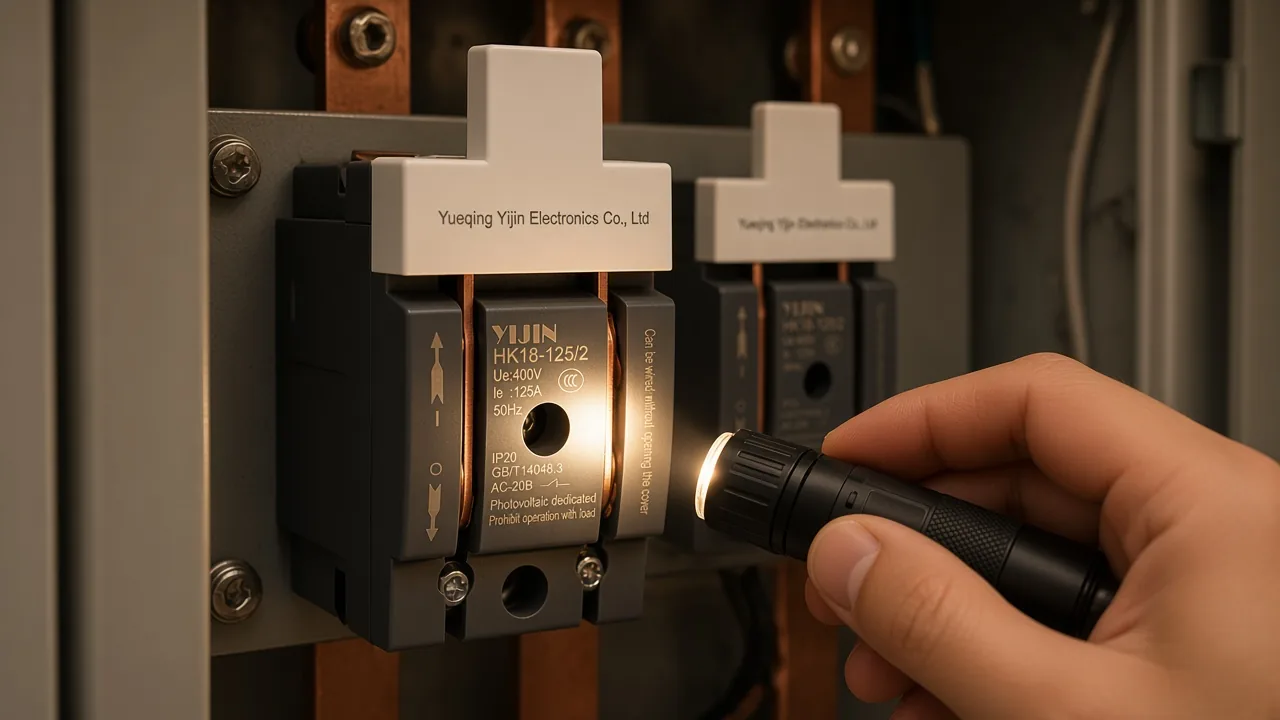
Face markings are what the ampere check has to read.
An Open Knife Blade Is Not an Enclosed US Safety Switch
An exposed blade and an enclosed safety switch solve different problems, even when both get called disconnects. The knife switch leaves the blade and jaw where a person can see the open, and where a person can also touch live metal if the design is open. US shop language moved to “safety switch” when makers put that mechanism in a box and operated it from outside.
The enclosure is the safety change. The 60 A number does not make that change.
A knife-switch-style handle on a flange disconnect is still a handle. The contacts can be a visible-blade design inside a listed kit, which is yet another product class. Treating every use of the word knife as the same SKU is how a panel isolator and a motor safety switch get ordered as substitutes.
Horsepower sits in that gap too. Field electricians say a switch can be right on amperes and wrong on horsepower, and then the disconnect will not do the motor job people assumed from the ampere sticker.
From the field: On a lockout thread, an electrician warned that a disconnect rated for the amperes can still be the wrong device if it is not horsepower-rated for the motor, and that a disconnect and a safety switch are not the same object. — Electrician Talk, using a disconnect under load.
Yijin’s HK18 and HD11F pages do not present an enclosed UL safety switch, a NEMA rain-tight box, or a horsepower table. They present a knife isolator for infrequent isolation. If the spec is a listed 60 A safety switch for a motor at the machine, that spec is asking for a different class of hardware.
AC-20B Isolation Does Not Interrupt Overload Current
AC-20 means connecting and disconnecting under no-load conditions. The live HK18 and HD11F pages mark the utilisation category as AC-20B, and the HK18-125 face is printed “Prohibit operation with load.” That is the duty the buyer is getting from this AC-20B knife switch family. Opening the blade while the circuit is carrying current is outside that marking.
A circuit breaker, or a fuse upstream, still has to clear overloads and short circuits. A non-fused knife or disconnect does not grow fuses because the nameplate says 60 A. Forum electricians put it plainly: if an upstream device already protects that one load, a non-fused disconnect can be the local open; if the upstream device is sized for several loads and is too large for this one, this load still needs its own overcurrent device.
The isolator does not replace that choice.
HD11F’s own page says the same job in plainer words. The HD11F-250 page says operation should be carried out under no-load conditions. The product pages name IEC 60947-3 and GB/T 14048.3 as the standards they follow.
Those sentences are page statements. They do not confer a US listing, and they do not add a horsepower rating the pages never print.
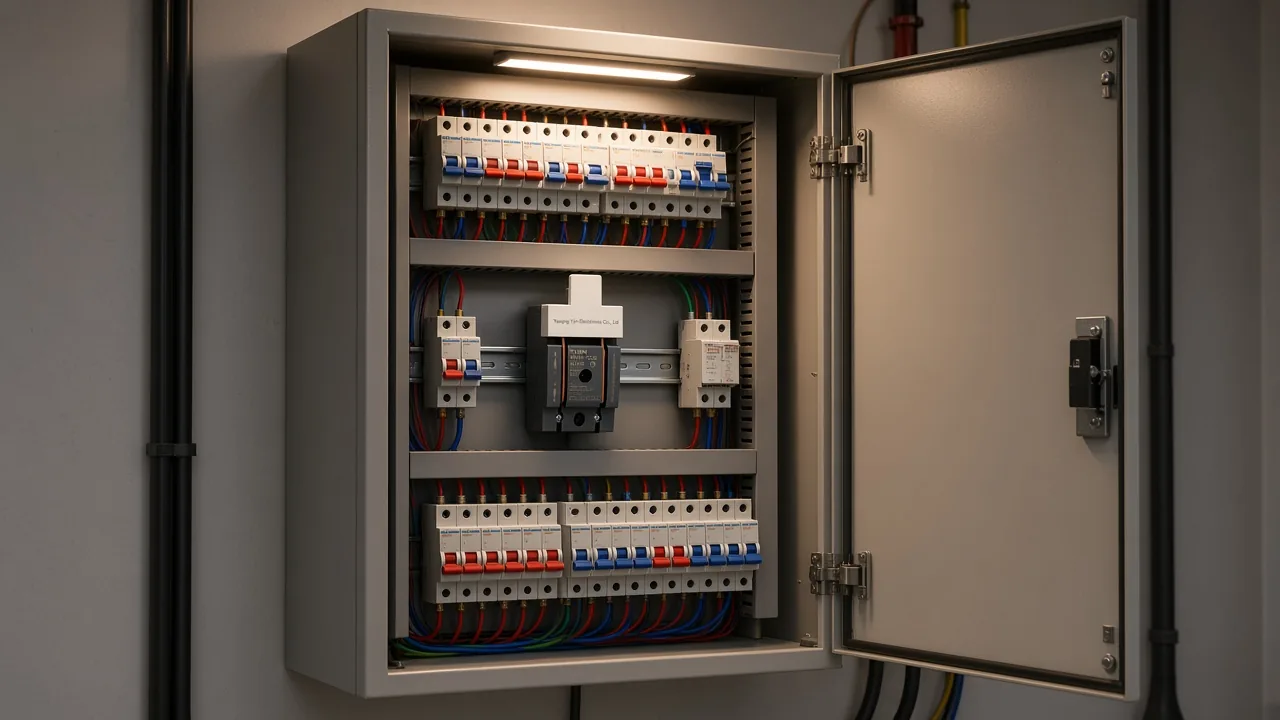
The open door is still an indoor equipment room.
Live Yijin Frames Start Above 60 A, and None Is a 60 A SKU
No live Yijin knife page lists a 60 A working current. A catalog search of the knife titles on 2026-09-14 returned the HK18 and HD11F frames only. The smallest working-current step on that set is 63 A, on the HK18-125 family.
Sixty and sixty-three are neighbors on a number line. They are different nameplates. That 63 A step sits apart from a listed 60 A safety-switch rating.
| Frame | Working currents on the live page | Fit against a 60 A circuit request |
|---|---|---|
| HK18-125 and HK18G-125 | 63 A, 80 A, 100 A, 125 A | Nearest verified steps; 63 A is the first step above 60 A |
| HK18-160 | 125 A, 140 A, 160 A | Only when the circuit actually needs those currents |
| HK18-250 | 160 A, 200 A, 225 A, 250 A | Larger 4P frame for circuits that need those currents |
| HD11F-250 | 160 A, 180 A, 200 A, 225 A, 250 A | Open knife isolator starting far above 60 A |
HD11F-250 working currents on the live page are 160 A, 180 A, 200 A, 225 A, and 250 A. The HD11F page also states insulation voltage of 1000 V, impulse withstand of 8 kV, and short-time withstand of 3 kA. Those figures belong to that open knife, not to a 60 A disconnect kit.
Using the 250 frame because it is “bigger than 60” ignores every other current the circuit has to live with, including the conductors and the upstream device.
Weather is a separate miss. Those knife-isolator pages cap installation altitude at 2000 m. They also say the switch should be installed with no rain or snow invasion.
An outdoor 60 A air-conditioner disconnect, or any rain-tight safety switch, is a different enclosure question. Nothing on the HK18 or HD11F pages adds a rain rating to fill that gap.
Where an HK18-125 Knife Isolator Is an Honest Fit
The HK18-125 knife isolator is the nearest verified frame when the circuit current is at or below one of the printed steps, 63 A, 80 A, 100 A, or 125 A, and the job is infrequent AC isolation at the voltage the page states. Poles are part of the order: the page shows 2P, 3P, and 4P under the 125 frame. Ordering text on the page asks for voltage, current level, and pole count together, which is the right habit for a 60 A request that still has to name a real step.
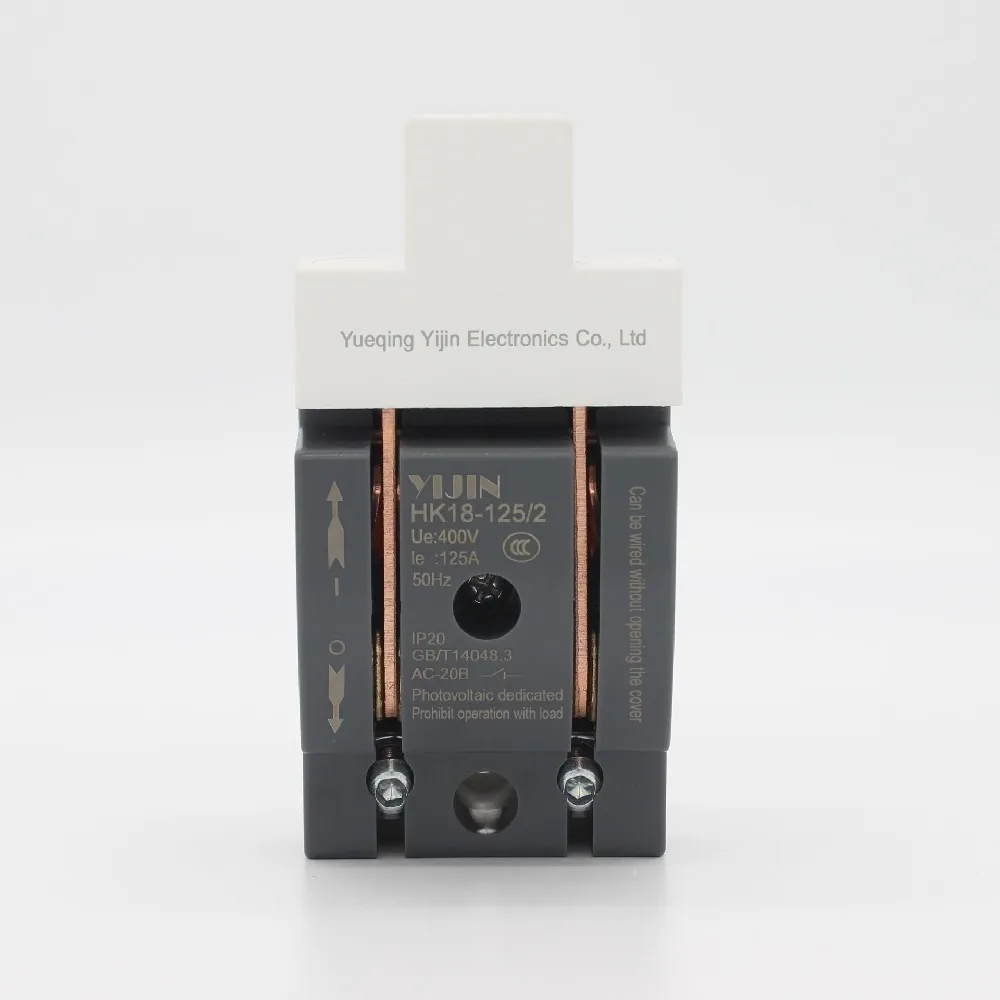
This is the unit the order should name.
Use it when all of these are true:
- The duty is isolation, and the load will be opened by other means before the blade moves.
- The supply matches the page voltage and frequency, indoors, with no rain or snow.
- The working current you order is a printed step rather than a rounded sixty-amp label.
- Overcurrent protection stays with the breaker or fuses that actually protect the circuit.
Leave it when the spec is a listed 60 A enclosed safety switch, a horsepower-rated motor disconnect, or an outdoor weatherproof unit. The HK18 series page is the family statement for the 125 frame. The HD11F-250 open knife switch is the larger no-load isolator, starting at 160 A.
It belongs on a circuit that needs those currents, not on a 60 A line because the frame is in stock.
FAQ
Is a 60 A non-fused disconnect downstream of a 100 A breaker allowed?
In the motor example electricians discussed, a local 60 A non-fused disconnect under a 100 A breaker was treated as ampere headroom once the disconnect rating cleared 115% of that motor’s full-load current. They still asked for a starter with overloads, and they asked whether the disconnect would be used to start and stop the motor. Ampere headroom was not the whole design.
Can a 60 amp disconnect sit on a 30 amp breaker?
A higher-rated disconnect on a smaller breaker circuit is a common field arrangement when the breaker is what limits the circuit. The disconnect still has to suit the voltage and the duty. It does not raise the breaker to 60 A.
Is a two-pole 30 A breaker the same as a 60 A disconnect?
No. A two-pole 30 A breaker is 30 A on each pole. Adding the poles does not create a 60 A device, and it does not describe a knife isolator.
Does a knife-switch-style handle mean the device is an open knife isolator?
No. Catalog kits use that phrase for a handle style on a flange disconnect. An open knife isolator is the blade-and-jaw device.
Read the model, the enclosure, and the duty marking before treating them as one part.
Do 60 A fuses belong in a 30 A disconnect frame?
The training deck describes 35 A to 60 A fuses as the sizes that fit a 60 A disconnect frame, and smaller fuses as the ones that fit a 30 A frame. The clip size is physical. A 60 A fuse is not a drop-in for the smaller frame.
Will an HK18 or HD11F knife isolator tolerate rain or snow?
The live pages say to install them with no rain or snow invasion. They do not add a rain-tight or outdoor enclosure rating. Keep them in a dry location that matches the page.
Is the HK18-125 63 A step a listed 60 A safety disconnect?
No. 63 A is a working-current step on an AC-20B knife isolator. It can cover a circuit at or below that step when the rest of the page fits.
It is not a 60 A listed safety-switch SKU, and this catalog does not list a 60 A knife model.
Must a motor disconnect be horsepower-rated as well as ampere-rated?
Field electricians treat horsepower as a separate check from amperes when the disconnect will serve a motor. A 60 A sticker does not answer the horsepower question. The HK18 and HD11F pages do not print a horsepower rating, so they are the wrong place to look for that motor duty.
References
- Knife switch — mechanism, visible open, and why enclosed safety switches replaced open blades.
- Disconnector — visible isolation versus load breaking.
- Utilization categories — AC-20 as connecting and disconnecting under no-load conditions.
- Los Alamos disconnect training notes — fuse frames and sixty-amp disconnect steps.
- Open knife arc versus enclosed safety switches — Electrician Talk.
- Sixty-amp non-fused disconnect under a larger breaker — Mike Holt forum.