 Yueqing Yijin Electronics Co., Ltd.
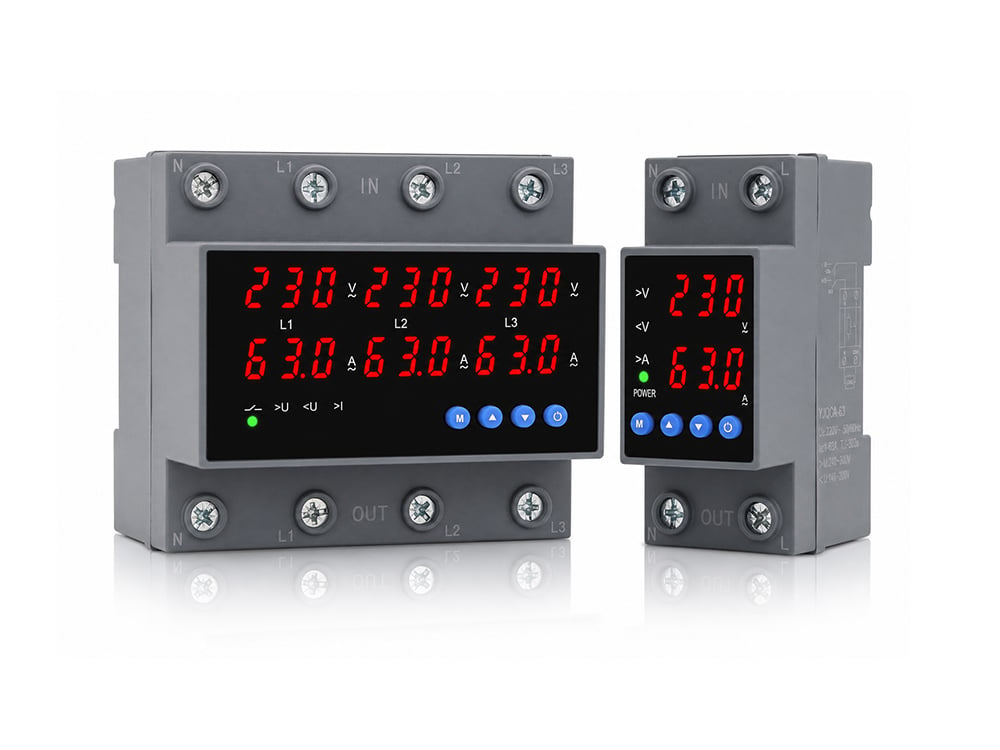



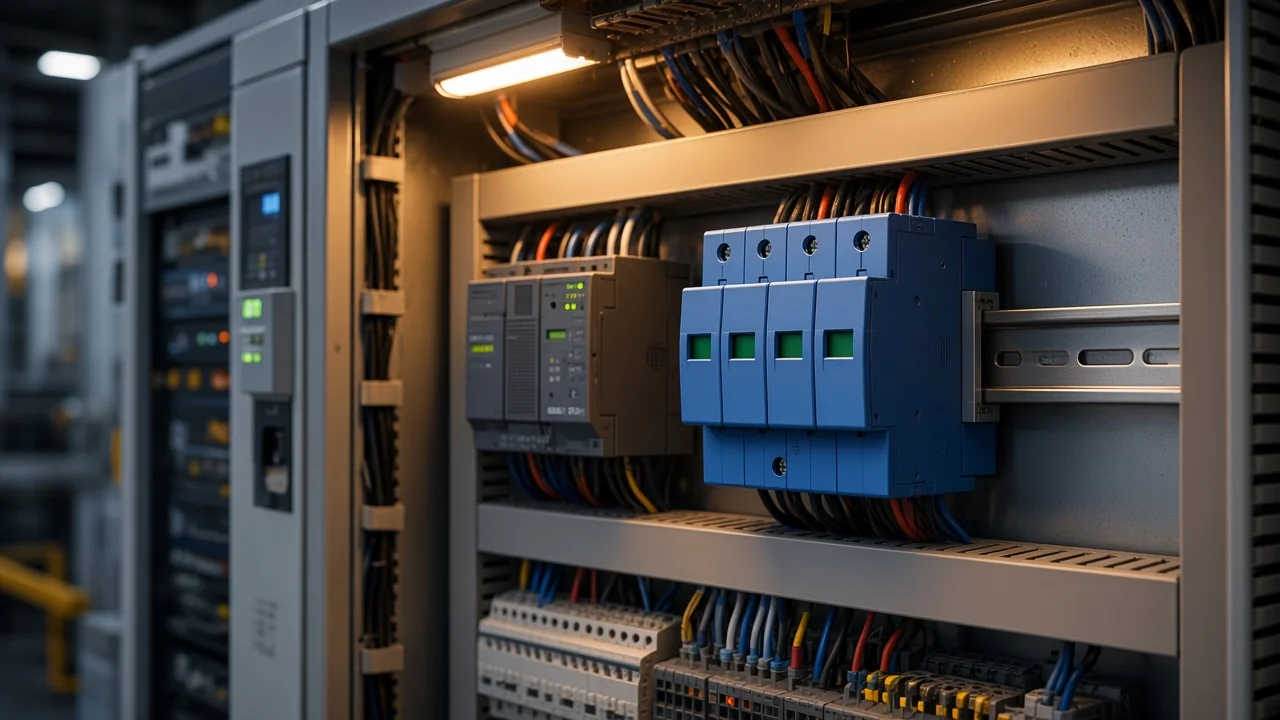
What Is a Surge Protective Device Type 3?
A surge protective device type 3 is the fine-protection layer placed near equipment to limit residual surges after upstream SPDs have already taken the heavier energy. It is point-of-use protection in a coordinated SPD cascade — not a standalone “whole building” answer, and not the same thing as renaming any DIN-rail Class II module “Type 3.” This guide defines Type 3, compares type 2 vs type 3 surge protector roles, explains why cascade matters, clears common SERP myths, and maps live Yijin Class II modules honestly against a type 3 surge protection device search.
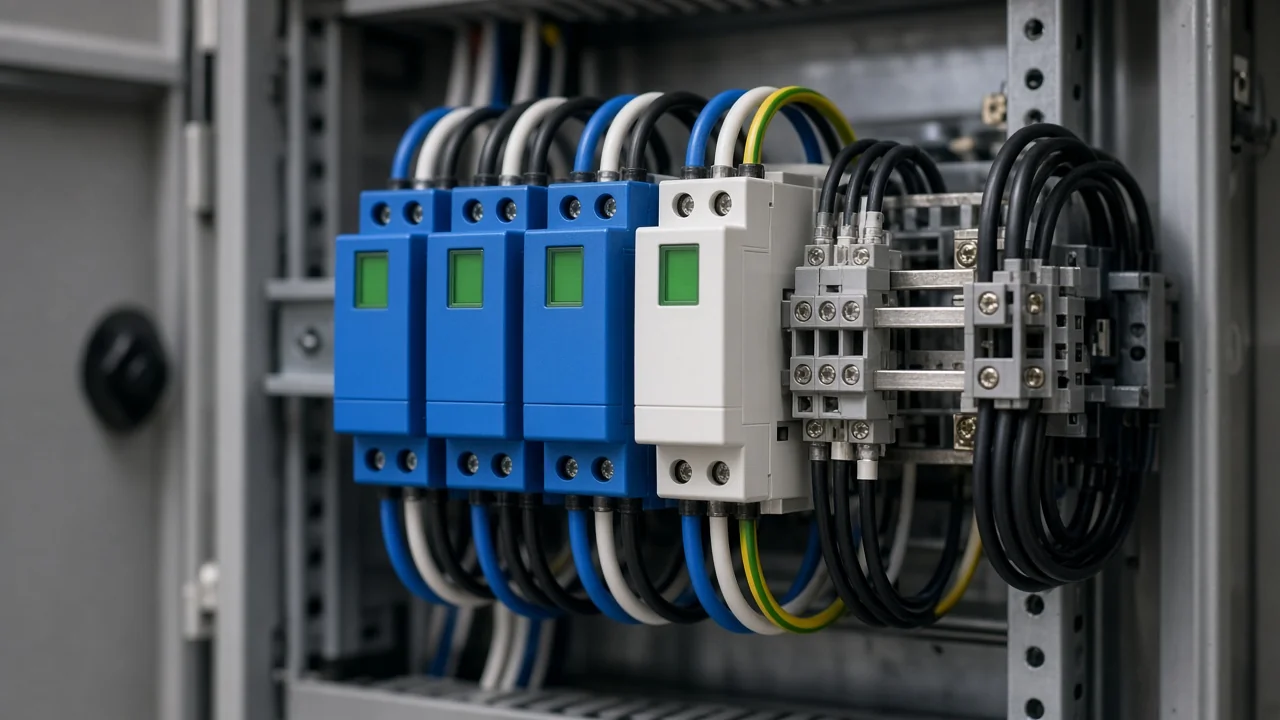
What a Type 3 Surge Protective Device Actually Does
A Type 3 SPD is the fine-protection layer near equipment that limits residual surges; it is not the whole surge strategy by itself.
In standards language, Type 3 belongs with the Class III family. That class is tested with a combination wave / Uoc approach rather than a large service-entrance impulse rating.
Encyclopedia wording for surge protective devices (SPDs) is about very short voltage spikes measured in microseconds, not sustained high or low RMS voltage. On a live SERP, “Type 3” often collapses into a plug-in surge strip for TVs and computers.
That consumer form factor can serve a point-of-use role. The engineering idea is broader: finish the cascade close to the sensitive load so leftover transient energy is clamped where wiring inductance has already reduced what arrives from the service.
Type 3 does not replace a service-entrance Type 1 SPD or a distribution Type 2 SPD. Upstream devices take the larger energy. Type 3 cleans up what remains.
Type 1 vs Type 2 vs Type 3: Roles and Test Classes
Types differ by where they sit and which impulse test class they declare — not by marketing nicknames alone.
IEC/EN low-voltage SPD documents group devices by test class:
- Type 1 SPD (Class I): high-energy impulse current testing (Iimp)
- Type 2 SPD (Class II): nominal discharge current testing (In) on an 8/20 μs family
- Type 3 SPD (Class III): combination wave / Uoc testing for residual energy near equipment
| Type | Typical role in the cascade | Test-class idea (IEC/EN education) | What it is trying to survive |
|---|---|---|---|
| Type 1 SPD | Service / origin energy | Class I / Iimp | High-energy events closer to the entrance |
| Type 2 SPD | Distribution / panel | Class II / In (and Imax) | Induced and switching-style surges on the board |
| Type 3 SPD | Equipment / point-of-use | Class III / combination wave / Uoc | Residual energy near sensitive loads |
An SPD may be declared for more than one test class when the manufacturer actually runs the declared tests. A “1+2” or “2+3” marking is a declared multi-class product — not proof that any nearby Class II DIN module is automatically a Type 3 device.
Many Type 2 and Type 3 designs use a metal oxide varistor (MOV) as a voltage-limiting element. Component choice still does not erase the test-class and location differences.
For the standards landscape, see the Wikipedia surge protector overview and the IEC low-voltage SPD requirements abstract on the IEC webstore publication page.
Why Type 3 Sits Downstream in a Coordinated Cascade
Upstream SPDs take the larger energy; Type 3 cleans up what remains near sensitive loads.
Surge energy fades as it travels through building wiring. That is why a coordinated SPD cascade places heavier devices upstream and finer devices downstream.
Lightning Protection Zone (LPZ) language used on many industrial SPD pages is the same intuition in zone form: each boundary reduces what the next zone is asked to handle.
If you only install a Type 3 device, the first meaningful surge that arrives with higher residual energy can overwhelm that fine layer. If you only install a panel Type 2 SPD, sensitive electronics many meters of conductor away can still see leftover spikes.
From the field: On Electrician Talk, homeowners adding protection under newer code awareness are steered toward a service/panel SPD and then still hear that outlet-level surge devices are “extra protection for big screen TVs or other expensive items.” The job is layered, not either/or. Source: Surge protector thread on Electrician Talk.
Type 3 Myths: Strips, Distance Rules, and What SPDs Are Not
A plug-in surge strip may be used as point-of-use protection, but Type labels, distance talk, and Class II DIN modules are not interchangeable slogans.
Myth 1 — “Type 3 means any power strip.”
A strip can be a point-of-use product. Type 3, in IEC/EN education, is a test-class / fine-protection concept. Do not treat every strip as a declared Class III SPD.
Myth 2 — “NEC Type labels and IEC Type labels are one shopping SKU.”
US electrician discussions summarize NEC-style Type 1/2/3 by installation location.
One widely quoted forum summary puts Type 3 on the load side of branch-circuit protection. It also notes a conductor-distance restriction on the order of 30 ft from the service or local feeder disconnect.
That is location education for US practice — not a label you can paste onto an unlisted import datasheet. Source: surge suppressors thread on Electrician Talk.
Myth 3 — “An SPD limits short-circuit fault current.”
It does not. The same Electrician Talk thread corrects the common confusion: surge suppressors limit surge voltage; they are not short-circuit current limiters. Breakers and fuses remain separate devices.
Myth 4 — “Housing flammability marks equal a Listed SPD.”
Material flammability language on a plastic shell is not the same as a verified UL Listed surge protective device claim for the complete SPD.
How Yijin Class II Modules Relate to a Type 3 Conversation
Live YJ1 pages publish Class II parameters and LPZ interface language — they do not publish Type 3 listings.
When a buyer arrives from a Type 3 search, the honest Yijin mapping is:
- Use Type 3 education to understand fine protection and cascade.
- Read Yijin’s published Class II tables for distribution-board / LPZ-interface modules.
- Do not rename those Class II rows as Type 3 listed.
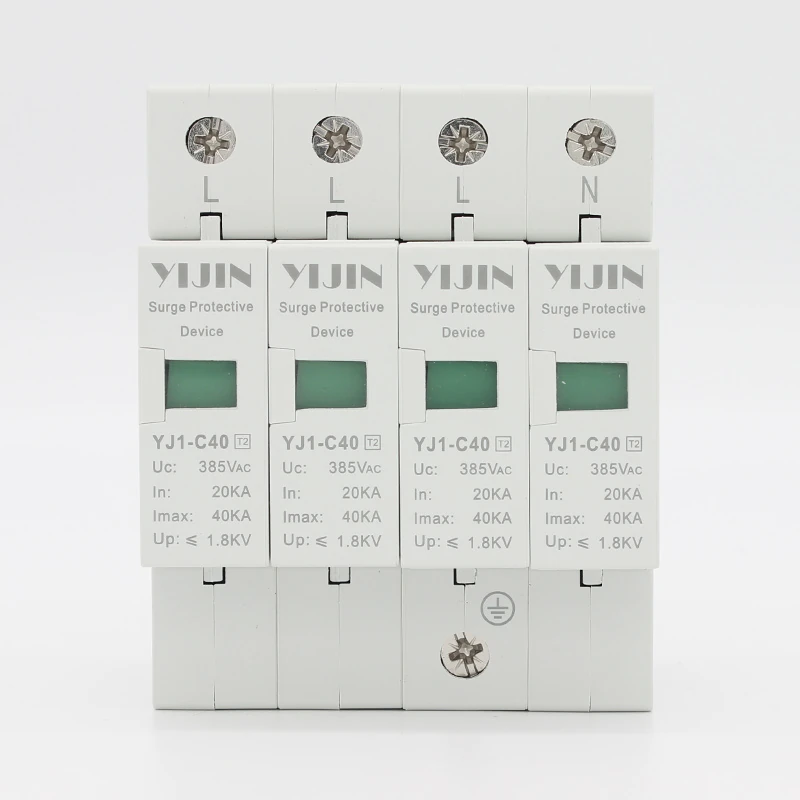
Live YJ1-D20 and YJ1-C40 pages state suitability for TT, IT, TN-S, and N-C-S style systems at AC 50 Hz (or 50–60 Hz on D20), 380 V and below.
They also state design basis IEC61643-1 / GB18802.1, 35 mm rail mounting, failure indication green→red, and Class II experiment parameter tables.
| Model (live page) | Experimental category | In (L-N) | Imax (L-N) | Up (L-N) | Notes from the page |
|---|---|---|---|---|---|
| YJ1-D20 | Class II experiment | 10 kA (8/20 μs) | 20 kA (8/20 μs) | 1.5 kV | Replaceable protector unit; Uc (L-N) 385 V |
| YJ1-C40 | Class II experiment | 20 kA (8/20 μs) | 40 kA (8/20 μs) | 1.8 kV | Higher Class II capacity table; Uc (L-N) 385 V |
On the live YJ1-D20 page, In (L-N) is 10 kA, Imax (L-N) is 20 kA, and Up (L-N) is 1.5 kV under the Class II experiment table.
On the live YJ1-C40 page, In (L-N) is 20 kA, Imax (L-N) is 40 kA, and Up (L-N) is 1.8 kV under the Class II experiment table.
Both pages describe equipotential / LPZ interface install contexts such as floor distribution boxes, computer centers, and telecom rooms. That is distribution-layer Class II context in a cascade conversation — still not a Type 3 marking on the public pages.
Important: If a submittal needs a declared Type 3 / Class III device, ask for that marking and test evidence explicitly. A published Class II YJ1 table is evidence of Class II parameters, not a Type 3 listing. Source: live YJ1-C40 and YJ1-D20 product pages (Class II experiment tables; no Type 3 marking).
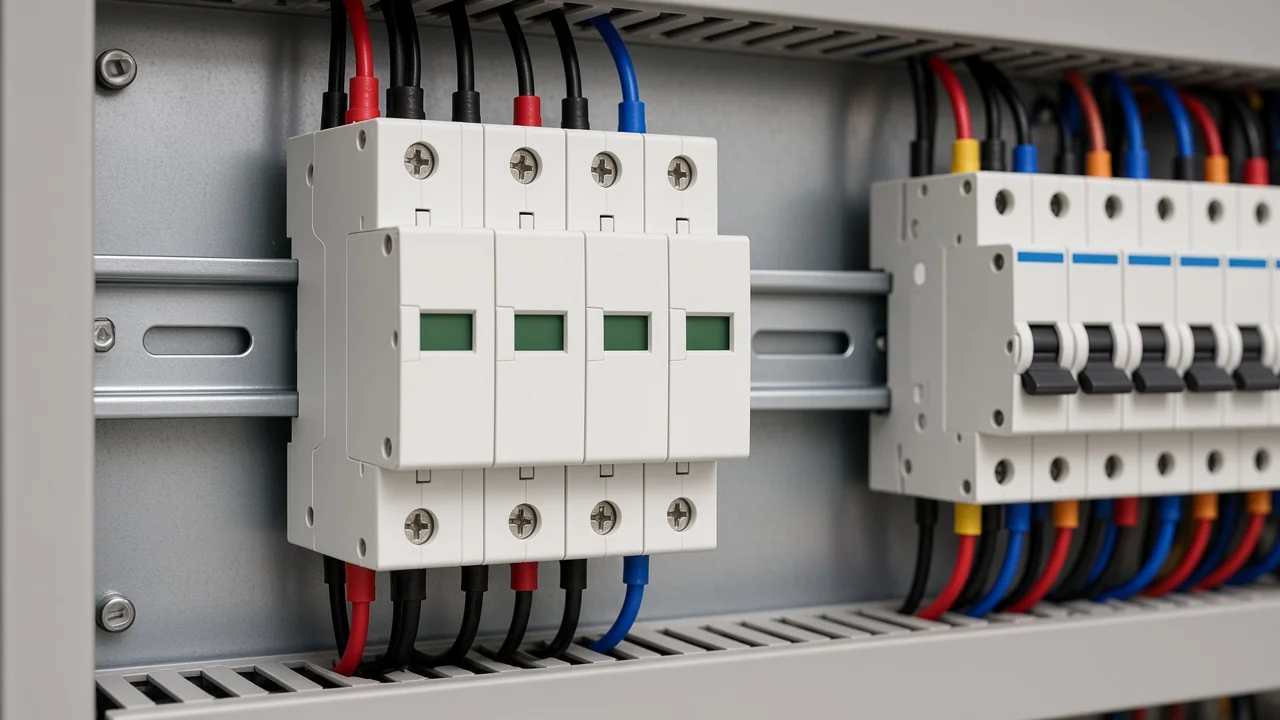
Browse the full Surge Protection Device category for related SKUs, including the YJ1 integrated surge protector page when you need the wider published Imax option set on that product page. Housing language there includes plastic meeting a V-0 flammability grade — material language only.
YJ1-C40 Product Fit for Class II Boards Beside a Type 3 Cascade
For many distribution-board Class II needs adjacent to a Type 3 cascade discussion, start with the published YJ1-C40 table, and compare YJ1-D20 when a lower Imax/Up set is enough.
Start here: YJ1-C40 surge protector — use the live Class II experiment table and pole options on that page as the distribution-layer starting point.
Compare next: YJ1-D20 surge protector when the board needs the lower published discharge and protection-level set shown on that page.
Neither recommendation claims Type 3 listing, UL Listed SPD status, or NEC compliance. Use them as first-party Class II references while you keep Type 3 fine-protection devices (where the project requires them) in their proper downstream role.
FAQ
What is a Type 3 surge protective device?
It is the fine / point-of-use layer in a coordinated SPD system — intended to limit residual surges near equipment after upstream protection has reduced the energy.
What is the difference between Type 2 and Type 3 SPDs?
Type 2 is the distribution/panel class associated with Class II / In testing. Type 3 is the equipment-side fine-protection class associated with Class III / combination-wave thinking. They are layers, not synonyms.
Do I still need Type 3 if I already have a Type 2 panel SPD?
Often yes for sensitive loads far from the panel. Type 2 reduces what arrives at the board; Type 3 addresses leftover energy at the equipment. Cascade is the usual answer, not “pick only one.”
Is a plug-in power strip the same as a Type 3 SPD?
Not automatically. A strip can serve a point-of-use role, but Type 3 / Class III is a classification and performance idea. Confirm markings and ratings instead of assuming the retail label equals the standard class.
Are Yijin YJ1-D20 or YJ1-C40 Type 3 listed devices?
Not on the live product pages reviewed for this article. Those pages publish Class II experiment tables and LPZ design-basis language. Do not invent a Type 3 listing from a Class II row.
What does Class II on a Yijin datasheet mean?
It means the published experimental category for that module’s 8/20 μs Class II parameters (In/Imax/Up on the page). It is not a Type 3 rename.
Where do NEC-style Type 3 devices typically go?
US forum summaries place Type 3 on the load side of branch-circuit protection, with a conductor-distance note on the order of 30 ft from the service or local feeder disconnect. Treat that as NEC-style location education, not as a Yijin install manual.
Can a Type 3 SPD replace a circuit breaker?
No. SPDs limit surge voltage. They do not replace overcurrent devices that clear fault current.
References
- Surge protector — Wikipedia — independent technical overview of SPD naming, clamping concepts, and the low-voltage SPD standards landscape.
- IEC low-voltage SPD requirements abstract — IEC Webstore — standards-body abstract for low-voltage SPD requirements and test methods.
- EN low-voltage SPD marking extract — iTeh — Type 1/2/3 and Class I/II/III marking/test-class education.
- surge suppressors — Electrician Talk — community discussion of NEC-style Type 1/2/3 location language and the voltage-vs-fault-current correction.
- Surge protector — Electrician Talk — community discussion of panel SPDs plus point-of-use extras for sensitive equipment.