 Yueqing Yijin Electronics Co., Ltd.



Arc Fault Detection Device Market: Standards, Buyers, and Specs
The arc fault detection device market exists because dangerous electrical arcs can start fires even when ordinary breakers never see an overload.
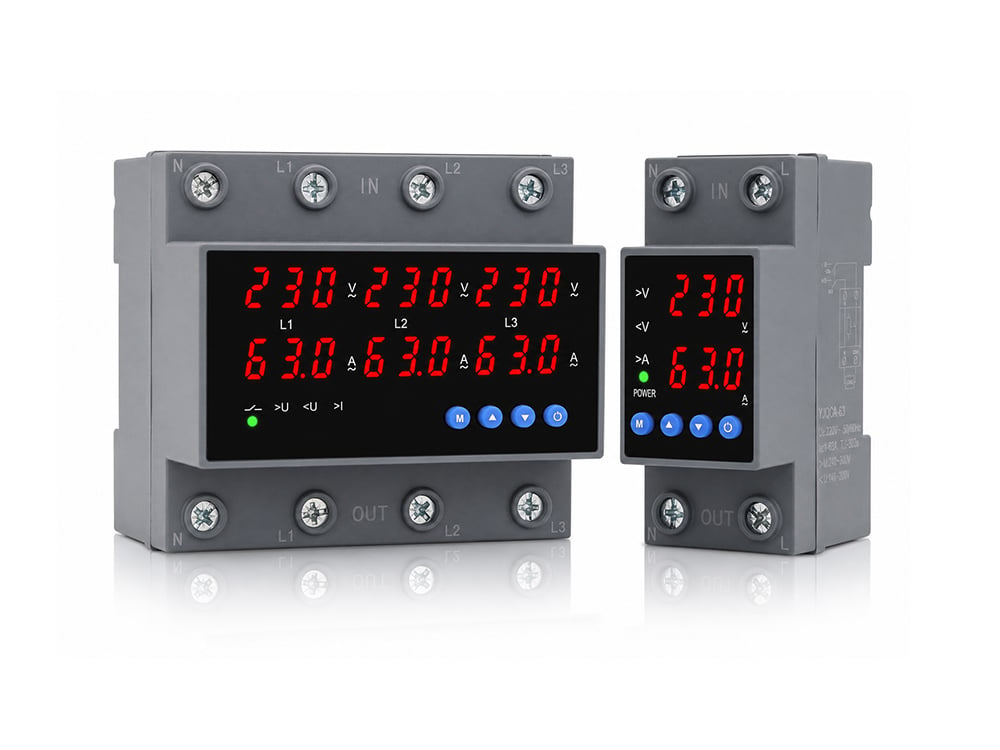
Buyers still get lost when report teasers blur AFDD and AFCI into one label, then quote conflicting market dollars. This guide maps demand drivers, keeps IEC and UL/NEC product languages honest, shows who buys which form factor, and points to a DIN-rail AFDD-style option only where that scope fits.
What Is Driving the Arc Fault Detection Device Market
Codes, electrical fire risk, and retrofit pressure—not a single global price tag—shape demand.
An arc fault detection device (AFDD) earns budget when designers close a fire-protection gap that miniature circuit breakers and residual devices do not cover alone. Public fire-safety education from NFPA describes how arc-fault circuit interrupters shut off power when abnormal arcing appears, a hazard distinct from ground-fault shock protection.
NFPA research summaries for 2020–2024 estimate tens of thousands of U.S. home structure fires each year where electrical failure/malfunction or electrical distribution equipment is involved, with hundreds of civilian deaths and billions in direct property damage. That burden keeps dwelling and light-commercial codes interested in arc-fault protection.
Commercial SERP reports advertise large dollar forecasts, then contradict one another. Treat published size, CAGR, and share percentages as unverified marketing unless you buy and audit the underlying study. For procurement, the durable drivers are simpler:
- adopted electrical codes that require or recommend arc-fault protection
- aging wiring, loose terminations, and damaged insulation in occupied buildings
- board space for combined AFDD+MCB or AFDD+RCBO modules
- adjacent interest in DC/PV arc detection that should not be confused with AC final-circuit AFDD
If your RFQ only says “arc fault detection device market average price,” rewrite it. Specify the standard family, voltage, current, poles, and listing path instead.
AFDD vs AFCI: Two Product Languages, One Fire-Risk Job
AFDD is the IEC term; AFCI is the North American UL/NEC term—similar fire-risk job, not an automatic swap.
IEC 62606 covers arc fault detection devices for household and similar a.c. circuits.
The standard’s preview notes that in the USA, Arc Fault Circuit Interrupters (AFCI) are considered similar to AFDDs.
“Similar” is a concept note, not a certificate transfer.
An Arc-fault circuit interrupter (AFCI) is the North American product name for that listed branch-circuit protection class.
IEC notes the concepts as similar; listings still do not transfer automatically.
IEC 62606 also frames maximum rated voltage at 240 V a.c. and maximum rated current at 63 A a.c. for devices in that standard’s scope.
Construction may be a standalone opening device, an integrated protective device, or a separate detection unit assembled with a declared protective device.
North American practice centers on listed AFCI products evaluated to UL 1699 (with Canadian documents such as CSA C22.2 No. 270 appearing in related conversations) and on installation rules adopted from the National Electrical Code / adopted electrical code editions.
Spec writers should name the NEC / adopted electrical code edition on the purchase order before they pick a catalog page.
Independent technical explainers emphasize combination AFCI, branch/feeder AFCI, receptacle AFCI, and dual-function AFCI/GFCI forms common in U.S. panels.
These products usually land in a DIN-rail distribution board in IEC markets, or in a listed loadcenter when the job is North American AFCI.
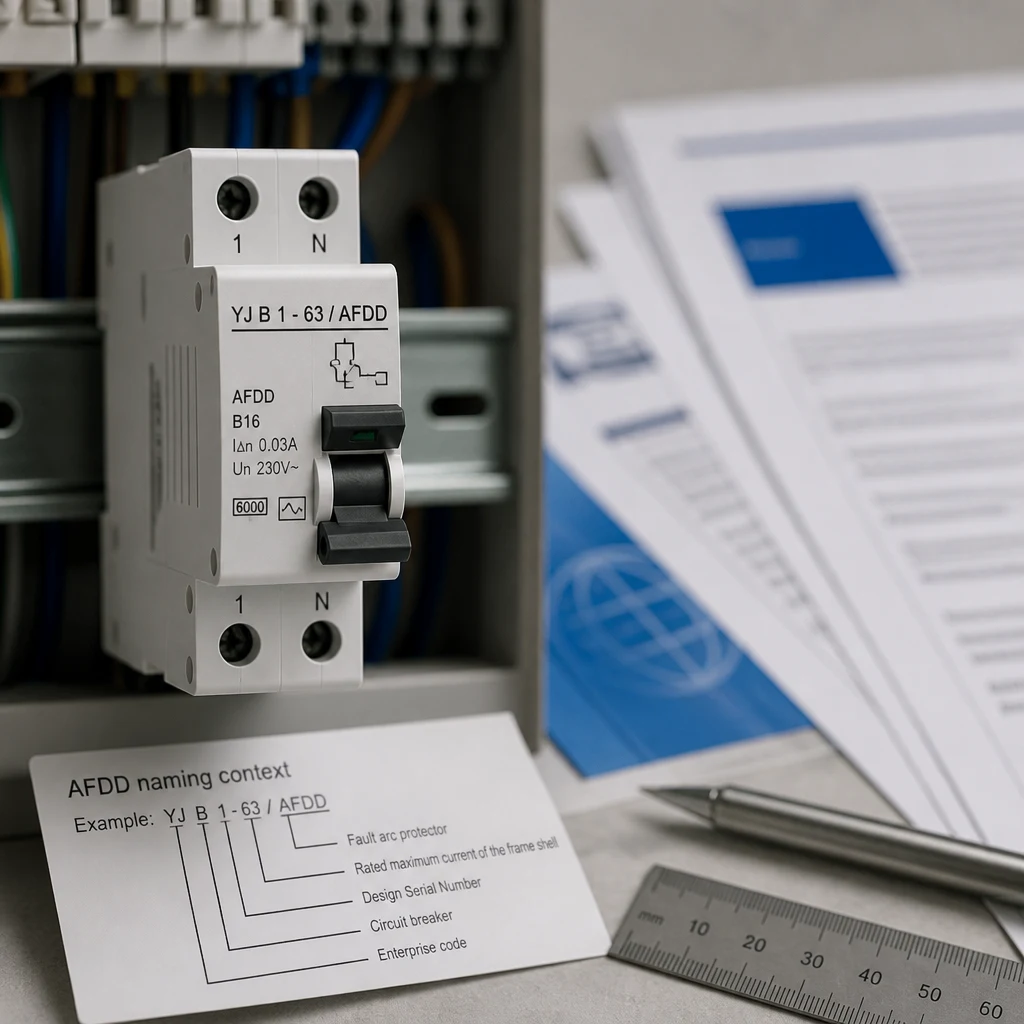
Use the snapshot below when a purchase order mixes regional names.
| Region / language | Usual product name | Product standard cue | Installation cue | Buyer trap |
|---|---|---|---|---|
| IEC / many export markets | AFDD | IEC 62606 | National wiring rules (for example BS 7671 recommendations) | Assuming “AFDD” satisfies a US listed AFCI schedule |
| United States / Canada practice | AFCI | UL 1699 (and related CSA docs) | Adopted NEC / CEC rules for dwelling circuits | Dropping an IEC DIN-rail AFDD into a listed US panel as if it were a UL AFCI |
| Shared technical idea | Arc-signature detection + disconnect | Detect dangerous arcs; ignore many normal sparks | Final / branch circuits | Treating AFCI and GFCI as the same hazard control |
Keep RCD / GFCI / RCBO language in the residual-current column. Arc-fault devices address fire-type arcing; ground-fault devices address shock-type leakage.
Dual-function hardware exists where both are required, but the labels still mean different sensors.
Who Buys Arc Fault Protection—and for Which Jobs
Residential, hospitality, combustible-storage, and institutional projects drive different recommendation strengths.
In IEC-market education around BS 7671 / IEC wiring practice, AFDDs are often recommended for locations such as sleeping accommodation, places storing flammable materials, combustible construction, fire-propagating structures, and spaces holding irreplaceable goods.
That is a risk-location logic, not a slogan that every socket circuit worldwide must carry an AFDD.
U.S. dwelling work is different.
Adopted NEC editions expand where AFCI protection is required on many living-area branch circuits.
The exact room list and device means change by code cycle and authority having jurisdiction, so buyers should cite the adopted edition—not a blog’s memory of “bedrooms only.”
Commercial and institutional buyers show up when:
- insurers or owners ask for preventive fire protection beyond basic overcurrent devices
- hotels, dormitories, or care facilities concentrate sleeping risk
- museums, libraries, or archives concentrate irreplaceable contents
- timber or other combustible construction raises fire-spread concern
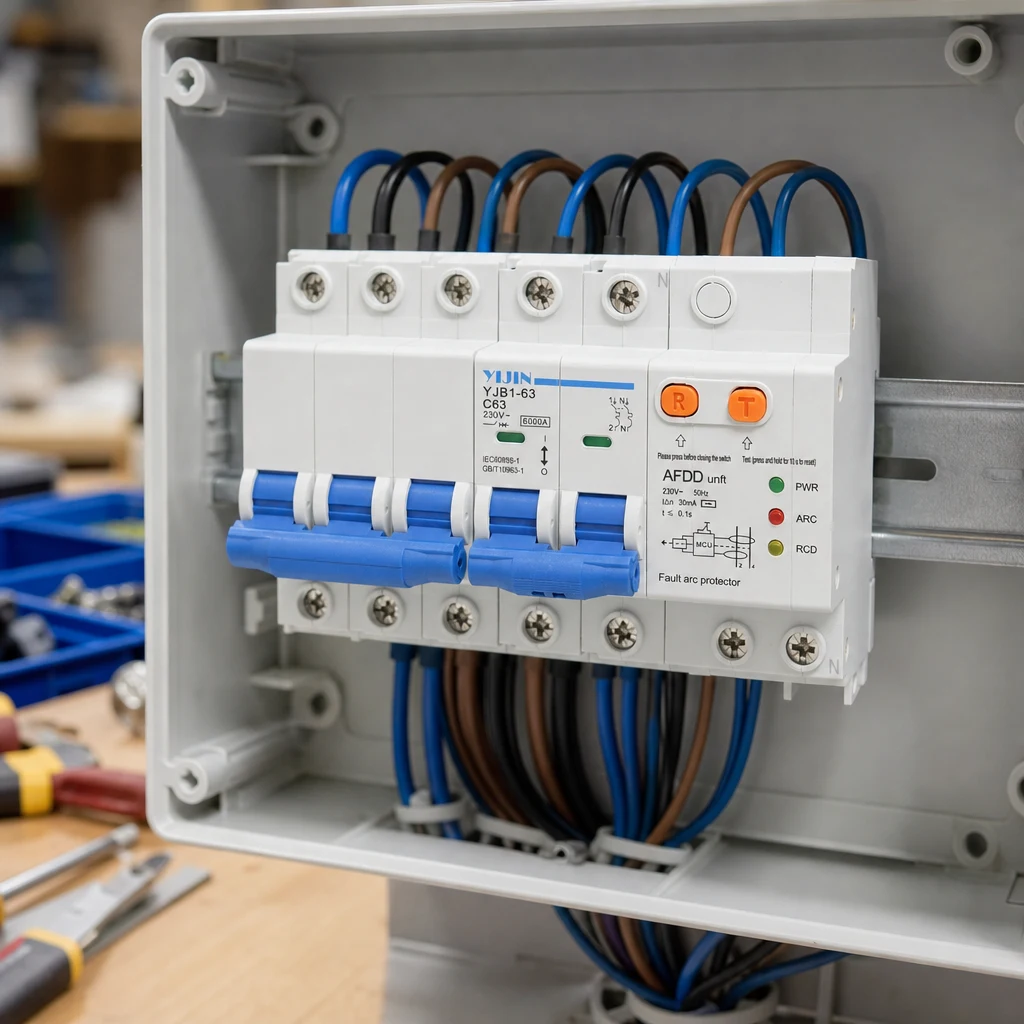
First-party application notes for Yijin’s leakage-capable AFDD-style SKU mention residential buildings, childcare and elderly facilities, flammable-material storage, museums/libraries, and crowded commercial spaces. Treat those as illustrative contexts for DIN-rail AFDD-style hardware—not as UL Listing proof for U.S. dwelling panels.
Adjacent DC arc-fault demand in PV strings is a related but separate shopping cart. Do not load an AC final-circuit AFDD RFQ with PV DC detector parameters unless the design actually needs both.
Device Architectures Buyers Actually Specify
Standalone detectors, AFDD+MCB/RCBO combos, U.S. panel AFCIs, and dual-function units solve different board constraints.
An MCB / circuit breaker still owns overload and short-circuit clearing.
An AFDD monitors waveform signatures for dangerous arcing and opens the circuit when its criteria are met.
UK education materials stress that AFDDs do not replace MCB overload/short-circuit duties or RCD earth-fault duties.
Common architecture language:
- Standalone AFDD in series with a declared protective device
- Combined AFDD + MCB (or AFDD + RCBO) in one DIN-rail footprint
- Add-on AFDD module paired only with a manufacturer-declared companion device
- U.S. panel AFCI breaker (branch/feeder, combination, or dual-function AFCI/GFCI)
- Outlet-type AFCI where the adopted means allow receptacle-based protection
Boards differ, so lock the architecture before comparing catalog photos.
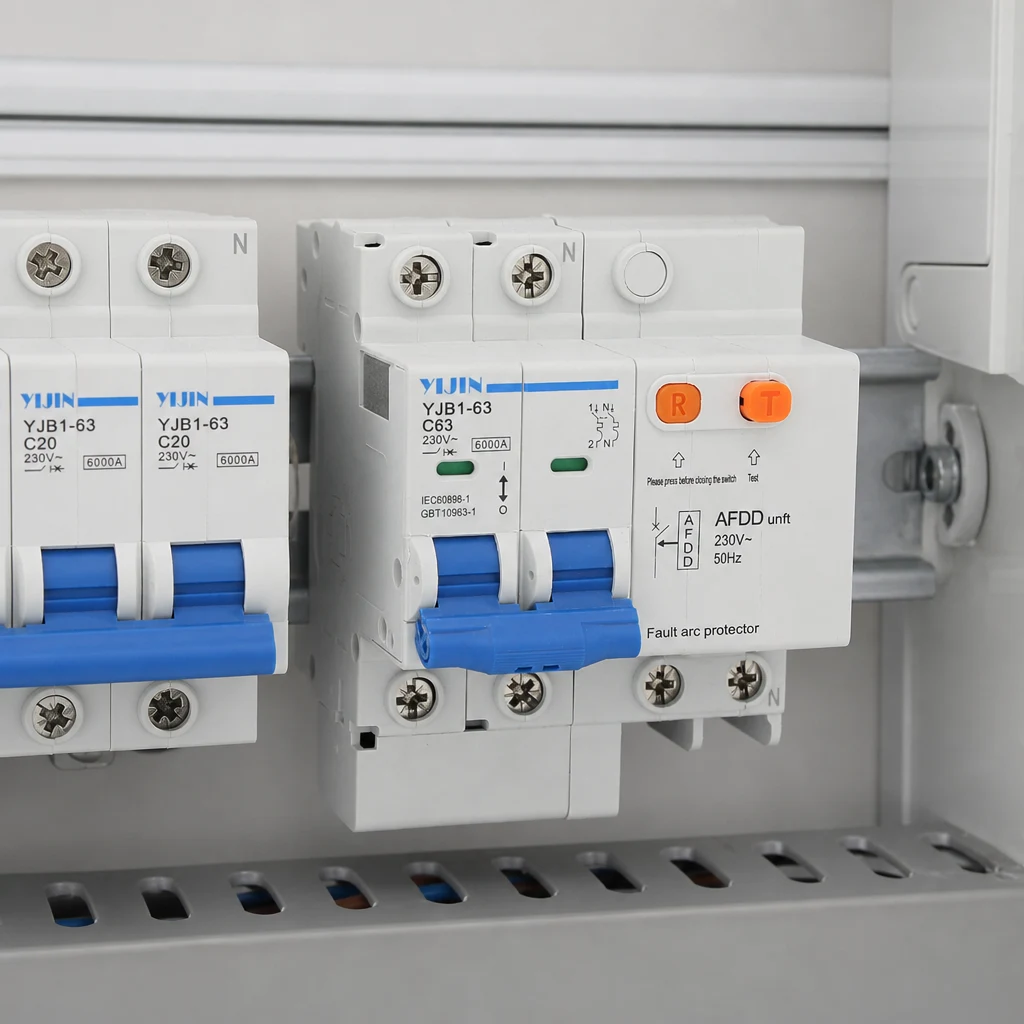
The matrix below is a buyer-gate scan, not a wiring diagram.
| Architecture | Typical board | Spec writer should lock | Poor fit |
|---|---|---|---|
| AFDD + MCB combo | IEC consumer unit / distribution board | Ue, In, poles, curve, breaking capacity, IEC 62606 claim | US loadcenter needing listed AFCI brand match |
| AFDD + RCBO | Boards needing residual + arc in one chain | Residual type/rating + arc function | Projects that only asked for GFCI |
| Add-on AFDD module | Retrofit beside existing MCB/RCBO | Declared pairing list | Mixing brands against the module instructions |
| Listed AFCI breaker | North American panel | Panel listing, AFCI type, dual-function if required | IEC DIN-rail AFDD without US listing evidence |
| Dual-function AFCI/GFCI | Areas needing arc + ground-fault | Both functions on the schedule | Assuming any AFDD includes GFCI |
Series arc faults sit in the load path (loose terminations, broken conductors). Parallel arc faults bridge line-to-neutral or line-to-earth across damaged insulation. Specs should say which protection package is required; marketing adjectives are not a substitute.
Buyer Spec Checklist (and Field Trip Realities)
Lock voltage, In, poles, standard, and combined functions—and expect LED or wiring diagnostics when devices trip.
Write the purchase line so a stranger can buy the right class.
- System voltage and frequency for the board.
- Rated current and poles.
- Use product standard language that says IEC 62606 AFDD versus UL 1699 AFCI.
- Whether overload, short-circuit, and residual functions are integrated or external.
- Mounting: DIN-rail consumer unit versus listed panel breaker.
- Documentation and listing marks the AHJ will accept.
- Compatibility notes for electronic loads and shared-neutral wiring rules.
From the field: Electricians on Electrician Talk repeatedly chase AFCI trips after LED retrofits and noisy electronic loads, while Mike Holt forum threads often find shared neutrals or neutral-to-ground contacts before “bad breaker” is proven. Diagnose the circuit and loads first—do not treat “nuisance” as permission to remove required protection.
— source: Electrician Talk LED retrofit AFCI thread · Mike Holt AFCI trip discussion
Trip complaints show up after LED retrofits more often than after a visible burn mark. Budget time for load isolation tests, neutral landing checks, and manufacturer diagnostic guidance. A cheaper device that cannot be commissioned cleanly is not cheaper.
Yijin AFDD-Style Options Under Others
For IEC-framed DIN-rail boards, the live catalog keeps the AFDD-style module under the mixed Others hub.
YJB1-63/AFD lists 230 V service and currents up to 63 A on the product table — not a claimed UL AFCI.
On Yijin’s site, the AFCI/AFDD cluster lives under the mixed Others category, so hub language should stay scoped rather than implying a dedicated AFCI-only catalog.
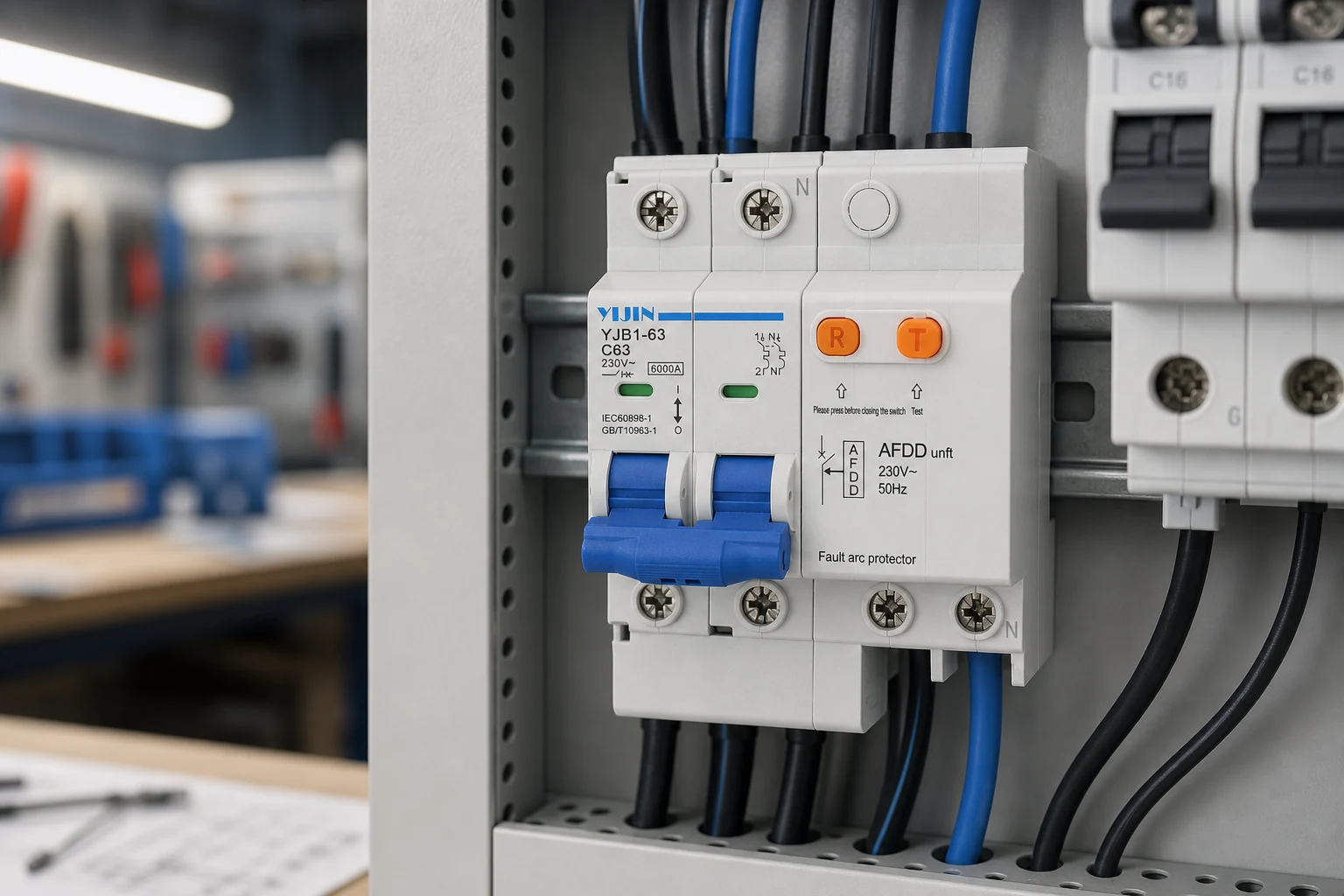
The primary SKU is the YJB1-63/AFD arc fault circuit breaker. The product page describes an AFDD arc fault protection circuit breaker assembled from a small circuit breaker and an arc fault protection module, with overload, short-circuit, and arc-fault protection (series and parallel arcs stated).
First-party parameters for that model include rated operational voltage 230 V, rated currents 10/16/20/25/32/40/50/63 A, rated frequency 50 Hz, 2P, standard GB/T31143, C/D release characteristics, IP20, standard rail installation, mechanical life greater than 6000 operations, altitude 2000 m, and ambient temperature −40℃~+75℃ on the published table.
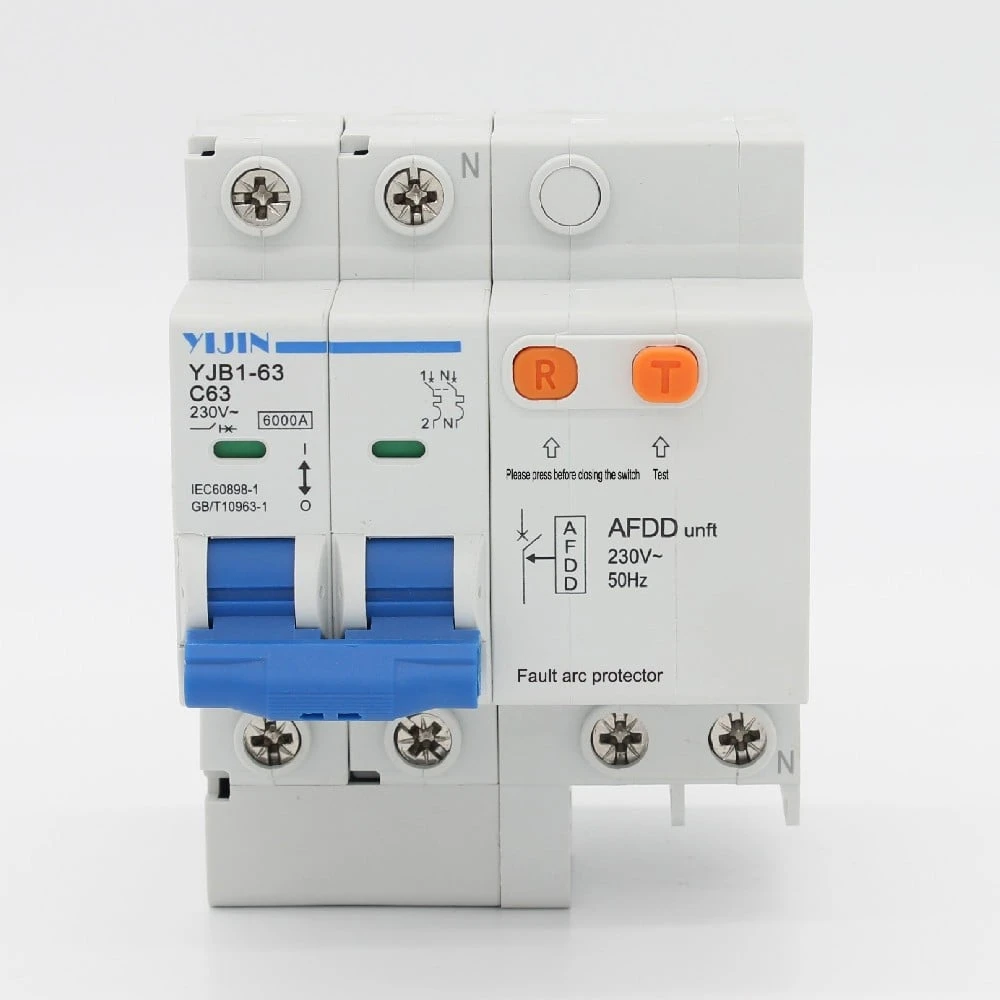
When the schedule also needs leakage monitoring, compare the YJB1-63/AFD Circuit Breaker with Leakage Arc Fault. That sister page adds leakage monitoring to the overload, short-circuit, and arc package.
Why this fits IEC/GB-framed DIN-rail RFQs: the live pages speak AFDD language, rail mounting, and 230 V final-circuit ratings up to 63 A.
Why not for a U.S. listed AFCI line: the first-party pages do not provide verified UL Listed / NEC-compliant AFCI evidence for North American dwelling panel substitution. Keep that path on listed AFCI breakers matched to the panel and adopted code.
Regional Standards Snapshot for Spec Writers
Match product standard language to the authority having jurisdiction.
| Spec question | IEC-market AFDD path | North American AFCI path |
|---|---|---|
| Product name on the PO | Arc fault detection device (AFDD) | Arc-fault circuit interrupter (AFCI) |
| Product standard to cite | IEC 62606 (and national adoptions) | UL 1699 listing for the device type |
| Installation rule cue | National wiring regulations / BS 7671 recommendation logic | Adopted NEC article requirements for dwelling circuits |
| Typical form factor | DIN-rail module or combo in consumer unit | Panel AFCI breaker or allowed receptacle means |
| Residual-current pairing | Often RCBO/RCD coordination | GFCI or dual-function AFCI/GFCI where required |
| Yijin first-party fit today | AFDD-style DIN-rail SKUs under Others, per published GB/T31143 scope | Not evidenced as UL Listed AFCI substitutes |
Use this table in kickoff meetings. If the ship-to country and the listing language disagree, stop and rewrite the line item before anyone buys hardware.
FAQ
What is an arc fault detection device?
It is a protective device that monitors circuit current for dangerous arc signatures and disconnects the affected circuit to reduce electrical-fire risk. Standard breakers still handle many overload and short-circuit events; AFDDs target arcing that those devices can miss.
Is AFDD the same as AFCI?
No.
AFDD is the IEC product language under IEC 62606.
AFCI is the North American product language tied to UL/NEC practice.
IEC notes the concepts as similar; listings and installation rules are not automatically interchangeable.
Do I need AFDD on every circuit?
Not as a universal global rule. IEC-market guidance such as BS 7671 education recommends AFDDs in defined higher-risk location types. Local regulations and the project specification decide the actual schedule.
When did AFCI become mandatory?
There is no single worldwide date. In the United States, AFCI requirements expanded across NEC cycles and depend on the edition adopted by the local authority. Always cite the adopted code year for the job.
Are arc fault breakers a worthwhile investment?
They are worthwhile when the project’s fire-risk and code path call for arc-fault protection that overcurrent and residual devices do not provide alone. Value shows up as matched listing, commissionable installation, and fewer unresolved trip callbacks—not as a generic ROI slogan.
Can an IEC AFDD replace a UL-listed AFCI in a US panel?
Only if the project’s listing, panel compatibility, and adopted code explicitly allow that device. An IEC 62606 AFDD does not automatically replace a UL 1699 AFCI. Yijin’s published AFDD-style pages do not claim that substitution.
What should buyers specify beyond “AFDD”?
Voltage, frequency, rated current, poles, product standard, integrated vs external overcurrent/residual functions, mounting system, and documentation/listing marks. Add load-compatibility notes for LED drivers and electronic equipment when relevant.
Why do AFCIs trip on LED loads?
Field discussions often point to electronic driver noise, shared neutrals, or neutral-to-ground contacts before a defective breaker is proven. Isolate loads, verify wiring, and use manufacturer diagnostics before changing protection strategy.
References
- NFPA — Electrical Safety in the Home
- Electrician Courses 4U — What you need to know about Arc Fault Detection Devices
- Industrial Control Academy — Arc Fault Protection in Electrical Systems
- Electrician Talk — AFCI nuisance trip / LED retrofit discussion
- Mike Holt Forum — Bonding/grounding and AFCI breakers