 Yueqing Yijin Electronics Co., Ltd.



Double Pole Double Throw Knife Switch: Topology vs Isolation Buying Guide
A double pole double throw knife switch is a manual knife-style switch that steers two circuits between two alternate paths — usually six terminals on one handle. The same search phrase also pulls up lab catalogs, motor-reverse diagrams, and “heavy duty disconnect” shopping cards. Below is how to separate those jobs, when true DPDT changeover hardware is required, and when a no-load isolating knife switch such as Yijin’s HD11F or HK18 is the honest fit.
What a Double Pole Double Throw Knife Switch Is
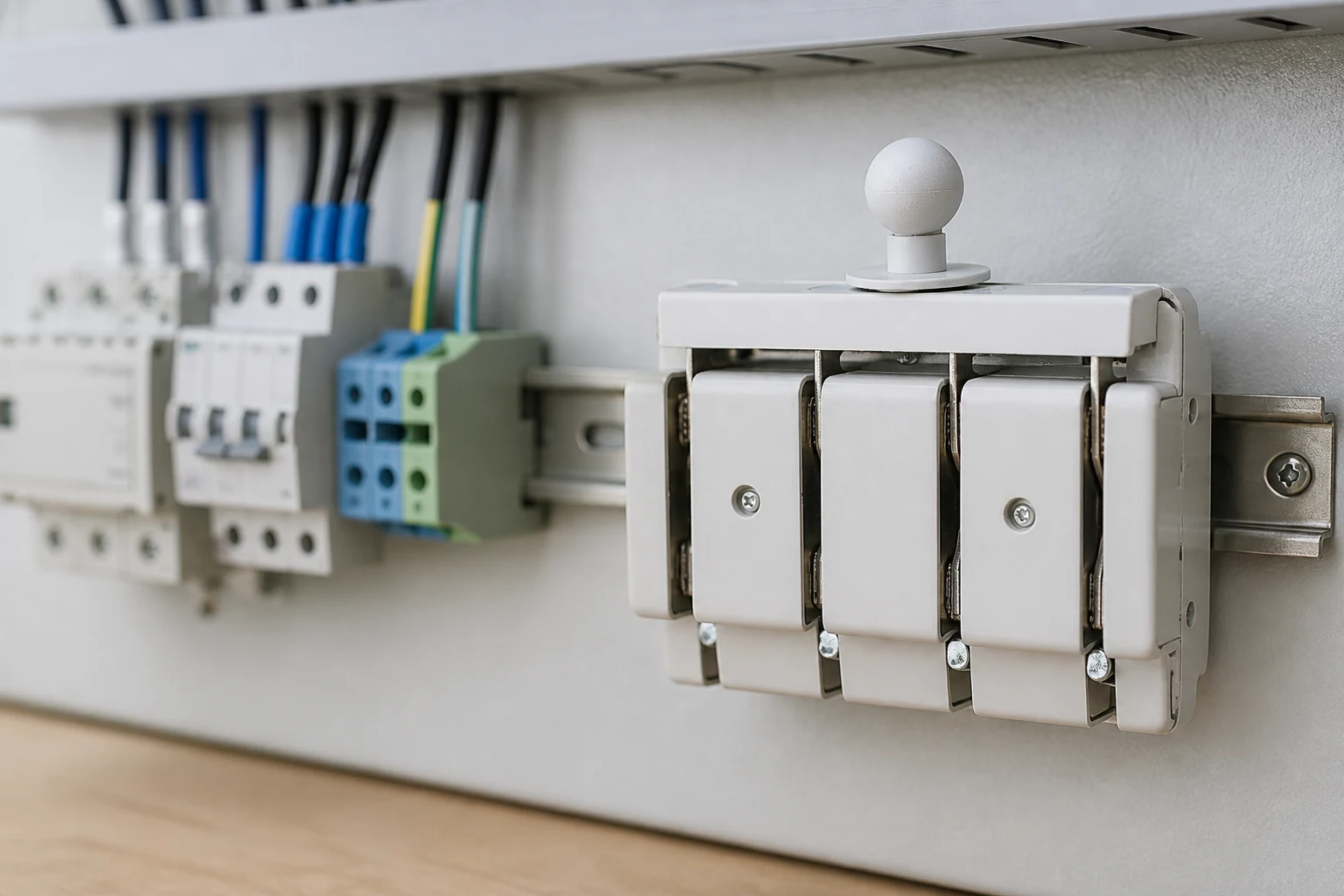
A DPDT knife switch is a two-pole, two-throw knife topology: one actuator moves two blades, and each blade can land on one of two contact sets.
Pole / throw vocabulary matters here. A pole is how many separate circuit paths the handle moves together. A throw is how many ON landings each of those paths can choose.
Double pole means two paths move together. Double throw means each path has two possible landings. Put together, a typical DPDT knife presents two common (hinge) terminals and four outer throw terminals — six points of connection.
The “knife” part is mechanical. A hinged metal blade swings into a jaw so the connection is visible. That visibility is why schools still buy open DPDT knives for demonstrations.
| Type | Poles | Throws (per pole) | Typical terminal count | Everyday reading |
|---|---|---|---|---|
| SPST | 1 | 1 | 2 | Simple on/off for one circuit |
| SPDT | 1 | 2 | 3 | One circuit, two paths |
| DPST | 2 | 1 | 4 | Two circuits, on/off together |
| DPDT | 2 | 2 | 6 | Two circuits, two paths each |
If a supplier only prints “2P” or “3P” without saying double throw / changeover / six-terminal DPDT, treat pole count and throw count as separate questions.
Lab DPDT Knives Versus Power Disconnect Shopping
Many Google results for this query are classroom knives; marketplace amp labels are a different shopping class again.
Classroom DPDT knives commonly publish ratings such as 12 V / 1 A.
Education suppliers openly sell them as experiment gear with bakelite or plastic bases and binding posts, including ratings such as 1 A at 12 Vdc. Those parts teach poles and throws. They are not panel isolators.
Shopping cards also advertise “heavy duty DPDT knife” disconnects with amp options in the tens or hundreds. Those listings prove demand for a power-class double-throw knife. A marketplace title is still not your datasheet.
Before you treat any SKU as DPDT changeover hardware, confirm the terminal map, whether there is a true center-off path, and the make/break duty the manufacturer actually tested.
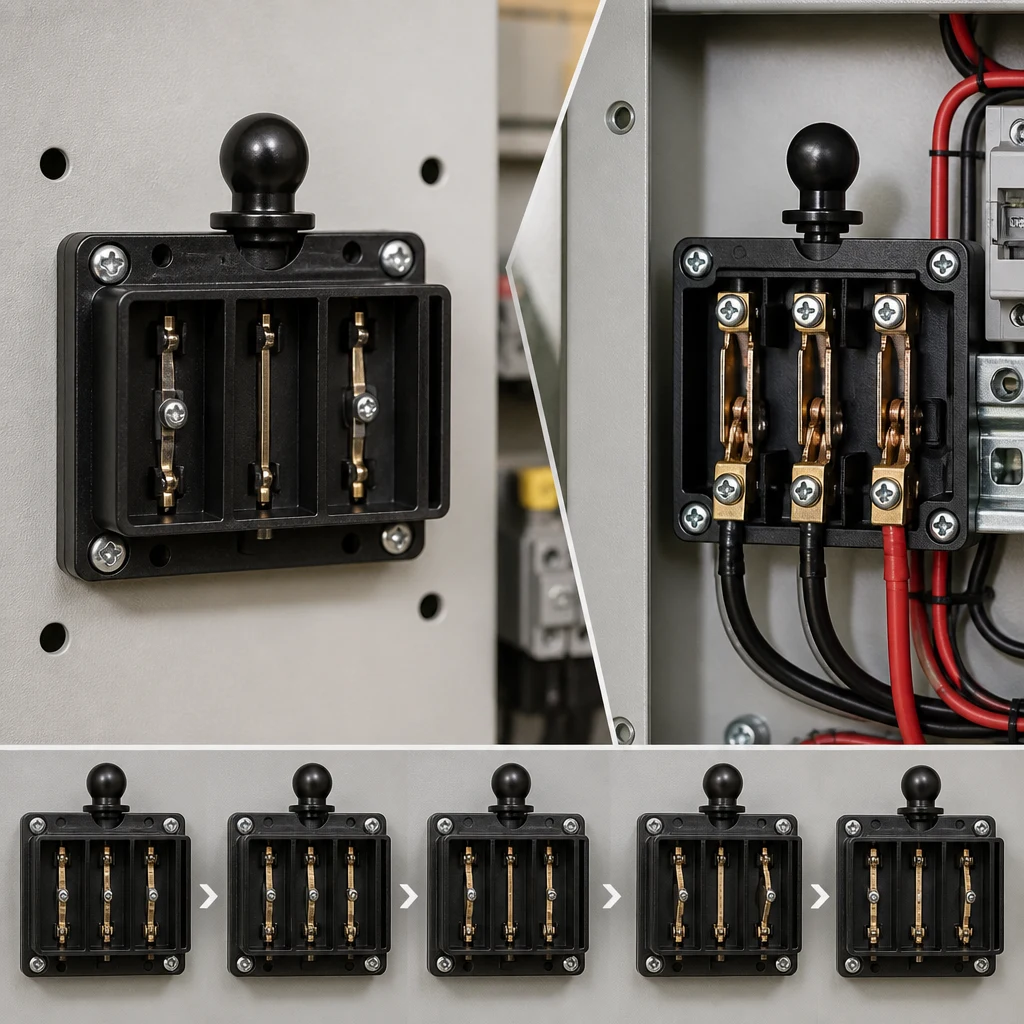
Yijin’s own knife-switch pages live under the isolating switch category. They describe protective-opening and photovoltaic knife switches for infrequent isolation — not classroom 12 V demos.
Terminals and Common DPDT Wiring Patterns
Commons usually sit in the middle; the outer screws are the alternate landings for each pole.
On a conventional six-terminal DPDT, treat the center pair as the commons (the hinges). Each outer pair is a throw set. Moving the handle connects both commons to throw set A or throw set B.
DC motor polarity reversal is one common drawing: supply on the commons, motor leads on one throw set, and crossed jumpers that swap polarity on the other throw set. For higher current, shops often move from a hand DPDT to a contactor / motor reverse DPDT arrangement instead of asking a small knife to carry the start surge.
In beginner wiring threads, technicians keep repeating the same field rule. Prefer a center-off (On-Off-On) switch, and bring the motor to a stop before you reverse.
Treat motor-reverse as an application drawing, not a free upgrade hiding inside every knife listing. If your drawing needs crossed throw jumpers and a center-off selector, buy hardware whose terminal map matches the drawing.
True Double-Throw Changeover Versus Isolation
Choose changeover/transfer hardware when two live sources feed one load; choose isolation when the job is a single-path disconnect.
Double-throw transfer equipment — including many enclosed double-throw safety switch / manual transfer options — is built so an operator can move a load between source A and source B. A center Off position is the practical expression of break-before-make: you leave one source before you take the other.
Isolation is a different line on the one-line diagram. An isolating switch / isolator / disconnector in knife form gives you a visible open for infrequent manual isolation on one circuit path. You are opening a path so work can proceed after the circuit has been made safe to operate.
Procurement language collides here. Engineers on professional forums regularly ask whether a double-throw safety switch equals a manual transfer switch. Shared vocabulary still leaves different product classes on the shelf.
If your one-line diagram shows two sources feeding one load, you are in changeover territory. If your diagram shows one source and a maintenance disconnect, you are in isolation territory — even if both products have blades.
AC-20B Duty: Why a Knife Switch Is Not a Breaker
AC-20B isolators are for connecting and disconnecting under no-load conditions; they are not circuit breakers.
Under IEC 60947-3 education material, a disconnector/isolator is not assigned load make/break ratings the way a load-break switch or breaker is. Utilization category AC-20B specifically means connecting and disconnecting under no-load conditions.
Devices in that family are expected to be operated when the circuit is already unloaded — or to be interlocked so load-side operation is prevented.
Important: Opening an open knife or an AC-20B isolator under load can arc, damage contacts, and injure the operator. A knife switch also does not provide overcurrent protection. Pair isolation with the correct upstream protective device — source.
That duty line is why industrial isolating-knife pages emphasize infrequent manual operation and no-load conditions. Asking a knife to behave like a snap-action breaker is a buying error.
When HD11F or HK18 Isolating Knife Switches Fit
Buy HD11F or HK18 when you need published isolation duty on a first-party knife switch — and look elsewhere when your drawing needs labeled DPDT changeover.
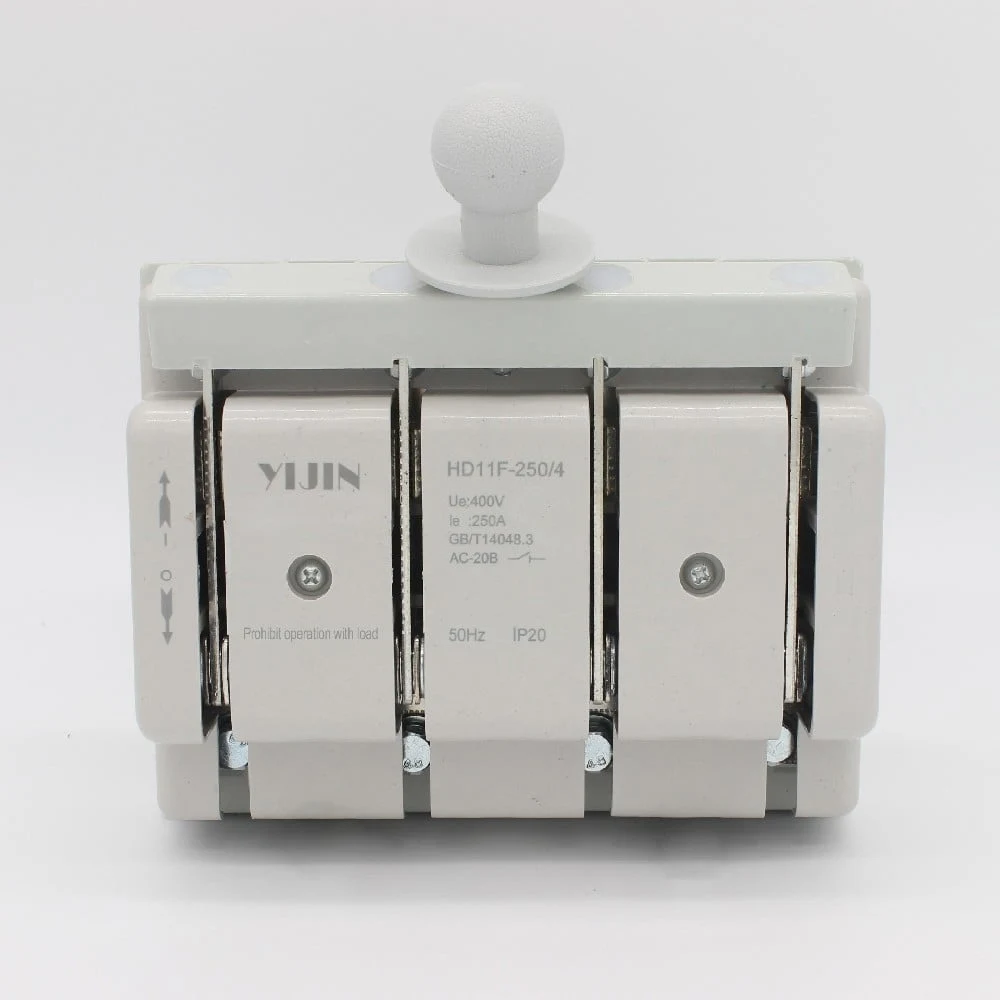
Yijin’s live HD11F-250 protective opening knife switch is sold as a protective-opening isolating knife for infrequent manual connection, disconnection, and isolation in low-voltage distribution. The product page states compliance with GB/T14048.3 and IEC 60947-3, utilization category AC-20B, and no-load operation.
Published parameters on that page include 3P or 4P constructions, rated working voltage 400 V, insulation voltage 1000 V, conventional free-air thermal current 250 A, working-current options from 160 A to 250 A, impulse withstand 8 kV, and rated short-time withstand current 3 kA.
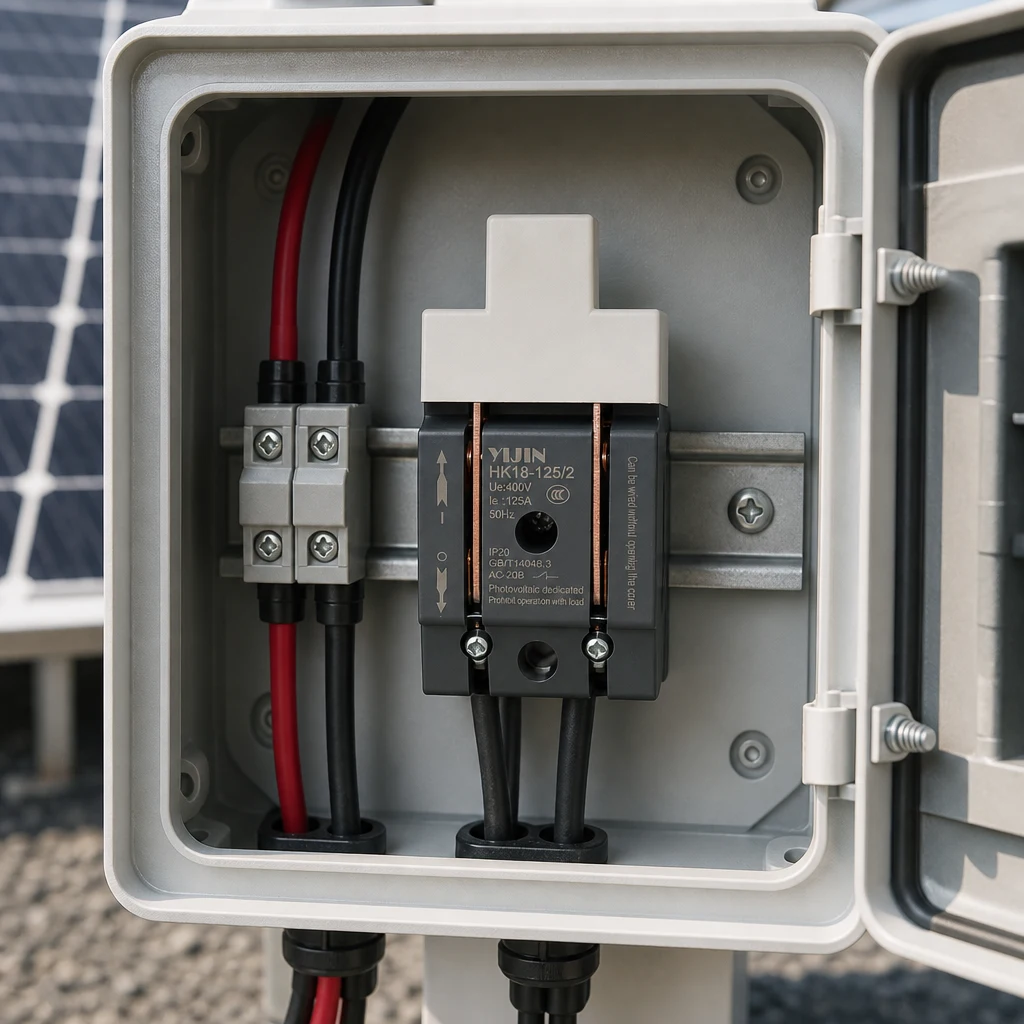
The HK18-125 type knife switch for photovoltaic applications is the PV-named sibling in the same isolating-switch family. The live page lists 2P/3P/4P options, 400 V, working-current options 63 A to 125 A, impulse withstand 6 kV, AC-20B, and the same IEC 60947-3 / GB/T14048.3 standards statement, with rail or base-plate mounting notes aimed at compact isolation installs.
| Parameter (from live product pages) | HD11F-250 | HK18-125 |
|---|---|---|
| Role on page | Protective-opening isolating knife | PV-named isolating knife |
| Poles offered | 3P, 4P | 2P, 3P, 4P |
| Rated working voltage | 400 V | 400 V |
| Working current options | 160–250 A | 63–125 A |
| Impulse withstand Uimp | 8 kV | 6 kV |
| Utilization category | AC-20B | AC-20B |
| Standards stated on page | IEC 60947-3 / GB/T14048.3 | IEC 60947-3 / GB/T14048.3 |
| Labeled DPDT on page? | No | No |
True DPDT / double-throw changeover belongs on the PO when the drawing needs six-terminal path selection, source A / source B transfer, or a documented motor-reverse DPDT map. Yijin’s reviewed knife pages publish isolation duty instead, so keep HD11F and HK18 on isolation bills of materials.
HD11F or HK18 fit when you need infrequent no-load isolation, a published AC-20B knife switch, and pole/current options that match the tables above. Start from the isolating switch hub, then open the SKU page that matches current and pole count.
No UL Listed or NEC compliance claim is made here for these models. Use the product-page parameters as written, and let the local authority having jurisdiction own installation code decisions.
A Practical Buying Checklist for This Query
Match the job, the topology, the duty category, and the published poles/current before you issue a PO.
- Name the job in one line. Demo / polarity reverse / source changeover / single-path isolation.
- Count terminals and throws on the drawing. Two alternate landings per pole means double-throw topology — not only “2P.”
- Read the utilization category. AC-20B means no-load isolation duty. Load make/break needs another device class.
- Separate protection from isolation. Keep the breaker or fuse on overcurrent duty; keep the knife on visible isolation.
- Check enclosure and exposure. Open educational knives are for benches. Power installs usually need enclosed, interlocked hardware appropriate to the site.
- If isolation is the job, compare real SKU tables. For Yijin, that means HD11F-250 or HK18-125 parameters from the live pages — not a DPDT label borrowed from a marketplace title.
The checklist is a filter for the PO, not a slogan. The phrase “double pole double throw knife switch” is precise about contacts; the purchase order still has to be precise about duty.
FAQ
What is a double pole double throw knife switch?
It is a knife-style switch with two poles and two throws per pole — typically six terminals — so one handle can steer two circuits between two alternate paths.
How is DPDT different from DPST or SPDT?
SPDT selects two paths for one circuit. DPST switches two circuits on/off together. DPDT switches two circuits and gives each circuit two path choices.
Is a DPDT knife switch the same as a 4-way switch?
No. A US residential 4-way switch is a different product used in multi-location lighting control. Contact analogies in education threads still leave lighting hardware and power knives in different catalogs.
Can I use a knife switch as a circuit breaker?
No. A knife or isolator is not an overcurrent protective device. Pair it with the correct breaker or fuse, and keep AC-20B isolators on no-load operation.
When should I buy true DPDT changeover vs an isolating knife switch?
Buy true DPDT/changeover when the drawing needs path selection between two alternatives or a documented reversing map. Buy an isolating knife switch when you need published no-load isolation on a single circuit path.
What do HD11F-250 and HK18-125 provide on this site?
They are isolating knife switches with live-page AC-20B parameters and IEC 60947-3 / GB/T14048.3 statements. Those pages present isolation duty rather than labeled DPDT changeover.
Does AC-20B mean I can switch motor loads?
No. AC-20B is no-load connect/disconnect. Motor load switching needs a utilization category and device class tested for that duty.
How do people usually wire DPDT for DC motor reverse?
A common pattern puts supply on the commons, motor leads on one throw set, and crossed jumpers on the other throw set. Prefer center-off hardware and stop the motor before reversing.